Healthcare organizations are facing a difficult combination of challenges: rising administrative costs, clinician burnout, staffing shortages, and growing patient expectations around accessibility and responsiveness.
As a result, healthcare providers are looking for technologies that can reduce administrative workload without creating additional complexity for clinical teams.
AI voice agents are emerging as one of the most practical applications of artificial intelligence in this space because they address problems healthcare organizations are already trying to solve every day.
From appointment scheduling and patient follow-ups to clinical documentation and care coordination, voice AI is changing how healthcare providers interact with patients, manage information, and deliver services.
According toGrand View Research, the global AI in healthcare market exceeded $22 billion in 2024 and is expected to grow rapidly over the coming years. Voice AI is becoming one of the fastest-growing segments as hospitals, clinics, and digital health companies invest in automation to improve patient experiences and reduce operational pressure.
At EnlightLab, we work with healthcare organizations to build custom AI voice solutions that integrate with existing workflows, EHR platforms, and patient communication systems.
In this article, we’ll explore what AI voice agents are, how they work, where they create the most value, the challenges organizations should expect during implementation, and what the future of healthcare voice AI may look like.
What Are AI Voice Agents in Healthcare?
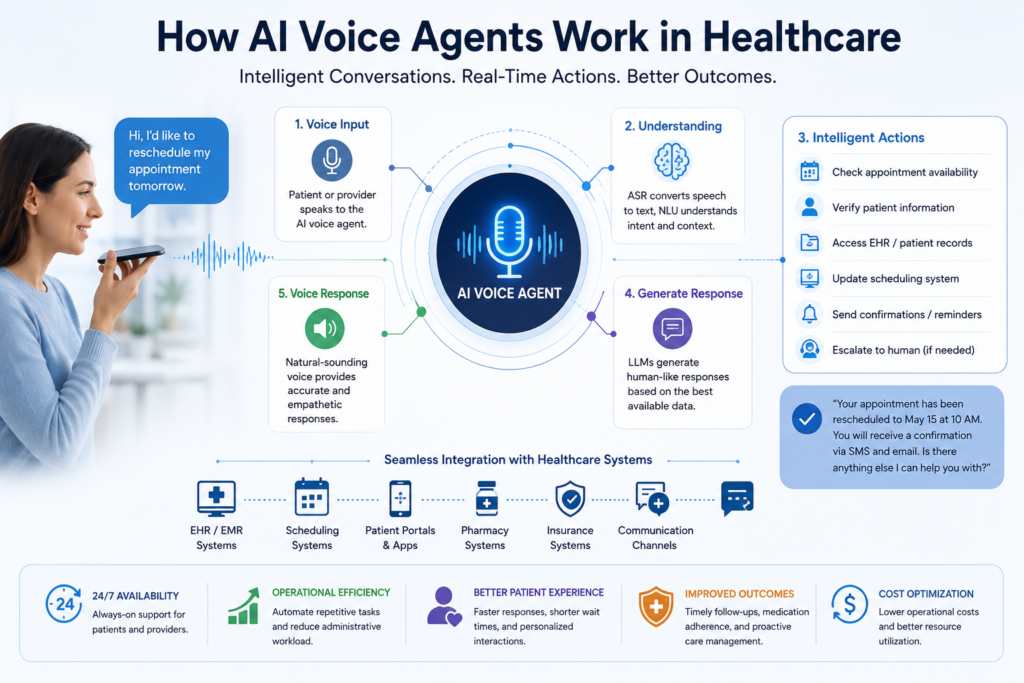
An AI voice agent is a software system that uses a combination of Automatic Speech Recognition (ASR), Natural Language Processing (NLP), Large Language Models (LLMs), and Text-to-Speech (TTS) technologies to understand, process, and respond to human speech in real time. Unlike traditional IVR (Interactive Voice Response) systems that follow rigid menu trees, modern AI voice agents are conversational – they understand context, handle interruptions, ask follow-up questions, and maintain multi-turn dialogue.
In a healthcare context, AI voice agents are deployed across a wide range of functions: answering patient queries, triaging symptoms, sending medication reminders, assisting physicians with documentation, navigating insurance verification, and more. As part of healthcare software development services, these AI voice agents help providers scale patient engagement, reduce administrative burden, and deliver consistent, high-quality responses across large volumes of simultaneous interactions.
Key Technologies Powering Healthcare Voice AI
- Automatic Speech Recognition (ASR): Converts spoken language into text with high accuracy, even in noisy hospital environments or with diverse accents.
- Natural Language Understanding (NLU): Interprets the intent and meaning behind patient or provider speech, not just keywords.
- Large Language Models (LLMs): Models like GPT-4 or medical-specific variants process complex queries, generate clinical summaries, and enable nuanced dialogue.
- Text-to-Speech (TTS): Converts AI-generated responses back into natural, empathetic human-sounding speech.
- Healthcare API Integrations: Real-time connection to EHR platforms (Epic, Cerner, Allscripts), scheduling systems, and pharmacy databases.
Top Use Cases of AI Voice Agents in Healthcare
The versatility of AI voice agents makes them applicable across nearly every department in a healthcare organization. Below are the most impactful use cases being deployed today.
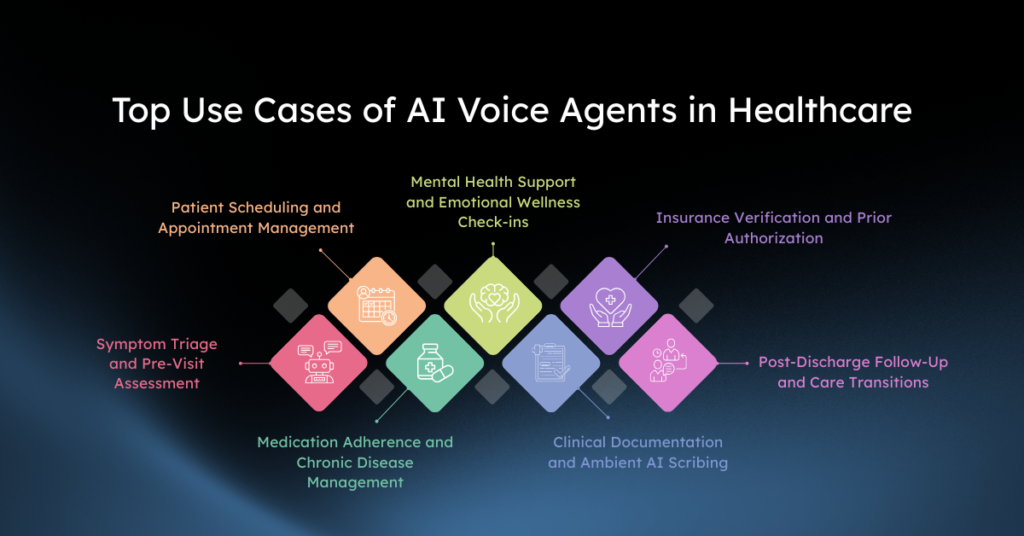
1. Patient Scheduling and Appointment Management
Appointment scheduling is often the first place healthcare organizations choose to deploy voice AI because the operational impact is easy to measure and implementation risk is relatively low. AI voice agents can handle inbound calls to book, reschedule, or cancel appointments without any human agent involvement. They verify insurance, check physician availability, confirm patient details, and send SMS/email confirmations – all within a single phone call.
Healthcare systems using AI voice scheduling have reported up to 40% reduction in front-desk call volume and a significant drop in no-show rates due to automated pre-appointment reminders and confirmations.
2. Symptom Triage and Pre-Visit Assessment
AI voice agents can conduct structured symptom assessments before a patient visits a clinic or speaks with a physician. Using validated clinical triage protocols, the agent collects information about onset, severity, duration, and associated symptoms, then routes the patient to the appropriate care level – urgent care, emergency room, telehealth consultation, or scheduled appointment.
This not only optimizes physician time but also ensures patients receive timely and appropriate care, reducing unnecessary ER visits and improving clinical outcomes.
3. Medication Adherence and Chronic Disease Management
Non-adherence to medication regimens is one of the most significant and costly challenges in chronic disease management. AI voice agents can proactively call or message patients to remind them to take medications, log whether they have taken their doses, ask about side effects, and escalate concerns to care coordinators when necessary.
For patients managing diabetes, hypertension, asthma, or heart disease, these consistent touchpoints significantly improve adherence rates and reduce hospital readmissions. Studies show that AI-driven medication reminders can improve adherence by 20–30%.
4. Clinical Documentation and Ambient AI Scribing
Physician burnout is at epidemic levels, and documentation burden is a leading contributor. Clinicians spend an average of 2 hours on EHR documentation for every 1 hour of direct patient care. AI voice agents deployed as ambient scribes listen to physician-patient conversations in real time, extract relevant clinical information, and automatically generate structured clinical notes that populate directly into the EHR.
This technology allows physicians to be fully present with their patients while AI handles the administrative burden, reclaiming hours of productive time per day. Companies like Nuance (DAX) and Suki have pioneered this space, and demand continues to grow rapidly.
5. Post-Discharge Follow-Up and Care Transitions
Hospital readmission rates are a key quality metric and a major cost driver for healthcare systems. AI voice agents can automatically call discharged patients within 24–48 hours to assess recovery progress, confirm medication understanding, flag complications, and schedule follow-up appointments – all without requiring human staff intervention.
This proactive outreach has been shown to reduce 30-day readmission rates by up to 25%, improving both patient outcomes and hospital performance scores.
6. Insurance Verification and Prior Authorization
Insurance verification and prior authorization are notoriously time-consuming, manual processes. AI voice agents can automate calls to insurance companies, collect benefit information, verify coverage eligibility, and even initiate prior authorization requests – dramatically reducing the administrative burden on billing and front-office staff. Healthcare organizations integrating AI for these tasks report saving 10–15 staff hours per week, per employee.
7. Mental Health Support and Emotional Wellness Check-ins
AI voice agents are also making inroads in mental health, where access to care remains severely constrained. Trained on evidence-based therapeutic frameworks, AI voice agents can conduct structured wellness check-ins, deliver psychoeducation, guide breathing exercises, and monitor patient-reported outcomes between therapy sessions. They serve as accessible, non-judgmental first points of contact for individuals experiencing mild anxiety or depression, helping bridge the gap between professional care intervals.
Key Benefits of AI Voice Agents in Healthcare
Operational Efficiency at Scale
Healthcare organizations are perpetually resource-constrained. AI voice agents provide an unprecedented ability to scale patient communication and administrative workflows without proportionally increasing headcount. A single deployment can handle thousands of simultaneous patient interactions – scheduling, answering FAQs, sending reminders – freeing up human staff for complex, high-value tasks.
Improved Patient Experience and Engagement
Modern patients expect instant, always-available communication. AI voice agents eliminate hold times, provide consistent responses, and are available at 3 AM when a patient has a medication question. By delivering convenient, responsive experiences, they significantly improve patient satisfaction scores (HCAHPS) and increase engagement with care plans.
Reduction in Administrative Costs
Administrative costs account for roughly 34% of total healthcare expenditure in the United States. AI voice agents can automate a significant portion of these costs – appointment scheduling, patient registration, insurance verification, and post-visit follow-up – generating substantial ROI for healthcare organizations.
Clinician Burnout Mitigation
By handling documentation, routine patient communication, and administrative tasks, AI voice agents give clinicians back hours in their day. This reduction in non-clinical burden is clinically significant: physicians who spend less time on documentation report higher job satisfaction, fewer errors, and greater capacity for patient-centered care.
Enhanced Data Capture and Analytics
Every patient interaction with an AI voice agent generates structured, analyzable data. Healthcare organizations can use this data to identify care gaps, track patient sentiment, monitor population health trends, and continuously improve their service delivery – insights that would be impossible to extract from unstructured phone calls with human agents.
Challenges and Considerations in Healthcare Voice AI Deployment
Despite its transformative potential, deploying AI voice agents in healthcare is not without complexity. Organizations must navigate several critical challenges.
HIPAA Compliance and Data Security
Healthcare data is among the most sensitive and regulated in the world. Any AI voice solution must be fully HIPAA-compliant, with end-to-end encryption, secure data storage, Business Associate Agreements (BAAs) with vendors, and rigorous access controls. EnlightLab builds healthcare AI solutions with compliance at the architectural level – not as an afterthought.
EHR and System Integration Complexity
Healthcare IT environments are notoriously fragmented, with legacy systems, proprietary databases, and limited interoperability. Integrating AI voice agents with EHR platforms like Epic, Cerner, or Meditech requires deep technical expertise in HL7 FHIR standards, API development, and custom middleware. This is an area where an experienced technology partner like EnlightLab delivers critical value.
Clinical Accuracy and Liability
In healthcare, inaccurate information can have life-or-death consequences. AI voice agents must be trained on high-quality, medically validated data, regularly audited for accuracy, and designed with appropriate human escalation pathways. Clear governance frameworks and clinician oversight are essential to ensure patient safety.
Patient Trust and Adoption
Not all patients are comfortable interacting with AI systems, particularly older demographics or those with low digital literacy. Successful deployments invest in patient education, design voices that are warm and empathetic, make it easy to escalate to a human at any point, and continuously gather feedback to improve the experience.
How Enlight Lab Builds Healthcare AI Voice Solutions
As an IT consulting and custom software development company, EnlightLab brings together deep domain expertise in healthcare technology and cutting-edge AI engineering to build voice agent solutions that are production-ready, compliant, and built to scale.
Our engagement model for healthcare AI voice projects follows a structured, outcome-focused methodology:
-
- Discovery and Requirements Analysis: We work closely with clinical, operational, and IT stakeholders to understand existing workflows, identify automation opportunities, and define measurable success metrics.
-
- Architecture Design and Technology Selection: We evaluate and recommend the right stack – whether that’s Azure Health Bot, Google CCAI, AWS HealthLake, or a custom LLM-powered system – based on your specific use case, compliance requirements, and budget.
-
- Custom Development and EHR Integration: Our engineering team builds and integrates the voice agent with your EHR, scheduling platform, and communication infrastructure using HL7 FHIR APIs and custom connectors.
-
- HIPAA Compliance and Security Review: We conduct thorough security assessments, implement data encryption, and ensure all components meet HIPAA standards before deployment.
-
- Pilot Deployment and Optimization: We deploy in a controlled environment, gather data, and iteratively refine the agent’s performance, accuracy, and user experience before full-scale rollout.
-
- Ongoing Support and Analytics: Post-launch, we provide continuous monitoring, performance reporting, model updates, and feature enhancements to ensure the solution evolves with your needs.
The Future of AI Voice Agents in Healthcare
The next five years will bring dramatic advances in healthcare voice AI capabilities. Here are the trends shaping the future of this technology:
Multimodal AI: Voice + Vision + Data
Future AI agents will seamlessly combine voice with visual inputs – reviewing lab reports, imaging data, and wearable device outputs in real time during a conversation. A patient describing chest pain could trigger the agent to simultaneously analyze their most recent ECG and flag an anomaly to a cardiologist instantly.
Personalized, Predictive Patient Communication
AI voice agents will leverage predictive analytics to proactively reach out to patients at elevated risk – before a health crisis occurs. A patient whose blood glucose trends suggest deteriorating diabetes control might receive a personalized outreach call suggesting a dietary consultation and medication review.
Autonomous Clinical Workflows
As AI models become more capable, voice agents will take on increasingly complex clinical workflow tasks – drafting specialist referral letters, coordinating multi-specialty care plans, and autonomously managing chronic disease care protocols with minimal human oversight.
Deepening Regulatory Frameworks
Regulatory bodies including the FDA and ONC are developing clearer frameworks for AI medical devices and clinical decision support tools. As governance matures, healthcare organizations will gain greater confidence in deploying AI voice agents for higher-acuity clinical applications.
Conclusion: The Voice-Enabled Future of Healthcare Is Here
AI voice agents represent one of the most powerful and practical applications of artificial intelligence in healthcare today. They address real, urgent challenges: overwhelmed front-desk staff, burned-out clinicians, fragmented patient communication, and soaring administrative costs. And unlike many emerging technologies, they are deployable right now – with measurable ROI, proven clinical workflows, and a rapidly maturing vendor ecosystem.
The healthcare organizations that move early on AI voice technology will gain a significant competitive and operational advantage – improving patient experiences, reducing costs, and empowering their clinical teams to deliver the quality of care that every patient deserves.
At EnlightLab, we are passionate about building technology that solves real-world problems in healthcare and beyond. Whether you are a hospital system exploring AI-powered patient communication, a healthcare startup building a voice-first product, or an enterprise looking to modernize your clinical workflows, our team has the expertise and experience to make it happen.