Most products never find users. Most AI projects never reach production. Most enterprise software initiatives deliver less than half the projected value. The pattern behind all three failures is the same: teams move from idea to build without stopping to confirm that the problem is real, the customer is reachable, and the solution is what people actually want.
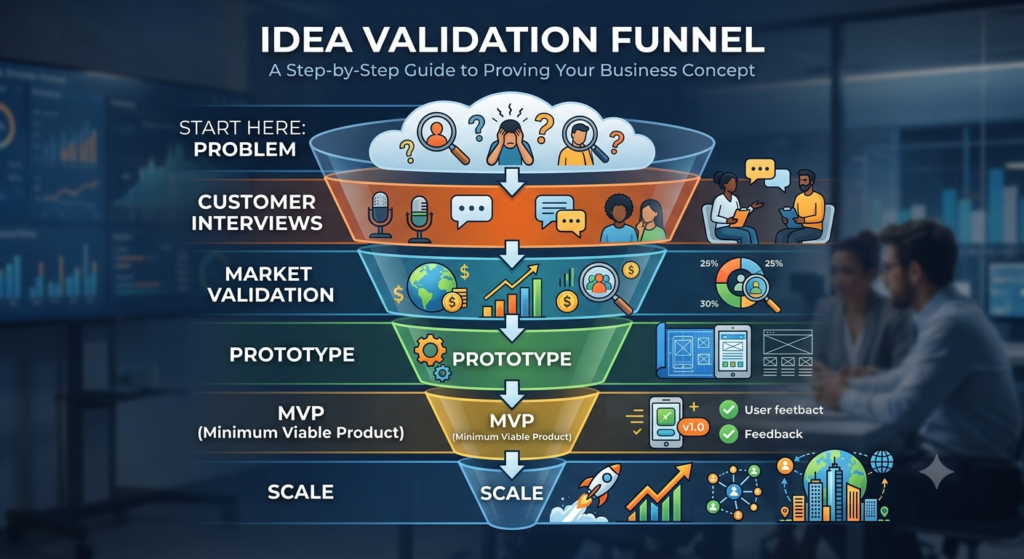
CB Insights analysis of startup post-mortems found that 42% of failed startups cited no market need as a primary cause of failure. Y Combinator co-founder Paul Graham has described the core error as building things people do not want. The Lean Startup methodology, developed by Eric Ries, formalized the antidote: validate assumptions before committing resources to build.
This guide gives you a seven-step validation framework that works equally well for a startup founder evaluating their first product and an enterprise innovation team assessing a new AI initiative. The steps are the same. The stakes are the same. The cost of skipping them is also the same.
Why Most Products Fail
No real demand
The most common failure is building a solution for a problem that is not painful enough to drive action. People say they would use a product. They do not actually pay for it or change their behavior when it ships. Asking someone if they would use something is not the same as observing whether they do.
CB Insights found 42% of failed startups cited no market need as a top-three cause of failure. This is not a funding problem or a technology problem. It is a validation problem that proper research would have caught before significant resources were committed.
Solving the wrong problem
A related failure is solving a real problem but solving the wrong version of it. A team builds an analytics dashboard because customers complained about visibility. The real problem was that the customers did not trust the underlying data. The dashboard makes the inaccuracy more visible, not less. The product ships. Usage is low. The team adds more features. The fundamental mismatch is never addressed.
Customer interviews conducted before building would have surfaced the trust issue in the first conversation. The fix would have been cheaper, faster, and targeted at the actual problem.
Building too much too early
Scope is the third failure mode. Teams build full products when a landing page would have confirmed demand. They build full features when a mockup would have tested the concept. Each week of unnecessary build is a week of feedback that was not collected.
Eric Ries documented this pattern in The Lean Startup: the goal of early-stage development is not to build a product, it is to learn whether a product is worth building. Every feature added before that question is answered is a waste.
The Cost of Skipping Validation
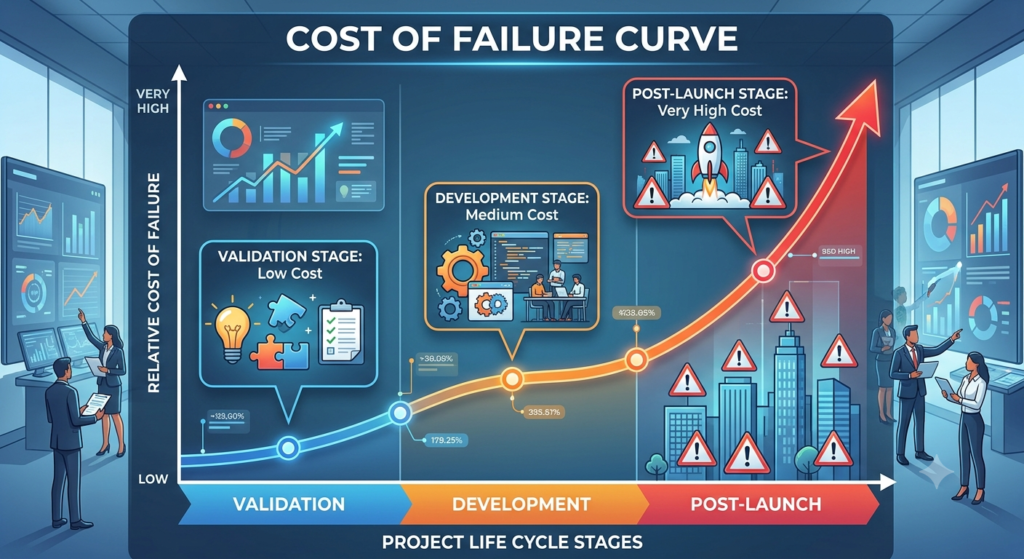
A structured validation process costs between $5,000 and $30,000, depending on scope and methodology. A misdirected product build costs $150,000 to $2 million and takes 6 to 18 months to discover it was wrong.
Budget waste
Building the wrong product is not just a missed opportunity. It is direct budget destruction. Engineering time, design time, infrastructure costs, and project management overhead all accumulate against a product that will never generate a return. CB Insights data shows that 29% of failed startups ran out of cash. Most of that cash was spent building, not validating.
Opportunity cost
Every month spent building the wrong thing is a month not spent finding the right one. For startups, this is existential. For enterprises, it is competitive. Competitors who validate faster move faster. The market does not pause while your team discovers, twelve months in, that the assumption at the center of your roadmap was wrong.
Team morale impact
Failed builds are not just financial events. Engineers who spent six months building a product nobody used do not immediately start the next project with full energy. Product managers whose roadmaps get cancelled mid-build lose credibility with stakeholders. The organizational cost of a failed initiative extends well past the direct budget figure.
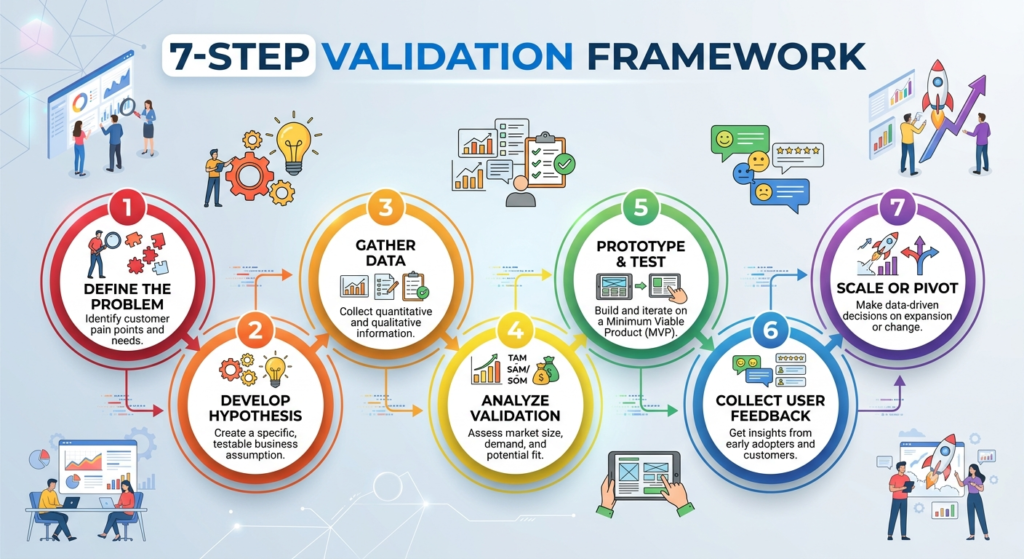
STEP 1: Clearly Define the Problem
Validation starts with a problem statement, not a solution. Most teams skip this and jump to describing what they want to build. The problem with that approach is that you cannot validate a solution until you have confirmed the problem is real.
A good problem statement answers three questions precisely:
- Who experiences this problem: Not ‘small businesses’ or ‘enterprises.’ A specific role in a specific context. ‘Logistics coordinators at 3PL companies managing over 50 daily shipments’ is a problem owner. ‘People who ship things’ is not.
- How often does it occur: A problem that happens once a year will not drive repeat usage or willingness to pay. A problem that occurs daily and takes 30 minutes to resolve manually has real commercial value.
- How is it solved today: If the answer is ‘nothing, there is no solution,’ be skeptical. Most real problems have some workaround, however painful. Understanding the current workaround tells you what switching costs look like and what your product needs to beat.
Write the problem statement in one paragraph before doing anything else. If you cannot write it clearly, you do not understand it well enough to validate it.
STEP 2: Identify Your Target Customer
Once the problem is defined, identify exactly who experiences it most acutely. You are not trying to find everyone who might have this problem. You are trying to find the ten to twenty people who have it so badly that they would pay to fix it today.
Ideal customer profile
An Ideal Customer Profile (ICP) describes the type of organization or individual that gets the most value from your solution. For B2B, it typically includes company size, industry, geography, tech stack, and buying triggers. For B2C, it includes demographic, behavioral, and psychographic characteristics.
The ICP is not your total addressable market. It is your starting point: the segment you will serve first and best, where word of mouth will travel fastest and product-market fit will be clearest.
Buyer personas
Within your ICP, map the people involved in the buying and using decision. In B2B products, the person who evaluates the product, the person who approves the budget, and the person who uses it daily are often three different people with three different success criteria. Build a one-page persona for each: their role, their goals, their frustrations, and what they read or trust.
User segmentation
Not all users within your ICP have the same needs. Segment early users by frequency of the problem, current workaround cost, and readiness to adopt new tools. Early adopters who have the problem acutely and are already looking for solutions are your first interviews, your first pilots, and your first customers.
STEP 3: Conduct Customer Interviews
Customer interviews are the most valuable validation tool available, and the most commonly done badly. The goal is not to pitch your idea and collect reactions. The goal is to understand the problem as the customer experiences it, in their own words, before you have described your solution.
Questions to ask
Use open, past-tense questions that surface real behavior rather than hypothetical intent:
- Tell me about the last time you dealt with this problem. Walk me through what happened.
- How did you try to solve it? What did you use?
- What did that solution cost you in time, money, or frustration?
- What would have to be true for you to change the way you handle this today?
- Who else in your organization is affected by this problem?
- Have you ever paid for something to solve this? What happened?
Common mistakes
- Pitching during the interview: As soon as you describe your solution, the customer starts responding to your idea rather than describing their experience. Keep your solution out of the first conversation entirely.
- Asking hypothetical questions: ‘Would you use a product that did X?’ is not a validation question. ‘Have you ever tried to do X before?’ is. The Rob Fitzpatrick framework from ‘The Mom Test’ makes this distinction central: talk about their life, not your idea.
- Treating positive reactions as validation: Polite interest is not the same as validated demand. People are socially conditioned to be encouraging. A customer who says ‘that sounds great’ but cannot describe a specific time they needed it has not validated your idea.
Identifying real pain points
Real pain points appear in specific stories, not general complaints. When a customer says ‘we waste hours every week reconciling these reports manually,’ that is a specific, quantifiable pain. When they say ‘it would be nice to have better visibility,’ that is a preference, not a pain.
Listen for: specific time or money lost, workarounds customers have built themselves, problems that have been escalated to management, and situations where the customer has already tried and failed to find a solution. These are the signals that a problem is worth solving.
STEP 4: Validate Market Demand
Customer interviews confirm the problem exists for individuals. Market demand validation confirms the problem exists at a scale worth addressing commercially.
Search trends
Use Google Trends and keyword tools to measure search volume for the problem your product solves. Not for your solution, for the problem. If people are searching for ‘how to reduce manual invoice processing time,’ that is evidence of demand. If search volume is negligible, you either have a new problem nobody has named yet, or a small problem not worth solving at scale.
Competitor analysis
Competitors are validation. If someone else is building in this space and getting paid, the problem is real. Study competitors not to copy them but to understand what they are solving and what they are leaving unsolved. Your differentiation lives in the gap between what exists and what customers still complain about.
If there are no competitors, ask why. First-mover advantage is rare. Markets with no competition often have no competition because the problem is too small, the customer is too hard to reach, or someone already tried and failed.
Community discussions
Reddit threads, LinkedIn groups, Slack communities, and industry forums are primary sources of unfiltered demand signal. Find where your target customer talks about their problems and read what they say. The language they use to describe problems is the language you should use in your product messaging.
Posts with high engagement, long comment threads, and repeated themes across multiple communities are strong demand signals. A single post with no replies is not.
Existing solutions and workarounds
Catalog every existing solution: direct competitors, adjacent tools, internal workarounds, and manual processes. Price points, user reviews, and feature gaps all tell you something about the market. A competitor with thousands of reviews and a 3.2-star rating has validated demand and also told you exactly what to build better.
STEP 5: Create a Landing Page Test
Build a single-page site that describes the problem you solve, the outcome you deliver, and a clear call to action. The call to action should require something: an email address, a waitlist signup, or a pre-order. Passive interest is not demand. Exchanging contact information for a future product is a behavioral commitment.
Measure interest
Run paid traffic from Google or LinkedIn to the landing page targeting your ICP. Keep the budget small: $500 to $2,000 is enough to generate a statistically useful signal. Measure the conversion rate from visit to signup. A 5% or higher conversion rate on cold traffic is a strong signal. Under 1% means either the problem is not acute enough, the messaging is wrong, or the audience is wrong.
Collect emails
Every email address collected is a potential customer who has opted in to hear more. These are the people you invite to your next round of interviews, your beta program, and eventually your launch. Treat this list as your most valuable early asset.
Validate messaging
The words you use on the landing page matter. Test different headlines that describe the problem differently. The version that converts best tells you how customers frame the problem themselves. That language belongs in your product, your sales process, and your marketing.
STEP 6: Build a Prototype Instead of a Product
A prototype tests whether your proposed solution is the right response to the validated problem. It is not functional software. It is a representation of what the product could be, built to generate feedback, not to process transactions.
Wireframes
Wireframes are low-fidelity sketches of the user interface: boxes, labels, and flows without design polish. They take hours to build, not weeks. They communicate structure and workflow. Show wireframes to ten target customers and you will learn more about usability in two days than you would from months of internal debate.
Mockups
Mockups are high-fidelity designs that look like the real product but are not interactive. They answer the question: does this look like something people would trust and want to use? Tools like Figma produce professional mockups without a single line of code. Enlight Lab’s product discovery practice uses high-fidelity mockups as the primary validation artifact before any development begins.
Interactive demos
An interactive demo is a clickable prototype that simulates the product experience without functional back-end logic. The user clicks buttons, sees screens change, and experiences the flow. This is the most powerful pre-build validation tool for complex or multi-step products. It answers the question that mockups cannot: does this flow make sense to use in sequence?
STEP 7: Build an MVP
After seven steps of validation, you have confirmed: the problem is real, the customer is reachable, the messaging resonates, and the proposed solution makes sense to use. Now you build. But you build the minimum, not the vision.
Core functionality only
List every feature in your product vision. Cross out everything that is not required for a customer to experience the core value. What remains is your MVP scope. If the list is still long, cross out more. The MVP exists to test whether the core value proposition works in practice. Everything else can come after you have confirmed it does.
Success metrics
Define success before you launch. What usage behavior would confirm that the MVP is working? What would tell you it is not? Set a specific threshold for each metric before the first user sees the product. Without pre-defined success criteria, teams rationalize results rather than evaluate them.
Relevant MVP metrics include: activation rate (do users complete the core action?), retention rate (do they come back?), task completion rate (do they succeed at the job the product is supposed to do?), and qualitative feedback from structured post-use interviews.
Feedback loops
Build the feedback mechanism into the MVP from the beginning, not as an afterthought. Schedule user interviews at two weeks and six weeks post-launch. Instrument the product to track where users drop off. Create a direct channel for users to report problems. The MVP is not a product you have launched. It is an experiment you are running.
Proof of Concept vs Prototype vs MVP
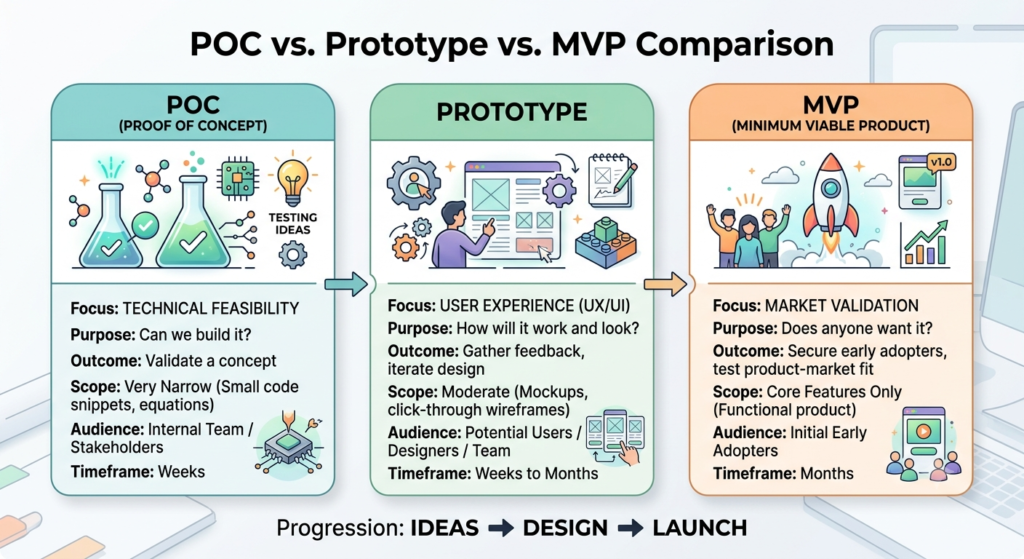
| Factor | Proof of Concept | Prototype | MVP |
|---|---|---|---|
| Objective | Can this be built technically? | Is this the right design and flow? | Will customers use and pay for this? |
| Audience | Internal technical team | Target customers and stakeholders | Early adopters and paying customers |
| Functionality | Core technical component only | Simulated, non-functional | Real, functional, intentionally limited |
| Cost | $2,000 to $15,000 | $3,000 to $25,000 | $15,000 to $150,000 |
| Timeline | 1 to 3 weeks | 1 to 4 weeks | 4 to 16 weeks |
| Success criteria | Technical feasibility confirmed | Positive usability feedback from target users | Defined usage and retention thresholds met |
| Output | Technical report or demo | Figma file or clickable demo | Deployed working software |
Before spending $15,000 to $150,000 on an MVP, use our AI MVP Blueprint tool to validate assumptions, define scope, and identify the smallest version of the product worth building.
Validation Metrics That Matter
Validation is not a feeling. It is a set of measurements against pre-defined thresholds. These are the five metrics that matter most across the seven validation steps:
| Metric | What It Measures | Threshold to Take Seriously |
|---|---|---|
| Landing page conversion rate | Interest in the proposed solution from cold traffic | 5%+ on paid traffic to a cold audience |
| Interview pain score | Severity of the problem based on qualitative signals | 7 of 10 interviews describe the problem as urgent and recurring |
| Waitlist or email signup growth | Unprompted organic interest in the product | 10%+ week-over-week growth without paid promotion |
| MVP activation rate | Percentage of users who complete the core action on first use | 40%+ of new users activate within first session |
| MVP retention rate | Percentage of users who return after first use | 25%+ of users return within 7 days for a weekly-use product |
Common Validation Mistakes
- Asking leading questions: ‘Would you pay for a product that solved X?’ leads the witness. The customer hears that you want them to say yes. Ask what they do today instead. Observe behavior; do not solicit endorsements.
- Validating with the wrong people: Interviewing friends, family, and existing professional contacts introduces bias. They want to support you. They will not tell you the idea is wrong. Your first ten interviews should be with strangers who match your ICP.
- Building features during validation: Customer interviews produce feature requests. That is not what they are for. Every feature request is a symptom of an underlying need. Understand the need. Do not build the feature until the MVP is validated.
- Ignoring negative feedback: One customer who refuses to use your product is more valuable than five who say it sounds interesting. Negative feedback tells you what is actually wrong. Positive feedback tells you what people say when they do not want to disappoint you.
- Declaring validation too early: Three positive interviews are not validation. They are a signal worth investigating. Validation requires consistent patterns across enough conversations to rule out coincidence. Ten to fifteen interviews for a B2B product is a minimum starting point.
- Conflating interest with intent: Someone who attends a demo, signs up for a waitlist, and says they are excited has shown interest. Someone who gives you their credit card has shown intent. Build toward behavioral signals, not verbal ones.
Final Validation Checklist
Use this before committing development budget to any new product or feature.
Problem Definition
- Problem statement written in one paragraph with a named owner, frequency, and current workaround
- Problem confirmed as painful enough to drive behavior change, not just preference
- The problem occurs frequently enough to support the use model you are building
Customer Clarity
- ICP is defined with specific industry, role, company size, and buying trigger
- Buyer persona and user persona are documented separately for B2B products
- Early adopter segment identified: who has this problem most acutely right now
Customer Interviews
- Minimum ten interviews completed with people who match the ICP
- Interviews were conducted before describing the solution to the respondents
- Real stories collected: specific events, specific costs, specific workarounds
- Consistent pain pattern confirmed across at least 70% of interviews
Market Demand
- Search volume confirmed for the problem category
- At least two to three competitors identified and analyzed
- Community demand signals found in forums, Reddit, or LinkedIn groups
- Competitor pricing and user review gaps documented
Landing Page and Prototype
- Landing page live and collecting emails or pre-orders
- Conversion rate above 5% on paid cold traffic
- Prototype or mockup tested with at least five target customers
- Usability feedback incorporated before MVP scoping
MVP Readiness
- MVP scope defined: only features required to deliver core value
- Success metrics and thresholds set before development begins
- Named owner for feedback collection and iteration cycle post-launch
- Budget confirmed for post-MVP optimization, not just the initial build
Final Thoughts
The seven steps in this framework are not bureaucratic. They are the minimum work required to confirm that what you are about to build is worth building.
Every week of validation saves multiple weeks of misdirected development. Every customer interview conducted before the first line of code is written narrows the gap between what you build and what customers actually need. Every landing page test that fails to convert is a product failure that costs $500 instead of $500,000.
This framework applies whether you are a solo founder evaluating your first SaaS idea, a product manager scoping an AI feature, or an enterprise innovation team assessing a new initiative. The scale differs. The discipline does not.
At Enlight Lab, our product discovery and AI consulting practice runs this exact framework for startups and enterprises before any development begins. We run customer interviews, build prototypes, test landing pages, and scope MVPs. Every engagement ends with a validated problem statement, a confirmed ICP, and a development brief that a team can build against confidently.