Quick Answer: Data engineering for AI is the work of building and maintaining the pipelines, infrastructure, and governance that make enterprise data reliable enough for AI systems to use. Most enterprise AI projects fail not because the models are wrong but because the data feeding them is incomplete, inconsistent, or inaccessible. Organizations that invest in data engineering before model selection consistently outperform those that do not.
Every enterprise AI project eventually confronts the same reality. The model is capable. The use case is validated. The budget is approved. And then the team discovers that the data needed to run the system is scattered across twelve systems, stored in four different formats, missing key fields, and last updated six months ago.
This is not a technology problem. It is a data engineering problem. And it is the primary reason that, according to Gartner, at least 50% of generative AI projects are abandoned after proof of concept. The models are not the weak link. The data infrastructure is.
This guide explains what data engineering is, why it determines AI success more than model selection, how enterprise AI data pipelines are architected, and what your organization needs to build before any AI initiative will deliver sustained value.
Why Most AI Projects Fail Before Delivering Business Value
Direct Answer: Most AI projects fail because of data problems, not model problems. Poor data quality, fragmented data sources, missing governance, and weak infrastructure prevent models from producing reliable outputs regardless of their capability.
The numbers are consistent across research sources. Gartner found that at least 50% of generative AI projects are abandoned after proof of concept. McKinsey’s State of AI 2025 report found that fewer than 20% of AI pilots scale to production within 18 months. IBM’s Global AI Adoption Index identified data complexity as a top barrier cited by 33% of enterprises.
Deloitte’s research found that over 52% of organizations cite data quality as the biggest blocker to AI deployment. This is not a new finding. It has appeared consistently in enterprise AI research for five consecutive years. The message is clear: organizations keep underinvesting in data infrastructure and then wonder why their AI systems underperform.
The five root causes that appear most frequently in failed enterprise AI programs are:
Poor data quality: Duplicate records, missing values, inconsistent formats, and outdated content produce unreliable model outputs. A predictive model trained on incomplete transaction data will produce inaccurate predictions. A RAG chatbot indexed on outdated policy documents will confidently give customers wrong information.
Data silos: Valuable business data is distributed across CRM, ERP, data warehouse, legacy databases, and departmental spreadsheets with no unified access layer. AI systems cannot reason across data they cannot reach.
Inconsistent formats and schemas: Customer records stored differently across three systems, dates in four formats, and product codes that changed after an acquisition create integration work that consumes months of engineering time before any model training begins.
Missing governance: Without defined data ownership, update cadences, and quality standards, data degrades over time. An AI system built on well-governed data in month one is running on unreliable data by month six if governance is absent.
Weak infrastructure: Batch pipelines that refresh overnight cannot support real-time AI applications. On-premise storage that cannot scale elastically limits the data volume available for model training. Infrastructure constraints become AI constraints.
The most expensive data engineering work is the work you do after your AI system goes live and the problems surface. Organizations that audit data readiness before model development save three to five times the remediation cost of those that discover gaps during or after build.
What Is Data Engineering?
Direct Answer: Data engineering is the discipline of designing, building, and maintaining the systems and pipelines that move data from source systems to the places where it can be used for analysis, machine learning, and AI applications. Data engineers make raw, messy business data reliable, accessible, and structured enough for downstream consumption.
Understanding the core components helps organizations evaluate their readiness before committing to an AI initiative.
Component
What It Does
Why It Matters for AI
Data collection and ingestion
Pulls data from source systems: databases, APIs, event streams, files, and third-party platforms
AI systems can only use data they can access. Incomplete ingestion means incomplete context for every model.
ETL and ELT pipelines
Extract, Transform, Load: moves data between systems while applying cleaning and transformation logic. ELT reverses the order, loading first then transforming
Transforms raw, inconsistent source data into the structured, clean format models require to produce reliable outputs
Data lakes
Large-scale storage for raw, unstructured, and semi-structured data in its original form
Preserves full data history and enables exploratory analysis before defining the exact schema AI models need
Data warehouses
Structured, schema-on-write storage optimized for analytical queries
Provides the clean, organized data layer that ML models and BI tools query for structured predictions and reporting
Real-time streaming
Processes data in motion using tools like Apache Kafka and Flink
Enables AI applications that require current data: fraud detection, real-time recommendations, live inventory management
Feature engineering
Transforms raw data fields into the specific numerical representations machine learning models consume
The quality of features directly determines model accuracy. Poor feature engineering limits model performance regardless of architecture.
Data governance
Policies, ownership, quality standards, and lineage tracking for all data assets
Ensures AI systems continue to receive accurate, current data. Without governance, data quality degrades silently.
Why Data Engineering Matters for AI
There is a principle in AI that practitioners repeat so often it has become almost invisible: an AI system is only as good as the data it receives. This is not a caveat. It is a design constraint that determines whether an AI initiative succeeds or fails.
Consider what happens at each layer of an AI application when the underlying data is poor.
A large language model on a RAG architecture: retrieves information from your knowledge base before generating a response. If that knowledge base contains outdated product specifications or contradictory policy documents, the model synthesizes those inaccuracies into a confident, incorrect answer. The model is working exactly as designed. The data is the failure.
A machine learning model predicting customer churn: trained on transaction data that is missing 30% of mobile app interactions will systematically underpredict churn for mobile-first customers. The model does not know what it does not know. The missing data produces a biased prediction.
A recommendation engine: trained on purchase history that does not reflect returned items will recommend products customers have already rejected. The signal the model is optimizing for is corrupted.
Clean, structured, reliable data produces AI that works. Incomplete, inconsistent, ungoverned data produces AI that appears to work in demos and fails in production.
Data engineering is the discipline that closes this gap. It is not the most visible part of an AI project. It rarely features in vendor demos. But it is the work that determines whether everything else delivers the promised return.
Enlight Lab Insight:Across our enterprise AI engagements, we have identified one consistent predictor of production success: organizations that complete a data readiness assessment before selecting a model or writing a prompt consistently achieve higher containment rates, lower hallucination rates, and faster time to production value than those that begin with model selection. Data readiness is the highest-leverage investment in the AI stack.
The Enterprise AI Data Pipeline: Architecture and Technologies
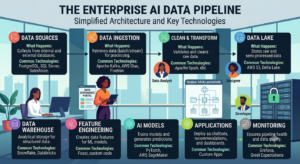
A production AI data pipeline moves data through several distinct layers before it reaches a model. Understanding each layer helps organizations identify where their current infrastructure is ready and where gaps need to be addressed before AI development begins.
Pipeline Stage
What Happens
Common Technologies
1. Data sources
Original systems where business data lives: transactional databases, APIs, IoT sensors, SaaS platforms, document repositories, event logs
Tracks data drift, model performance, pipeline health, and data quality metrics over time
Apache Kafka (event streaming), Prometheus, Grafana, Great Expectations, Monte Carlo
The most common architectural mistake in enterprise AI projects is building the model layer before the pipeline layers are stable. A model deployed on an unstable pipeline degrades in unpredictable ways. The performance problems are difficult to diagnose because the failure can originate at any point in the chain from source to output.
Common Data Engineering Challenges in Enterprise AI
Every enterprise data engineering project encounters a predictable set of obstacles. Recognizing them before they surface saves months of remediation time.
Duplicate records: Customer data entered in two systems, product codes assigned by different teams, and event logs without deduplication logic create records that inflate counts and corrupt model training. Deduplication must be designed into the pipeline, not applied as a manual cleanup exercise after each run.
Missing values: Incomplete records are more common in enterprise data than most teams expect. A transaction table with 15% null values in a key feature field is not a minor imperfection. It is a systematic gap that will bias every model trained on it.
Legacy systems without clean APIs: Many enterprise source systems were not designed for programmatic data extraction. Legacy ERP and mainframe systems often require custom extraction logic, scheduled exports, or middleware to surface data in a usable format. This work is invisible in project planning and always takes longer than estimated.
Siloed databases with no shared schema: Customer identifiers that do not match across CRM, billing, and support systems prevent joining records that represent the same customer. Resolving entity relationships across siloed systems is one of the most time-consuming phases of enterprise data engineering.
Poor metadata and documentation: When no one knows what a column means, where the data came from, or how it was transformed, data engineers spend hours reconstructing context that should have been documented from the start. Missing metadata multiplies integration time across every new use case.
Real-time processing requirements: AI applications for fraud detection, inventory management, and customer support often require data that is seconds or minutes old rather than hours or days old. Building real-time streaming pipelines is significantly more complex than batch processing and requires different infrastructure, monitoring, and failure-handling logic.
Scalability under production load: A pipeline that processes 100,000 records during testing may fail or slow unacceptably when processing 10 million records in production. Load testing data pipelines against realistic production volumes before deployment is essential and frequently skipped.
How Poor Data Impacts AI Performance in Production
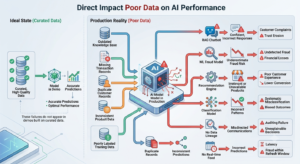
Direct Answer: Poor data quality causes AI hallucinations, inaccurate predictions, biased recommendations, compliance exposure, slow model performance, and higher operational costs. These failures do not appear in demos built on curated data. They appear in production after deployment.
Data Quality Issue
AI Impact
Business Consequence
Outdated knowledge base content
RAG chatbot retrieves stale information and generates confident, incorrect responses
Cannot audit why the model produced a specific output
Cannot explain decisions to regulators, customers, or internal teams
No real-time data feed
Fraud detection model operates on hour-old transaction data
Fraud committed in the window between data refresh and model inference
Every row in this table represents a production failure that would have been preventable with proper data engineering upstream. The model in each case is working correctly. The data is what failed.
Best Practices for Building AI-Ready Data Infrastructure
Organizations that consistently succeed with enterprise AI share a common set of data infrastructure practices. These are not aspirational standards. They are the practical decisions that determine whether an AI project reaches production.
Establish data governance before building pipelines
Assign a named owner for every data domain your AI program will touch. Define who is responsible for quality, who has authority to change schema, and how often content must be reviewed for currency. Without governance, data quality degrades silently between pipeline builds and model deployments.
Automate pipeline testing and validation
Every pipeline stage should include automated data quality checks that run on each execution. Tools like Great Expectations and dbt tests allow teams to define expectations (no null values in required fields, values within defined ranges, record counts within expected bounds) and fail the pipeline automatically when those expectations are violated. Catching quality issues at ingestion is orders of magnitude cheaper than catching them in model output.
Build for lineage and observability from day one
Every data asset should have traceable lineage: where did this record come from, what transformations were applied, and which downstream systems consume it. Lineage is not only a governance requirement. It is the diagnostic tool that allows data engineers to identify the source of a quality problem when it surfaces in model output.
Separate raw, curated, and production data layers
Raw data should be preserved in its original form in a data lake. Curated data should be cleaned and standardized in a warehouse layer. Production data for model training and inference should be a validated subset of the curated layer. Mixing these layers creates environments where a pipeline change can silently corrupt production model inputs.
Design for real-time where the use case requires it
Not every AI application needs real-time data. Batch pipelines that refresh every four hours are appropriate for weekly reporting. They are not appropriate for fraud detection or live inventory management. Identify the latency requirement of each AI use case before designing the pipeline, not after.
Implement security controls at the data layer
Role-based access controls, encryption at rest and in transit, and data masking for personally identifiable information should be implemented in the data infrastructure layer, not bolted on at the application layer. AI systems that retrieve data without appropriate access controls create audit exposure in regulated industries.
Version control pipelines and schemas
Treat data pipeline code with the same version control discipline applied to application code. Schema changes should go through review processes. Pipeline modifications should be testable in staging before deployment to production. Uncontrolled schema changes are a common cause of silent model performance degradation.
Data Engineering vs Data Science vs Machine Learning Engineering
These three disciplines are frequently confused in enterprise AI planning. Understanding the distinctions helps organizations staff projects correctly and avoid gaps in capability.
Dimension
Data Engineering
Data Science
ML Engineering
Primary focus
Building and maintaining data pipelines, storage, and infrastructure
Analyzing data, identifying patterns, building and evaluating models
Deploying, scaling, and monitoring models in production systems
Deployed model APIs, monitoring dashboards, retraining pipelines, CI/CD for models
Works with
Source systems, databases, cloud storage, data consumers across the organization
Clean data from data engineers, business stakeholders defining problems
Models from data scientists, data pipelines from data engineers, production infrastructure
Business value
Makes AI and analytics possible by ensuring data is reliable, accessible, and current
Identifies what the data means and what models should be built
Turns model experiments into production systems that generate ongoing business value
When you need them
Before any AI or analytics initiative; foundational to everything downstream
When you have reliable data and a defined business problem to model
When you have a validated model ready for production deployment
Enlight Lab Insight: The most common resourcing mistake in enterprise AI programs is hiring data scientists before data engineers. Data scientists need clean, accessible, well-structured data to do their work. Without data engineers establishing that foundation first, data scientists spend 70 to 80% of their time on data preparation rather than model development. Sequence your hiring and investment to match your data readiness, not your ambition.
Enterprise Data Engineering Use Cases by Industry
Industry
Data Engineering Challenge
AI Use Case Enabled
Business Outcome
Healthcare
Patient records across EHR systems, claims data, lab results in different formats and standards
The pattern across every industry is consistent: the complexity of the data engineering challenge scales with the number of source systems, the volume of data, and the real-time requirements of the AI use case. Organizations that solve the data engineering challenge first build AI applications that work. Organizations that skip it build proofs of concept that fail to scale.
Enterprise Data Engineering Readiness Checklist
Use this checklist before committing a development budget to any AI initiative. Every unchecked item is a data risk that will surface during or after build.
Data inventory and accessibility
All data sources required for the AI use case are identified and documented
APIs or extraction methods exist for each source system
Data volumes and refresh frequencies are documented and validated
Data access permissions are defined and do not conflict with privacy requirements
Data quality
Completeness: required fields have less than 5% null rate for critical features
Accuracy: data has been validated against a known-good source or business rules
Consistency: same entities use the same identifiers across all source systems
Currency: data is refreshed on a cadence appropriate for the AI use case latency requirement
Infrastructure readiness
A data warehouse or lakehouse is in place for structured analytical data
Pipeline orchestration tooling is configured and tested
Cloud storage or on-premise equivalent can handle projected data volumes
Real-time streaming infrastructure is in place for use cases requiring sub-hour data freshness
Governance and ownership
A named owner is assigned for every data domain the AI system will use
Data lineage is traceable from source to model input
Schema change management process is defined and enforced
Data retention and deletion policies comply with applicable privacy regulations
Security and compliance
PII and sensitive fields are masked or encrypted in pipeline layers accessible to AI systems
Role-based access controls are implemented at the data layer
Audit logging is active for all data access events
Data handling complies with applicable regulations for the industry and geography
Monitoring
Automated data quality checks run on every pipeline execution
Anomaly detection is configured to alert when record volumes, null rates, or value distributions change unexpectedly
Pipeline execution logs are centralized and searchable
A defined process exists for investigating and resolving data quality alerts
Common Data Engineering Mistakes That Undermine AI Projects
Starting AI before fixing data: The most expensive sequence in enterprise AI is building a model before the data is ready. Every problem discovered after build costs three to five times more to fix than the same problem found during a pre-build data audit. Assess data readiness before selecting a model or writing a prompt.
Ignoring governance: A pipeline that produces clean data today but has no ownership, update process, or quality monitoring will produce unreliable data in six months. Governance is not a documentation exercise. It is the operational practice that keeps AI systems performing after launch.
Building manual pipelines: Manual data preparation processes that require a data engineer to run scripts each morning are fragile, slow, and impossible to scale. Every data movement that an AI system depends on should be automated, monitored, and recoverable without manual intervention.
Poor documentation: Undocumented pipelines become technical debt that slows every future AI initiative. When the engineer who built the pipeline leaves, the knowledge leaves with them. Every pipeline, schema, and transformation logic should be documented as part of the build, not retrospectively.
No monitoring after deployment: Data quality problems that develop gradually after deployment are invisible without monitoring. A product catalog that accumulates 500 new items a month with inconsistent formatting will degrade RAG chatbot quality incrementally until customers start complaining. Monitoring catches this before it reaches the customer.
Treating security as an afterthought: Data pipelines that move sensitive customer or financial data without appropriate access controls, encryption, and audit logging create regulatory exposure. In regulated industries, data security is an architecture requirement, not a post-deployment checklist item.
Final Thoughts: Data Engineering Is the Foundation, Not the Afterthought
Every successful enterprise AI initiative begins with a question that is not about models: is our data reliable enough to support this?
The organizations generating real, measurable AI returns are not the ones that moved fastest to production. They are the ones that invested in data governance, pipeline automation, and quality monitoring before they selected a model or wrote a prompt. McKinsey’s 2025 research found that only 6% of organizations qualify as true AI high performers. What separates this group is not access to better models. It is the organizational discipline to build reliable data infrastructure first.
The model selection conversation, the benchmark comparisons, and the prompt engineering debates are all secondary to the question of whether the data feeding the system is complete, current, and trustworthy. When it is, AI delivers the business value it promises. When it is not, even the most capable model produces outputs that erode trust faster than they build it.
At Enlight Lab, our data engineering and AI consulting practice works with enterprises to build the data foundation before the AI application. We run data readiness assessments, design and build production pipelines, establish governance frameworks, and ensure the infrastructure is auditable, maintainable, and compliant with the standards your industry requires. We do not recommend a model until the data is ready to support it.
Ready to assess your data readiness and build the foundation your AI initiative needs? Contact Enlight Lab at enlightlab.com to scope a data engineering engagement. We will audit your current infrastructure, identify the gaps between where your data is and where it needs to be, and design a roadmap that gets your AI program to production on a foundation that holds.
Frequently Asked Question (FAQ)
What is data engineering?
Data engineering is the discipline of designing, building, and maintaining the pipelines, storage systems, and infrastructure that move raw business data into reliable, accessible formats for analytics, machine learning, and AI applications. Data engineers work with source systems, build ETL and ELT pipelines, manage data lakes and warehouses, implement governance frameworks, and ensure the data reliability that every downstream AI and analytics use case depends on.
Why is data engineering important for AI?
Data engineering is important for AI because AI systems produce reliable outputs only when they receive reliable inputs. According to Deloitte, 52% of organizations cite data quality as the biggest barrier to AI deployment. Gartner found that at least 50% of generative AI projects are abandoned after proof of concept, with data problems being the most common cause. A language model with poor retrieval data hallucinations. A machine learning model trained on incomplete data produces biased predictions. Data engineering is what makes AI systems trustworthy.
What is an AI data pipeline?
An AI data pipeline is the sequence of systems and processes that move data from source systems through ingestion, cleaning, transformation, and storage into the format that AI models consume. A typical enterprise AI data pipeline includes data ingestion from source systems, transformation and cleaning stages, a data lake for raw storage, a data warehouse for structured analytical data, a feature engineering layer, the AI model itself, and a monitoring layer that tracks data quality and model performance continuously.
What is the difference between data engineering and data science?
Data engineering builds the infrastructure that makes data reliable, accessible, and structured. Data science analyzes that data to identify patterns and build predictive models. Data engineers build pipelines. Data scientists build models. In practice, data scientists require reliable data from data engineers before they can do meaningful modeling work. Organizations that skip data engineering and hire data scientists first find that their data scientists spend 70 to 80% of their time on data preparation rather than model development.
How much does enterprise data engineering cost?
Enterprise data engineering costs vary by scope, data volume, and integration complexity. A focused data engineering assessment and architecture design for a single AI use case typically costs $15,000 to $50,000. Building the data infrastructure for a production AI application including pipeline development, warehouse configuration, and governance framework typically costs $75,000 to $300,000. Large-scale enterprise data platforms spanning multiple business units and data sources range from $300,000 to several million dollars depending on scope and existing infrastructure.
How long does data engineering implementation take?
Timeline depends on complexity and the state of existing infrastructure. A data readiness assessment takes two to four weeks. Building a focused data pipeline for a single AI use case typically takes four to eight weeks. Establishing a full enterprise data platform with governance, monitoring, and multiple source integrations typically takes three to six months. Organizations with significant legacy system complexity or data quality remediation requirements should plan for six to twelve months before their data infrastructure is reliably AI-ready.
Turn Your AI Vision into Reality with Trusted AI Experts
Develop Secure, Scalable, and Custom AI Software That Drives Business Growth
Quick Answer: AI chatbots for financial services are conversational AI systems powered by large language models (LLMs) and Retrieval-Augmented Generation (RAG) that automate customer support,
Quick Answer: Building AI applications with Claude requires five foundational elements: clear business objectives, well-prepared enterprise data, a Retrieval-Augmented Generation (RAG) architecture, secure system integrations,