It’s not the right default for everything. Teams building highly multimodal products, deep Google Workspace integrations, or applications that need OpenAI’s Codex-grade agentic coding stack (currently GPT-5.5, with GPT-5.6 in limited preview) or Google’s Gemini 3.5 family may be better served elsewhere. The best strategy isn’t picking one model for everything – it’s building an architecture flexible enough to route each workload to the model that fits it.
Why Enterprise AI Has Changed
A year ago, most enterprise AI conversations came down to one question: “Should we use ChatGPT?” That question no longer makes sense. Organizations now compare models on reasoning quality, context window, security posture, compliance fit, and integration depth – not popularity.
The projects have changed, too. Early enterprise AI meant FAQ bots and ticket classifiers. Today’s initiatives look more like AI-powered support agents, internal knowledge assistants, coding copilots, claims automation, financial analysis tools, and multi-agent systems – workloads that need real reasoning, not scripted responses. That shift is why model choice is now an architecture decision, not a procurement checkbox.
What Is Claude, Actually
Claude is Anthropic’s family of large language models, built for organizations that need reliable, safe, enterprise-ready AI. The current lineup spans Claude Haiku 4.5 (fast, low-cost), Claude Sonnet 5 (Anthropic’s new default, strong at writing and everyday reasoning), Claude Opus 4.8 (deep reasoning and long-horizon agentic work), and the Mythos-tier Claude Fable 5 for the most demanding tasks.
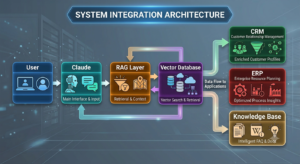
Enterprises commonly use Claude for knowledge assistants, contract analysis, technical documentation, compliance support, and RAG applications – synthesizing retrieved company knowledge into grounded, context-aware answers rather than generating from training data alone. It’s built to augment employees, not replace their judgment.
Why Enterprises Are Choosing Claude
Long-context document understanding
Legal agreements, insurance policies, and technical manuals routinely run hundreds of pages. Claude holds up well across long documents without needing them chopped into small chunks, which reduces both implementation complexity and the risk of losing context between sections.
Strong fit for RAG-powered knowledge systems
Most enterprise knowledge assistants pair a model with company data through Retrieval-Augmented Generation. Claude’s reasoning tends to synthesize retrieved passages – internal docs, policies, CRM notes, support articles – into accurate, grounded answers rather than confident-sounding guesses.
Enterprise governance and predictability
When a model touches customer records, financials, or IP, predictable behavior matters as much as capability. Anthropic’s safety-first design philosophy has made Claude a comfortable fit for governance-conscious buyers – though every enterprise deployment still needs its own review process and human oversight, regardless of vendor.
Reasoning-heavy knowledge work
Executive reporting, policy summarization, and research synthesis reward structured reasoning over flashy generation. This is where Claude models have consistently scored well against peers on independent evaluations.
A solid base for AI agents
Modern agents retrieve data, call APIs, execute multi-step workflows, and validate their own outputs. Claude’s consistency across long reasoning chains makes it a workable foundation for agent architectures where logical correctness matters more than creative flair.
Worth knowing
On June 12, 2026, Anthropic briefly suspended Claude Fable 5 and Claude Mythos 5 to comply with U.S. export controls; access was restored July 1, 2026 after the controls were lifted. It’s a reminder that frontier-model availability is now partly a policy variable, not just an engineering one worth factoring into any single-vendor architecture.
Expert Insight from Enlight Lab
Over the past two years, the executive question has changed from “which chatbot should we build?” to “which model aligns with our architecture, governance, and long-term strategy?” The most common mistake we see is teams comparing benchmark leaderboards before they’ve defined the business problem.
We treat the LLM as one layer of the solution – not the whole solution. Data quality, RAG design, orchestration, integration with existing systems, and human oversight usually matter more to long-term success than which model sits behind the API. And we rarely recommend a single model across every use case: support assistants, coding tools, and document intelligence platforms have different requirements, and a model-agnostic architecture lets you adapt as the landscape shifts – which, in 2026, it does roughly every quarter.
The Enlight Lab Enterprise LLM Selection Framework
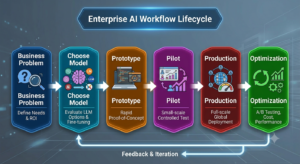
Planning an enterprise AI initiative? Our AI consulting team helps organizations evaluate models, design RAG architectures, and build production-ready AI systems. We use a structured, six-phase approach that balances technical capability against business priorities – never benchmarks alone.
Define the business objective
Are you cutting support costs, building a knowledge assistant, automating documents, or improving developer output? Different goals need different model strengths.
Deliverable: prioritized outcomes with measurable success metrics
Assess data readiness
An AI system is only as good as what it can retrieve. Audit internal docs, CRM data, knowledge bases, and security classifications before touching a model.
Deliverable: enterprise knowledge inventory
Evaluate model capabilities
Compare candidates against reasoning, context window, coding, API ecosystem, safety posture, cost, latency, and multimodal needs never rankings alone.
Deliverable: weighted capability scorecard
Build a pilot
Pick one department. Measure adoption, hallucination rate, and employee feedback before any wider rollout.
Deliverable: pilot results report
Deploy to production
Treat it like mission-critical software: authentication, monitoring, logging, human review workflows, version control, and prompt management.
Deliverable: production runbook
Optimize continuously
Models, knowledge, and business needs all evolve. Budget for ongoing prompt refinement, cost tuning, and governance review this doesn’t end at launch.
Deliverable: quarterly optimization cadence
Claude vs. GPT-5.5 vs. Gemini 3.5
As of July 2026, the three leading enterprise-relevant lineups are Anthropic’s Claude (Opus 4.8 / Sonnet 5 / Fable 5), OpenAI’s generally available flagship GPT-5.5 (with the GPT-5.6 family in restricted preview), and Google’s Gemini 3.1 Pro / 3.5 Flash, with Gemini 3.5 Pro expected to reach general availability this month. None of these leapfrogs the others on every dimension the right pick depends on the workload.
| Capability | Claude | GPT-5.5 | Gemini 3.5 |
|---|---|---|---|
| Long-document / RAG reasoning | Strong lead | Solid | Solid, largest context window at 2M tokens (Pro) |
| Agentic coding | Strong | Strong lead | Fast-improving, cost-efficient |
| Enterprise governance & predictability | Strong lead | Solid | Solid |
| Multimodal / video understanding | Solid | Strong | Strong lead |
| Google Workspace integration | Limited | Moderate | Strong lead |
| Cost-efficiency at scale | Moderate | Moderate | Strong (Flash tier) |
| Best-suited for | Knowledge assistants, RAG, document intelligence | General-purpose apps, agentic coding | Google-ecosystem productivity, multimodal, long context |
Qualitative comparison based on publicly reported capabilities as of July 2026. Model lineups shift quickly reverify before quoting exact benchmark figures or pricing.
When Claude Is and Isn’t the Right Choice
Choose Claude for
- Enterprise search & internal knowledge assistants
- Contract and legal document review
- Insurance and healthcare documentation
- Policy analysis and compliance support
- Financial reporting & research synthesis
- RAG-powered AI agents
Consider alternatives for
- Heavy multimodal / video-first products
- Deep Google Workspace-native workflows
- Consumer apps needing broad plugin ecosystems
- Codex-grade specialized coding agents
- Ultra-long-context work beyond 1M tokens today
The same trade-offs apply to voice agents
Everything above applies just as directly to AI voice agents. A support-line agent handling policy lookups and account questions benefits from Claude’s document grounding; a voice agent doing rapid multilingual triage might lean on a faster, cheaper tier. Voice, Enlight Lab’s enterprise AI voice agent platform, is built model-agnostic for exactly this reason so the reasoning layer behind your voice agents can be swapped or routed per use case as the model landscape shifts, without rebuilding the whole system.
Common Mistakes Enterprises Make
- Choosing by popularity. The most talked-about model isn’t always the best fit for your workload.
- Ignoring data readiness. No model overcomes fragmented, outdated internal knowledge.
- Assuming one model fits every use case. Support, coding, and document intelligence have different needs.
- Underestimating integration work. CRMs, ERPs, ticketing, and identity systems need planning early, not last.
- Treating deployment as the finish line. Prompts, knowledge bases, and governance need ongoing attention.
- Skipping human oversight. Regulated or customer-facing workflows still need a review path.
Industry Use Cases
| Industry | Common use cases |
|---|---|
| Healthcare | Clinical documentation, patient knowledge assistants, policy search |
| Financial services | Regulatory analysis, compliance support, internal knowledge assistants |
| Insurance | Claims documentation, underwriting support, policy search |
| Legal | Contract review, legal research, document analysis |
| Manufacturing | Technical manuals, maintenance docs, SOP search |
| HR | Policy assistants, onboarding copilots, benefits documentation |
| Software / SaaS | Engineering docs, developer copilots, support automation |
Key Takeaways
- Claude (Opus 4.8 / Sonnet 5 / Fable 5) is a strong default for knowledge assistants, RAG, and document-heavy enterprise work.
- There’s no single “best” model GPT-5.5 and Gemini 3.5 both lead in specific areas.
- Model selection should follow business objectives, not the other way around.
- Data quality, integrations, and governance usually matter more than the model choice itself.
- A flexible, model-agnostic architecture is the safest long-term bet as the landscape keeps shifting.
Not Sure Which AI Model Fits Your Business?
Choosing between Claude, GPT-5.5, Gemini, and open-source models isn’t just a technical decision. It affects security, operating costs, scalability, and long-term flexibility.
At Enlight Lab, we help organizations evaluate AI models, design enterprise architectures, implement Retrieval-Augmented Generation (RAG), and deploy production-ready AI solutions aligned with business objectives.
If you’re planning an AI initiative, our team can help you make the right architectural decisions before development begins.