The decision looks straightforward on a slide deck. It rarely is in practice.
According to McKinsey’s 2025 State of AI report, 88% of organizations now use AI in at least one business function. Yet only 12% of CEOs report achieving both revenue growth and cost reduction from those investments, per PwC’s 2026 CEO Survey of 4,454 executives. The gap between broad adoption and measurable business value is where most build-vs-buy decisions go wrong.
One of the most common mistakes we see is organizations choosing between custom and off-the-shelf based on ambition rather than evidence. A leadership team hears about an impressive competitor deployment and decides to build from scratch, without first validating whether a vendor solution could solve the same problem in eight weeks instead of eighteen months. The reverse also happens: companies buy an off-the-shelf platform and spend $300K customizing it to fit workflows the vendor never designed it for.
This guide gives you a structured way to make this decision based on your data, your team, your timeline, and your compliance requirements, not based on what worked at a company with different constraints.
What Are Off-the-Shelf AI Tools?
Off-the-shelf AI tools are pre-built software products that deliver AI capabilities through a subscription or licensing model. They are designed to serve common enterprise use cases without requiring the buyer to train models, build infrastructure, or maintain machine learning pipelines.
Common examples include Microsoft 365 Copilot for productivity and document workflows, Salesforce Einstein for CRM intelligence and sales automation, ServiceNow AI for IT service management, and platforms like Zendesk AI and Intercom for customer support automation. At the infrastructure layer, Azure AI, AWS Bedrock, and Google Vertex provide foundation model access with managed deployment environments.
These tools share three defining characteristics. First, deployment is fast: most production deployments complete within four to twelve weeks for standard use cases. Second, the vendor manages model updates, security patches, and infrastructure scaling. Third, pricing is predictable, typically seat-based or usage-based subscriptions ranging from $20K to $200K per year for comparable enterprise scope, according to cost benchmarks published by Technobrave in 2026.
The trade-off is customization. Off-the-shelf tools are designed for breadth, not depth. They serve horizontal use cases well. They struggle when your workflows require more than 30% custom configuration, when your data cannot leave your security perimeter, or when the vendor’s generic model misses domain-specific patterns that your business depends on.
What Are Custom AI Agents?
Custom AI agents are AI systems built specifically for your organization’s workflows, data, and technical environment. Unlike off-the-shelf tools, custom agents are designed from the ground up around your proprietary data, your internal systems, and your business logic.
A custom AI agent might handle multi-step insurance claims processing by integrating with your policy management system, your claims database, and your compliance documentation. A generic tool cannot replicate that because it does not have access to your proprietary data, and your process logic cannot be adequately expressed through a vendor’s configuration interface.
Custom AI agents can be built on foundation models including OpenAI’s GPT series, Anthropic’s Claude, Google’s Gemini, Meta’s Llama, and Mistral, depending on which model best fits the specific workload. The choice of underlying model matters less than the architecture surrounding it: the retrieval system, the enterprise integrations, the governance layer, and the monitoring infrastructure.
Building custom is not the same as training from scratch. Most successful enterprise custom AI agents use foundation models via API, then layer proprietary data, retrieval pipelines, custom business logic, and system integrations on top. This approach delivers 80% of the benefit of full custom training at 20% of the cost and timeline.
Custom AI agent development costs range from $150K for a focused single-workflow agent to $5M or more for a full enterprise-grade platform, based on 2026 cost benchmarks from Technobrave. Timeline runs from nine months to twenty-four months from kickoff to production.
Custom AI Agents vs Off-the-Shelf AI Tools: Side-by-Side Comparison
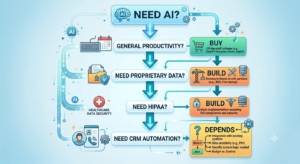
| Dimension | Off-the-Shelf AI Tools | Custom AI Agents | Hybrid Approach |
|---|---|---|---|
| Time to first value | 4-12 weeks | 9-24 months | 6-14 weeks (then extend) |
| Upfront cost | $20K-$200K/year | $150K-$5M+ | $50K-$500K |
| Customization ceiling | Limited by vendor roadmap | Unlimited | Moderate to high |
| Data privacy control | Shared responsibility | Full ownership | Configurable |
| Compliance suitability | Standard compliance | HIPAA, GDPR, SOC 2, ISO 27001, PCI DSS | Configurable by layer |
| Maintenance burden | Vendor-managed | Internal team required | Shared |
| Competitive moat | None (shared with peers) | High, if unique data exists | Moderate |
| AI model flexibility | Vendor-determined | GPT, Claude, Gemini, Llama, Mistral | Configurable |
| CRM/ERP integration depth | API-level | Deep coupling possible | Varies |
| Vendor lock-in risk | High | None | Moderate |
| Best for | Validated use cases, fast ROI | Proprietary data, regulated industries | Most enterprise scenarios |
When Should You Choose Off-the-Shelf AI Tools?
Off-the-shelf AI tools are the right starting point in specific, identifiable conditions. Choose them when the problem is horizontal rather than vertical, the use case is well-covered by mature vendors, your team lacks ML engineering depth, and speed to value is more important than differentiation.
The data is clear on the risk reduction argument. Companies that piloted a buy-first approach before committing to custom AI development reported 3.2x higher ROI, according to Forrester’s 2026 research. Enterprises that rushed into custom builds without first validating the use case with a vendor proof-of-concept wasted an average of fourteen months and $780K in sunk costs, per Gartner’s 2025 analysis.
Choose off-the-shelf AI tools when:
-
- The use case is common: email classification, document summarization, customer support FAQ handling, sales pipeline scoring, HR candidate screening
-
- Your team has no ML engineers who can maintain a custom model in production
-
- You need results within a quarter, not within a year
-
- The vendor’s model accuracy is within 5% of what a custom build would achieve (which is true for most horizontal use cases)
-
- You are a startup or early-stage company where capital efficiency matters more than differentiation
One misconception worth addressing directly: buying off-the-shelf does not mean avoiding customization costs entirely. Gartner’s 2025 data found that 72% of enterprises that purchased pre-built AI solutions required significant customization within the first year. Integration engineering alone, connecting the tool to your existing CRM, ERP, or HRMS, often costs as much as the license itself.
When Should You Invest in Custom AI Agents?
Custom AI agent development makes financial and strategic sense under a specific set of conditions. One or two of these factors is not enough. The case for building strengthens as multiple conditions apply simultaneously.
Build custom AI agents when:
-
- Your training data is proprietary and genuinely scarce: clinical trial records, decades of industrial sensor readings, unique customer behavioral sequences, or proprietary financial models that no vendor can replicate
-
- Your workflow requires more than 60% customization of any off-the-shelf platform, meaning you are effectively rebuilding it anyway
-
- Regulatory requirements demand on-premise inference: healthcare, defense, and financial services organizations frequently need inference to happen on controlled infrastructure that no SaaS vendor can provide
-
- Deep system integration is non-negotiable: your process requires tight coupling to internal ERP, SCADA, MES, or legacy systems where API-level integration creates unacceptable latency or data loss
-
- A competitor using the same SaaS vendor would reach feature parity with you, eliminating your differentiation
The cost math requires honest accounting. A custom AI agent built for factory floor quality control runs $400K to $1.2M for a production-ready deployment. If that system reduces scrap rates by 3% on a $50M annual production line, the investment recoups within ten months, according to an example detailed in KGT Solutions’ 2026 build vs buy framework. The financial case exists. It requires specific conditions to hold.
What does not justify custom AI agent development: a leadership team building because competitors are, because the board asked about AI strategy, or because a proof-of-concept demo generated internal excitement. Those are the scenarios where $700K gets spent on systems that never leave staging.
Cost Comparison: What Realistic Enterprise AI Pricing Looks Like in 2026
Most build-vs-buy cost comparisons omit the hidden costs that determine whether the decision actually paid off. BCG’s 2025 enterprise AI spending analysis found that organizations underestimate total AI project costs by an average of 40%.
Off-the-shelf AI tool costs:
| Cost Category | Typical Range |
|---|---|
| Annual license/subscription | $20K-$200K/year |
| Integration engineering | $100K-$400K (vendor professional services) |
| Internal training and change management | $30K-$80K (underestimated by 60% of teams) |
| Usage-based pricing escalation | 2-5x growth as adoption scales |
| Total Year 1 budget (realistic) | 2-3x the license cost |
Custom AI agent development costs:
| Cost Category | Typical Range |
|---|---|
| Development and deployment | $150K-$5M+ |
| Data labeling and annotation | $50K-$150K |
| MLOps infrastructure (versioning, monitoring, A/B testing) | $80K-$200K/year |
| Model retraining cycles | Recurring every 3-6 months |
| Engineering opportunity cost | Highest risk factor (hardest to quantify) |
The three-year total cost of ownership often converges between the two approaches. Custom builds carry high upfront capital costs but lower ongoing variable costs. Off-the-shelf tools carry lower upfront costs but scale faster in pricing as adoption grows, and customization fees close the gap quickly.
Calculate the three-year TCO for both options before deciding. If the difference is less than 30% of projected revenue impact, the custom build may be worth pursuing. If it is more, start with a vendor solution and build selectively where proprietary data creates a genuine advantage.
Security and Compliance: What Changes When You Build vs Buy
Security is where the build-vs-buy decision has the most asymmetric consequences. Gartner’s 2025 survey of IT application leaders found that 74% view AI agents as a new attack vector, and only 13% strongly agree their organization has the governance structures needed to manage them effectively.
Off-the-shelf tool compliance considerations:
Most major vendors support SOC 2 Type II and ISO 27001 as baseline certifications. HIPAA compliance is available through Business Associate Agreements with select vendors. GDPR data residency controls vary significantly by vendor and region. The risk is shared responsibility: you depend on the vendor’s security posture, and your data may flow through infrastructure you cannot audit.
Custom AI agent compliance capabilities:
Custom agents can be designed to meet HIPAA, GDPR, SOC 2, ISO 27001, and PCI DSS from the ground up. On-premise inference keeps sensitive data entirely within your security perimeter. Role-based access controls, audit logging, encryption at rest and in transit, and prompt injection protections can be built to your exact specifications.
The compliance requirement alone frequently determines the correct path in regulated industries. A healthcare organization processing protected health information cannot route that data through a third-party vendor’s infrastructure without a compliant architecture and a verified BAA. A financial institution handling non-public client information has similar constraints.
Build compliance into Phase 1. Retrofitting security and governance after deployment is consistently more expensive and less complete than designing for it from the start. This holds for both off-the-shelf configurations and custom builds.
Integration Capabilities: How Deep Does the Connection Need to Be?
Integration depth is the second most common factor that forces organizations toward custom development when they expected to buy.
Off-the-shelf tools connect to common enterprise software through pre-built connectors. Salesforce Einstein integrates natively with Salesforce CRM. Microsoft 365 Copilot integrates deeply with the Microsoft ecosystem. ServiceNow AI connects directly to ServiceNow workflows. These integrations are fast and reliable when you operate within those ecosystems.
The problem surfaces when your workflow requires data from multiple disconnected systems: a proprietary ERP that predates REST APIs, a legacy HRMS with no webhook support, an internal ticketing system built on custom infrastructure, or enterprise knowledge bases stored across SharePoint, Confluence, and a network of department-specific file systems.
Custom AI agents can be built with direct system integrations to any platform that exposes data in any format: SQL databases, legacy flat files, internal APIs, SCADA systems, and proprietary data warehouses. Each integration adds development time and maintenance overhead, but it also makes the agent genuinely useful in ways that an API-level connection cannot match.
A practical test: if your RFP requires more than 30% custom configuration from a vendor, you are no longer buying a product. You are building one with extra steps.
AI Model Flexibility: Why Vendor Lock-In Matters More Than Model Quality
Off-the-shelf tools are built on models chosen by the vendor. Microsoft 365 Copilot uses Microsoft’s Azure OpenAI deployment. Salesforce Einstein uses Salesforce’s internally trained and curated models. You do not choose the model, and you cannot switch it when a better option emerges.
Custom AI agents are model-agnostic by design. The most effective enterprise architectures select different models for different tasks within the same system. A custom agent might route complex document analysis to Claude Opus, high-volume classification queries to Claude Haiku or Llama, and multimodal tasks involving images to GPT-4o or Gemini. This architecture reduces costs by 40 to 70% compared to routing every query through the most capable model, while maintaining quality where it matters most.
The models available in 2026 include OpenAI’s GPT-4o and o3 series, Anthropic’s Claude 3.5 and Claude 4 family, Google’s Gemini 2.5, Meta’s Llama 4, and Mistral’s enterprise models. Each has different strengths. Claude excels at long-document reasoning and enterprise knowledge systems. GPT-4o leads in multimodal workflows and coding. Gemini performs best within Google Workspace environments.
The right architecture does not commit to one model provider. AI capabilities and pricing shift faster than most enterprise software cycles. An agent built on a single vendor’s model today may require significant rework in eighteen months when pricing changes or a superior model becomes available.
Scalability Considerations: Where Each Approach Breaks Down
Both approaches have predictable failure modes at scale. Understanding them in advance prevents expensive surprises.
Where off-the-shelf tools break at scale:
Usage-based pricing models escalate faster than most procurement teams forecast. A tool that costs $50K annually at 500 users may cost $400K at 4,000 users, with no corresponding improvement in capability. Customization limitations become more painful as your use case evolves. Vendor roadmap decisions about which features to prioritize are made without your specific needs in mind.
Where custom AI agents break at scale:
ML engineering talent is scarce and expensive. The same team that builds a focused single-workflow agent often struggles to maintain six agents while building three more. Model retraining cycles, monitoring infrastructure, and data pipeline maintenance compound over time. Without a dedicated MLOps function, custom agents degrade in quality as the underlying data distributions shift.
The scalability answer for most enterprises is a hybrid model. Gartner projects that 40% of enterprise applications will embed task-specific AI agents by end of 2026. The organizations capturing that value will not have built everything from scratch. They will have bought horizontal capabilities from vendors and built custom intelligence for the workflows where proprietary data creates a competitive advantage.
Real-World Enterprise Examples: How Different Industries Make This Decision
Healthcare: A regional hospital network cannot route patient records through a third-party vendor’s infrastructure. They build a custom RAG-based clinical decision support agent trained on their own patient outcome data and clinical protocols, deployed on their own infrastructure, meeting HIPAA requirements by design. An off-the-shelf tool was evaluated and rejected because it required PHI to leave the security perimeter.
Financial services: A mid-sized asset management firm uses Microsoft 365 Copilot for standard productivity tasks: summarizing meeting notes, drafting internal communications, and searching internal documents. For portfolio risk analysis, they built a custom agent trained on their proprietary trading data and connected to their internal risk systems. The horizontal use case went to a vendor. The differentiated use case was built.
Manufacturing: A $50M annual production line implements a custom computer vision agent trained on proprietary defect image data. The platform vendor’s generic model detected 58% of defects. After building a custom intelligence layer for $280K on top of a standard IoT monitoring platform, detection accuracy reached 94%, according to KGT Solutions’ 2026 case analysis.
Retail: A large e-commerce retailer deploys Salesforce Einstein for standard CRM automation and customer segmentation. For personalized recommendation logic based on twelve years of proprietary purchase behavior data, they built a custom recommendation agent. Generic vendor models were tested and found to be within 5% accuracy for segmentation, justifying the buy. For recommendations, proprietary data created a 23% lift in conversion that no vendor model could replicate.
Customer support: A SaaS company with a standard support workflow deploys Zendesk AI for ticket classification and FAQ handling. They do not build custom. The vendor model handles 70% of support volume without customization. The remaining 30% escalates to human agents through automated routing. Time to value: eight weeks.
The pattern across all these examples is consistent. Horizontal use cases with standard data go to vendors. Workflows dependent on proprietary data, deep system integration, or strict compliance requirements get built.