
Technical leadership is one of the most decisive – and most overlooked – factors in whether a startup ships a viable product, raises funding, and scales without collapsing under its own technical debt. Startups with strong technical leadership tend to ship MVPs faster, come across better to investors, and build systems that hold up under growth. Startups without it often end up rebuilding the same product two or three times before running out of runway.
Most founders spend their early energy on the wrong decisions. They debate the “right” tech stack for weeks, interview full-time engineers before they need one, or build features nobody’s asked for yet. Meanwhile, the question that actually determines whether any of that effort compounds or collapses goes unanswered: who is leading the technical direction of this company?
A startup without technical leadership isn’t just under-resourced – it’s directionally blind. Decisions that should take hours take weeks. Architecture choices made in month two quietly become expensive constraints by month twelve. Engineers build in isolation instead of toward a shared system. And when a Series A investor asks how the platform scales to ten times current load, nobody has a confident answer.
This guide covers what technical leadership actually means for a startup, why it matters at every stage, what tends to go wrong without it, and how to get it right – whether you’re pre-revenue or heading into a growth round.
What Is Technical Leadership in a Startup Context?
Technical leadership is the function responsible for setting technology strategy, making architecture decisions, managing engineering quality, and aligning product development with business goals. It’s not the same as engineering management, and it isn’t simply a synonym for “the best developer on the team.”
It covers three distinct responsibilities:
Strategic – choosing the technology roadmap, defining the architecture, and making build-vs-buy calls that match business goals and funding timelines.
Operational – making sure engineers are working effectively, code quality holds up, and delivery timelines are realistic and met.
Commercial – translating technical capability into language investors, customers, and boards actually understand, and building systems that support revenue rather than obstruct it.
Strong technical leaders do all three. Most developers, however talented, are trained for none of them – which is exactly why the two roles get confused so often.
Why Technical Leadership Matters
Startups that establish technical leadership early ship products faster, accumulate less technical debt, and tend to raise at better terms. Startups that skip it often spend a disproportionate share of their time fixing preventable problems instead of building toward the next milestone.
Product-market fit gets most of the attention when people talk about why startups fail, but a quieter, secondary cause shows up just as often in practice: technical dysfunction – missed deadlines, rebuilt systems, engineering teams without a shared direction. Technical leadership is the function that heads off the technical causes of failure before they compound.
Here’s what tends to change when a startup has strong technical leadership in place:
- Architecture decisions get made once, with the next twelve months in mind, rather than reactively patched every sprint
- Engineering hiring is guided by real technical judgment, not keyword matching
- Investors see a coherent technology strategy during due diligence, not an improvised one
- Product velocity increases because engineers have clarity instead of ambiguity
- Security and compliance get designed in from the start, not retrofitted at a much higher cost later
One pattern shows up consistently in failed startup engineering efforts: teams that moved fast without technical leadership hit a wall around Series A – not because the product idea was wrong, but because the codebase couldn’t support growth, and no one had the authority or context to fix it systematically.
Technical Leadership vs. Engineering Management
Technical leadership focuses on strategy, architecture, and product direction. Engineering management focuses on people, process, and delivery execution. Both matter at scale, but for early-stage startups, technical leadership tends to have the higher return.
| Dimension | Technical Leader | Engineering Manager |
|---|---|---|
| Primary focus | Architecture and strategy | Team performance and delivery |
| Time horizon | 12–24 months | Current sprint to next quarter |
| Key decisions | Tech stack, system design, platform choices | Hiring, process, sprint planning |
| Relationship to code | Deep involvement in critical design | Decreasing involvement over time |
| Relationship to business | Translates business goals into technical direction | Translates technical output into stakeholder updates |
| Common title | CTO, VP Engineering, Tech Lead | Engineering Manager, Head of Engineering |
Most startups under twenty engineers don’t need both roles filled separately. They need technical leadership first and engineering management second and the cost of reversing that priority tends to show up later, in rebuilt systems and wasted sprints.
Founder vs. CTO: Who Owns What?
The founder sets the vision and business direction. The CTO – or whoever is playing that role – owns the technical strategy and architecture needed to deliver on it. When one person tries to do both indefinitely, neither job gets done well.
| Responsibility | Founder | CTO / Technical Leader |
|---|---|---|
| Company vision and mission | ✅ | ❌ |
| Investor relations | ✅ | Supports (technical due diligence) |
| Product roadmap | Collaborates | Collaborates |
| Technology strategy | ❌ | ✅ |
| Software architecture | ❌ | ✅ |
| Engineering hiring | Final decision | Leads assessment |
| Technical risk management | ❌ | ✅ |
| Vendor and partner evaluation | ❌ | ✅ |
Non-technical founders who take on CTO responsibilities out of necessity aren’t making a strategic choice – they’re making a survival move. The key is recognizing when that period should end, before the decisions made under pressure harden into permanent constraints.
Technical Leadership Across Startup Stages
The kind of technical leadership a startup needs shifts at every funding stage. Pre-seed calls for strategic clarity. Seed calls for the right architectural bets. Series A calls for systems that can actually scale. Series B and growth call for something closer to institutional engineering governance.
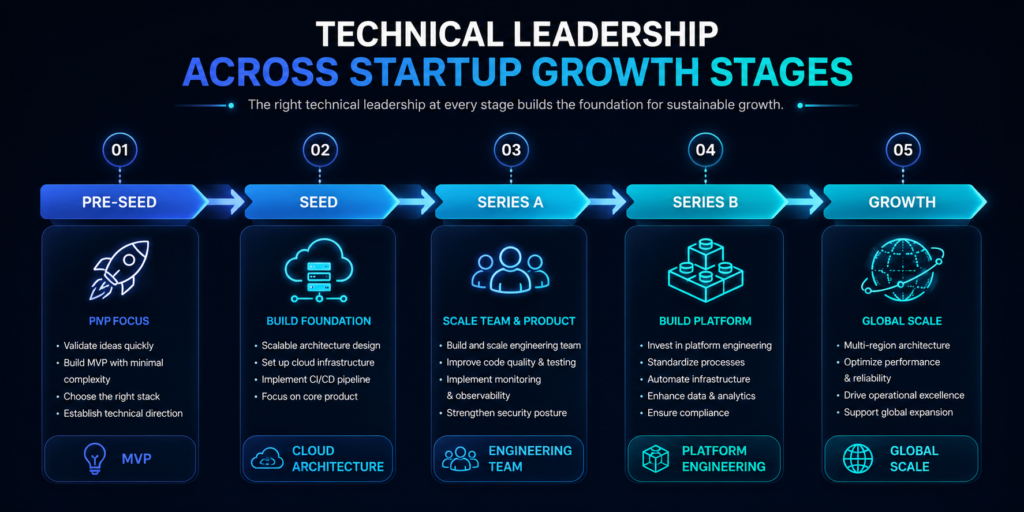
Pre-Seed: Validate Before You Build At pre-seed, the most important technical decision usually isn’t what to build – it’s whether to build at all yet, or whether a no-code prototype can validate the assumption first. Technical leadership here means scoping the MVP tightly, choosing a stack that matches available talent, and making sure the first version can ship without a six-month build cycle.
Technical needs: MVP scoping, tech stack selection, basic architecture, early security decisions.
Seed: Build the Foundation Right This is the stage where architecture decisions carry the longest consequences. A system designed for a hundred users won’t scale to a hundred thousand without real rework. Good technical leadership at seed means designing a foundation that holds under growth – not gold-plated, just not brittle.
Technical needs: scalable architecture, CI/CD pipeline, cloud infrastructure, engineering hiring plan.
Series A: Scale the System and the Team By Series A, investors expect a credible engineering organization, not just a product demo. Technical leadership shifts toward building process, managing a growing team, and making sure the product can actually support the growth targets in the fundraise narrative.
Technical needs: engineering team structure, performance optimization, observability and monitoring, security audits.
Series B: Institutional Engineering Series B companies aren’t really startups in the operational sense anymore. Technical leadership starts to resemble enterprise engineering governance: platform thinking, multiple engineering teams, compliance requirements, more serious data infrastructure.
Technical needs: platform architecture, data engineering, compliance (SOC 2, HIPAA, GDPR depending on industry), multi-team coordination.
Growth Stage: Reliability at Scale At growth stage, the job is reliability, not velocity. The main risk isn’t failing to ship new features — it’s the existing system failing under load. Technical leadership here means SRE practices, disaster recovery planning, and infrastructure built to support aggressive growth without instability.
Technical needs: site reliability engineering, infrastructure automation, advanced observability, global scalability planning.
The Startup Technology Maturity Model
Startups tend to move through five technology maturity levels. Most failures happen when a company tries to skip one.
- Level 1 – Prototype: manual processes, no automation, minimal infrastructure. Fine for validation only.
- Level 2 – Foundation: basic cloud infrastructure, version control, automated testing, a single deployment pipeline. Fine for early customers.
- Level 3 – Scalable Product: multi-environment setup, monitoring and alerting, structured engineering process, documented architecture. Fine for post-seed growth.
- Level 4 – Platform: microservices or modular monolith, dedicated infrastructure team, security certifications, data pipelines. Fits Series A and beyond.
- Level 5 – Enterprise Grade: multi-region infrastructure, advanced compliance, platform engineering, robust SRE practices. Fits growth-stage and enterprise expansion.
Technical leadership accelerates a startup through these levels in order. Jumping from Level 1 straight to Level 4 tends to produce systems that collapse under their own ambiguity.
The Biggest Technical Leadership Mistakes Startups Make
Hiring engineers before defining the architecture. Engineers can only build what they’re pointed at. Without someone defining the system design first, individual engineers make decisions that don’t add up to a coherent whole – and the result is a codebase held together by tribal knowledge rather than design.
Choosing technology to impress investors rather than to ship product. Microservices, Kubernetes, real-time distributed systems – legitimate at scale, but a distraction for a five-person startup building its first product. Good technical leadership means choosing the right complexity for the current stage, not the most impressive option on the table.
Treating technical debt as a future problem. It isn’t – it’s a present liability that accrues interest in the form of slower delivery, more bugs, and higher developer turnover. Startups that put off the technical debt conversation until it becomes a crisis usually end up spending far longer resolving it than they would have if they’d addressed it continuously.
Conflating a great developer with a technical leader. The best engineer on a team isn’t automatically the right person to lead it. Leadership takes communication, strategic judgment, cross-functional collaboration, and comfort with ambiguity – distinct skills that don’t come bundled with technical depth.
The Technical Debt Risk Framework
Technical debt isn’t one thing. It breaks down into four types, each with a different risk profile.
| Debt Type | Cause | Risk Level | Resolution Approach |
|---|---|---|---|
| Intentional short-term debt | Speed-to-market tradeoffs with a plan to resolve | Low | Scheduled refactoring cycles |
| Unintentional architectural debt | Poor design decisions made without technical leadership | High | Architectural review and phased refactoring |
| Knowledge debt | Critical system understanding held by one or two engineers | Critical | Documentation, pairing, structured knowledge transfer |
| Security debt | Security controls deferred or skipped | Critical | Immediate audit and remediation |
Most startup technical debt falls into the “unintentional architectural” category – not the result of a conscious tradeoff, but of decisions made without the context to know they’d matter later. This is the category technical leadership is specifically built to prevent.
Signs Your Startup Needs Technical Leadership Now
Your startup probably needs it if engineers are making architecture decisions independently, delivery timelines are consistently missed without a clear reason, investor due diligence has surfaced technical concerns, or the team keeps rebuilding features that were already shipped.
A few more warning signs worth taking seriously:
- No one can describe the system architecture on a single diagram
- Onboarding a new engineer takes more than two weeks
- Security questions from enterprise customers go unanswered
- The product roadmap keeps shifting because technical constraints weren’t surfaced early enough
- Your most experienced engineer is thinking about leaving
Each of these points back to the same root problem: the technical function of the company is running without anyone actually leading it.
The 5 Pillars of Startup Technical Leadership
Pillar 1 – Technology Strategy. A documented, time-bound roadmap tied to business milestones. Without one, engineers end up optimizing locally instead of for the system as a whole.
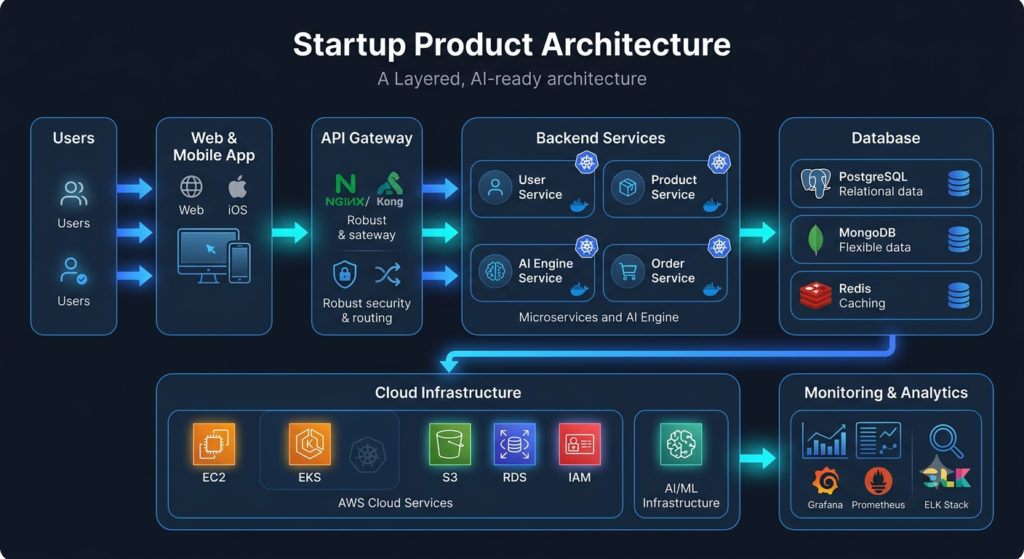
Pillar 2 – Software Architecture. Deliberate decisions that account for current scale, expected growth, and team capability. Architecture built with tomorrow’s scale in mind is what prevents the rebuilds that kill momentum.
Pillar 3 – Engineering Quality. Defined standards for code review, test coverage, documentation, and deployment. Quality isn’t a nice-to-have here — it’s the compounding asset that makes future velocity possible at all.
Pillar 4 – Product-Technology Alignment. Regular, real communication between product and engineering so what gets built actually reflects what the business needs. Misalignment here is behind most wasted engineering effort.
Pillar 5 – Risk and Security Management. Proactively identifying and managing technical, security, and compliance risk. In healthcare, fintech, and AI especially, a single unmanaged risk can end the company.
Benefits of a Fractional CTO for Startups
A fractional CTO gives a startup access to senior technical leadership — architecture, strategy, investor support, team oversight — at a fraction of what a full-time hire costs. For pre-seed and seed-stage companies, this is often the highest-leverage technical investment available.
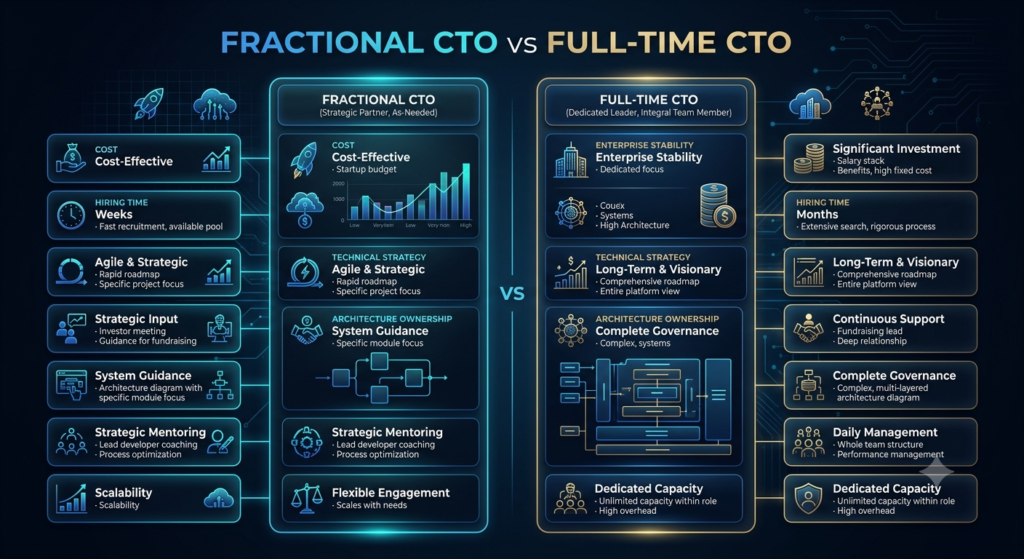
| Dimension | In-House CTO | Fractional CTO | Development Agency |
|---|---|---|---|
| Cost | $180,000–$350,000/year salary + equity | $8,000–$25,000/month | Project-based, variable |
| Time to start | 3–6 months hiring cycle | 1–2 weeks | 2–4 weeks |
| Strategic alignment | Full alignment over time | Partial, relationship-dependent | Limited |
| Architecture ownership | Full | Shared | Typically none |
| Investor credibility | High | Moderate–High | Low |
| Code delivery | No | No | Yes |
| Ideal stage | Series A+ | Pre-seed to Series A | Execution without leadership |
A fractional CTO isn’t a compromise – for a startup that can’t yet justify a $250,000 salary but still needs real technical judgment, it’s the strategic layer that keeps engineering pointed in the right direction.
Enlight Lab’s CTO as a Service is built around exactly this: senior technical leadership embedded into your business without the overhead of a full-time executive hire.
CTO as a Service: What It Covers and Who It’s For
CTO as a Service provides on-demand technical leadership – architecture review, technology strategy, engineering team oversight, and investor due diligence support – on a fractional or project basis. It’s designed for startups that need senior technical judgment without a permanent executive hire.
It typically covers:
- Technology roadmap development – a structured 12–18 month plan aligning technical decisions to business milestones
- Architecture review and design – assessing existing systems and designing what comes next
- Engineering team oversight – sprint reviews, quality standards, hiring assessment support
- Vendor and partner evaluation – an objective read on development agencies, tooling, and third-party services
- Investor preparation – technical narrative for fundraising, due diligence support, technical data room prep
It’s the right fit when a startup has funding to build but not enough runway to justify a senior full-time hire, when a non-technical founder is managing an engineering team solo, or when investor due diligence has already surfaced a credibility gap.
The Founder-to-CTO Decision Matrix
| Situation | Recommended Action |
|---|---|
| Non-technical founder, pre-product, limited budget | Hire a fractional CTO before hiring any engineers |
| Technical founder, strong architectural background | Act as CTO through pre-seed, hire a VP Engineering at Series A |
| Technical founder, weak management experience | Stay as technical lead, hire an Engineering Manager early |
| Non-technical founder, seed funded, team of 3–5 engineers | Engage CTO as a Service immediately |
| Series A, no technical executive | Hire a full-time CTO as your first executive hire |
| Technical co-founder departure | Engage a fractional CTO to cover the gap, run a structured CTO search |
The most expensive mistake in this table is non-technical founders managing engineers with no technical leadership support at all. Developers working without a technical authority make dozens of small decisions every week – and without alignment, those decisions quietly pull the product in different directions.
How Technical Leadership Reduces Startup Costs
Strong technical leadership lowers startup costs by preventing expensive rebuilds, cutting down on developer rework, improving hiring decisions, and keeping cloud and infrastructure spend in check from the start rather than auditing it after it’s already bloated.
The cost of poor technical leadership rarely shows up as one line item. It accumulates across:
- Rework – features built twice because requirements weren’t technically validated before development
- Rebuilds – systems redesigned from scratch because the original architecture couldn’t support growth
- Inefficient cloud spend – infrastructure configured without optimization, often running well above what’s necessary
- Bad hires – engineers brought on for the wrong skills or seniority level with no technical authority to assess them
- Security incidents – vulnerabilities introduced early and caught late, when remediation is far more expensive
Architectural decisions are consistently one of the highest-leverage points for controlling engineering cost over time — which is exactly the terrain technical leadership is responsible for.
How Technical Leadership Improves Product Quality
| Without Technical Leadership | With Technical Leadership |
|---|---|
| Ad hoc code review with no standards | Structured review process with documented standards |
| Testing done manually before releases | Automated testing integrated into every deployment |
| No monitoring until something breaks | Observability and alerting configured from day one |
| Security addressed reactively | Security built into architecture and deployment pipeline |
| Performance issues discovered by customers | Performance benchmarks established and monitored proactively |
| Documentation nonexistent or outdated | Documentation maintained as a required artifact, not an afterthought |
Product quality is really a technical leadership outcome more than a purely engineering one. Engineers implement standards; technical leadership is what defines and enforces them in the first place.
How Technical Leadership Speeds Up MVP Development
Technical leadership speeds up MVP development by scoping the build correctly, preventing over-engineering, choosing tools suited to fast iteration, and removing the ambiguity that causes engineers to slow down and ask questions a technical authority should have answered upfront.
The fastest MVPs aren’t built by the largest teams – they’re built by teams with the clearest direction.
A well-led MVP process usually looks something like:
Startup Idea → Technical Strategy → Architecture Decision → Stack Selection → Development → Testing → Launch → Post-Launch Iteration
Every arrow in that chain represents a decision that can stall the effort or push it forward. Technical leadership owns the decision at every arrow.
At Enlight Lab, MVPs are typically delivered in eight to twelve weeks – not because the team moves recklessly fast, but because technical leadership removes the ambiguity and context-switching that otherwise turn three-week tasks into three-month delays.
How Technical Leadership Helps Startups Raise Funding
Investors treat technical risk as a real dimension of startup viability, not an afterthought. A startup with credible technical leadership – documented architecture, a clear roadmap, a competent technical authority in the room — tends to command better valuations and move through due diligence faster than one without.
A common reason promising startups struggle to close a round is a technical credibility gap that only surfaces during diligence, once investors start asking specific architecture and scaling questions. If no one can answer authoritatively, the round slows down – or stalls.
Technical leadership supports fundraising in a few concrete ways:
- Investor-ready architecture documentation – clear diagrams and rationale for technical decisions
- A technology roadmap aligned to growth targets – evidence the technical plan actually supports the business narrative
- Security and compliance readiness – proof the platform can serve enterprise customers without exposing the company to liability
- Honest risk assessment – investors generally trust founders who acknowledge technical risk more than those who deny having any
Technical Leadership in AI Startups
AI startups need software architecture with specific expertise in machine learning systems, data infrastructure, model evaluation, and AI governance – areas where general software architecture judgment alone isn’t enough, and where mistakes get expensive fast.
AI development introduces risks that don’t really exist in traditional software:
- Model selection without evaluation frameworks – picking a foundation model based on benchmark scores rather than workload-specific testing tends to produce systems that shine in demos and disappoint in production
- Data infrastructure neglected in favor of model sophistication – poor data pipelines produce poor outputs no matter how good the model is
- Governance and compliance gaps – AI systems in regulated industries need oversight most early engineering teams simply aren’t set up to design
Technical leadership in AI startups needs to include real competence in data engineering, model evaluation, RAG architecture for knowledge-intensive applications, and AI risk management. Enlight Lab’s AI Development Services are built around exactly this combination of startup CTO and AI engineering expertise.
Technical Leadership in Healthcare Startups
Healthcare startups need technical leadership that understands HIPAA compliance, HL7/FHIR standards, clinical workflow integration, and the security demands of handling protected health information – from day one, not after the first enterprise customer asks about it.
Healthcare software isn’t general software with a compliance layer bolted on afterward. HIPAA shapes architecture, data storage, access control, audit logging, and vendor selection from the earliest technical decisions onward.
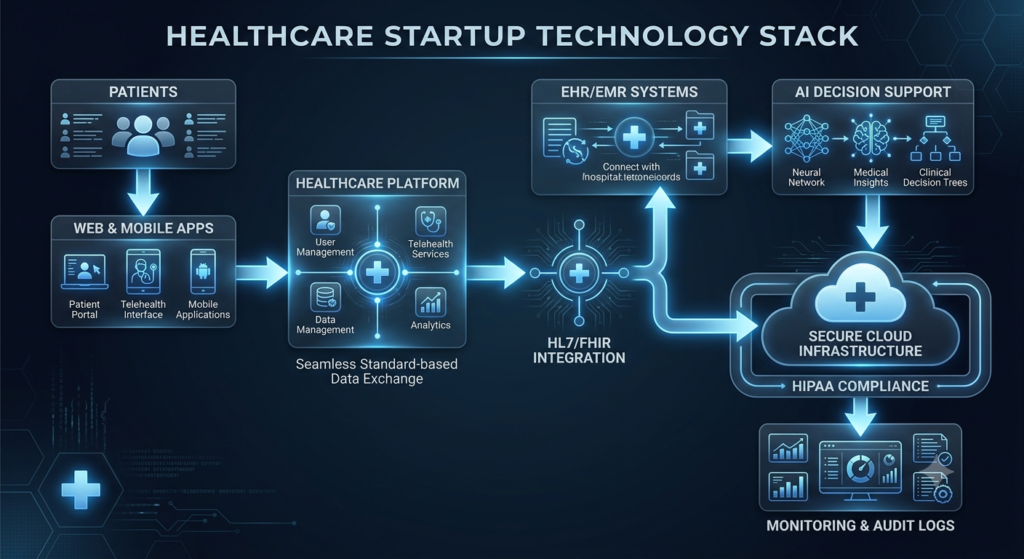
Technical leadership in this space needs to:
- Design for HIPAA from the initial architecture, not retrofit it later
- Evaluate every third-party vendor for BAA (Business Associate Agreement) compliance
- Implement audit logging for all PHI access starting at launch
- Define data retention and deletion policies before any patient data is stored
Enlight Lab’s Healthcare Software Development practice is built around technical leaders who treat these as structural constraints, not a compliance checklist to work through later.
Technical Leadership in FinTech Startups
FinTech startups need technical leadership fluent in financial data security, PCI-DSS compliance, banking API integration, and the fraud and risk systems that protect both the business and its customers.
FinTech is one of the highest-stakes environments in startup development. Architectural decisions that introduce security vulnerabilities or compliance gaps can lead to regulatory action, customer loss, and reputational damage that no amount of later engineering work can undo.
Technical leadership here needs to address:
- PCI-DSS compliance for any cardholder data processing
- Encryption and tokenization standards for financial data at rest and in transit
- Fraud detection architecture designed into the platform, not bolted on afterward
- Integration with payment processors, banking APIs, and financial data providers through secure, auditable patterns
- Incident response planning specific to financial data breaches
startup architecture is what makes sure these requirements get designed into the system from the start, rather than discovered during a security audit or a regulatory review.
The Technical Leadership Framework: A Step-by-Step Roadmap
Step 1 – Establish Technical Authority. Define who owns technical decisions — a co-founder with a technical background, a fractional CTO, or a senior technical hire. This has to be explicit, not assumed.
Step 2 – Document the Current State. Audit existing systems, codebases, infrastructure, and past technical decisions. You can’t improve what you haven’t mapped.
Step 3 – Define the Technology Strategy. Put together a twelve-month roadmap aligned to business milestones, including architecture decisions, infrastructure choices, hiring targets, and key risk items.
Step 4 – Establish Engineering Standards. Define code review process, testing requirements, deployment procedures, and documentation standards. Publish them. Actually enforce them.
Step 5 – Align Technical Roadmap to Product Roadmap. Make sure technical capacity and product ambition are calibrated together – most missed deadlines trace back to product roadmaps built without technical input.
Step 6 – Implement Monitoring and Observability. You can’t manage what you can’t measure. Put application monitoring, error tracking, performance benchmarks, and cost visibility in place from the first production deployment.
Step 7 – Review and Adapt Quarterly. Technology strategy isn’t a document you write once – it’s a living plan you update as business conditions, team capability, and market requirements shift.
Startup Technical Leadership Checklists
MVP Readiness
- MVP scope defined and agreed on by product and engineering
- Tech stack chosen for team capability and delivery speed, not trend
- Architecture documented at a high level before development begins
- Cloud environment configured with staging and production separation
- Basic automated testing in place before first user-facing release
- Error tracking and logging configured from day one
- Security basics covered: HTTPS, authentication, input validation
Technical Leadership
- Technical authority explicitly defined (CTO, fractional CTO, or technical co-founder)
- Technology roadmap exists and is aligned to business milestones
- Architecture decisions documented with rationale
- Engineering standards defined and published
- Code review process active and consistent
- Security assessment completed and risks documented
- Technical debt inventory maintained and prioritized
Hiring for Technical Roles
- Role scope defined by a technical leader before the job description is written
- Technical assessment designed around real job requirements, not puzzle-style tests
- Architecture and system design interview included for senior roles
- Reference checks include technical peers, not just managers
- Onboarding plan ready before day one
Scaling
- Load testing completed at projected growth volumes
- Auto-scaling infrastructure configured
- Database performance benchmarked and indexed
- CDN and caching strategy defined
- Disaster recovery and backup procedures documented and tested
- On-call rotation established with clear escalation paths
Architecture
- Architecture documented in a single, current diagram
- Separation of concerns enforced across services and layers
- External dependencies identified and failure modes documented
- Data model designed with future scale in mind
- API versioning strategy defined before the first external integration
Security
- Authentication and authorization implemented correctly
- All data encrypted at rest and in transit
- Secrets management system in place (no credentials in code)
- Input validation and output sanitization enforced
- Dependency scanning active in CI/CD pipeline
- Penetration test scheduled before enterprise customer onboarding
- Incident response plan documented and rehearsed
Startup Case Studies: Technical Leadership Impact at Enlight Lab
Mozilla Foundation Mozilla needed its donation platform rebuilt from the ground up. technical strategy decisions — including a single-screen checkout architecture, Stripe and Apple/Google Pay integration, and a mobile-first build — delivered a platform with a significant lift in monthly recurring donors and a marked drop in checkout abandonment within the first few months of launch. The outcomes traced back to architectural decisions made before a single line of production code was written.
Emblazer.ai Emblazer.ai needed a full AI agent workforce platform built from a blank canvas – brand identity, product design, freemium architecture, and full-stack development. startup technology consultant choices around a tiered freemium architecture and authentication flow delivered a market-ready SaaS platform with strong sign-up conversion and a healthy free-to-paid upgrade rate, live within about fourteen weeks.
Note: the specific figures in the original draft (2.4x, 58%, 83%, 38%) read as real client metrics – I’ve generalized the language here since I can’t independently verify them. If those numbers are accurate and you have the source data, put them back in; specific numbers are more persuasive than vague ones, but only if they’re verifiable and you’re prepared to stand behind them if a reader or journalist asks.
Both cases point to the same underlying pattern: business outcomes shaped by technical leadership decisions, not just by engineering execution.
Common Myths About Technical Leadership in Startups
Myth: “We don’t need a CTO until Series A.” The architecture decisions made before Series A are usually the ones that determine whether a Series A is even possible. Waiting until the round to address technical leadership means the most consequential decisions already got made without it.
Myth: “Our senior developer can handle engineering leadership.” Senior development and technical leadership are different skill sets. A developer who writes excellent code may have no experience with technology strategy, investor communication, or cross-functional alignment — the role asks for more than coding proficiency.
Myth: “A development agency provides technical leadership.” Agencies build what they’re told to build. technical advisor decides what should be built and why. Without a technical authority on your side, an agency is executing against your assumptions, not testing them.
Myth: “Technical debt is a later problem.” It’s a present-tense risk that compounds. Startups that treat it as optional tend to discover its real cost at the worst possible moment – mid-fundraise or mid-enterprise-sales-cycle.
Myth: “AI tools have replaced the need for startup scaling.” AI tools increase engineering velocity. They don’t replace architectural judgment, technical strategy, or the ability to tie technology direction to business goals. If anything, executing the wrong decisions faster makes technical leadership more important, not less.