
Engineering teams scale slowly. Business demands do not. That gap between what your current team can deliver and what the market requires is where projects stall, timelines slip, and competitors gain ground.
Many CTOs discover the problem the hard way: a key developer leaves mid-project, a board-approved product roadmap suddenly requires skills the team does not have, or a compliance deadline forces a security audit the internal team is not equipped to run. Each of these situations shares a common thread—the organization needs qualified engineering talent faster than traditional hiring can supply it.
According to Gartner’s 2024 CIO Agenda Survey, 86% of CIOs reported that talent availability is the primary barrier to achieving technology priorities. The shortage is not temporary. The global talent gap in technology is structural, driven by an acceleration in digital transformation that has outpaced the supply of senior engineers, cloud architects, AI specialists, and data engineers.
This guide explains exactly what IT staff augmentation is, how it works, and—most importantly—the 10 clearest signals that your organization should be considering it right now. Whether you are a startup founder trying to ship a product or a VP of Engineering managing enterprise delivery timelines, the patterns covered here are consistent across industries and company sizes.
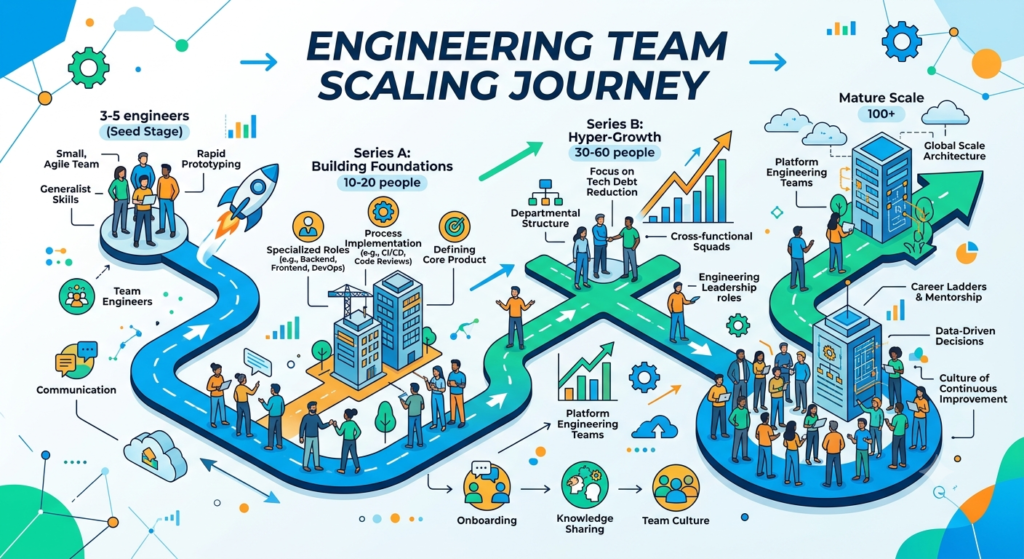
Why Growing Companies Struggle to Scale Engineering Teams
Direct Answer: Scaling an engineering team through traditional hiring takes an average of three to six months per senior hire—from job posting to productive contribution. That timeline does not align with the speed at which product requirements, compliance deadlines, and market windows move.
In enterprise software projects, the friction compounds. A senior backend engineer role may attract hundreds of applicants but only a handful of qualified candidates. Each candidate requires multiple rounds of technical assessment, leadership interviews, reference checks, background verification, offer negotiation, notice periods, and onboarding. The full cycle—from approved headcount to a developer making their first meaningful commit—routinely exceeds four months.
Engineering leaders often describe this as “hiring for last quarter’s needs.” By the time the hire is productive, the project context has shifted.
The consequences are measurable. Teams that are understaffed relative to delivery commitments consistently show three patterns: increased defect rates as developers cut corners on testing, rising burnout and attrition among senior staff who absorb the excess workload, and a growing backlog of technical debt that slows every subsequent delivery cycle.
IT staff augmentation addresses the timeline problem directly. Pre-vetted specialists can typically begin within one to two weeks. They come with the technical skills already validated—no probationary period, no learning curve on fundamental competencies. Your team provides the domain context. The augmented specialist provides the technical execution.
How IT Staff Augmentation Works
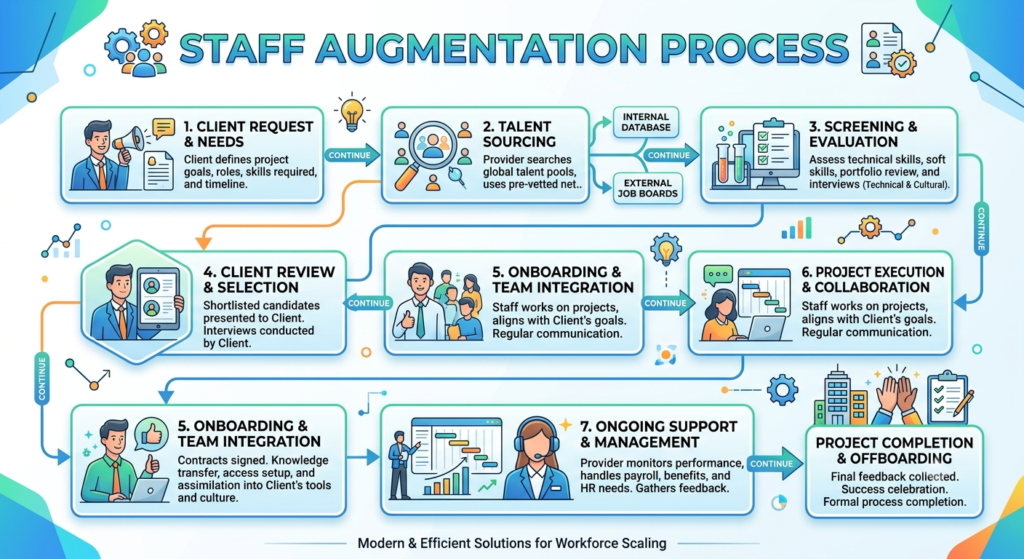
The engagement model follows a consistent structure across most providers:
- Requirements Definition: The client defines the role, required skills, experience level, technology stack, and engagement timeline. The more precise this specification, the faster and more accurate the matching process.
- Candidate Matching: The provider presents pre-screened candidates from their talent network, typically within three to seven business days. Candidates are matched against technical requirements, domain experience, and communication skills.
- Client Interviews: The client team interviews shortlisted candidates using their own technical assessment process. This maintains your hiring standards—you approve every specialist before they join.
- Onboarding: Selected candidates are onboarded into your development environment, communication tools, and project workflows. Most augmented specialists are contributing to active sprints within their first week.
- Ongoing Collaboration: Augmented staff work under the client’s technical direction. Daily management, task assignment, and performance feedback sit with the client. The provider handles employment, compliance, payroll, and HR administration.
- Scaling and Transition: Engagements scale up or down based on project needs. At engagement end, knowledge transfer protocols ensure continuity before the augmented specialist exits.
10 Signs Your Business Needs IT Staff Augmentation
Sign 1: Your Project Requires Skills Your Current Team Doesn’t Have
Why this happens: Technology stacks evolve faster than most internal teams can keep pace with. A company that built its core platform on one technology often finds itself needing expertise in AI, cloud-native architecture, or a new framework to remain competitive—without time to upskill existing staff.
Business impact: Projects stall. Alternatively, internal developers attempt to deliver in unfamiliar technologies, producing work that requires expensive refactoring later. According to McKinsey, rework caused by poor initial implementation accounts for 30 to 40% of total project cost in many enterprise software programs.
Enterprise example: A financial services firm built its core banking system on Java but needed to develop a new mobile banking app in React Native. Rather than retraining existing developers over six months, the organization brought in three React Native specialists through staff augmentation and shipped the app in 14 weeks.
How staff augmentation solves it: You access specialists who already have the skills you need. There is no ramp-up on fundamentals—only on your specific domain and project context.
Expert recommendation: Define the skill gap precisely before engaging a provider. Be specific: “React Native developer with experience integrating biometric authentication in financial apps” will return better matches than “mobile developer.”
Sign 2: You Are Missing Deadlines Due to Understaffing
Why this happens: Scope grows, team capacity does not. Many delivery failures are not caused by poor execution—they are caused by understaffing relative to committed scope.
Business impact: Missed deadlines carry compounding costs: penalty clauses in client contracts, lost first-mover advantage in product launches, and the organizational credibility damage that follows a public deadline failure. Gartner estimates that large IT projects run an average of 45% over budget and 7% over time while delivering 56% less value than predicted.
Enterprise example: A SaaS company committed to launching a new analytics module for an enterprise client by a contractual deadline. When two senior developers left within a month of the launch date, the company engaged Enlight Lab’s IT Staff Augmentation Services to bring in two backend engineers within eight days. The launch was delivered on schedule.
How staff augmentation solves it: Augmented staff can be onboarded and contributing to active sprints within one to two weeks—far faster than any permanent hire can be sourced and onboarded through traditional recruiting.
Expert recommendation: Do not wait until a deadline is at serious risk. Initiate staff augmentation discussions when you are four to six weeks behind schedule. Earlier engagement preserves enough time for proper onboarding and reduces the chance of rushed integration errors.
Sign 3: Your Recruiting Timeline Is Too Slow for Your Delivery Pace
Why this happens: Traditional recruiting was designed for steady-state hiring, not for the dynamic talent demands of modern software development. Each sprint introduces new technical decisions; each quarter may require different specializations.
Business impact: Teams operate below capacity for months at a time. Senior developers who should be doing architecture work spend hours screening resumes and conducting interviews, pulling them away from their highest-value contribution.
Enterprise example: A healthcare software company needed a senior DevOps engineer and a cloud architect to support an AWS migration. After six weeks of traditional recruiting with no qualified hires, the company pivoted to staff augmentation and had both roles filled within 10 days.
How staff augmentation solves it: Staff augmentation providers maintain pre-vetted talent networks, allowing them to present qualified candidates significantly faster than cold recruiting. According to LinkedIn’s 2024 Global Talent Trends report, the average time-to-fill for senior technical roles through traditional channels is 63 days. Staff augmentation typically reduces this to 7 to 14 days.
Expert recommendation: Track your time-to-fill metric for technical roles. If it consistently exceeds 45 days, staff augmentation should be part of your talent strategy—not a fallback.
Sign 4: You Need to Scale Rapidly for a Specific Project or Phase
Why this happens: Software development is not a steady-state activity. Large projects—platform rebuilds, major feature launches, migrations—require concentrated engineering capacity during certain phases, then less afterward.
Business impact: Hiring permanent staff to meet a temporary peak creates overhead that persists after the project phase ends. Organizations that over-hire for peak demand then face a choice between carrying underutilized headcount or a difficult reduction in force.
Enterprise example: A retail enterprise needed 12 additional engineers to meet a holiday season e-commerce platform upgrade. Rather than hiring permanently, the company engaged staff augmentation for a four-month engagement. After the peak period, the team scaled back without restructuring.
How staff augmentation solves it: Engagements are scoped to the project timeline. You scale up when you need capacity and scale back when the project phase is complete—without the legal, cultural, and financial friction of layoffs.
Expert recommendation: Map your engineering capacity needs against your project roadmap at the start of each quarter. Identify phases where demand will spike and engage staff augmentation providers early enough to have specialists available when those phases begin.
Sign 5: Your Core Team Is Burning Out
Why this happens: Chronic understaffing forces senior developers to absorb junior tasks, handle support tickets, and context-switch across multiple workstreams simultaneously. This is a documented path to burnout, and burnout leads to attrition—which deepens the understaffing problem further.
Business impact: The cost of replacing a senior software engineer is estimated at 150 to 200% of their annual salary when accounting for recruiting, onboarding, and the productivity gap during the transition period (Society for Human Resource Management, 2023). Preventing attrition through timely staff augmentation is almost always less expensive than replacing the people who leave.
Enterprise example: A FinTech startup’s engineering team of eight was carrying the workload appropriate for 14. Three senior engineers had raised attrition risk in performance reviews. The company added four augmented engineers to redistribute the workload and retained all three at-risk team members through the critical launch period.
How staff augmentation solves it: Adding augmented specialists redistributes workload immediately, without the six-month hiring cycle that typically precedes burnout becoming attrition.
Expert recommendation: Monitor workload distribution as a leading indicator, not a lagging one. If your senior engineers are consistently working 50+ hour weeks, augmentation is warranted before you lose them—not after.
Sign 6: You Are Expanding Into a New Technology or Platform
Why this happens: Digital transformation, new product lines, and technology modernization programs consistently require engineering expertise in areas where the internal team has limited or no experience.
Business impact: Assigning technology-adjacent work to engineers who lack domain expertise in the target technology produces results that appear functional but carry structural risk. Technical debt introduced during a platform migration or AI integration can take years to remediate.
Enterprise example: A manufacturing firm implementing IoT-based predictive maintenance needed engineers with experience in edge computing and time-series data pipelines. Neither capability existed in-house. Rather than spending 12 months training internal engineers, the company brought in two IoT specialists through Enlight Lab’s IT Staff Augmentation Services while internal engineers shadowed and built competency alongside them.
How staff augmentation solves it: You import domain expertise for the duration of the initiative, then build internal capability in parallel. The augmented specialist delivers the project; your internal team gains practical experience that transfers to future initiatives.
Expert recommendation: Use technology expansion projects as deliberate knowledge transfer opportunities. Structure the engagement so internal engineers are actively involved, not isolated from the augmented specialists.
Sign 7: You Are Building a Product but Lack an Internal Engineering Team
Why this happens: Startups and non-technology enterprises often have product vision and market access but lack the engineering bench to build. Hiring a full engineering team before validating the product risks significant capital on unproven assumptions.
Business impact: Without engineering capacity, product development stalls. Founders attempt to manage freelancers without technical leadership, producing fragmented codebases that are expensive to maintain and difficult to scale.
Enterprise example: A logistics company identified an opportunity to build a proprietary route optimization platform. The company had domain expertise and a product roadmap but no engineering team. Through staff augmentation, they assembled a team of a solution architect, two backend engineers, and a frontend developer—launched an MVP in three months, then used the validated product to justify hiring a permanent engineering team.
How staff augmentation solves it: Augmented staff provide the engineering capacity to build, validate, and launch the product. Once the product is proven, the organization can build a permanent team with clear technical requirements informed by actual product experience.
Expert recommendation: Engage a solution architect before any other role when building from scratch. Architecture decisions made in the first few weeks of a greenfield project have the longest-lasting impact on the system’s scalability and maintainability.
Sign 8: Your Compliance or Security Requirements Have Changed
Why this happens: Regulatory environments evolve—HIPAA, SOC 2, ISO 27001, GDPR, PCI DSS, and emerging AI governance frameworks each impose specific technical controls. Organizations entering new markets or sectors often face compliance requirements that their existing engineering team is not equipped to implement.
Business impact: Compliance failures carry financial penalties, reputational damage, and in regulated sectors, license risk. A healthcare company that discovers a HIPAA gap during an audit faces a very different situation than one that built compliant architecture from the start. According to IBM’s Cost of a Data Breach Report 2024, the average cost of a data breach in the healthcare industry reached $9.77 million—the highest of any sector for the 14th consecutive year.
Enterprise example: An insurance company expanding into a new European market needed GDPR-compliant data architecture across its customer management platform. The internal team understood the business requirements but not the technical implementation. A data privacy engineer engaged through staff augmentation designed and implemented the required controls in eight weeks.
How staff augmentation solves it: Compliance specialists can be engaged for defined periods to assess, design, and implement the required controls—without requiring permanent headcount in a specialty that may not be needed at full capacity after the initial implementation.
Expert recommendation: Engage compliance-specialized engineers during the architecture phase, not after the system is built. Retrofitting compliance controls is consistently more expensive and less complete than designing for them from the beginning.
Sign 9: Your Product Quality Is Declining as the Team Grows
Why this happens: Counterintuitively, some engineering quality problems emerge during growth phases. As teams expand rapidly, inconsistent coding standards, inadequate code review processes, and weak QA coverage create defect accumulation that accelerates rather than slows.
Business impact: According to NIST research, a defect caught during testing costs 15 times more to fix than one caught during development, and a defect caught in production costs 30 times more. Poor QA practices during rapid scaling create compounding technical debt that eventually forces expensive remediation programs.
Enterprise example: A SaaS platform tripled its engineering team in 18 months. Defect rates increased proportionally. The company engaged three senior QA engineers and a DevOps engineer through IT Staff Augmentation Services to establish automated testing frameworks and CI/CD quality gates. Defect rates dropped 60% within three months.
How staff augmentation solves it: QA engineers and DevOps specialists can be engaged specifically to build quality infrastructure—automated test suites, deployment pipelines, monitoring systems—that benefits the entire engineering team long after the engagement ends.
Expert recommendation: Do not treat QA as a downstream activity that can be addressed after development is complete. Engage QA engineers during sprint planning, not after features are built.
Sign 10: You Are Losing Competitive Ground Because Delivery Is Too Slow
Why this happens: In competitive software markets, delivery velocity is a strategic variable. Companies that can ship features faster than competitors can respond to customer feedback faster, capture market segments faster, and attract better talent. Engineering capacity directly constrains delivery velocity.
Business impact: GitHub’s 2023 State of the Octoverse found that developer velocity—measured by cycle time, deployment frequency, and change failure rate—correlates directly with business outcomes including revenue growth and customer retention. Teams that cannot scale their delivery capacity cannot scale their competitive advantage.
Enterprise example: A B2B SaaS company was shipping one major feature per quarter while its primary competitor was shipping monthly. The gap was not architectural—it was capacity. Adding four augmented engineers to two product squads increased deployment frequency to bi-weekly within two sprints.
How staff augmentation solves it: Augmented specialists integrate into your squads immediately, contributing to active delivery cycles without requiring new processes or structural changes to your engineering organization.
Expert recommendation: Measure deployment frequency as a team health metric, not just a DevOps metric. If your delivery cadence is below your competitive benchmark, capacity is likely a contributing factor—and augmentation is a faster correction than hiring.
Benefits of IT Staff Augmentation
| Benefit | Description | Measurable Impact |
| Speed to productivity | Pre-vetted specialists onboard in 7–14 days | vs. 60–90+ days for permanent hire |
| Cost efficiency | No recruitment fees, benefits, or severance | 20–40% lower cost than equivalent permanent hire for short-term engagements |
| Skills precision | Match specialist to exact technology and domain | Reduces ramp-up time by 60–80% |
| Flexibility | Scale up or down based on project phase | No restructuring cost when project ends |
| Knowledge transfer | Internal team builds competency alongside specialists | Lasting capability gain beyond the engagement |
| Risk reduction | Try before committing to permanent headcount | Lower organizational risk during uncertain growth phases |
| Delivery continuity | Fill gaps caused by attrition without project disruption | Prevents timeline impact from unexpected departure |
Comparison Table: Hiring Models
| Factor | In-House Hiring | IT Staff Augmentation | Project Outsourcing |
| Time to start | 60–120 days | 7–14 days | 14–30 days |
| Cost (senior engineer) | $120K–$200K+ per year + benefits | $85–$180/hr depending on role and region | Fixed project fee, often higher total cost |
| Management control | Full | Full | Limited |
| Integration with team | Full | Full | Partial or none |
| Suitable for | Long-term, permanent needs | Variable demand, skill gaps, short-to-mid-term projects | Defined deliverables with clear scope |
| Knowledge retention | High | Medium (can be improved with structure) | Low |
| Compliance responsibility | Employer | Provider handles employment | Provider handles employment |
| Scalability | Slow | Fast | Moderate |
| IP and code ownership | Clear | Clear | Requires contractual clarity |
Choose in-house hiring if the role is permanent, domain-critical, and strategic enough to justify a 90-day recruiting cycle.
Choose IT staff augmentation if you need to fill a skills gap quickly, scale for a defined project phase, or access specialized expertise that does not justify a permanent hire.
Choose project outsourcing if the deliverable has fixed scope, clear acceptance criteria, and does not require daily collaboration with your internal team.
Decision Framework: Is IT Staff Augmentation Right for Your Business?
Direct Answer: IT staff augmentation is the right model when your organization has a defined skills gap, a timeline that cannot wait for traditional hiring, and the internal leadership capacity to manage augmented staff effectively. It is not the right model if the organization lacks the technical leadership to direct and evaluate augmented engineers.
Ask your team these five questions before making a decision:
- Do we have a specific skills gap that is blocking a project or creating delivery risk?
- Is our timeline shorter than the typical recruiting cycle for the roles we need?
- Do we have a technical lead who can direct, review, and integrate augmented staff into our existing team?
- Is the need temporary, phase-specific, or uncertain enough that permanent hiring carries meaningful risk?
- Can we define the role requirements precisely enough to match the right specialist?
If you answered yes to three or more, IT staff augmentation is likely the more effective path.
Technology Experts You Can Hire
| Role | Primary Responsibilities | Common Engagement Duration |
| Software Engineers | Full-cycle development, system design, code review | 3–18 months |
| Frontend Developers | UI/UX implementation, React, Vue, Angular, Next.js | 2–12 months |
| Backend Developers | APIs, databases, server-side logic, microservices | 3–18 months |
| Full Stack Developers | End-to-end feature development | 3–12 months |
| Mobile Developers | iOS, Android, React Native, Flutter | 3–12 months |
| DevOps Engineers | CI/CD, infrastructure automation, deployment pipelines | 3–12 months |
| Cloud Engineers | AWS, Azure, GCP architecture and migration | 2–9 months |
| AI Engineers | LLM integration, ML pipelines, AI application development | 3–12 months |
| Machine Learning Engineers | Model development, training pipelines, MLOps | 3–18 months |
| Salesforce Developers | Platform customization, Apex, Flow, integrations | 2–9 months |
| QA Engineers | Test automation, quality frameworks, regression coverage | 2–12 months |
| Data Engineers | ETL pipelines, data warehouses, data lakes | 3–12 months |
| Solution Architects | System design, technology selection, architecture documentation | 1–6 months |
| Business Analysts | Requirements gathering, process mapping, stakeholder alignment | 2–9 months |
| Project Managers | Delivery coordination, risk management, stakeholder reporting | 3–12 months |
Organizations building AI products should also consider specialized engagement through Enlight Lab’s AI Development Services, which combines staff augmentation with pre-built AI architecture patterns for faster delivery.
Industry Use Cases
Healthcare: Healthcare organizations use staff augmentation to bring in engineers with HL7, FHIR, and HIPAA compliance experience for EHR integrations, patient portal development, and clinical data platforms. Traditional hiring in healthcare technology is particularly slow due to narrow candidate pools with both clinical domain knowledge and technical skill. Enlight Lab’s Healthcare Software Development team supports these engagements directly.
Finance: Banks and financial institutions engage augmented engineers for core banking modernization, regulatory reporting platforms, fraud detection systems, and API-first product development. Risk and compliance requirements make the due diligence on augmented specialists particularly important in this sector.
Insurance: Insurance companies use staff augmentation for claims automation, underwriting decision platforms, and digital policy management. Actuarial system integrations and legacy platform modernization are common engagement types.
Retail: Retail organizations augment engineering teams for e-commerce platform development, inventory management systems, personalization engines, and peak season capacity. Engagement timelines in retail frequently align with seasonal delivery cycles.
Manufacturing: Manufacturing firms engage augmented engineers for IoT platform development, predictive maintenance systems, digital twin implementations, and ERP integrations. The intersection of operational technology and information technology creates a specialist demand that few internal teams can satisfy permanently.
Travel: Travel companies use staff augmentation for booking engine development, inventory management systems, and real-time pricing platforms. Seasonal demand variability makes permanent hiring a poor fit for many engineering initiatives in this sector.
Education: EdTech organizations and educational institutions augment teams for learning management system development, student information systems, and AI-powered personalization platforms.
Real Estate: Property technology companies engage augmented engineers for listing platforms, transaction management systems, and data analytics tools.
SaaS: SaaS companies are among the highest users of staff augmentation, using it to accelerate product development, add specialized capabilities, and scale engineering teams during fundraising-driven growth phases.
Government: Government agencies and contractors use staff augmentation for secure application development, legacy system modernization, and data platform projects. Augmented specialists on government engagements typically require security clearances or background checks, which should be factored into engagement timelines.
Common Hiring Challenges & How Staff Augmentation Solves Them
| Challenge | Traditional Hiring Result | Staff Augmentation Result |
| Long time-to-fill for senior roles | 60–120 day vacancy | 7–14 day onboarding |
| Specialist skills not available locally | Geographic search expansion adds weeks | Global pre-vetted network accessed immediately |
| Budget approved late in the quarter | Project delayed until Q+1 | Engagement starts within days of approval |
| Developer leaves mid-project | 3–4 month gap before replacement productive | Replacement specialist engaged within two weeks |
| New technology skill gap | 6–12 month internal training program | Specialist hired with skill already validated |
| Temporary demand spike | Over-hire with future restructuring cost | Scale up for peak, scale back without overhead |
Best Practices for IT Staff Augmentation
Define requirements before engaging a provider. The quality of the match depends on the precision of the specification. “Senior backend developer” produces poor results. “Senior backend developer with five or more years in Python, FastAPI, and PostgreSQL, with experience building multi-tenant SaaS platforms” produces good ones.
Assign a dedicated internal technical lead. Augmented staff perform best when they have clear direction, prompt feedback on code reviews, and an internal point of contact who can make architectural decisions. Organizations that expect augmented engineers to self-manage without internal leadership consistently report poor outcomes.
Onboard augmented staff the same way you onboard permanent hires. Provide system access, project context, architecture documentation, coding standards, and team introductions on day one. The onboarding investment directly determines time-to-contribution.
Treat augmented specialists as team members, not contractors. Include them in standups, retrospectives, and team decisions. Augmented engineers who are isolated from team culture deliver lower-quality work and less valuable insights than those who are fully integrated.
Establish knowledge transfer protocols from the start. If the engagement has a defined end date, plan knowledge transfer sessions in the final weeks. Document decisions the specialist made. Record architectural reasoning. This prevents institutional knowledge from leaving with the specialist.
Review performance monthly. Do not wait until a problem has compounded before addressing it. Monthly check-ins between your technical lead and the provider allow course corrections before minor issues become project risks.
Common Mistakes
Engaging staff augmentation too late. The most common mistake is waiting until a deadline is critical before initiating an augmentation search. Starting four to six weeks earlier preserves time for proper vetting and integration.
Underspecifying the role. Vague role definitions produce poorly matched candidates. Every week spent re-screening candidates after a poor initial match is a week the project does not have.
Expecting augmented staff to operate without management. Staff augmentation provides engineering execution capacity. It does not replace technical leadership. If your organization lacks a technical lead who can direct and review augmented engineers, that is the first gap to address.
Selecting on hourly rate alone. The cheapest option consistently produces the highest total cost when you factor in mismatched skills, rework, and delayed delivery. Evaluate candidates on technical fit and domain experience, not rate alone.
Failing to protect IP. Ensure contracts include clear clauses covering intellectual property ownership, code confidentiality, and data protection. This is non-negotiable, particularly for proprietary product development.
Ignoring culture fit. Technical skills can be validated quickly. Communication quality, collaboration style, and work ethic are harder to assess in a short interview but matter enormously during a six-month engagement.
Implementation Checklist
Before you begin an IT staff augmentation engagement:
- Define the specific role, required skills, technology stack, and experience level
- Confirm internal technical leadership is available to direct and review augmented staff
- Identify the engagement timeline and project phase the specialist will support
- Review and execute provider contracts covering IP, confidentiality, and compliance
- Prepare onboarding materials: repository access, documentation, architecture overview, team introduction plan
- Schedule a kick-off meeting between the augmented specialist, technical lead, and project manager
- Define performance expectations and review cadence
- Establish knowledge transfer protocols if the engagement has a fixed end date
The Enlight Lab Engineering Scaling Framework
Most organizations approach engineering team scaling reactively—adding capacity after delivery problems are already visible. The Enlight Lab Engineering Scaling Framework provides a proactive, seven-stage approach to scaling engineering teams with precision and control.
Stage 1: Assess
Audit current engineering capacity against your twelve-month delivery roadmap. Identify specific skills gaps, delivery risks, and timeline constraints. This assessment should be quantitative: which projects are delayed, by how many weeks, and due to what specific skills shortages?
Do not estimate. Measure. Engineering leaders who rely on intuition during the assessment phase consistently underestimate both the depth of the skills gap and the time required to close it through traditional hiring.
Stage 2: Plan
Translate assessment findings into a capacity plan. Determine which gaps require permanent hiring, which are better addressed through staff augmentation, and which require both. Map the plan against the project roadmap to identify critical path dependencies.
One common challenge organizations face at this stage is treating all engineering roles as equivalent. A senior architect who will design the platform foundation has fundamentally different risk and timeline implications than a mid-level developer executing within an established architecture. Plan differently for each.
Stage 3: Select
Engage providers with a precise role specification. Conduct technical assessments using your own evaluation process—do not delegate this to the provider. You are the technical authority on what “good” looks like for your specific context.
Evaluate at minimum three candidates per role before making a selection. The first candidate who meets minimum requirements is rarely the best fit. The selection investment at this stage prevents replacement costs later.
Stage 4: Onboard
Treat onboarding as a project with defined deliverables and a timeline. Augmented specialists should have full system access, complete project context, and a clearly assigned technical mentor within their first 48 hours.
The most common onboarding failure is giving augmented staff access to systems and documentation without giving them someone to ask questions to. Assign a named internal contact whose responsibility is to unblock the augmented specialist during their first two weeks.
Stage 5: Collaborate
Integrate augmented specialists into your team’s working rhythms—standups, code reviews, sprint planning, and retrospectives. Isolation degrades performance. Integration accelerates it.
Engineering leaders often find that augmented specialists contribute valuable external perspective during retrospectives and architecture discussions. They have seen how other organizations solve similar problems. Creating space for that perspective to surface improves outcomes for the entire team.
Stage 6: Optimize
Review performance monthly. Adjust task assignments, team composition, and communication processes based on actual delivery data, not assumptions. If an augmented specialist is underutilized in their current assignment, that is a planning failure—correct it.
Track the contribution of augmented staff against the project metrics that motivated the engagement: delivery velocity, defect rate, time-to-release. These metrics tell you whether the engagement is delivering value, and they inform future capacity planning decisions.
Stage 7: Scale
Use insights from the current engagement to refine your engineering scaling strategy. Which roles were matched quickly? Which required multiple candidate rounds? Which engagement models produced the best knowledge transfer outcomes?
Each engagement should leave your organization with better institutional knowledge about how to scale—not just a completed project. Organizations that run IT staff augmentation as a strategic capability, rather than a reactive procurement activity, consistently deliver better outcomes than those that treat it as an emergency measure.
Future of IT Staff Augmentation
Direct Answer: IT staff augmentation is moving toward embedded, specialized AI and cloud talent as the primary demand driver. By 2026 and beyond, the skill categories organizations cannot hire fast enough will shift from general software development toward AI engineering, MLOps, cloud security, and data architecture.
Gartner predicts that by 2027, more than 50% of organizations will use AI engineering talent sourced through flexible engagement models rather than permanent hiring—up from less than 15% in 2024. The economics and the velocity requirements both point in the same direction.
Three structural shifts are reshaping the market:
Global talent pools are becoming more accessible. Remote-first development practices mean organizations can access engineering talent from any geography without relocation. This expands the talent supply available through staff augmentation while intensifying competition for the best specialists.
AI is changing what engineering work looks like. As AI tools handle more of the routine coding, testing, and documentation work, the demand for engineers who can architect, govern, and build AI systems is accelerating. Staff augmentation providers who can supply AI-native engineering talent will command significant premium positioning.
Engagement models are becoming more flexible. Fixed-term engagements are giving way to outcome-based models, fractional CTO arrangements, and embedded advisory roles. Organizations that engage specialized expertise through flexible models will adapt faster than those constrained by the pace of permanent hiring.
Organizations building for this future should explore Enlight Lab’s Custom Software Development and Cloud Consulting capabilities alongside staff augmentation, as the most competitive organizations combine flexible talent with specialist advisory support.