You have an idea for a SaaS product. Perhaps you’ve identified a problem businesses struggle with every day, spoken to a few potential customers, or noticed an opportunity to build something better than the tools already available.
Naturally, you want to start building.
You might begin comparing programming languages, exploring AI coding tools, or asking developers how quickly they can turn your idea into a working product.
But here’s something many first-time founders discover too late: building software is not just about writing code. It’s about making a series of decisions that determine how your product works, how much it costs, and how easily it can grow.
A product can look impressive during a demo and still struggle when real customers start using it. Development costs can increase because the original requirements were unclear. A simple feature can become surprisingly expensive because of an architectural decision made months earlier.
These problems aren’t inevitable. Many can be avoided by thinking through a few important technical questions before development begins.
Whether you’re a non-technical founder building your first startup, a business owner turning an internal process into software, or a startup CEO preparing to launch a new product, the following seven decisions deserve your attention.
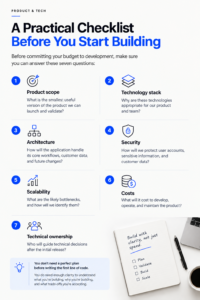
1. Decide What Your MVP Actually Needs to Do
One of the most common mistakes founders make is trying to build the complete product before validating whether customers want it.
You might have a list of 30 features, a detailed dashboard design, several automation ideas, and a vision for how the product will evolve over the next three years.
That vision is valuable. However, it doesn’t mean everything belongs in version one.
An MVP, or minimum viable product, is the smallest useful version of your product that allows you to test your core assumption with real users.
Imagine you’re building a SaaS platform that helps sales teams qualify incoming leads.
Your initial feature list might include lead scoring, automated emails, advanced analytics, team permissions, CRM integrations, AI-powered recommendations, and custom reporting.
But what if your biggest assumption is simply that sales teams will pay for automatically qualified leads?
Your first version might only need lead capture, a qualification workflow, a simple dashboard, and the ability to export results.
You can add advanced analytics and deeper integrations once you understand how customers use the product.
How should you prioritize MVP features?
Before development starts, divide your features into three categories:
- Essential: Features required to deliver the product’s main value.
- Important later: Features that improve the experience but aren’t necessary for initial validation.
- Experimental: Features based on assumptions that still need testing.
Then ask yourself one question: What is the smallest version of this product that a real customer would find useful enough to try?
Your answer should guide the initial scope.
A smaller MVP doesn’t mean compromising on quality. It means concentrating your time and budget on proving the right thing before investing in everything else.
2. Choose a Tech Stack That Fits Your Product, Not the Latest Trend
Your tech stack is the collection of technologies used to build and run your application. It can include your frontend framework, backend language, database, hosting platform, authentication system, and third-party services.
Founders often approach this decision by asking, “Which technology is the best?”
That’s not quite the right question.
The better question is: Which technology is appropriate for the product we’re building, the team we have, and the problems we expect to solve?
For example, a relatively straightforward B2B SaaS dashboard has different requirements from a real-time collaboration platform or a product processing large volumes of financial transactions.
A simple application might work well with a managed backend and a relational database. A product with complex business logic may need a more customized backend architecture.
Similarly, using AI coding tools can accelerate development, but the generated code still needs to be tested, secured, reviewed, and maintained.
What should founders evaluate?
Consider these factors before choosing your stack:
- Development speed: Can your team build and release features efficiently?
- Maintainability: Will developers be able to understand and modify the code later?
- Talent availability: Is it realistic to hire people who can maintain the application?
- Integration requirements: Does the stack support the services your product needs?
- Operating costs: What will hosting, databases, APIs, and other services cost as usage grows?
- Flexibility: Can the architecture accommodate likely product changes?
Avoid choosing a technology simply because another startup uses it or because it is popular on social media.
A sensible tech stack is one your team can build with confidently, operate reliably, and evolve as the business learns more about its customers.
3. Plan Your SaaS Architecture Before You Start Scaling
Architecture describes how the different parts of your application fit together and communicate with one another.
It influences how your product handles requests, stores data, processes business logic, and responds when usage increases.
For an early-stage startup, it’s tempting to ignore architecture altogether. After all, you might have only five customers and a limited development budget.
But overengineering is not the answer either.
You generally don’t need a complicated microservices architecture before you’ve established product-market fit. Starting with a well-structured application can be simpler and cheaper to operate.
The important thing is to understand the trade-offs.
Monolithic architecture or microservices?
A monolithic application keeps much of the core functionality within a single deployable application. This can make early development, testing, and deployment easier.
Microservices separate functionality into independently deployable services. They can be useful when different parts of a mature product need independent scaling or ownership, but they also introduce additional operational complexity.
Neither approach is automatically better.
For many first-time SaaS founders, a modular monolith is a practical starting point: one application with clearly separated components that can be changed without unnecessarily affecting everything else.
Think about multi-tenancy early
If your SaaS product serves multiple businesses, you must also decide how customer accounts and their data will be separated.
For example, imagine a project management platform used by two competing companies. Employees from one company must never be able to access another company’s private projects.
Your architecture needs to enforce those boundaries consistently across database queries, APIs, file storage, and background jobs.
Customer isolation, authentication, and access control are foundational SaaS design considerations, not optional extras to add after launch. Microsoft’s SaaS architecture guidance discusses these responsibilities in detail.
You don’t need to solve every future scaling problem today. You do need an architecture that supports your current requirements without creating avoidable barriers to future growth.
4. Make Security and Data Privacy Part of the First Release
Security is easy to postpone when you’re focused on building features.
A founder might think, “We’ll improve security once we have more customers.”
Unfortunately, that approach can create expensive problems, particularly when your SaaS product handles customer records, business documents, financial information, or other sensitive data.
Customers aren’t just buying functionality. They’re trusting you with information they may not be comfortable losing or exposing.
Security should therefore be considered during product design, development, testing, and deployment.
What should your first version include?
At a minimum, evaluate the following:
- Authentication: How will users securely sign in and recover access to their accounts?
- Authorization: What is each user allowed to view, edit, export, or delete?
- Data protection: How will sensitive data be protected in transit and at rest?
- Secrets management: Where will API keys, database credentials, and other secrets be stored?
- Backups and recovery: Can you restore important data if something goes wrong?
- Monitoring: How will you identify suspicious activity and investigate failures?
- Dependencies: How will you identify and address vulnerabilities in third-party packages?
Security requirements depend on your product, customers, and industry. A healthcare application, for example, may face obligations that differ significantly from those of a basic project management tool.
If you’re building an AI-powered SaaS product, consider additional risks, including prompt injection, sensitive information disclosure, and granting AI systems excessive permissions. The OWASP GenAI Security Project provides guidance on risks affecting AI applications.
You don’t need an enterprise-sized security team to take security seriously. You need clear responsibilities, appropriate safeguards, and a plan for responding when something goes wrong.
5. Design for Growth Without Paying for Scale You Don’t Have
Every founder hopes their product will grow.
But preparing for growth doesn’t mean buying expensive infrastructure or designing for millions of users before you’ve acquired your first ten.
The goal is to understand what could become a bottleneck and make sensible decisions about how to address it.
Consider a SaaS application that initially serves 50 customers. A single application server and a managed database may be sufficient.
As the product grows, database queries may become slower, background tasks may compete for resources, or certain features may receive significantly more traffic than others.
At that point, you can measure the problem and decide whether to optimize queries, introduce caching, increase infrastructure capacity, or move specific workloads into separate services.
What should you plan for now?
Think through these questions before launch:
- What happens if the number of users increases tenfold?
- Which features are likely to consume the most computing resources?
- How will you monitor performance and application errors?
- Can you increase capacity without rebuilding the entire product?
- What happens if a third-party service becomes unavailable?
- How will you test whether the application remains reliable under heavier workloads?
You don’t need precise answers to every future scenario. You need enough visibility to identify risks before they become business-critical.
It’s also important to remember that scalability isn’t only about handling more users. It’s about maintaining acceptable performance, protecting customer data, controlling costs, and keeping the service reliable as demand changes.
6. Understand Your SaaS Operating Costs Before Choosing Your Pricing
A product can attract paying customers and still struggle financially if its operating costs are poorly understood.
Founders often calculate the initial development budget but overlook the recurring expenses required to keep the product running.
These expenses can include hosting, database services, file storage, email delivery, monitoring, payment processing, customer support tools, and external APIs.
AI-powered products may introduce additional variable costs through model usage, transcription, voice generation, or other usage-based services.
Imagine your product charges customers $49 per month. If each active customer generates substantial API usage, your infrastructure and service costs could increase with every new account.
Growth would bring more revenue, but it could also bring unexpectedly high expenses.
What should you calculate?
Before launch, estimate your monthly operating costs under at least three scenarios:
| Scenario | What to estimate |
|---|---|
| Early launch | Costs for your first 10–50 customers |
| Initial growth | Costs as customer activity increases |
| Higher usage | Costs if customers use resource-intensive features frequently |
These are planning scenarios, not universal customer thresholds. Choose numbers that reflect your own business model.
Also calculate your approximate gross margin:
Gross margin = (Revenue − Cost of revenue) ÷ Revenue × 100
For SaaS, cost of revenue may include infrastructure, third-party services, and other direct costs of delivering the product. The exact calculation depends on how your business accounts for expenses.
For example, if a customer pays $100 per month and the direct cost of serving that customer is $20, the gross margin is 80%.
This simplified example excludes other business expenses such as marketing, salaries, and administration.
Understanding these numbers helps you make better decisions about pricing, usage limits, subscription tiers, and which features should be included in each plan.
Your technical architecture and business model are closely connected. Both need to work together for your SaaS product to become sustainable.
7. Decide Who Will Own Technical Decisions After Launch
Getting your first version built is an important milestone. But software is never truly finished.
Customers will request new features. Integrations will change. Bugs will appear. Security requirements will evolve. Eventually, you’ll need to make decisions about performance, infrastructure, hiring, and the product roadmap.
Someone needs to be responsible for making those decisions.
If you’re a technical founder, that responsibility may sit with you. If you’re a non-technical founder, you may need a technical co-founder, an experienced engineering lead, or support from a Fractional CTO.
The important thing is to avoid treating technology as a one-time project that ends when the developer delivers the application.
What should technical ownership cover?
Before development begins, establish who is responsible for:
- Reviewing architecture and major technical trade-offs.
- Ensuring code quality, testing, and security practices are appropriate.
- Managing deployments, monitoring, backups, and incident response.
- Evaluating third-party services and technical dependencies.
- Planning technical improvements alongside business priorities.
- Making decisions about hiring and future engineering capacity.
You don’t necessarily need a full-time CTO on day one.
For some early-stage startups, a Fractional CTO can provide strategic technical leadership on a part-time basis. They can help define the architecture, evaluate development teams, establish engineering practices, and align technical priorities with business goals.
For other companies, a strong technical co-founder or senior engineer may be the better fit.
The right choice depends on your product’s complexity, available budget, internal expertise, and the amount of ongoing technical leadership you need.
What matters most is that someone experienced is accountable for the decisions that could materially affect your product’s future.
Final Thoughts: Build the Right Foundation Before Building More Features
Your first SaaS product doesn’t need a complicated architecture, an enormous engineering team, or an expensive technology stack.
It needs a clear purpose, a focused MVP, sensible technical decisions, and a team that understands the trade-offs involved.
The best technical decisions are rarely the ones that make your product sound the most advanced. They’re the ones that help you deliver customer value, learn from the market, protect the business, and improve the product without unnecessary cost or complexity.
If you’re a founder preparing to build a SaaS product, take the time to answer these questions before development starts. A few thoughtful decisions today can save considerable time, money, and frustration later.
Building a SaaS product? Enlight Lab can help.
At Enlight Lab, we help founders turn product ideas into working software through MVP development and technical leadership.
Whether you need help defining your first release, choosing an appropriate architecture, or making critical technology decisions, the goal is the same: build a product that solves a real problem and has a sensible path forward.
Planning your first SaaS product? Connect with Enlight Lab to discuss your idea and the right next steps.