A founder gets three quotes for a new software product. One is significantly cheaper than the others, and the sales team promises to launch in half the time.
The founder signs.
Three months later, deadlines have slipped, important requirements have been misunderstood, and every change request comes with a new estimate. The original quote looked attractive. Now the business is paying for delays, rework, management time, and opportunities it has missed while waiting for the product.
This is how choosing the wrong software development partner can become an expensive business decision.
The problem does not always appear as a broken product. Sometimes the software works at launch but becomes difficult to maintain, expensive to extend, or unreliable as the business grows.
The true cost of a software development partner is not just what you pay to build the product. It is what you spend to launch, maintain, improve, and operate it successfully.
In this guide, we will examine seven hidden costs of choosing the wrong partner, explain how to estimate the total cost before signing a contract, and share practical questions and a scorecard you can use to compare software development companies.
Why the Lowest Software Development Quote Can Become the Most Expensive Choice
Two software development companies can review the same project brief and submit very different proposals. That does not automatically mean one is better than the other.
The difference may come down to their assumptions about the work involved.
One proposal might include requirements discovery, user experience design, automated testing, deployment, documentation, and post-launch support. Another might cover only development, leaving the remaining work for later.
Both proposals may appear to describe the same product, but they are not necessarily offering the same level of delivery.
Before comparing prices, check whether each proposal includes:
- Requirements discovery and scope definition
- UI/UX design and user experience validation
- Third-party integrations
- Testing and quality assurance
- Security and access controls
- Deployment and infrastructure setup
- Technical documentation and knowledge transfer
- Post-launch maintenance and support
A lower quote is not automatically a bad choice. Some teams operate efficiently, and some projects are genuinely straightforward. The important question is whether the proposal covers the work required to deliver a reliable product.
A Simple Example
Imagine two vendors are building a SaaS application.
Proposal A costs less upfront, but excludes automated testing, detailed documentation, and post-launch support.
Proposal B costs more upfront and includes these activities in the agreed scope.
At first glance, Proposal A appears to offer better value. But the buyer still needs to arrange testing, understand the codebase, and find someone to handle issues after launch.
Those activities have not disappeared. Their costs have simply moved outside the original proposal.
The lesson is straightforward: compare scope, assumptions, deliverables, exclusions, and acceptance criteria alongside the quoted price.
Ask every vendor to explain what is not included. In many cases, the exclusions reveal more about the real cost than the headline figure.
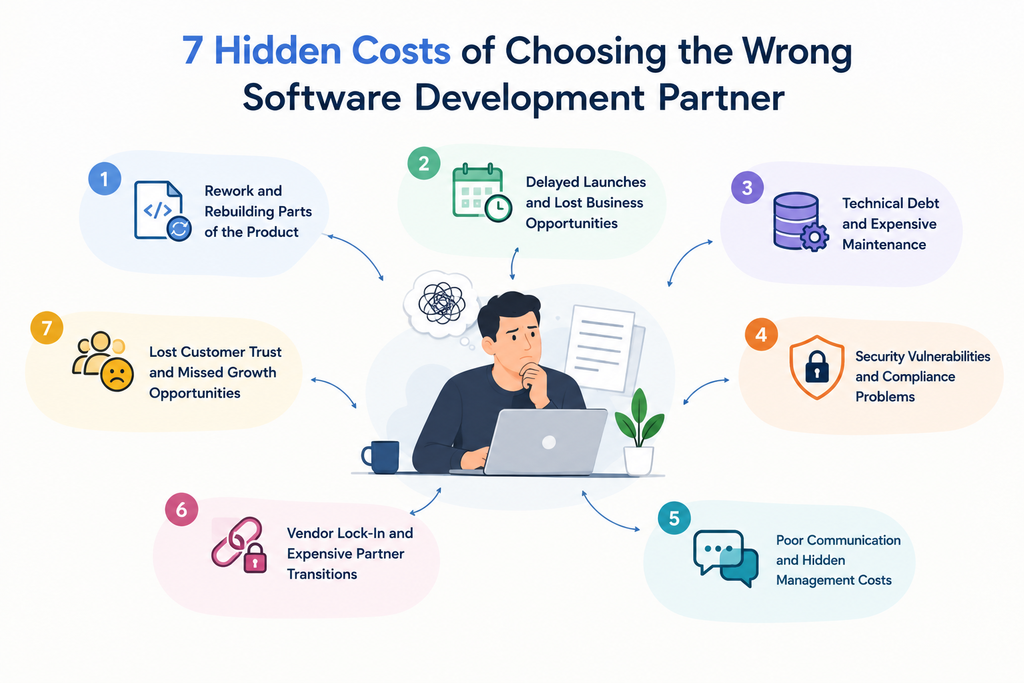
7 Hidden Costs of Choosing the Wrong Software Development Partner
1. Rework and Rebuilding Parts of the Product
Rework happens when a team has to correct or rebuild something that should have been understood or implemented properly the first time.
It can result from unclear requirements, weak architecture, rushed implementation, insufficient testing, or poor communication between the business and development team.
Consider a SaaS product that initially assumes every account has only one user role. Later, the business needs administrators, team members, and external clients with different permissions.
That decision can affect authentication, database access, reporting, integrations, and the application’s overall security model.
What looked like a small assumption can turn into a substantial engineering task.
Some rework is unavoidable. Customer feedback changes priorities, business requirements evolve, and teams learn more as a product develops. The problem is not every change. It is avoidable rework caused by decisions that were never properly examined.
A reliable development partner reduces this risk through structured discovery, written requirements, architecture reviews, code reviews, and testing throughout development.
How to reduce this cost:
Before signing, ask the vendor how it validates requirements, identifies technical assumptions, and manages changes when new information emerges.
You should understand how decisions are documented and who is responsible for approving changes to the original scope.
2. Delayed Launches and Lost Business Opportunities
A delayed launch can affect more than the development schedule.
It may postpone customer onboarding, revenue generation, market expansion, an internal process improvement, or a contractual commitment.
The impact depends on what the product is expected to achieve and which business activities depend on it.
For example, a company planning to launch a customer portal before a major renewal period may lose a valuable opportunity if the portal is delayed. Another company may face additional operational costs because employees must continue using manual processes.
These losses are not always easy to calculate, and a delay does not automatically mean lost revenue. However, the business still loses time and flexibility.
Unrealistic timelines can make the problem worse. A vendor may promise an aggressive launch date to win a contract, only to discover later that integrations, testing, or dependencies require more work than expected.
Delays also happen on well-managed projects. A third-party API may change, an integration may behave unexpectedly, or the client may need additional time to approve a feature.
What matters is how early the risk is identified and how transparently it is managed.
How to reduce this cost:
Look for milestone-based plans, clearly documented dependencies, regular demonstrations of working software, and realistic delivery estimates.
Ask how the team communicates schedule risks and what happens when a milestone is threatened.
A partner who raises a problem early gives you more options than one who reports it when the deadline has already passed.
3. Technical Debt and Expensive Maintenance
Technical debt is the future cost created by shortcuts or compromises in software design and implementation.
Examples include tightly coupled code, missing automated tests, inconsistent coding standards, outdated dependencies, and insufficient documentation.
These issues may not be visible during a product demonstration. They often become apparent when the business needs to add features, support more users, integrate another system, or respond to a security issue.
A feature that should take a few days might take several weeks because the team cannot confidently determine which parts of the application will be affected.
That increases maintenance costs and slows product development.
However, technical debt is not always a mistake. An early-stage startup may deliberately choose a simpler architecture to validate demand before investing in a more sophisticated system. That can be a sensible business decision when the trade-offs are understood and the team has a plan for revisiting them.
The expensive version is uncontrolled technical debt that accumulates without a clear reason or ownership.
Not every early product needs enterprise-level architecture. It needs architecture that fits its current requirements while leaving a reasonable path for growth.
How to reduce this cost:
Ask prospective partners how they review code, test important workflows, document architecture decisions, manage dependencies, and prepare a codebase for future developers.
Also ask how they balance speed with maintainability. A good answer should reflect your product’s actual needs, not simply promise to build everything to the highest possible level of complexity.
4. Security Vulnerabilities and Compliance Problems
Software security is often treated as a technical detail until a problem affects customers or business operations.
Weak access controls, exposed credentials, insecure integrations, and unmanaged dependencies can create risks that are expensive to resolve after launch.
Depending on the product, the consequences may include incident response, service interruptions, remediation work, customer concerns, contractual issues, or legal and regulatory exposure.
The applicable requirements depend on your industry, geography, data sensitivity, and product type. Businesses handling healthcare information, financial data, or other sensitive information may have additional obligations to consider.
Security also becomes more expensive when it is treated as an afterthought.
For example, adding appropriate access controls after launch may require changes to the application’s data model, authentication system, APIs, and user workflows.
A security certificate or vendor assurance is not a guarantee that every part of your software is secure. The actual development practices and controls matter.
How to reduce this cost:
Ask vendors about:
- Access control and permission management
- Secure storage of credentials and API keys
- Dependency updates and vulnerability management
- Data protection and backup practices
- Security testing appropriate to your product
- Incident response responsibilities
- Relevant contractual and regulatory requirements
Make sure responsibilities are clear before development begins. For compliance questions, consult qualified legal or security professionals where appropriate.
5. Poor Communication and Hidden Management Costs
When project updates are vague, decisions are undocumented, and responsibilities are unclear, someone on your side has to fill the gap.
That person is often the founder, product manager, or engineering lead.
They spend time chasing updates, explaining requirements repeatedly, resolving misunderstandings, and checking whether the team is working on the right priorities.
This time has a business cost even if it never appears on the development invoice.
There is also a difference between receiving frequent updates and having genuine visibility.
A weekly message saying that everything is on track tells you very little. A working demonstration, a shared backlog, a clear list of open issues, and documented delivery risks give you a much better understanding of progress.
Communication problems become especially expensive when important decisions are made informally and later disputed.
How to reduce this cost:
Agree on communication channels, milestone reviews, reporting expectations, decision ownership, and access to project management tools.
During the evaluation process, pay attention to how the vendor handles difficult questions. Does the team explain risks clearly? Does it challenge unrealistic assumptions? Does it acknowledge uncertainty?
These behaviors offer useful clues about how the relationship may work after the contract is signed.
6. Vendor Lock-In and Expensive Partner Transitions
Vendor lock-in occurs when a business becomes so dependent on a development partner that switching to another team becomes difficult, expensive, or disruptive.
This can happen when the client lacks access to source code, cloud infrastructure, deployment processes, technical documentation, or important credentials.
It can also develop when knowledge is concentrated in one or two developers and no one has documented the system’s architecture or operational requirements.
Lock-in is not always deliberate. Sometimes it is simply the result of rushed delivery and poor handover practices.
Regardless of the cause, the business may struggle to change partners, bring engineering in-house, or maintain the product independently.
A long-term partnership is not the same as dependency.
In a healthy partnership, you continue working with the vendor because the team provides value, communicates well, and delivers reliable work. You are not staying because leaving would be impractical.
How to reduce this cost:
Clarify the following before work begins:
- Who owns the source code and intellectual property
- Who controls the repositories and cloud accounts
- How credentials and access are managed
- Which third-party libraries and licenses are used
- What documentation must be delivered
- How knowledge transfer will work
- What happens when the contract ends
Make sure the agreement reflects these expectations and that the handover process is practical, not just a promise in the proposal.
7. Lost Customer Trust and Missed Growth Opportunities
Software quality affects the experience customers have with your business.
Recurring defects, confusing workflows, unreliable performance, and missing functionality can reduce adoption and make customers less confident in the product.
The impact may not appear as a single large expense. Instead, it accumulates through support requests, customer complaints, workarounds, delayed improvements, and time spent fixing preventable issues.
Consider a growing SaaS company whose engineering team spends most of its time correcting production problems. The roadmap keeps slipping because planned features compete with urgent fixes.
The business has fewer opportunities to respond to customer feedback, test new ideas, and improve the product.
This is an opportunity cost. The team is spending time maintaining the status quo instead of moving the business forward.
It is important not to assume that every customer problem comes from a development partner. Product strategy, changing requirements, and market conditions also matter. However, poor engineering practices can make those challenges harder to address.
How to reduce this cost:
Choose a partner that builds quality checks into the delivery process and helps you validate important workflows with real users.
Discuss how the team will prioritize defects, monitor production behavior, and support improvements after launch.
The goal is not to promise a perfect release. It is to create a product that can be improved reliably as you learn from customers.
How to Calculate the True Cost of a Software Development Partner
The total cost of ownership includes more than the initial development price. It includes the costs required to build, launch, maintain, and operate the software over a defined period.
A useful planning formula is:
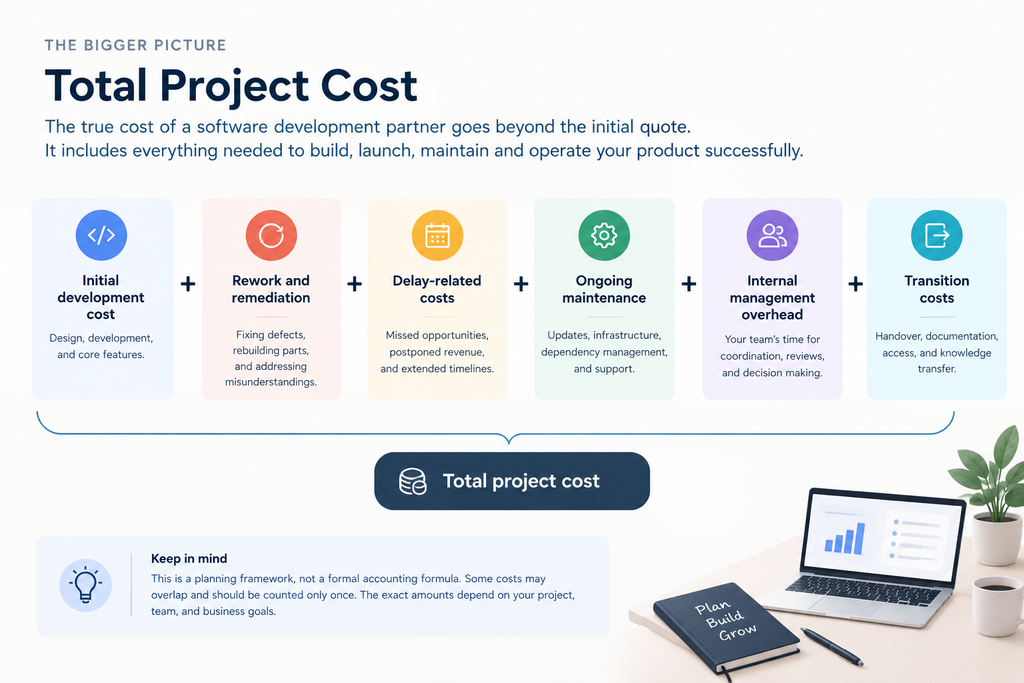
Total project cost = Initial development cost + Rework and remediation + Delay-related costs + Ongoing maintenance + Internal management overhead + Transition costs
This is a planning framework, not a formal accounting formula. Some categories may overlap, so count each cost only once.
Delay-related costs also require careful judgment. If a delayed launch might affect revenue, estimate the impact based on your business assumptions rather than treating the entire potential revenue amount as a guaranteed loss.
A Hypothetical Cost Comparison
Consider two proposals for a software project. The figures below are illustrative assumptions, not industry averages or market benchmarks.
| Cost category | Lower-priced, narrower proposal | Higher-priced, more complete proposal |
|---|---|---|
| Initial development | $60,000 | $90,000 |
| Rework and remediation | $30,000 | $10,000 |
| Delay-related costs | $15,000 | $5,000 |
| First-year maintenance | $20,000 | $12,000 |
| Internal management time | $10,000 | $6,000 |
| Transition costs | $0 | $0 |
| Total estimated cost | $135,000 | $123,000 |
In this example, the lower-priced proposal costs $60,000 upfront, while the more complete proposal costs $90,000. But after the assumed additional costs are included, the first option reaches $135,000 and the second reaches $123,000.
The example demonstrates how an initial price difference can narrow or reverse once additional costs are considered.
It does not mean the higher-priced vendor will always be cheaper in the long run. The result depends on the scope, the vendor’s actual performance, the product’s complexity, and the assumptions used.
The purpose of the calculation is to help you ask better questions before committing to a project.
How to Estimate These Costs for Your Own Project
Before comparing proposals, estimate the costs that matter to your business.
Rework: What might it cost to correct misunderstood requirements, defects, or unsuitable technical decisions?
Delays: Which launch dates, customer commitments, revenue opportunities, or internal projects depend on delivery?
Maintenance: What support, infrastructure, dependency updates, and ongoing engineering work will the product require during its first year?
Management time: How much time will your team spend clarifying requirements, chasing updates, resolving misunderstandings, and reviewing work?
Transition: If the relationship ends, what would another team need to understand, access, document, or rebuild?
Use estimates you can explain. Avoid choosing worst-case figures simply to make one vendor appear more attractive.
Also avoid double-counting. If the cost of correcting a defect is already included under rework, do not add it again under maintenance. If potential lost revenue is uncertain, present it as a separate scenario rather than guaranteed loss.
Finally, compare the same scope and time period for every vendor. A first-year maintenance estimate for one proposal should not be compared with a three-year estimate for another.
This calculation will not predict the final cost perfectly. It will help you identify which assumptions need clarification before you commit.
8 Questions to Ask Before Hiring a Software Development Company
A proposal can look convincing and still leave important questions unanswered. Use these eight questions when evaluating two or three potential partners.
1. How will you understand our business goals and technical requirements before estimating?
A strong answer should explain how the vendor learns about your users, business workflows, technical constraints, integrations, and expected outcomes.
Warning sign: The vendor provides a detailed estimate after a brief conversation without identifying major assumptions or dependencies.
2. What is included in the proposal, and what is explicitly excluded?
Ask for a clear list of deliverables, milestones, dependencies, and exclusions.
Warning sign: The proposal promises full development but does not explain what that means in practical terms.
3. How do you estimate timelines and communicate delivery risks?
The vendor should explain how it estimates work, accounts for dependencies, and updates the plan when new information emerges.
Warning sign: The team guarantees an aggressive deadline without explaining how it reached the estimate.
4. How do you test code and maintain software quality?
Ask about code reviews, automated and manual testing, acceptance criteria, and the process for handling defects.
Warning sign: Testing is treated only as a final phase or is not clearly included in the scope.
5. Who will own the source code, repositories, infrastructure, and intellectual property?
Ownership should be clear in the contract, with appropriate access and handover arrangements.
Warning sign: The vendor avoids the question or leaves ownership terms unclear.
6. How will we track progress and review working software?
Look for regular demonstrations, a shared backlog, milestone reviews, and visibility into open issues and risks.
Warning sign: Progress is communicated only through status reports, with no practical way to review working software.
7. What happens when requirements change or unexpected problems arise?
A good partner should have a clear change-control process that explains the impact on scope, budget, and schedule.
Warning sign: The vendor either promises to absorb every change without qualification or has no defined process for handling changes.
8. How will you support the product after launch, and how will handover work if the engagement ends?
Discuss maintenance, incident handling, documentation, knowledge transfer, and support responsibilities.
Warning sign: Support is described as available but has no defined scope, response expectations, or commercial terms.
Your software development contract should reflect the answers. At a minimum, review scope and exclusions, payment milestones, acceptance criteria, change control, intellectual property, confidentiality, support terms, and handover obligations.
Have a qualified lawyer review the contract where appropriate. This article provides general business guidance, not legal advice.
Software Development Partner Evaluation Scorecard
Use this scorecard to compare shortlisted vendors before making a final decision.
Score each category from 1 to 5:
- 1: Little evidence or an unclear answer
- 2: Significant gaps remain
- 3: Acceptable, but some questions remain
- 4: Clear answer with reasonable supporting evidence
- 5: Strong answer supported by specific evidence
| Evaluation criteria | Score (1–5) |
|---|---|
| Understanding of business goals and requirements | |
| Clarity of scope, deliverables, and exclusions | |
| Realistic timeline and estimation process | |
| Code quality, testing, and security practices | |
| Communication and project visibility | |
| Source code, intellectual property, and infrastructure ownership | |
| Documentation and knowledge transfer | |
| Post-launch maintenance and support | |
| Total score (out of 40) |
How to Use the Scorecard
Do not choose a partner based on the total score alone. A high overall score should not compensate for a serious weakness in security, ownership, or delivery transparency.
Ask each vendor to support its answers with evidence, such as a sample delivery plan, an explanation of its review process, a relevant case study, or a clear description of its handover procedure.
If a vendor scores poorly in an important category, ask follow-up questions before proceeding. If the answers remain vague, treat that as a project risk rather than assuming it will be resolved after signing.
Use the scorecard alongside the written proposal, contract, references, and your own assessment of the vendor’s communication.
The goal is not to find a perfect vendor. It is to understand the trade-offs before they become expensive.
Red Flags to Watch for Before Signing a Contract
Certain warning signs deserve additional scrutiny during vendor evaluation.
Watch for:
- Guaranteed delivery dates without meaningful discovery
- A fixed quote based on vague requirements
- Reluctance to explain technical trade-offs
- No clear testing or acceptance process
- No direct access to the people doing the work
- Unclear source code ownership or intellectual property terms
- No documentation or handover plan
- Vague post-launch support commitments
- A proposal that promises every feature without explaining dependencies or risks
One warning sign does not automatically make a company unsuitable. Ask follow-up questions and consider the overall picture.
A fixed-price proposal can work well when the scope is clearly defined. It becomes risky when the price is fixed but the requirements are not. The gap may eventually be settled through change requests, reduced quality, or disagreements about what was promised.
If your requirements are not clear enough to estimate confidently, a short paid scoping phase before the main build can be a sensible way to reduce uncertainty.
It is also important to assess your own readiness. Overruns are not always the vendor’s fault. Late decisions, shifting priorities, unclear ownership on the client side, and third-party dependencies can all affect delivery.
A fair evaluation considers both the vendor’s responsibilities and your own team’s ability to make decisions and provide timely feedback.
How to Choose a Software Development Partner for Long-Term Success
When evaluating a custom software development company, look beyond its portfolio and initial price.
The right partner should demonstrate the ability to:
- Understand the business problem, not just the requested features
- Explain estimates, assumptions, and exclusions clearly
- Build a realistic delivery plan
- Apply engineering and quality practices appropriate to the project
- Communicate risks before they become major problems
- Establish clear ownership and documentation
- Apply sensible security and reliability practices
- Build software that can be maintained and improved
- Provide a practical post-launch support and handover plan
The best partner is not necessarily the cheapest or the most expensive. It is the one that makes project risks visible, explains trade-offs honestly, and delivers work aligned with your goals.
A good partner will also challenge your assumptions when doing so protects the product or the business.
If every answer you hear is “yes, no problem,” be cautious. You want a team that can explain what is feasible, what requires further investigation, and what trade-offs you should consider.
Choose a Partner That Fits Your Actual Needs
Different projects require different capabilities.
If you are building a new SaaS product, examine the vendor’s approach to SaaS development and product architecture.
If you need a custom application, review its experience with custom web application development.
If you need independent technical guidance to evaluate vendors, architecture, or delivery risks, CTO as a Service may be relevant to your situation.
For products where deployment, reliability, and infrastructure are important concerns, DevOps consulting may also be worth exploring.
You can review Enlight Lab’s published case studies to understand how the company presents its project experience.
Choose links and references that are relevant to your requirements rather than treating a long list of services as proof that a vendor is right for your project.
Final Thoughts: Choose a Software Development Partner for the Long Term
The real cost of choosing the wrong software development partner rarely stops at the original contract. It can include rework, delayed launches, technical debt, security issues, management overhead, and the cost of moving the project to another team.
The best way to reduce that risk is to ask better questions before signing. Compare proposals on the same scope, examine the assumptions behind each estimate, clarify ownership, and understand how the team will handle testing, changing requirements, and post-launch support.
A lower quote can be the right choice when the scope is clear and the team has a credible delivery process. A higher quote can also be poor value if it comes with vague commitments and little accountability.
What matters is whether the partner can explain how it will deliver the product, manage the risks, and leave your business in a position to maintain and improve the software.
At Enlight Lab, we help businesses plan, build, and evolve custom software and SaaS products with senior technical guidance and hands-on engineering.
If you are comparing development partners or want a clearer view of your project’s technical risks before committing to a build, book a 30-minute conversation with Dhananjay Goel. We can discuss your goals, current challenges, and the decisions worth resolving before development begins.