The Gap Between AI Experiments and Business Results
A company spends several weeks experimenting with AI. Its team builds a chatbot that answers questions from internal documents, demonstrates how quickly it can summarize reports, and explores how AI could automate repetitive tasks.
The demonstrations look promising. Leadership sees the potential, and the team is excited about what it has built.
Three months later, however, the chatbot is rarely used. The reporting workflow still depends on manual work. Nobody has established whether the experiments saved time, reduced costs, or improved the customer experience.
The company has proved that AI can do something interesting. It has not proved that AI can improve the business.
This is the challenge many organizations face when moving from AI experimentation to implementation. The problem is not always the technology. Often, the missing pieces are a clearly defined business objective, usable data, integration with existing workflows, measurable success criteria, and someone responsible for the outcome.
For founders, CEOs, and technology leaders, the question is no longer simply whether AI can perform a task. It is whether that task is worth automating, whether the solution can operate reliably, and whether the investment makes commercial sense.
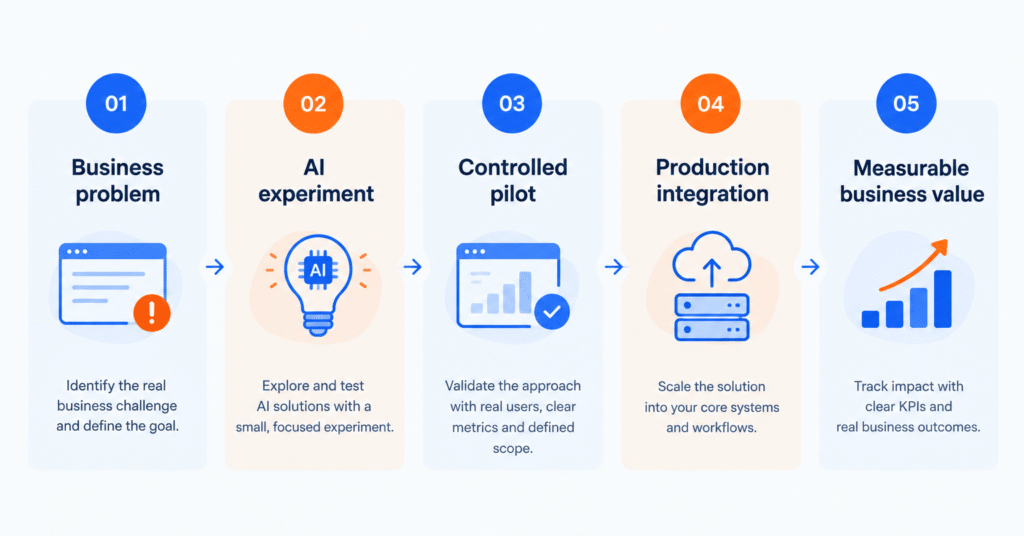
A successful AI experiment demonstrates possibility. A successful AI implementation delivers measurable value inside a real business process.
This guide explains how to move between those two stages, from identifying the right opportunity to validating a pilot, measuring ROI, and deciding whether to scale.
1. Why AI Experiments Fail to Deliver Business Value
An AI experiment can succeed technically while failing commercially.
A model might summarize documents accurately, generate useful responses, or classify incoming requests. But if the solution does not improve a business process, it is difficult to justify the investment beyond the initial experiment.
Several problems commonly create this gap.
Starting with technology instead of a business problem. Teams become interested in a new model or AI platform and search for something to do with it. This reverses the right sequence. The business problem should determine the technology, not the other way around.
No measurable definition of success. If the goal is simply to build an AI assistant, the team may consider the project successful when the assistant works. Business leaders need different evidence, such as reduced processing time, lower cost per task, or improved service quality.
Disconnected workflows. A useful AI tool may still be ignored if employees must switch applications, manually transfer information, or repeat work in another system.
Poor data readiness. AI systems cannot reliably use information that is incomplete, outdated, inconsistent, or inaccessible.
No clear ownership. Someone needs to be responsible for adoption, performance, exceptions, maintenance, and the decision to invest further.
Underestimating production requirements. A demonstration using sample data is different from a live system that handles customer information, permissions, integrations, errors, and ongoing operating costs.
Consider a hypothetical SaaS company that builds an AI assistant for customer support. During testing, it answers common product questions well. However, it cannot access current customer account information, does not recognize when a question requires escalation, and operates separately from the company’s ticketing system.
The demonstration is promising, but the support team cannot use it safely in everyday operations.
The lesson is straightforward: technical feasibility is only one part of an AI business case. The solution must also fit the workflow, meet the required quality standards, and create an outcome the business can measure.
2. Understand the Journey From AI Experiment to Production
Before planning an AI initiative, distinguish between the stages of development. Each stage should answer a different question and support a different investment decision.
| Stage | Main question | Evidence required | Next decision |
|---|---|---|---|
| Experiment | Could this technology help? | Early demonstrations and initial observations | Identify a worthwhile problem to investigate |
| Proof of concept | Can the approach work technically? | Tests against representative data and a defined quality threshold | Proceed to a controlled pilot or stop |
| Pilot | Does it improve a real business workflow? | Baseline comparisons, user feedback, failure analysis, and operating costs | Stop, improve, or prepare to scale |
| Production | Can it operate reliably and sustainably? | Monitoring, security controls, ownership, performance, and cost data | Continue, optimize, expand, or retire |
An experiment is about learning. A proof of concept establishes whether an approach is technically feasible. A pilot tests its usefulness under real operating conditions. Production requires the solution to work reliably as part of the business.
Confusing these stages leads to unrealistic expectations. A successful proof of concept does not automatically justify a large implementation budget.
In some cases, the right decision is to stop after the proof of concept. That is not wasted work if the team has discovered that the opportunity is too expensive, too risky, or unlikely to deliver meaningful value.
The objective is not to move every experiment into production. It is to invest further only when the evidence supports doing so.
3. Start With a Business Problem, Not an AI Tool
The most useful starting point is a business process that is expensive, slow, repetitive, difficult to scale, or dependent on scarce expertise.
Avoid beginning with a statement such as “We need an AI chatbot” or “We should automate our operations with AI.” These describe possible solutions without explaining what needs to improve.
Instead, define the problem in terms of the current process, the people affected, and the desired outcome.
For example:
Weak objective: We want to implement AI for customer support.
Stronger objective: Our support team spends too much time answering repetitive product questions. We want to reduce manual handling time without lowering answer quality or customer satisfaction.
The second objective provides a basis for evaluating solutions.
Here are several business problems worth investigating.
- Customer support: Repetitive questions consume agents’ time. A potential outcome is lower handling time while maintaining answer quality.
- Internal knowledge retrieval: Employees struggle to find policies, product documentation, or previous decisions. A potential outcome is less time spent searching for information.
- Lead qualification: Sales teams manually review incoming enquiries. A potential outcome is faster routing and more consistent prioritization.
- Document processing: Staff manually extract information from invoices, forms, or reports. A potential outcome is shorter processing time and fewer data-entry errors.
- Operational reporting: Teams spend hours collecting and summarizing information. A potential outcome is faster reporting and more time for analysis.
- Software development: Engineers spend time on repetitive code explanations, test generation, or documentation. A potential outcome is reduced routine effort without compromising code quality or security.
These are potential benefits, not guaranteed results. Each opportunity needs to be validated against the organization’s actual workflow and baseline performance.
Before moving forward, ask three questions:
- Is this a meaningful business problem?
- Can we measure how well the current process performs?
- Would improving this process justify the cost and risk of an AI solution?
If the answers are unclear, the next step is problem discovery, not development.
4. Prioritize AI Opportunities Before Investing
Most growing companies have more AI ideas than the time, budget, or engineering capacity to implement them.
A structured prioritization framework helps leaders compare opportunities instead of choosing the most exciting demonstration.
Evaluate each opportunity across five dimensions.
1. Business impact
What happens if the problem is solved? Consider operating costs, customer experience, processing delays, employee capacity, and revenue opportunities.
2. Technical feasibility
Can the proposed solution perform the task reliably enough for its intended purpose? Consider the complexity of the task, the consequences of errors, and the need for human intervention.
3. Data readiness
Are the required information sources available, accurate, current, and accessible under appropriate permissions?
4. Implementation effort
What will it take to develop, integrate, test, deploy, maintain, and support the solution?
5. Risk
Could errors expose sensitive information, affect customers, create compliance concerns, or trigger inappropriate business actions?
Score each dimension from 1 to 5. Higher impact, feasibility, and readiness scores are generally favorable. Lower effort and risk scores are preferable.
A hypothetical prioritization example
Imagine a SaaS company comparing two customer support initiatives.
| Dimension | AI-assisted reply drafting | Fully automated refund decisions |
|---|---|---|
| Business impact | 4 | 4 |
| Technical feasibility | 4 | 3 |
| Data readiness | 4 | 2 |
| Implementation effort | 2 | 4 |
| Risk | 2 | 5 |
These scores are illustrative, not measured results.
Both initiatives could address meaningful business problems. However, drafting replies for human approval may be a better starting point because it can be easier to test, less difficult to reverse, and less risky than allowing AI to make financial decisions independently.
The lesson is not that automated refunds are always a bad idea. It is that the appropriate starting point depends on the available data, required controls, business impact, and consequences of failure.
A prioritization framework does not eliminate uncertainty. It makes assumptions visible and helps teams decide where further investigation is justified.
5. Assess Your Data and Technical Readiness
An AI solution is only as useful as the information and systems it can access.
A business may identify a valuable opportunity but discover that the relevant data is scattered across applications, stored in inconsistent formats, or restricted by permissions that have not been considered.
Before investing in development, review the following areas.
- Data quality: Is the information accurate, current, and consistent?
- Data access: Can the solution retrieve the information it needs from approved sources?
- System integration: Do existing applications provide suitable APIs or other integration methods?
- Security and permissions: Can access be restricted according to the user’s role and the sensitivity of the information?
- Privacy and compliance: Does the use case involve personal, confidential, or regulated data that requires additional review?
- Operational ownership: Who will monitor the system, handle failures, and maintain it?
- Human oversight: Which outputs require approval, and when should the system escalate a task?
A readiness assessment may lead to several different decisions.
The company might need to improve its data before proceeding. It might need to simplify a broken workflow first. An existing software product might already solve the problem adequately. Alternatively, the assessment might confirm that a custom solution is feasible and commercially justified.
All four outcomes can be useful.
The point is to identify constraints before they become expensive development problems.
6. Build a Controlled Pilot Around One High-Value Use Case
Once an opportunity has been prioritized, the next step is to test it in a limited, controlled environment.
A pilot should answer a business question, not simply demonstrate that an AI model works.
For example, instead of asking whether an AI system can generate customer support responses, ask whether AI-assisted drafting can reduce the time agents spend preparing responses while maintaining the team’s quality standards.
A well-designed pilot follows a clear process.
Step 1: Define the workflow. Select a specific task, team, and user group. Avoid expanding the scope before the first use case has been evaluated.
Step 2: Establish a baseline. Record current handling time, workload, error rates, and other relevant performance measures.
Step 3: Define success criteria. Decide what improvement would justify further investment and which quality or safety thresholds must be maintained.
Step 4: Set boundaries. Specify what the AI system may do, what it must not do, and when it must involve a person.
Step 5: Test realistic scenarios. Include incomplete information, unusual requests, ambiguous inputs, and situations in which the system should not answer confidently.
Step 6: Involve real users. Collect feedback from the people who will use the solution in their daily work.
Step 7: Measure performance. Compare pilot results against the baseline, accounting for both benefits and operating costs.
Step 8: Decide what happens next. Stop, improve, or prepare for a broader rollout based on the evidence.
Establishing a baseline is particularly important. Without it, teams can demonstrate that an AI tool works without knowing whether it improves the process it was designed to support.
7. A Practical Example: Moving AI-Assisted Customer Support Toward Production
Consider a hypothetical B2B SaaS company with a growing customer support team. The team answers repetitive product questions while also handling complex technical issues that require human judgment.
Leadership wants to explore AI but does not want to risk customer trust by automating support prematurely.
Here is how the company could apply the roadmap.
Phase 1: Define the problem
The team reviews its existing support workflow to understand which questions are repetitive, which require specialized knowledge, and which involve sensitive account information.
It identifies a candidate use case: drafting responses to common product questions using approved documentation.
The goal is not to replace the support team. It is to help agents prepare accurate responses more efficiently.
Phase 2: Establish a baseline
Before development, the company collects information about its current workflow.
It might measure:
- Average time spent preparing responses to eligible questions
- Number of tickets handled by agents
- Frequency of corrections or escalations
- Customer satisfaction for the relevant ticket category
- Cost of operating the existing process
The company records the measurements it can reliably obtain rather than assuming it already knows the potential savings.
Phase 3: Design the pilot
The initial system retrieves relevant information from approved product documentation and drafts suggested responses.
Agents review and approve every response before sending it. Questions involving account-specific decisions, unclear policies, or sensitive issues are escalated to the appropriate person.
The pilot begins with a limited group of agents and a clearly defined category of support requests.
Phase 4: Evaluate the evidence
The company compares the pilot with the original workflow.
It examines whether response preparation became faster, whether agents needed to correct the drafts, whether unsupported answers appeared, and whether customer satisfaction remained acceptable.
It also calculates the cost of the system, including integration, model usage, maintenance, and human review.
No result should be assumed in advance. The pilot might reveal a valuable improvement, a need for better documentation, or a use case that is not yet ready for broader adoption.
Phase 5: Make the production decision
If the evidence supports further investment, the company can improve integration with its ticketing system, introduce monitoring, define operational ownership, and establish fallback procedures.
It may later consider automating a narrow category of low-risk responses, but only after establishing appropriate quality standards and controls.
This example illustrates an important principle: the business value does not come from adding AI to customer support. It comes from improving a specific workflow while managing the risks of doing so.
The same approach can be applied to document processing, internal knowledge systems, reporting, and other operational use cases.
8. Decide Whether to Buy, Build, or Avoid AI
Not every AI opportunity requires custom development. Before committing engineering resources, compare three options.
| Option | Best suited for | Main consideration |
|---|---|---|
| Buy an existing product | Common business needs that established software already handles well | Fit, recurring cost, integrations, data handling, and vendor limitations |
| Build a custom solution | Distinctive workflows, complex integrations, or requirements existing products cannot adequately meet | Development effort, ownership, maintenance, and long-term operating cost |
| Do not use AI yet | Problems with limited value, unsuitable data, excessive risk, or simpler alternatives | Whether process improvement or conventional automation would be more effective |
For example, a company that needs a standard AI writing assistant may be better served by an existing product than by commissioning a custom system.
A company with a specialized workflow involving proprietary business data and several internal applications may have a stronger case for custom development.
And if the underlying process is poorly defined, fixing the process may deliver more value than introducing AI.
A practical decision sequence is:
- Confirm that the business problem is worth solving.
- Check whether a process change or conventional automation could solve it.
- Evaluate existing products against the actual requirements.
- Consider custom AI development if the alternatives fall short.
- Validate the chosen approach before committing to a wider rollout.
The best solution is not necessarily the most sophisticated one. It is the option that addresses the problem effectively at an acceptable cost and level of risk.
9. Measure AI ROI Before Scaling
AI initiatives need business metrics, not just model performance scores.
A system can produce accurate outputs without reducing costs. It can save employee time without increasing revenue. It can also reduce processing time while introducing errors that create more work elsewhere.
Define success metrics before the pilot starts.
Depending on the use case, these might include:
- Time saved per task
- Cost per completed task
- Processing time
- Accuracy and error rates
- Human correction rates
- Employee adoption
- Customer satisfaction
- Workflow completion rate
- Revenue or conversion impact, where directly relevant
Use the original baseline to evaluate changes.
A simple financial framework is:
Net benefit = Measurable benefits − Total implementation and operating costs
ROI (%) = (Net benefit ÷ Total investment) × 100
Include relevant costs such as development, software, model usage, integration, data preparation, monitoring, maintenance, employee training, and human oversight.
An illustrative ROI calculation
Suppose a hypothetical company estimates that an AI initiative produces $120,000 in measurable annual benefits, while its total first-year investment and operating costs are $80,000.
The calculation would be:
- Measurable benefits: $120,000
- Total costs: $80,000
- Net benefit: $40,000
- Illustrative ROI: 50%
These numbers are hypothetical and are not industry benchmarks or Enlight Lab client results. Actual financial benefits would need to be validated against the company’s data.
There is also an important distinction between time saved and money saved.
If AI frees up ten hours of employee time each week, that does not automatically mean payroll costs fall. The company must decide whether those hours will support additional work, faster customer service, reduced hiring needs, or another measurable business objective.
Measure the outcome the business actually cares about, not simply the activity the AI system performs.
10. Prepare the Solution for Production
A successful pilot provides evidence that a use case deserves further consideration. Production requires additional work to ensure the solution can operate reliably as usage increases.
Before scaling, review the following requirements.
Reliability and performance: Test realistic workloads, unusual inputs, and failure scenarios.
Security and permissions: Ensure that the solution can access only the information and systems it is authorized to use.
Monitoring: Track quality, errors, latency, usage, and operating costs where relevant.
Human oversight: Establish escalation procedures for uncertain, sensitive, or consequential decisions.
Fallback procedures: Determine what happens when the model, integration, or supporting service becomes unavailable.
Operational ownership: Assign responsibility for incidents, maintenance, and ongoing improvements.
Cost management: Understand how usage patterns affect operating costs as more people adopt the solution.
Continuous improvement: Review user feedback, emerging failure patterns, and whether the system continues to meet its original objectives.
AI performance can change as business information, user behavior, and underlying models change. Monitoring should therefore be part of the operating plan, not something added only after a problem occurs.
Scaling AI solutions should follow demonstrated value and operational readiness. Expanding a weak pilot simply makes the weaknesses more expensive.
11. A Practical 90-Day AI Implementation Roadmap
A 90-day roadmap can help an organization structure its next steps. It is a planning framework, not a guarantee that every AI project will reach production within three months.
The appropriate timeline depends on the complexity of the use case, data readiness, integration requirements, and risk.
Days 1 to 30: Identify and validate
- Identify meaningful business problems with input from the teams affected.
- Review available data and technical constraints.
- Compare opportunities using business impact, feasibility, readiness, effort, and risk.
- Establish baseline measurements.
- Select one use case and define its success criteria.
Expected outcome: A prioritized use case with a clear business objective, known constraints, and a plan for testing its value.
Days 31 to 60: Build and test
- Design a limited pilot.
- Connect the required data and systems.
- Establish human review and appropriate safeguards.
- Test realistic and difficult scenarios.
- Collect user feedback and measure performance against the baseline.
Expected outcome: Evidence about technical feasibility, usability, quality, and potential business value.
Days 61 to 90: Evaluate and plan the next step
- Review pilot performance and operating costs.
- Identify reliability, security, and integration gaps.
- Calculate the business case using available evidence.
- Decide whether to stop, improve, or expand.
- Establish ownership and a production plan if further investment is justified.
Expected outcome: An evidence-based investment decision and a clear next step.
Some projects will need more than 90 days to become production-ready. Others may reveal within a few weeks that the proposed solution is not worth pursuing.
Both outcomes are useful if they help the business make better investment decisions.
12. When to Bring in an AI Consulting or Technology Partner
Internal teams can often identify opportunities and run initial experiments themselves. Outside expertise can become valuable when the business needs to make more complex decisions or move beyond the proof-of-concept stage.
Consider external support when:
- You have several AI ideas but cannot determine which deserve investment.
- Your team needs help evaluating feasibility and data readiness.
- Existing systems make integration difficult.
- A promising pilot is not ready for production.
- Security, governance, or reliability requirements need closer attention.
- You need an independent build-versus-buy assessment.
- AI decisions must align with the wider product and engineering roadmap.
A good technology partner should help clarify the business problem before recommending a solution. That includes evaluating alternatives, identifying technical risks, defining success criteria, and explaining what ongoing ownership will require.
Enlight Lab helps startups and growing businesses evaluate and implement technology initiatives through AI consulting, AI agent development, custom software development, and SaaS development.
For businesses that need senior technical guidance, CTO as a Service can help connect technology investments with product priorities, engineering decisions, and long-term business objectives.
Led by Fractional CTO Dhananjay Goel, who brings 18+ years of software and engineering leadership experience, Enlight Lab focuses on helping businesses make practical technology decisions and build solutions aligned with their needs.
You can explore our case studies for examples of our work.
The right partner should not encourage you to build more AI simply because the technology is available. They should help you determine what is worth building, what should be tested first, and what evidence is needed before scaling.
Conclusion: Make AI Prove Its Business Value
Turning AI experiments into business value requires more than choosing a capable model or building an impressive demonstration.
It requires a disciplined process: identify a meaningful problem, assess the opportunity, validate the approach, integrate it into a real workflow, measure the results, and scale only when the evidence supports further investment.
For business leaders, the most important decision may not be which AI tool to adopt. It may be deciding which problem deserves attention, which risks are acceptable, and what success should look like before development begins.
Start with one business process. Establish how it performs today. Define the improvement you want to achieve. Then test a focused solution and let the evidence guide your next decision.
If your company has experimented with AI but is still deciding what to implement next, a focused technical discussion can help you assess the opportunity and identify a practical path forward.
Book a 30-minute conversation with Dhananjay Goel to discuss your AI initiative, evaluate the next steps, and determine what is worth pursuing.
Sometimes the most valuable outcome is a solution ready to scale. Sometimes it is the clarity to avoid building the wrong thing.