Introduction: The ‘SaaS Fatigue’ Crisis
Take a moment to calculate the hours your team spends navigating fragmented software interfaces. Every single day, your top talent clicks through endless menus, copies data between windows, and fights with clunky dashboards just to complete basic administrative tasks. Ask yourself a simple question: is your technology empowering your team, or is it turning your highest-paid employees into manual data entry clerks? The future of work is not about working harder to manage software. It is about building autonomous systems that think and act for you.
At Enlight Lab, we build the future of your business using AI. After years in the tech industry and helping companies scale from day one to massive valuations, we have seen countless technological shifts. Yet the shift to AI agents is the most transformative one we have witnessed. The days of logging into a portal to pull a report are coming to an end.
Consider a typical week in a growing company. Your operations, finance, and sales teams waste entire afternoons digging up information that should be at their fingertips. With every platform switch and manual update, focus is lost, opportunities go unnoticed, and frustration builds. This isn’t simply a matter of lost productivity; it is innovation energy leaking from your organization. When teams are buried under the weight of their tools, strategic thinking, creative problem-solving, and decisive action become rare occurrences rather than a daily norm.
Defining SaaS fatigue and its symptoms
Over the last decade, companies bought into the myth of the “all-in-one” platform. Software vendors promised that adding more tools to your stack would streamline operations. Instead, this created a massive buildup of disjointed tools and a hidden tax on productivity that is seldom discussed.
Every time an employee moves between apps, copies and pastes data, or searches for information across dashboards, they accrue what we call the ‘UI Tax.’ Studies and real-world audits reveal that this cognitive switching and manual data movement account for up to 20 percent of lost productivity in growing organizations. For a team of fifty, that is the equivalent of losing the weekly output of ten people to menial, non-strategic work. This ‘UI Tax’ not only wastes time but saps energy and focus, making strategic thinking and creative problem-solving the exception, not the rule. Users are now suffering from deep SaaS fatigue.
The symptoms of this platform exhaustion are obvious and damaging:
- Constant context-switching, as employees juggle communication, reporting, and project management apps
- Messy data silos, with information trapped and duplicated across different applications
- Overwhelming notification noise, leading to missed priorities and cognitive overload
Remote work and distributed teams have intensified these issues. Leaders now confront the reality that their digital investments often backfire, creating friction and confusion that ripple across the company. Employees find themselves stitching together processes by hand, losing valuable hours and making preventable mistakes. With no unifying platform or intelligent automation, teams are forced to “babysit” their workflows, acting as an integration layer between various point solutions.
The inefficiencies of traditional menu-driven software
Complex user interfaces create bottlenecks instead of solving them. Each layer of abstraction, each menu, and every filter add to the cognitive load of your staff. What once promised to empower them instead shackles their time and attention.
Traditional software forces human workers to act as the manual integration layer between disconnected applications. If your sales team has to manually move data from an email into a CRM and then into a project management tool, the software is failing you.
This inefficiency also extends to administration, compliance, and support. Updating employee information, reconciling expenses, or resolving customer issues often means repeating identical steps across several apps. Training and onboarding become never-ending cycles, as every new software upgrade disrupts established workflows. And when something breaks, diagnosing the problem requires traversing a maze of settings, permissions, and integrations.
From a technical perspective, this complexity means engineering resources are spent maintaining convoluted front ends and endless patchwork integrations rather than building true value. Technical debt increases with every additional feature or connector, which further slows innovation and flexibility.
Thesis Statement
The growing frustration among business owners and their teams proves that static, feature-heavy software has reached its absolute limit. To scale efficiently, modern companies must replace menu-driven apps with goal-oriented AI agents. By transitioning to this new paradigm, you can drastically reduce your cloud infrastructure costs, accelerate software release cycles, and build a digital workforce that operates around the clock.
AI agents are not a futuristic idea; they are the logical answer to a world drowning in software sprawl. As a CEO or CTO, learning to harness autonomous systems is essential in securing your competitive advantage, freeing your teams for high-value work, and turning software back into a force multiplier for your business.
Defining the ‘Agentic Era’
The transition: From passive software to an active “teammate.”
Legacy tools are entirely passive. They sit idle on a server, waiting for human input before they execute even the simplest function. The agentic era flips this model. We are moving toward active AI teammates that work continuously in the background.
We must move beyond the outdated mindset of “AI add-ons.” Today’s agentic systems are powered by LLM Orchestration: intelligent coordination between language models that serve as the logic engine for all automation. Modern agents do not just answer questions or generate text. They actively interact with business applications using Multi-Agent Systems, where multiple autonomous agents collaborate and hand off complex workflows seamlessly. Each agent leverages Tool-Use (Function Calling) to invoke APIs, process live data, and execute multi-step tasks autonomously, with no click required.
An active AI teammate integrates deeply into your business logic, orchestrates complex processes, monitors incoming data streams, and triggers precise actions, sometimes before you even realize you need them.
The difference is profound. Picture a sales representative supported by an invisible analyst powered by LLM orchestration. This system surfaces lead recommendations each morning, updates client records in real time, and composes personalized follow-ups, all by securely calling internal APIs. Imagine a finance team enabled by multi-agent collaboration, with each agent specializing in a phase of the invoice lifecycle, using function calling to synchronize systems, reconcile transactions, and escalate only when intervention is necessary. These are not superficial bolt-ons. They fundamentally change how business gets done and redefine what software can achieve.
Legacy tools are entirely passive. They sit idle on a server, waiting for human input before they execute even the simplest function. The agentic era flips this model. We are moving toward active AI teammates that work continuously in the background.
We need to cut through the AI hype and move beyond basic chatbots. You do not just need a system that answers questions or generates text. You need a system that actually executes complex tasks. An active AI teammate integrates deeply into your business logic, monitoring incoming data streams, surfacing relevant insights, and automating routine actions—sometimes before you even realize you need them.
The difference is profound. Picture a sales representative supported by an invisible analyst that surfaces lead recommendations each morning, updates client records in real time, and composes personalized follow-ups. Imagine a finance team with an agent that reconciles invoices as emails arrive and flags inconsistencies for review automatically. These are not add-ons or “nice-to-have” tools. They fundamentally shift the mental model of what software can and should do.
Defining “agentic” in the context of AI and business
What makes a system truly “agentic”? In a business context, an agentic system possesses the ability to:
- Understand high-level goals and business intent (not just execute commands)
- Plan an entire sequence of actions required to achieve an outcome, adapting as new data arrives
- Execute those actions autonomously, requesting human input only for important exceptions or final approvals
This shift moves organizations from a world where software is a static toolkit toward a future where you manage a fleet of intelligent digital employees. You no longer operate the software step by step. Instead, you empower AI agents to manage processes, escalate only the important cases, and self-optimize through continuous learning.
How AI agents differ from traditional software
AI agents use dynamic problem-solving rather than hard-coded, rigid logic paths. Traditional software breaks down the moment a user inputs something unexpected. AI agents, powered by advanced reasoning models and machine learning, possess contextual understanding and can self-correct during task execution.
For technical leaders, this brings new requirements and new freedoms. Consider these key technical dimensions:
- Latency in Agentic Reasoning:
Success depends on the ability of agents to process and act on large volumes of data rapidly. Long response times reduce trust and limit usefulness. Advanced caching strategies, batching of tasks, and task-specific model optimization become critical. For example, a customer support agent automating responses must remain responsive under peak loads while drawing on live company records.
- State Management Across Multi-Agent Workflows:
In multi-agent ecosystems, workflows often span numerous hand-offs and stages—think of a marketing agent triggering actions for a sales agent, which then informs a product agent downstream. Maintaining up-to-date, shared context across agents requires robust centralized state management, event buses, and real-time data synchronization strategies. Otherwise, errors can propagate through the network or valuable context can be lost, undermining trust and reliability.
- Error Handling and Recovery:
Unlike deterministic scripts, agentic systems must reason probabilistically and handle novel failure modes. Robust autonomous agents must detect and recover from errors, such as failed API calls, stale data, or ambiguous business rules. Automated fallback mechanisms and escalation protocols ensure that agents can resolve common problems or loop in humans when uncertainty exceeds a set threshold.
Technical stakeholders should design agent frameworks that log every state transition, support versioned workflows, surface transparent reasoning steps, and allow for simulation and rollback. The agentic era is as much about engineering for trust and resilience as it is about unlocking speed and capacity.
Examples of agentic systems in action
Custom agent development is the cornerstone of this shift. These are not pre-built “AI add-ons”; they are workers tailored for your precise environment.
- Sales Agent: An advanced AI agent can autonomously research new leads by crawling public databases and social networks, updating your CRM instantaneously, segmenting prospects, drafting personalized outreach, and flagging high-value targets for human follow-up. Every step is executed behind the scenes, freeing your sales professionals to focus on strategic conversations.
- Support Agent: In technical support, agents can learn from ticket histories, recommend resolutions based on pattern analysis, and auto-close resolved issues. For edge cases, the agent escalates only when human expertise is truly required, making bottlenecks and response backlogs a thing of the past.
- Data Ops Agent: For operations, data management agents ingest, clean, and reconcile data continuously. They identify duplicates, surface anomalies, and enforce compliance protocols on the fly.
By aligning agentic systems with your unique workflows, you unlock compounding value: fewer errors, proactive insights, and scalable operations that grow smarter with usage.
The Paradigm Shift: From ‘Features’ to ‘Outcomes’
The limitations of feature-based software
For decades, the focus has been on features. Vendors led with lists of dashboards, custom filters, and report builders. The implicit promise was that more features meant greater value. But this model has proven unsustainable for ambitious, fast-scaling organizations.
Costs spiral as each feature requires separate integration, training, and maintenance. Your cloud bill grows, not just with usage, but with the weight of unnecessary capabilities. Employees waste hours navigating options they never use. Meanwhile, your engineering team grinds to a halt, managing upgrades and dealing with UI regressions between every minor version update.
A survey of high-growth startups revealed that more than 40% of paid SaaS features go unused in any given month. The real cost is not just subscription fees, but the distraction and confusion created by excess.
The movement toward result-oriented interactions
The counter-intuitive truth is bold yet provable: The best UI is no UI. Removing the interface is not about minimizing user involvement, but about unleashing your team’s true potential. When the heavy lifting is handled by smart systems, users can focus entirely on specifying their goals and interpreting the results, not navigating arcane menus.
This results-first philosophy means telling your technology what you want, not how to get there. It is the managerial equivalent of moving from micro-management to outcome-driven delegation.
Metaphors That Make the Shift Clear:
- The GPS vs. The Paper Map:
With old software, your team has a set of tools—and a map—but still has to choose the route. With agentic systems, the “GPS” figures out the best way, responds to changing traffic, and even suggests side trips that deliver more value.
- Hiring a Chef vs. Buying Kitchen Gadgets:
Why spend hours learning how to use a pasta maker when you can hire a chef? Similarly, spend less time on features and more time enjoying the meal—the outcome is what truly matters.
- Taking a Taxi vs. Driving a Manual Car:
Delegating the “driving” of workflows lets your best people focus on the destination, not the mechanics of getting there.
Illustrating the benefits of outcome-driven systems
Switching to outcome-driven operations delivers a clear set of advantages:
- Cognitive clarity: Reduce the mental load on teams, freeing up capacity for creative, strategic work
- Accelerated delivery: Drastically shorten time-to-value as projects move from definition to deployment without delays in UI or workflow development
- Flexibility: Enable non-technical stakeholders to get what they need from systems using plain language, chat, or voice interactions
- Fewer handoffs: As agents handle process execution end-to-end, teams move from a relay race of tasks to a cohesive sprint toward results
Real-world scenarios demonstrating improved efficiency
Picture a product manager needing a detailed weekly sales analysis. Instead of logging into three platforms, exporting spreadsheets, cleaning data, and formatting the visuals, they simply request the analysis: “Show me sales trends by region over the last month, highlight anomalies, and suggest three accounts at risk.” The agent compiles a tailored dashboard and an executive summary, drawing from live data.
Or think of regulatory compliance: an agentic system reviews all transactions in real time, auto-flags potential violations for review, and surfaces a compliance report at the end of each quarter with minimal human input.
Outcome-driven AI doesn’t just save time; it ensures accuracy, focuses human effort where it will have the biggest impact, and gives your business a tangible edge in responding to market shifts or client demands.
LLMs as the New Operating System
The foundational role of LLMs in modern tech stacks
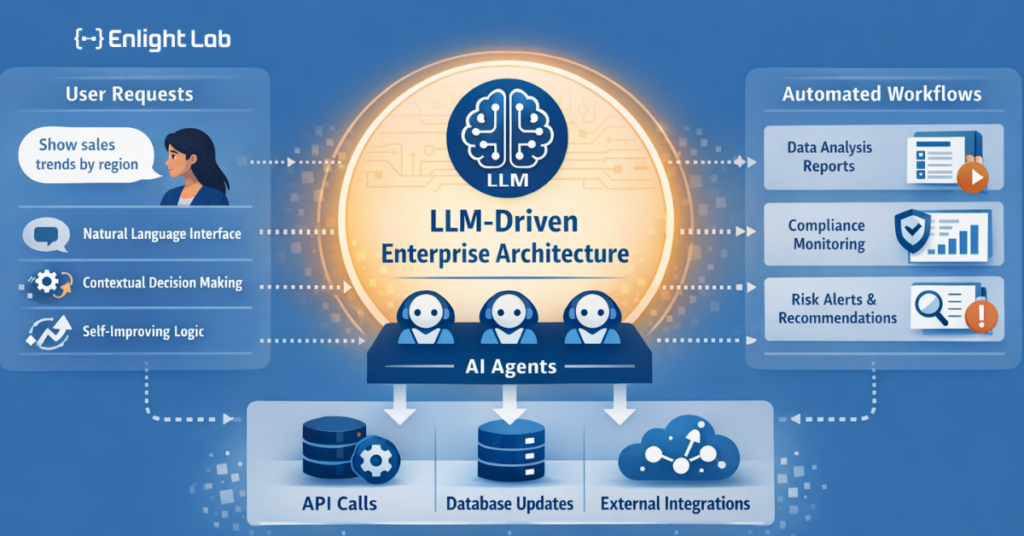
Large Language Models (LLMs) represent the new heart of enterprise architecture. No longer just for generating marketing copy or code snippets, LLMs now bridge the gulf between business intent and machine action.
Deploying an LLM means you can translate requests and workflows phrased in plain English into sequences of API calls, database updates, and external integrations. Your teams communicate business goals directly, while the system determines and executes the details, without needing intermediate user interfaces.
From a technical perspective, LLMs provide:
- Natural language interface: Eliminate the last barriers to digital adoption by letting workers interact with systems using plain commands
- Contextual decision-making: Use real-time signals, environmental cues, and historical patterns to infer and execute the best next action
- Self-improving logic: Refine processes continuously based on user feedback, system logs, and changing conditions
Enabling headless architectures
A key architectural innovation is the move to “headless” systems. In a headless world, your microservices, databases, and APIs serve as the foundation, while LLM-driven agents orchestrate all interactions. There is no need for a web portal or mobile app for every function; a single conversational or command interface suffices.
Trust-First Architecture and Human-in-the-Loop Governance: A modern agentic system must be architected for trust from the start. This means building a “Trust-First” framework, where governance is not an afterthought but core to the design. In practical terms, this requires robust ‘Human-in-the-Loop’ (HITL) checkpoints. Rather than letting agents execute every instruction unchecked, the system automatically flags and pauses high-risk actions, such as significant financial transfers, contract generation, or critical legal decisions.
At each HITL checkpoint, a designated human reviewer is prompted to review, approve, or veto the flagged action before execution. If an agent seeks to initiate a wire transfer or sign a legal agreement, the workflow halts until a qualified person evaluates the context and outcome. This ensures that final authority rests with experienced decision-makers, not just algorithms, providing an auditable layer of oversight for every high-impact operation.
HITL checkpoints also allow continuous calibration: feedback from human approvals and vetoes is systematically logged and fed back into agent behavior, creating a self-improving governance loop. The result is clear visibility, accountability, and the peace of mind that your critical business operations remain both agile and secure.
Security Considerations:
- Authentication: Every agent interaction with an API must be authenticated using robust, modern protocols like OAuth 2.0, ensuring only authorized agents can execute high-impact actions.
- Rate Limiting: Protect your systems from runaway agent activity by setting fair limits on operations and monitoring for abusive patterns.
- Auditing: All agent actions should be logged, versioned, and attributable, so you can trace and audit every transaction in the event of an incident.
The flexibility of LLM-driven systems
LLM-based frameworks deliver several transformational benefits:
- Plug-and-play integrations: Easily swap out vendors, microservices, or APIs. Agents adapt routes on the fly, minimizing downtime or costly migrations.
- Horizontal scalability: Add more inference nodes to handle surges in user or agent demand without touching the business logic layer.
- Edge computing compatibility: Push certain workloads closer to where the data is generated or consumed, whether that’s in remote offices, IoT networks, or distributed teams.
Scalability is no longer just about adding servers; it is about continuous operational flexibility. If a legal requirement changes or a new market emerges, agents can absorb new rules, retrain on live data, and update their workflows with minimal intervention.
Cost-efficiency and performance
By abandoning heavy, monolithic front-ends, agentic architectures minimize your infrastructure costs. No more rendering massive JavaScript bundles to maintain dashboards for thousands of users. Instead, computational resources are consumed only during agent tasks, making cloud spend far more predictable and aligned with value delivered.
Operational performance shines as well:
- Optimized DevOps: Updates to agents or backend services can be shipped independently, making agile changes safe and routine
- End-to-end transparency: With all agent actions logged and reasoned, continuous improvement and troubleshooting become cultural norms
- Data privacy and compliance: Advanced privacy strategies—anonymization, data minimization, strong identity controls—are fully compatible with agentic architecture, making regulatory compliance an achievable baseline rather than an afterthought
Compliance with GDPR, CCPA, or industry-specific rules is greatly simplified when autonomous agents enforce policies as they go, instead of requiring batch jobs or manual audits.
Business Implications and ROI
The cost savings of adopting AI agents
Adopting AI agents is not just a strategic move; it delivers hard returns. Automating repetitive, manual tasks directly lowers operational overhead. For example:
- In customer service, chat and email agents can resolve up to 90 percent of tier-one queries instantly, reducing the need for large entry-level teams
- In finance, payroll and expense-management agents can verify claims, detect potential fraud, and reconcile errors without sitting in a spreadsheet marathon
Less obvious, but even more valuable, is the improvement in employee experience. When individuals can shed menial work, morale, retention, and productivity rise together, lowering hidden costs tied to burnout and turnover.
The rise of fractional AI leadership
A crucial lever for transformation is agile leadership attuned to both legacy constraints and frontier opportunities. The Fractional CTO is not just a temporary advisor but the essential bridge connecting entrenched technical debt with the demands of the agentic era.
Agent-Readiness Audit: Before deploying AI agents, a thorough Agent-Readiness Audit is needed. Most companies operate with ‘Dirty Data’—inconsistent formats, missing fields, duplicates, and insecure repositories—which will immediately break even the most advanced AI agent. The Fractional CTO leads this audit to diagnose hidden data fragmentation, broken integrations, and unreliable APIs across your stack. This technical due diligence reveals where your ‘Data Plumbing’ is leaking and must be fixed before automation can deliver value.
Their first order of business is to oversee and execute comprehensive data remediation. This means:
- Standardizing datasets and cleansing records
- Enforcing data validation protocols at every integration point
- Documenting processes and establishing clear data ownership
- Upgrading infrastructure to ensure compatibility and security
Only after these critical steps does it make sense to deploy multi-agent systems. Building strong data foundations first is what allows AI agents to operate autonomously, execute reliably, and scale without causing chaos. A Fractional CTO views this as essential groundwork, not a nice-to-have, for any business ready to unlock the trapped value in legacy software.
What does a Fractional CTO bring to the ‘agentic’ journey?
- Objective system audit: Identify technical debt, integration friction, and data hygiene gaps that could sabotage agent deployment
- Agent-Readiness Assessment: Analyze your systems for consistency, reliability, and API compatibility. Pinpoint legacy elements that need modernization before agents can function autonomously
- Data health interventions: If your data is fragmented, inconsistent, or insecure, a fractional leader will coordinate data remediation—standardizing formats, enforcing validations, and removing technical roadblocks
- Vendor-neutral advice: Unlike vendors selling their stack, a fractional CTO has the mandate to act in your long-term interest, mapping processes to the most fit technical components and open standards
This ensures you extract maximal ROI from each AI investment, reducing the risk of failed pilots or half-integrated tools.
The move toward 24/7 autonomous operations
With AI agents, your business can operate at all hours.
- Global support coverage without expensive night-shift staffing
- Continuous compliance monitoring so no anomaly or violation slips through cracks overnight
- Automated ops that prep systems for the next working day long before human employees return
This continuous digital labor levels the playing field for smaller firms. Startups with a handful of strategic leaders can now outpace incumbents with layers of middle management, simply by deploying fleets of agents across core and support processes.
Measuring success and ROI
Tracking the success of your AI transformation is critical. Instead of chasing vanity metrics, prioritize KPIs such as:
- Reduction in manual processing hours per department
- Decrease in average ticket or request resolution time
- Acceleration of formerly slow-running processes, such as onboarding, quarterly closes, or audit prep
- Net reduction in infrastructure costs, especially cloud SaaS spend
For each initiative, document the before and after state in clear business terms. This not only makes wins visible, but exposes further optimization opportunities as the organization matures in agent adoption.
Conclusion: Adapt or Become Obsolete
There is no way to sugarcoat it: traditional software and menu-driven architectures are throttling your productivity and flexibility.
- Agentic systems, powered by natural language models and streamlined backend integration, allow businesses to leapfrog competitors and unlock a new era of scale and innovation.
- The barrier to entry is now a willingness to rethink operations and invest in smart, outcome-driven change—no longer an overwhelming capital expense or years-long migration.
The urgency of transitioning to agentic systems
AI-first competitors are already reshaping the market.
- Speed of execution: New entrants can spin up new processes or deploy changes overnight, where SaaS-reliant incumbents require weeks of testing and rollout.
- Cost advantage: With 80 percent less operational overhead, an AI-first startup can undercut prices, hire better talent, or fund aggressive growth.
- Market share capture: Agents launch personalized campaigns, onboard clients instantly, and execute tailored strategies at scale, outpacing slower rivals before the legacy team even finishes its next update.
As regulatory and market landscapes shift, agentic operations grant adaptability. Those stuck in static architectures risk broken workflows, compliance failures, and diminishing relevance.
The risks of maintaining legacy workflows
Holding on to outdated platforms and manual processes means:
- Money spent on unused software features and wasted cloud capacity
- Delays in product development, release cycles, and innovation—giving nimble, AI-first competitors space to enter and win
- Frustrated teams who see digital opportunities but are left executing repetitive tasks or fixing brittle integrations
Consider these disruptions:
- An AI-first logistics competitor reduces customer onboarding from days to minutes, automating document verification and assigning agents to coordinate routes in real time. Meanwhile, the incumbent struggles to ramp up new customers due to manual checks and fragmented systems.
- A modern fintech startup uses AI agents to review compliance paperwork and flag suspicious transactions in real time, making audits painless while their traditional rivals drown in quarterly reconciliations.
- In SaaS itself, vendors deploying agentic solutions streamline client onboarding, ticket management, and account renewals, meaning one customer rep can manage three times the book of business of their traditional peers.
Audit Your Infrastructure: Start Your Digital Transformation
Do not let outdated software and manual bottlenecks hold your company back. The Enlight Lab System Audit is the definitive way to uncover the trapped value hidden in your legacy software and manual workflows. This is the inflection point for every CEO and CTO intent on building a scalable and resilient business.
- Challenge yourself: Rigorously evaluate your current stack and operations. Find where your people spend the most time babysitting software rather than driving outcomes.
- Take action: Bring in strategic technical leadership geared for transformation, not maintenance.
- Partner for growth: Enlight Lab stands ready to help you identify your most expensive manual bottlenecks, audit your agent-readiness, and chart a roadmap into the agentic era.
Contact Enlight Lab today to schedule your comprehensive System Audit. We will deliver the clarity, expertise, and innovation strategy required for your next phase of growth. The future belongs to those who automate it. Build it with Enlight Lab.