Mastering Enterprise AI Governance and Compliance is no longer optional. Organizations must navigate evolving global regulations to ensure secure, ethical, and legally sound artificial intelligence deployments.
Building a business is hard enough without worrying that your latest feature release might trigger a multi-million-dollar lawsuit. You invest in artificial intelligence to move faster, automate tedious workflows, and give your customers a better experience. Then, the legal landscape shifts. Suddenly, courts are scrutinizing training data, regulators are demanding model transparency, and your team is left wondering how to deploy new tools without stepping on a legal landmine.
You are not alone in this frustration. According to a 2025 survey by Perforce Software, 91% of enterprise leaders believe sensitive data should be allowed in AI training, yet 78% remain highly concerned about the theft or breach of that exact data. The tension between rapid innovation and regulatory caution is the defining challenge for CTOs and founders today. Ignoring these rules is no longer an option, as regulatory bodies transition from issuing guidelines to enforcing strict penalties.
This guide breaks down exactly what you need to know to protect your business. By implementing proven AI regulation and compliance strategies for modern enterprises, you can stop viewing compliance as a roadblock. Instead, you can use it as a framework to build secure, trustworthy, and scalable products that your customers can rely on.
This guide outlines how businesses can mitigate algorithmic risks, implement ethical AI policies, and leverage modern technologies to maintain continuous alignment with international laws.
Why is AI Regulation Evolving So Rapidly for Enterprises?
The rapidly evolving landscape of artificial intelligence demands stringent oversight to prevent misuse and protect data privacy. The necessity of regulation for ethical and safe AI deployment stems from the technology’s capacity to make autonomous decisions that impact human lives.
Overviewing global regulatory trends reveals a shift from voluntary guidelines to strict legal mandates. Frameworks such as the EU AI Act and the NIST AI Risk Management Framework (NIST AI RMF) define how organizations must approach Enterprise AI Governance and Compliance. Establishing these guardrails ensures accountability.
What Are the Key Regulatory Frameworks Impacting Enterprise AI Governance and Compliance?
To build an effective compliance program, business leaders must first understand the rules of the road. The regulatory environment is fragmented, but a few major frameworks dictate how companies must operate globally.
Global impact of the EU AI Act
The European Union’s AI Act is the world’s first comprehensive legal framework for artificial intelligence, and its rollout is already impacting global markets. As of February 2025, the EU officially banned “unacceptable risk” AI systems, such as cognitive behavioral manipulation and social scoring. By August 2025, strict rules for general-purpose AI (GPAI) models will take effect, with the full legislation becoming applicable in August 2026. Non-compliance carries severe consequences, with fines reaching up to €35 million or 7% of a company’s global turnover. Any modern enterprise doing business in Europe must classify its AI tools according to these risk tiers immediately.
Implications of GDPR and data privacy
The General Data Protection Regulation (GDPR) intersects heavily with AI development. AI models require massive datasets, which often include personally identifiable information (PII). Under GDPR, data subjects have the right to be forgotten. Complying with this request in a machine learning context requires “machine unlearning” – a complex technical process to remove specific data points without destroying the entire model. Startups must ensure they have a lawful basis for processing personal data before feeding it into any AI system.
United States sector-specific regulations
Unlike the EU, the United States relies on a patchwork of state and sector-specific laws. Colorado’s Artificial Intelligence Act, set to take effect in February 2026, requires developers and deployers of high-risk AI to conduct impact assessments and prevent algorithmic discrimination.
At the federal level, the NIST AI Risk Management Framework (NIST AI RMF) provides voluntary guidelines that many enterprise procurement teams now demand. Additionally, agencies like the Federal Trade Commission (FTC) are actively prosecuting companies for deceptive AI marketing claims.
What Are the Main Challenges in AI Compliance?
Integrating artificial intelligence introduces unique operational hurdles. Technical leaders must balance performance goals with ethical and legal constraints.
Data privacy and ethical AI use
The hunger for training data often collides with privacy rights. Engineering teams frequently scrape public websites or utilize customer data to refine models. However, using proprietary or sensitive information without explicit consent creates massive legal exposure. Companies must implement strict data provenance tracking to prove exactly where their training material originated.
Transparency and model explainability
Regulators increasingly demand to know how an algorithm reached a specific decision. This concept, known as explainable AI (XAI), is particularly critical in finance, healthcare, and human resources. If an AI system denies a customer’s loan application or rejects a job candidate, the enterprise must be able to explain the exact parameters that drove that outcome. Black-box models that offer no insight into their reasoning are becoming a severe liability.
Bias and fairness in AI algorithms
AI models learn from historical data, which inherently contains human biases. If a hiring algorithm is trained on resumes from a male-dominated industry, it will naturally favor male applicants. Deploying biased models harms consumers and invites immediate regulatory scrutiny. Modern enterprises must actively test their systems for discriminatory patterns before, during, and after deployment.
Cross-border data flow and jurisdiction issues
Cloud-based AI tools often process data across multiple geographic locations. A startup based in New York might use a model hosted in Germany to process data from customers in Japan. Navigating the conflicting data sovereignty laws of these different regions requires robust mapping and strict vendor agreements to ensure compliance across all active jurisdictions.
How Can Businesses Develop Robust AI Regulation and Compliance Strategies for Modern Enterprises?
Proactive governance is the only way to scale AI safely. Founders and CTOs should embed compliance into their engineering culture from day one.
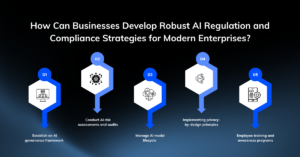
Establish an AI governance framework
Every modern enterprise needs an internal AI governance committee. This cross-functional group – typically comprising legal, security, engineering, and product leaders – defines acceptable AI use cases. The committee should maintain an active AI deployment inventory, logging every algorithm used across the company. This ensures that shadow IT does not expose the business to unvetted regulatory risks.
Conduct AI risk assessments and audits
Before launching any AI-driven feature, companies must conduct a thorough risk assessment. This involves mapping the data flow, identifying potential biases, and evaluating the impact of a model failure. Regular third-party audits provide an objective evaluation of these systems, ensuring they align with frameworks like the NIST AI RMF or the EU AI Act.
Manage AI model lifecycle
Responsible AI development practices demand privacy-by-design and fairness testing at every stage. Continuous monitoring and auditing of AI systems ensure that models do not experience data drift or develop biased outputs after deployment.
Implementing privacy-by-design principles
Privacy should never be an afterthought. Engineering teams must adopt privacy-by-design methodologies, incorporating data minimization and anonymization techniques directly into the model architecture. By stripping personally identifiable information from datasets before training begins, companies drastically reduce their compliance burden.
Employee training and awareness programs
A company’s AI compliance is only as strong as its least informed employee. According to a 2025 Moody’s survey, over 50% of risk and compliance professionals are now using or trialing AI, up from 30% in 2023. As adoption spreads across departments, staff must understand the risks of feeding confidential company data into public large language models (LLMs). Clear guidelines and regular training sessions mitigate these internal security threats.
How Do Sector-Specific Regulations Impact AI Deployments?
Different industries face unique compliance burdens:
- Healthcare: AI tools used for diagnostics must comply with medical device regulations and patient privacy laws (like HIPAA).
- Finance: Algorithmic trading and credit scoring models require rigorous fairness testing to avoid discriminatory lending practices.
- Defense: Military and defense contractors must adhere to strict security clearances and autonomous weapon limitations.
What Practical Steps Ensure Enterprise Implementation?
Moving from theory to practice requires specific operational steps to maintain Enterprise AI Governance and Compliance.
Why is Conducting an AI Inventory and Risk Mapping Important?
Organizations cannot govern what they do not know exists. Conducting an AI inventory and risk mapping helps enterprises locate “shadow AI” (unauthorized tools used by employees) and assess the risk level of all deployed models.
How Do Employee Training and Awareness Programs Help?
Human error remains a significant risk. Employee training and awareness programs ensure that staff understand data privacy policies, recognize algorithmic bias, and know how to safely use generative artificial intelligence tools.
Which Technologies Support Enterprise AI Governance and Compliance?
Leveraging technology for compliance streamlines oversight. RegTech software automates policy enforcement, while MLOps tools provide version control, bias detection, and audit trails for machine learning models.
Why Should Companies Partner with Legal and Compliance Experts?
Partnering with legal and compliance experts ensures that internal policies reflect the latest regulatory updates. External audits provide objective assessments of an organization’s Enterprise AI Governance and Compliance posture.
What Can We Learn from Case Studies and Best Practices?
Analyzing real-world scenarios helps organizations refine their Enterprise AI Governance and Compliance frameworks.
What Are Examples of Successful AI Compliance Implementations?
Financial institutions utilizing the NIST AI RMF have successfully deployed fraud detection models that maintain high accuracy while passing strict regulatory fairness audits. These companies embed compliance checkpoints directly into their development pipelines.
What Are the Lessons Learned from Non-Compliance?
In 2024, Air Canada was held liable when its customer service chatbot provided inaccurate refund information to a passenger. This case highlights the critical need for human oversight and continuous monitoring of customer-facing artificial intelligence.
What Are Industry-Specific Best Practices for Managing AI Risk?
- Pro Tip: In healthcare, anonymize all training data and utilize federated learning to keep patient records localized.
- Pro Tip: In finance, conduct monthly algorithmic audits to ensure credit-scoring models do not inadvertently discriminate against protected demographics.
Common Mistakes to Avoid
- Ignoring Shadow AI: Failing to track third-party generative artificial intelligence tools used by employees.
- Treating Compliance as a One-Time Event: Artificial intelligence models evolve; continuous auditing is mandatory.
- Siloing Governance: Leaving Enterprise AI Governance and Compliance solely to the IT department rather than creating cross-functional teams.
What is the Future of AI Regulation and Compliance?
The regulatory landscape will continue to expand as artificial intelligence capabilities grow.
What Are the Emerging Trends in AI Governance?
Emerging trends in AI governance include mandatory algorithmic impact assessments and the rise of automated compliance monitoring tools. Regulators are increasingly focusing on the environmental impact of training large language models.
How Does International Cooperation Impact Standardization?
The role of international cooperation and standardization is vital for multinational corporations. Organizations like the ISO provide unified frameworks (such as ISO/IEC 42001) that help businesses meet overlapping jurisdictional requirements.
How Can Businesses Prepare for Future Regulatory Challenges?
Preparing for future regulatory challenges requires building flexible governance frameworks. Organizations must monitor global legislative developments and maintain agile MLOps pipelines that can quickly adapt to new testing requirements.
Next Steps for Enterprise Leaders
Securing your organization’s future requires prioritizing proactive risk management. Maintaining rigorous Enterprise AI Governance and Compliance protects brand reputation, ensures legal safety, and drives sustainable innovation. Do not wait for regulatory penalties to enforce accountability. Take control of your artificial intelligence strategy and partner with Enlight Lab today to build a compliant, future-proof AI ecosystem.