Making technology investments as a founder or CTO often feels like trying to hit a moving target. You have to balance your immediate business needs with long-term scalability. Right now, the most significant shift in enterprise technology is the transition from single-task artificial intelligence to advanced multimodal AI models.
Early AI platforms required separate tools for text generation, image creation, and data analysis. This fragmentation slowed down your workflows and created unnecessary friction for your development teams. Multimodal AI models solve this problem by natively processing text, audio, images, and video within a single system.
For non-technical entrepreneurs and seasoned engineering leaders alike, understanding these unified AI systems is critical. Selecting the right AI architecture determines how quickly your business can ship products, resolve customer support tickets, and analyze market data.
This guide breaks down the specific AI systems dominating the market in 2026, complete with verifiable benchmarks and practical business use cases to help you make informed technical decisions.
What Are Multimodal AI Models and Why They Are Important in 2026
Multimodal AI models are AI systems that process and combine multiple data types such as text, images, audio, and video within a single framework to generate more context-aware and accurate outputs.
They enable cross-modal reasoning, reduce pipeline complexity, and unlock real-world applications like intelligent support systems, visual analysis, and AI copilots.
The Evolution from Single-Task Systems
Just a few years ago, AI architecture relied entirely on unimodal designs. You used a large language model to write emails, a separate diffusion model to generate images, and a distinct audio model to transcribe meetings. Integrating these disjointed systems required complex API engineering and massive engineering overhead.
The breakthrough for multimodal AI models came with the adoption of the Mixture-of-Experts (MoE) architecture. According to industry analyses from 2025 and 2026, MoE allows an AI system to scale up its total parameter count without requiring massive computational power for every single query. Instead of activating the entire neural network for a simple prompt, an MoE model uses a specialized router to send the task to a specific “expert” subset of the network.
This architectural shift changed everything for enterprise software. AI platforms could suddenly process a massive PDF, analyze an accompanying chart, and listen to an audio recording simultaneously. For you, this evolution means lower inference costs and significantly faster data processing capabilities.
Top 6 Multimodal AI Models Leading Innovation for 2026
The AI market has moved past the idea of a single, all-knowing algorithm. Today, you can achieve success by choosing specialized AI models based on specific functional strengths.
Here is a breakdown of the 6 top-notch multimodal AI models you should consider for your product.
Google Gemini 3.5 Flash Model
Google Gemini 3.5 Flash is an ultra-fast and lightweight multimodal model optimized for high-volume, high-frequency tasks where speed and efficiency are critical. While it shares the advanced Mixture-of-Experts (MoE) architecture of its predecessors, it is specifically distilled for rapid performance, making it a cost-effective choice for developers. Gemini 3.5 Flash delivers powerful multimodal reasoning at a fraction of the cost, handling complex inputs with impressive speed.
Key Features
- Speed and Efficiency: Purpose-built for high-speed, low-latency applications.
- Cost-Effective: Offers a significantly lower price point, ideal for scaling AI-powered features.
- Multimodal Grounding: Capable of grounding its reasoning in information from text, images, and audio, allowing for more precise and relevant responses.
- Large Context Window: Supports a 1-million-token context window, enabling it to process extensive information like lengthy videos or large document collections in a single prompt.
Use Cases
Choose Gemini 3.5 Flash for tasks that demand rapid response times, such as:
- AI-Powered Chatbots: Provides quick, summarized answers in real-time conversations.
- Real-Time Data Analysis: Analyzes live data streams for tasks like captioning images or extracting information from documents as they appear.
- High-Volume Task Automation: Efficiently handles large-scale, repetitive AI functions.
Innovative Aspects
- Model Distillation: Gemini 3.5 Flash is created through a process called “distillation,” where the essential knowledge from a larger model (like Gemini 3.5 Pro) is transferred to a smaller, more efficient one.
- Optimized for Speed: While still highly capable, its primary strength lies in its speed, making it the fastest model in the Gemini family for most common tasks.
Anthropic Claude 4.5 Sonnet for Complex Software Engineering
Anthropic Claude 4.5 Sonnet is a cutting-edge, safety-first hybrid reasoning model. It has been specifically optimized for high-stakes, autonomous coding and software engineering tasks, setting a new benchmark for AI in complex development environments.
Key Features
- Autonomous Operation: Claude 4.5 Sonnet is engineered to operate autonomously for hours, performing complex tasks without continuous human intervention.
- Advanced Agent SDK: It utilizes a sophisticated Agent SDK, enabling it to read entire codebases, strategically plan structural changes, and execute comprehensive test suites.
- Proven Debugging Prowess: According to SWE-bench Verified, the industry’s gold standard for evaluating an AI’s ability to solve real-world GitHub issues, Claude 4.5 Sonnet successfully resolves an impressive 70.6% of historical bugs.
Use Case
This model is the premier choice for businesses where agentic coding and dependable software debugging are critical priorities. It excels in environments that require reliable, autonomous code generation, bug fixing, and structural code refactoring.
Innovative Aspects
The primary innovation of Claude 4.5 Sonnet lies in its specialized design for autonomous software development. Its ability to independently manage complex coding projects from planning to execution represents a significant leap forward. This makes it an invaluable tool for engineering teams aiming to enhance productivity and code quality.
OpenAI GPT-5 for Expert-Level Knowledge Retrieval
GPT-5 is a unified AI system, not a single algorithm. It uses intelligent prompt routing to handle queries, sending simple questions to a fast, lightweight sub-model and complex problems to a more advanced reasoning module.
Key Features
- Intelligent Prompt Routing: Dynamically allocates queries to the most appropriate sub-model for optimal performance. Simple tasks go to faster models, while complex problems are handled by more advanced ones.
- Expert-Level Accuracy: Consistently achieves exceptional scores on the Graduate-Level Google-Proof Q&A (GPQA) benchmark. This demonstrates its ability to answer difficult, expert-level questions with remarkable precision.
- Hierarchical Processing: Utilizes a layered architecture that optimizes for both speed and accuracy.
Use Cases
It’s the ideal choice for businesses in highly technical fields, such as science, engineering, or finance, that require rigorous, expert-level logic, deep reasoning, and accurate knowledge retrieval.
Innovative Aspects
Its innovation lies in its hierarchical processing architecture. By dynamically allocating resources based on query complexity, GPT-5 optimizes both speed and accuracy. It delivers expert-level answers for complex problems while staying efficient for simpler tasks.
Moonshot Kimi K2 for Customer Service Agents
The Moonshot Kimi K2 is a trillion-parameter MoE model developed in China. It has been specifically engineered for service automation and excels at understanding and responding to human language.
Key Features
- Large Context Window: Boasts a massive 256,000-token context window, allowing it to process and understand extensive conversations and documents.
- Advanced Tool Usage: Ranks at the top of the Tau2-bench Telecom benchmark, demonstrating superior ability to use external tools and APIs effectively.
- Human-like Negotiation: Excels in negotiating with human users, making it highly effective for complex customer service interactions.
Use Cases
This model is designed for companies aiming to fully automate their inbound support desks. It can handle complex customer service issues, from simple queries to multi-step resolutions, at a highly efficient cost-per-task.
Innovative Aspects
Unlike many Western AI models focused on software engineering, Kimi K2’s innovation is its specialized focus on human-centric service automation. Its ability to navigate complex dialogues and utilize external tools makes it a leader in creating sophisticated, autonomous customer support agents.
Meta Llama 4 Scout for Enterprise Data Processing
Meta Llama 4 Scout is an open-weights multimodal AI model, which means businesses can host the system on their own private servers. This approach fundamentally changes the economics and security of enterprise AI.
Key Features
- Massive 10-Million-Token Context Window: Process enormous datasets in a single prompt, from entire financial histories to extensive legal libraries.
- Open-Weights Model: Host the system on your own private servers, giving you complete control over your data and enhancing security.
- Cost-Effective Data Processing: Analyze vast amounts of information, such as a decade of financial reports or thousands of legal contracts, without expensive, recurring API fees.
Use Cases
Llama 4 Scout is perfect for organizations where data privacy is a top priority. It’s ideal for massive-scale data processing, internal knowledge retrieval, and complex document analysis without incurring expensive API fees associated with third-party services.
Innovative Aspects
The combination of an open-weights framework with a colossal context window is its key innovation. This gives enterprises unparalleled control over their data and AI infrastructure, enabling deep, secure analysis of proprietary information at a scale that was previously impractical.
Google Veo 3 for Native Audio and Video Generation
Google Veo 3 is a generative media model that processes audio and video latents simultaneously in a single pass. This native multimodal architecture sets it apart from older tools that would simply layer an audio track over a silent video.
Key Features
- Unified Audio-Video Processing: Veo 3 processes audio and video latents together in a single pass, ensuring perfect synchronization.
- Realistic Physics Simulations: The model’s unified approach results in highly realistic physics simulations and motion within generated videos.
- Enhanced Coherence: By understanding the relationship between sound and motion, Veo 3 creates more believable and coherent audiovisual content compared to older models that simply layer audio over video.
Use Cases
Veo 3 is a production-ready engine for creative agencies, marketing firms, and entertainment startups. It can be used to generate holistic, physically plausible audiovisual content for advertisements, short films, and other media projects.
Innovative Aspects
Veo 3 represents a massive leap forward in generative media by treating audio and video as a single, interconnected entity from the start. This approach enables the creation of content with a level of realism and synchronicity that was previously unattainable, opening new doors for digital content creation.
Top Multimodal AI Models Comparison (2026)
| Model | Modalities Supported | Core Strength | Best For | Key Limitation |
| Google Gemini 2.5 Pro | Text, Image, Audio, Video | Deep multimodal reasoning with large context windows | Research, data-heavy workflows, video understanding | Higher complexity for implementation |
| Anthropic Claude 4.5 Sonnet | Text, Image | Strong reasoning with explainability and long-task execution | Enterprise workflows, document analysis, coding | Limited native audio/video support |
| OpenAI GPT-5 | Text, Image (Vision), Audio (via system integration) | Balanced performance with adaptive reasoning layers | Conversational AI, coding, agent-based systems | Multimodal depth varies by mode |
| Moonshot Kimi K2 | Text, Image (varies by deployment) | Cost-efficient, open-weight flexibility | Startups, self-hosted AI, agent systems | Less mature ecosystem compared to frontier models |
| Meta Llama 4 Scout | Text, Image, Video (emerging) | Massive context handling and open customization | Enterprise internal tools, large-scale data processing | Requires infrastructure and tuning for production |
| Google Veo 3 | Video, Audio, Text (generation-focused) | Advanced video generation and multimodal creativity | Media, content production, simulations | Narrow focus compared to general-purpose models |
Which Multimodal AI Model Should You Choose?
- For research & multimodal depth, use Gemini 3.5 Flash
- For enterprise reasoning & documentation, use Claude 4.5
- For general-purpose AI apps, use GPT-5
- For cost-sensitive deployments, use Kimi K2
- For custom/self-hosted AI, use Llama 4 Scout
- For video-first use cases, use Google Veo 3
Industry Impact on Healthcare, Finance, and Entertainment
The integration of these advanced AI systems is actively reshaping core business operations across major global industries.
- Healthcare: You can use multimodal AI models to cross-reference patient histories with real-time X-ray images and clinical trial data. For example, systems built on advanced AI architectures can now predict complex molecular interactions, dramatically reducing the time and cost required for pharmaceutical drug discovery.
- Finance: You can deploy models like Meta Llama 4 Scout to process years of unstructured market data. By analyzing text from earnings calls alongside visual data from market charts, these AI models identify investment patterns that human analysts simply cannot process fast enough.
- Entertainment: You can leverage Google Veo 3 to storyboard entire marketing campaigns rapidly. The ability to generate synchronized audio and video from a single text prompt significantly lowers production costs for your video marketing.
How To Choose the Right Multimodal AI Model
Define Your Objectives
Before selecting a multimodal AI model, it is crucial to identify the specific goals you hope to achieve. Whether you’re optimizing financial analysis, enhancing creative workflows, or streamlining customer experiences, having clear objectives will help you assess the capabilities of different models effectively.
Evaluate Data Compatibility
Different multimodal AI models are designed to process varying types of data. Be sure to select a model that aligns with the type of unstructured or structured data you work with, such as text, images, videos, or audio. Compatibility ensures smoother integration and better outcomes.
Consider Customization Potential
Some AI models provide greater flexibility for customization. If your industry requires specialized processing or unique outcomes, prioritize models that allow for fine-tuning and custom training on your domain-specific datasets.
Assess Scalability and Performance
The scalability of the AI model is another critical factor. Ensure the model can handle increasing workloads and deliver consistent performance as your data needs grow. This consideration is particularly important for businesses planning long-term expansion.
Analyze Cost and Support
Finally, factor in the cost of implementation and ongoing maintenance. Additionally, prioritize models supported by comprehensive documentation and active customer service to address any issues or questions during implementation and usage.
Ethical Challenges and Risks of AI Deployment
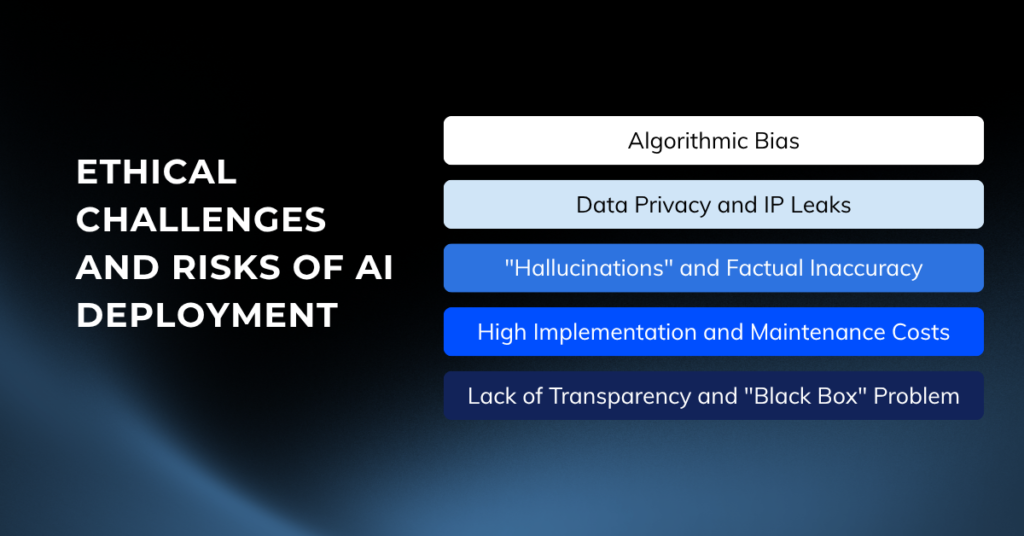
Integrating AI into your business architecture comes with distinct organizational responsibilities.
Challenge: Algorithmic Bias
Integrating AI into your business architecture introduces the risk of algorithmic bias.
- Problem: Multimodal AI models learn from vast datasets, which often reflect existing human prejudices. This can cause the AI to perpetuate these biases, leading to discriminatory outcomes in areas like hiring, loan applications, or customer profiling.
- Solution: Implement rigorous bias detection and mitigation strategies. This includes auditing datasets for representativeness, using fairness-aware machine learning algorithms, and conducting regular post-deployment performance reviews to identify and correct discriminatory patterns.
Challenge: Data Privacy and IP Leaks
Using AI, especially third-party models, raises significant data privacy and security concerns.
- Problem: Sending proprietary company data to closed-source APIs (like those from OpenAI or Google) can expose your organization to intellectual property leaks or data breaches.
- Solution: Mitigate this by using open-source models (e.g., Meta’s Llama series) for sensitive tasks or by securing enterprise-level data processing agreements that contractually prevent your AI vendor from using your data to train their models.
Challenge: “Hallucinations” and Factual Inaccuracy
AI models can generate plausible-sounding but entirely false information, a phenomenon known as “hallucination.”
- Problem: If an AI fabricates data, cites non-existent sources, or misinterprets a prompt, it can lead to poor business decisions, damage your brand’s credibility, and spread misinformation. This is especially risky in data-sensitive fields like finance, law, and healthcare.
- Solution: Always implement a human-in-the-loop (HITL) verification process for critical outputs. Use Retrieval-Augmented Generation (RAG) to ground the AI’s responses in a trusted, internal knowledge base, and fine-tune models with fact-checking datasets to reduce the frequency of hallucinations.
Challenge: High Implementation and Maintenance Costs
Deploying and maintaining a robust AI system requires significant investment beyond the initial setup.
- Problem: Costs include expensive computational hardware, specialized talent for development and oversight, API subscription fees, and continuous model training and fine-tuning. For many businesses, the total cost of ownership can be a major barrier.
- Solution: Start with smaller, well-defined pilot projects to demonstrate ROI before scaling. Leverage cloud-based AI platforms to avoid large upfront hardware costs, and utilize pre-trained models that require less data and computational power for fine-tuning.
Challenge: Lack of Transparency and “Black Box” Problem
Many advanced AI models, particularly deep learning networks, operate as “black boxes.”
- Problem: It can be extremely difficult, if not impossible, to understand how an AI model arrives at a specific conclusion. This lack of interpretability makes it challenging to troubleshoot errors, audit for bias, or comply with regulatory requirements that demand explainable decision-making processes.
- Solution: Employ Explainable AI (XAI) techniques like SHAP (SHapley Additive exPlanations) or LIME (Local Interpretable Model-agnostic Explanations). These tools provide insights into which features most heavily influenced the model’s decision, creating a layer of transparency for auditing and debugging.
Future Trends Beyond 2026
The AI market is moving rapidly toward specialized “Agentic” workflows. Instead of you prompting an AI for a single answer, you will be able to deploy interconnected AI agents that collaborate to complete entire projects.
You will also see a dramatic reduction in inference costs. As architectures like the Hybrid Transformer-Mamba (Hymba) become more prevalent, AI models will require significantly less computational overhead. This efficiency will allow you to run highly advanced multimodal AI models directly on your local hardware and mobile devices, eliminating latency and reducing cloud computing expenses.
Your Next Steps for AI Integration
The competition to build the most efficient tech stack is fierce, but your path forward is clear. You do not need to build your own AI from scratch. Your competitive advantage lies in identifying your specific business bottleneck and selecting the exact AI system built to solve it.
Start by auditing your most time-consuming operations. If your engineering team spends 30% of their week fixing minor bugs, pilot Anthropic Claude 4.5 Sonnet to automate those code reviews. If your customer service costs are eating into your margins, test Moonshot Kimi K2 to handle initial support tickets.
The organisations that win will be those that view multimodal AI models not as a novelty, but as a foundational layer of their business infrastructure.
Enlight Lab offers cutting-edge insights into model selection, ensuring you deploy systems optimised for performance and scalability. Thus, contact us today to integrate the right multimodal AI into your product or operations that drive innovation and maintain a competitive edge. The right architecture and model mix matter more than the model itself.