Artificial intelligence is no longer just a tool for basic automation; it’s a strategic asset that will define the next generation of business operations. As you look to integrate AI agents into your workflows, the most critical decision you’ll face isn’t if, but how. The market is messy, filled with competing claims about the best architectural approach. Your choice between a Single-Agent or a Multi-Agent System will fundamentally shape your company’s efficiency, scalability, and competitive edge.
According to recent research from Gartner, over 80% of enterprises will have used or deployed generative AI-enabled applications by 2026. Yet, many of these deployments fail to deliver a strong return on investment because companies choose the wrong underlying architecture. A single, powerful AI agent might seem like a straightforward solution, but asking it to juggle highly specialized, distinct tasks can lead to catastrophic bottlenecks. On the other hand, building a complex network of multiple AI agents communicating with one another might be an expensive overreaction to a simple problem.
Ultimately, there is no universal winner. Context is everything. The right choice depends entirely on the complexity of your problems, your resource limitations, and your plans for future growth.
This guide will analyze the core architecture of both single-agent and multi-agent systems, outlining their technical strengths, operational weaknesses, and ideal use cases. By the end, you will have the clarity needed to make the right architectural decision and build an AI framework that drives real business outcomes.
Single Agent Systems: Delve Deeper
When you’re looking at AI solutions, it’s helpful to think of single-agent systems as specialists, designed to operate independently and handle tasks within a specific domain of expertise. We find these systems are often simpler in architecture because they focus on performing a narrow range of tasks with high efficiency.
For your business, this approach is particularly advantageous when you need to address straightforward or well-defined problems, like automating customer service inquiries or managing inventory databases.
One of the key benefits we see with single-agent systems is how easy they are to implement and maintain. Since they are tailored to a singular purpose, they typically require fewer of your resources and are faster to deploy. This makes them an ideal starting point if you have a limited budget or are seeking quick solutions to isolated challenges.
How a Single‑Agent System Works
At runtime, the agent receives an input, loads its working context (instructions, recent history, retrieved documents), reasons across that information, and produces an output. The entire process is linear and synchronous. There is no parallel task execution and no internal delegation.
If the agent needs additional information, it must explicitly retrieve or be provided with it; otherwise, it operates strictly within what fits inside its context window.
Where We See It Operating Successfully
Single‑agent systems are already delivering real value in production environments:
- Customer support and helpdesk automation, where each interaction is self‑contained.
- Code assistants used by engineers for generation, refactoring, and explanation.
- Document Q&A tools for contracts, policies, compliance reviews, and internal knowledge bases.
- Internal productivity copilots for summarization, drafting, and analysis.
Best‑Fit Business Profiles
We typically recommend single‑agent systems when you:
- Want fast deployment with minimal engineering overhead
- Are automating narrow, well‑defined workflows
- Need strong explainability and predictable costs
- Are you early in AI maturity or scaling cautiously
Not every problem needs orchestration. Often, the fastest path to impact is one well‑designed agent that does one thing exceptionally well.
Multi-Agent Systems: The Collaborative Crew
Multi-agent systems consist of multiple interacting agents that work collaboratively to solve complex problems. These systems excel in handling tasks requiring distributed decision-making, adaptability, and scalability across dynamic environments.
Multi‑agent systems represent the shift from isolated intelligence to coordinated execution. Instead of a single model handling everything, we deploy multiple specialized agents working together to help you achieve your complex objectives. This collaborative environment allows you to tackle more intricate problems that might be unmanageable for a single-agent system.
As your trusted partner, we at Enlight Lab do not think in terms of simply adding more models. We design systems of intelligence that work the way strong teams do in the real world, with clear roles, coordination, and shared ownership of outcomes.
How Multi‑Agent Systems Work
A typical multi‑agent system consists of:
- An orchestrator or supervisor agent that understands the overall objective, decomposes tasks, and manages flow.
- Sub‑agents specialized for specific functions (research, planning, coding, validation, execution).
- Tool‑enabled agents that interface with databases, APIs, code runtimes, or analytical systems.
Tasks are broken down, assigned, executed (often in parallel), and then aggregated into a final outcome. This allows the system to handle problems that exceed the cognitive or contextual limits of a single agent.
Advantages of Multi-Agent Systems
When enterprise workflows outgrow the capabilities of a single model, transitioning to a distributed architecture unlocks several critical benefits.
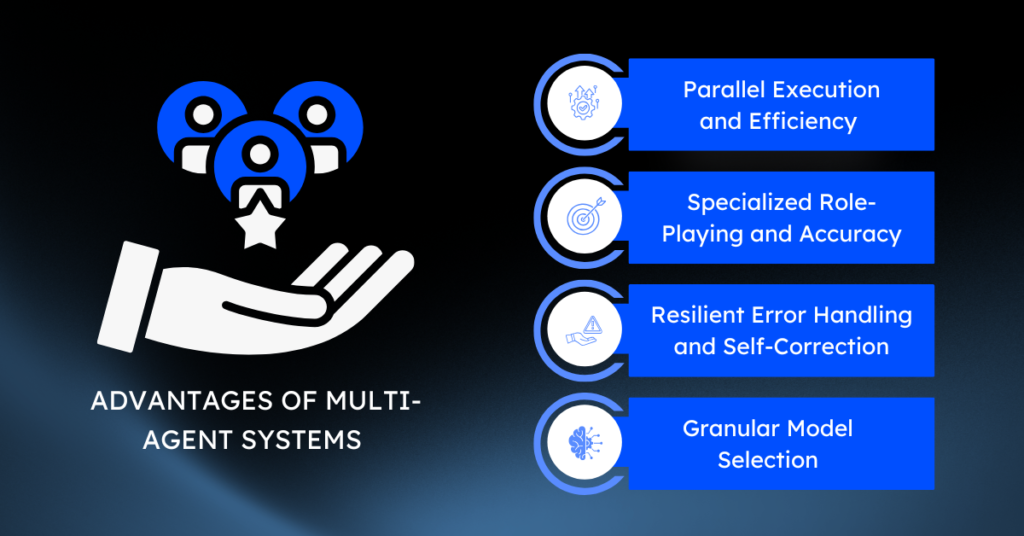
1. Parallel Execution and Efficiency
One of the most significant advantages of multi-agent systems is the ability to run concurrent processes. While a single agent must wait for a database query to finish before drafting an email, a multi-agent orchestrator can dispatch the database task to an “analyst” agent and simultaneously ask a “communications” agent to begin structuring the email template. This parallel execution dramatically reduces total time-to-completion for complex workloads.
2. Specialized Role-Playing and Accuracy
Generalist models are prone to generic outputs. By utilizing multi-agent orchestration, you can inject highly specific system prompts into individual agents. A “Security Compliance Agent” can be instructed to evaluate code strictly against OWASP top 10 vulnerabilities, while a “Performance Agent” evaluates the exact same code for memory leaks. Because each agent focuses on a narrow directive, the overall accuracy of the system increases significantly.
3. Resilient Error Handling and Self-Correction
Single agents often fail silently or get trapped in reasoning loops. Collaborative AI agents introduce an internal system of checks and balances. You can design workflows where a “Critic” agent evaluates the output of a “Generator” agent before passing the final result to the user. If the output fails the criteria, the Critic sends it back for revision. This autonomous QA process ensures higher reliability for mission-critical enterprise applications.
4. Granular Model Selection
Not every task requires the most expensive, highly parameterized LLM on the market. Multi-agent systems allow for cost optimization through model routing. You can assign complex reasoning tasks to a heavy, high-tier model, while assigning simple formatting or data extraction tasks to a smaller, faster, and cheaper open-source model.
Who Should Adopt This Model
We recommend multi‑agent systems when you are:
- Tackling complex, cross‑domain workflows
- Operating at enterprise or platform scale
- Optimizing for throughput and robustness, not just speed
- Ready to invest in orchestration, monitoring, and AI governance
Multi‑agent systems are not the starting point. For organizations ready to scale intelligence, they represent the future operating model.
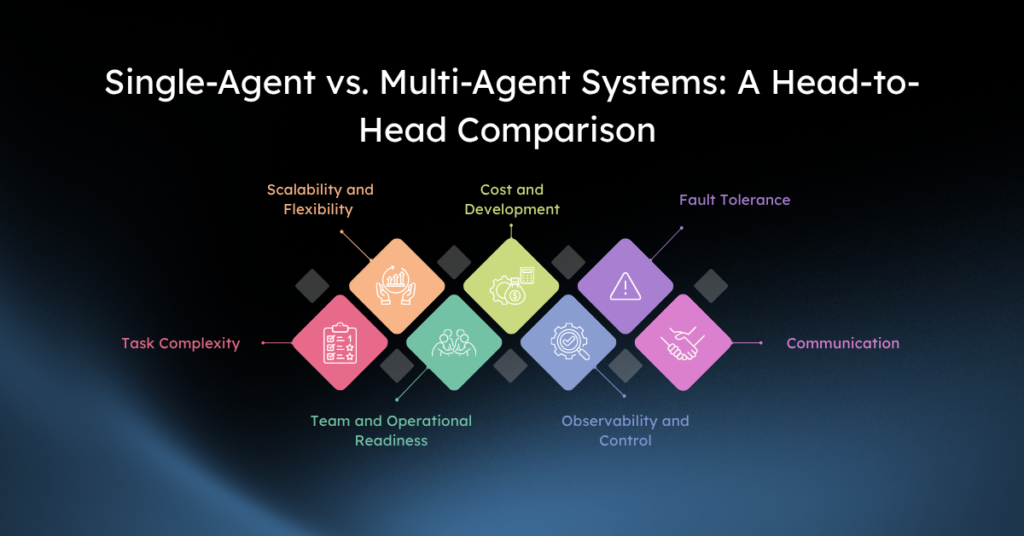
Single-Agent vs. Multi-Agent Systems: A Head-to-Head Comparison
Thinking about which system to implement? Let’s walk through the key differences so you can make the best choice for your project.
1. Task Complexity
First, we need to consider the complexity and scope of the problem you’re trying to solve.
If your workflows are single-domain and clearly bounded, we typically recommend starting with a single‑agent system. You get focus, speed, and clarity with minimal overhead. However, when you are dealing with multi‑domain problems such as research combined with decisioning, execution, and validation, complexity quickly exceeds what one agent can manage reliably. In those circumstances, we notice multi‑agent systems perform better because they allow you to distribute thinking across specialized roles instead of forcing one model to reason about everything at once.
2. Scalability and Flexibility
Single-agent systems execute sequentially, which often means lower latency for simple interactions. If responsiveness is your top priority and tasks are lightweight, this works in your favor.
Multi‑agent systems introduce coordination overhead, but they unlock parallel execution. When your workloads involve heavy reasoning, large data sets, or multiple steps, this is where these systems truly shine. They are highly scalable and incredibly flexible.
Need more processing power or want to cover a larger area? We can simply add more agents to the system. They are built to adapt to changing environments and new tasks on the fly, offering you a future-proof solution that evolves with your business.
3. Cost and Development
From a cost standpoint, single-agent systems are easier to predict and control. Token usage, infrastructure needs, and maintenance effort are straightforward. These systems typically come with lower initial development costs. So, if you’re working with a tight budget on a well-defined problem, this can be an attractive starting point.
The initial setup and development for Multi‑agent systems are more complex, which often means a higher upfront investment. These systems cost more to operate, no question. That said, when task complexity increases, we often see them lower total cost by reducing retries, downstream errors, and human intervention.
The real decision for you is whether you are optimizing for short‑term efficiency or long‑term scalability.
4. Fault Tolerance
The biggest risk of a single-agent system is the single point of failure. If your one agent goes down, the entire system stops working. It’s a high-stakes scenario that can bring operations to a halt.
Multi‑agent systems introduce the risk of cascading failures if orchestration is weak. If one agent fails, the others can adapt, take over its tasks, and keep the system running smoothly. This built-in redundancy ensures your operations remain robust and reliable, even when things go wrong.
5. Communication
Since the single agent operates alone, there’s little to no need for complex communication protocols. It perceives its environment and acts independently.
Communication is the lifeblood of multi-agent systems. They require robust and efficient channels for agents to coordinate their actions, share data, and work together toward a common goal. We’d help you design this communication network to ensure seamless collaboration.
6. Observability and Control
If transparency matters, single‑agent systems give you a clearer line of sight into reasoning and outcomes. Multi‑agent systems require stronger observability tooling to maintain control. The power is there, but only if you invest in visibility and governance.
7. Team and Operational Readiness
Finally, readiness matters. If your team is lean or early in AI adoption, single‑agent systems reduce execution risk. Multi‑agent systems make sense when you are prepared to manage orchestration, monitoring, and failure handling. Our role is to help you earn that complexity at the right time.
The right answer depends on where you are today and how deliberately you want to scale intelligence.
| Feature | Single-Agent Systems | Multi-Agent Systems |
| Control | Centralized decision-making | Distributed decision-making |
| Complexity | Simple architecture, easier to implement | Complex coordination among agents |
| Flexibility | Limited to predefined tasks | Highly flexible, adapts to new tasks |
| Fault Tolerance | Single point of failure | High resilience due to distributed nodes |
| Communication | Minimal or non-existent | Intense agent-to-agent communication |
| Cost | Lower initial development cost | Higher initial setup cost, but cost-efficient long term |
| Problem Solving | Limited to isolated problems | Solves complex and collaborative problems |
| Scalability | Poor scalability as system size increases | Excellent scalability with minimal bottlenecks |
Common Pitfalls to Avoid
When designing and implementing agent-based systems, there are several pitfalls that can create inefficiencies, increase complexity, or lead to failure. Being cautious of these common mistakes can significantly improve your project outcomes:
- Over-engineering: One of the most frequent traps is unnecessarily adding agents simply to increase complexity. While it may seem appealing to have a network of agents, this can lead to bloated systems, higher maintenance requirements, and diminished performance. Focus instead on meeting the specific needs of your task with the simplest architecture possible.
- Under-engineering: On the other hand, assigning too much responsibility to a single agent, without a clear scope or division of labor, creates bottlenecks and hampers scalability. Ensure each agent has a well-defined role, and the workload is distributed appropriately to match the system’s goals.
- Ignoring observability and evaluation: Monitoring and evaluating your system’s performance from the beginning is essential. Neglecting observability tools and metrics can leave you blind to shortcomings and unable to make informed adjustments as the system evolves.
- Treating agent coordination like regular API calls: Agent interactions differ greatly from traditional software API calls. They require careful planning around communication protocols, concurrency, and timing to ensure smooth and efficient collaboration. Failing to account for these nuances can create unpredictable outcomes.
Skipping human-in-the-loop checkpoints: For systems dealing with high-stakes decisions, skipping human oversight or review can lead to unintended consequences. Incorporate human checkpoints throughout the lifecycle to ensure ethical and informed decision-making.
5 Signals That You’re Ready for Multi-Agent Architecture
Are you wondering if it’s time to upgrade from a single-agent system? Here are five signs we look for to help you decide if a multi-agent architecture is right for you:
- Your Task Volume is Overwhelming: If your current single agent can’t keep up with the scale or complexity of tasks, it’s a clear signal that you need to bring in more agents to handle the load.
- You Need Specialized Skills: When you face specific problems that require unique expertise, incorporating specialized sub-agents is the logical next step to enhance your capabilities.
- You’re Hitting Performance Bottlenecks: Is your single-agent system slowing down, especially when speed is critical? This is a strong indicator that a multi-agent setup can improve your performance.
- Your Tasks are Becoming Interdependent: When your goals require different domains to collaborate and share information, transitioning to a multi-agent system will streamline your workflow and deliver better results.
- Your Team is AI-Mature: If your team has well-defined workflows, solid monitoring systems, and a deep understanding of AI, you’re in a great position to manage the power and complexity of a multi-agent framework.
Designing for Future Scalability Even in Single-Agent Builds
When you build a single-agent system, design for future scalability. A modular architecture will allow you to add new agents and capabilities without disrupting existing operations. We recommend using APIs that follow standard communication protocols, along with robust data schemas and scalable infrastructure. This approach prepares your system for a smooth transition to a multi-agent framework when your needs evolve.
How to Choose the Right AI System for Your Business
Selecting the right AI framework is a strategic decision. It requires a clear evaluation of your current operations and future goals. Here’s how to decide:
- Analyze Your Business Needs: Are you solving a simple or a complex problem?
- Assess Task Complexity: Can one program handle all the steps?
- Determine Scalability Requirements: Where do you see your business in five years?
- Review Your Resources: What is your budget and technical capability?
By answering all these questions, you will be able to select the right AI agent system for your business.
Conclusion: The Right Choice Is the One That Fits
When it comes to selecting an AI architecture, the key is ensuring that the solution aligns perfectly with the problem you are addressing. A well-designed architecture should always serve your specific needs, not dictate them.
The decision between a single-agent and multi-agent architecture fundamentally dictates how your AI applications will perform, scale, and cost.
Single-agent systems offer a fast, cost-effective path for linear, straightforward automation tasks. They are easy to build, easy to prompt, and highly efficient for narrow use cases.
Multi-agent systems provide the scalability, role specialization, and self-correction necessary for mission-critical enterprise operations. By leveraging multi-agent orchestration, businesses can execute complex, cross-domain workflows efficiently and accurately.
Choosing the right architecture requires deep technical expertise. Enlight Lab specializes in evaluating enterprise workflows and designing custom agentic architectures that scale securely. With our architectural guidance and development execution, you can bring your AI initiatives into production safely and efficiently. The vision you create today can define your success tomorrow.