The software development landscape is undergoing a seismic shift. For years, scaling a SaaS platform meant a linear increase in engineering headcount and long, grueling development cycles. Today, the advent of large language models (LLMs) and generative AI has torn up that playbook. According to a recent survey by GitHub, developers using their AI-powered Copilot are reporting productivity gains of up to 55%, a figure that engineering leaders cannot afford to ignore.
As we move deeper into 2026, we’re rapidly transitioning from rigid, monolithic software architectures to dynamic, AI-native SaaS platforms that learn, adapt, and personalize in real time. Generative AI in SaaS development has moved past experimentation and “innovation theatre.” Over the last two years, it’s become core infrastructure. At Enlight Lab, we are seeing a clear divide: SaaS companies that adopt Generative AI at the architectural level are scaling with 3.7x higher ROI, while those treating it as a “feature” are drowning in technical debt and user churn.
For SaaS leaders like CTOs, Engineering Managers, and Founders, the question is no longer if you should adopt Generative AI, but how deeply and systematically you can embed it into your product, platform, and roadmap. This technology is now the critical differentiator that will determine market leadership in the coming years.
Teams that treat AI as a bolt-on feature quickly hit limits: ballooning costs, brittle integrations, hallucinations, and disappointed users. But teams that treat it as a foundational capability unlock compounding advantages.
High-performing, AI-driven SaaS companies aren’t asking, “Where can we add AI?” They’re asking:
- How does AI reshape our user workflows?
- How does it change the economics of our product?
- How will it evolve faster than our codebase?
This article is a technical deep dive into Generative AI in SaaS, focusing on architecture, integration, and roadmap levels rather than just the hype. We’ll cover what generative AI is, how LLM integration changes the game, and why embracing RAG architecture for SaaS puts you ahead.
What is Generative AI in SaaS?
Generative AI in SaaS Development is a special kind of artificial intelligence that creates new content, ideas, or solutions by itself. It doesn’t just follow set rules or patterns. It can write, design, or answer questions like a real team member. Traditional artificial intelligence (AI) techniques rely on predefined rules and data inputs to perform tasks. Generative AI leverages deep learning algorithms to generate new solutions from scratch.
Generative AI introduces probabilistic reasoning. Instead of a fixed path, the software understands user intent.
- Legacy Approach: A user filters a CRM to find “leads who haven’t been contacted in 30 days,” exports them, and manually drafts emails.
- Generative Approach: A user tells the CRM, “Re-engage all stale leads with a personalized offer based on their last purchase,” and the system executes the entire workflow.
How It Is Different from Traditional AI/ML in SaaS
Traditional AI/ML can predict or classify based on past data. Generative AI, by contrast, answers new questions, writes code, drafts emails, or creates customized experiences for each user.
Comparison Table: Traditional AI/ML vs. Generative AI in SaaS
| Aspect | Traditional AI/ML | Generative AI (LLMs, Diffusion) |
| Output Type | Predictions, classifications | New content, language, code, images |
| Flexibility | Fixed use cases | Adaptable to varied user prompts |
| Integration Complexity | Custom data pipelines | API-driven (LLM integration, RAG) |
| User Experience | Static, report-driven | Interactive, real-time assistance |
| Examples | Risk scoring, alerts | Content generation, smart assistants |
Core Components of Generative AI for SaaS
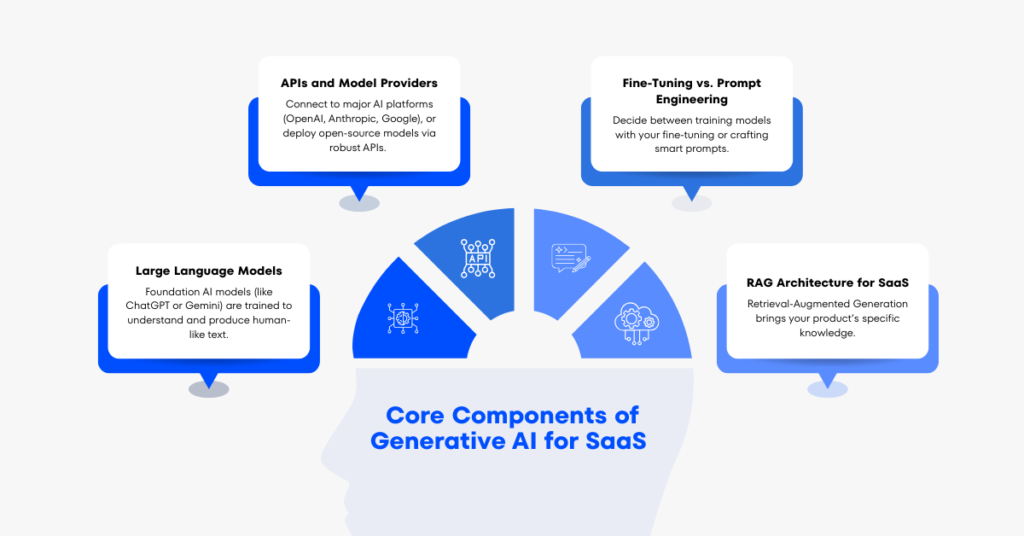
- Large Language Models (LLMs): Foundation AI models (like ChatGPT or Gemini) trained to understand and produce human-like text. LLM integration gives your SaaS features the ability to chat, summarize, write, and analyze.
- APIs and Model Providers: Connect to major AI platforms (OpenAI, Anthropic, Google), or deploy open-source models via robust APIs. Quick LLM integration gives you speed and scale.
- Fine-Tuning vs. Prompt Engineering: Decide between training models with your company data (fine-tuning) or crafting smart prompts (prompt engineering) so the model outputs what you need without retraining.
- RAG Architecture for SaaS: Retrieval-Augmented Generation brings your product’s specific knowledge into every AI reply, combining LLM flexibility with access to your unique data.
The Rise of Generative AI
Generative AI has rapidly emerged as a game-changing technology in the field of software engineering. While traditional artificial intelligence (AI) techniques rely on predefined rules and data inputs to perform tasks. Generative AI leverages deep learning algorithms to generate new solutions from scratch.
This approach has revolutionized how developers build applications by automating tedious and repetitive tasks that were previously done manually. With generative AI, engineers can now focus on higher-level tasks such as designing architectures, testing code, and solving complex problems.
Furthermore, unlike traditional coding methods, which are prone to human error, generative AI systems can produce highly accurate outputs with minimal effort.
The Transformative Benefits of Generative AI in SaaS Development
Integrating generative AI into the SaaS development lifecycle is a paradigm shift. By automating routine tasks and offering intelligent insights, AI empowers development teams to build better products faster. This leads to significant competitive advantages, from accelerated innovation to enhanced customer satisfaction.
Let’s explore the key benefits that generative AI brings to the table.
1. Accelerate Development Cycles and Time-to-Market
In the competitive SaaS landscape, speed is a critical advantage. Generative AI acts as a powerful catalyst, drastically reducing the time spent on repetitive and boilerplate coding.
- Instant Code Generation: AI tools can generate code snippets, complete functions, and even scaffold entire application components from simple natural language prompts.
- Focus on Innovation: This frees developers from mundane tasks, allowing them to focus on high-value, complex problem-solving.
- Faster Iteration: By automating the grunt work, teams can shorten iteration cycles, test new ideas more rapidly, and shrink the time-to-market for new features and products.
2. Enhance Code Quality
Writing clean, efficient, and bug-free code is fundamental to building a reliable SaaS product. Generative AI serves as a vigilant partner in maintaining high standards of code quality.
- Real-Time Analysis: AI tools analyze code as it’s written, offering intelligent suggestions to improve logic, optimize performance, and adhere to best practices.
- Proactive Bug Detection: They automatically detect potential bugs, security vulnerabilities, and anti-patterns that might otherwise make it to production.
- Reduced Technical Debt: This proactive approach ensures a cleaner, more robust codebase from day one, reducing technical debt and simplifying future updates.
This proactive approach ensures a cleaner, more robust, and highly maintainable codebase from the very beginning, reducing technical debt and simplifying future updates.
3. Foster Superior Collaboration
Effective collaboration is the backbone of any successful development team. Generative AI helps bridge communication gaps and streamline workflows across different roles. For instance, it can automatically generate clear, comprehensive documentation and code comments, making it easier for new team members to get up to speed or for developers to understand unfamiliar parts of the codebase. This shared understanding aligns developers, product managers, and QA testers, ensuring everyone is working from a single source of truth and minimizing misunderstandings.
4. Optimize Resources and Drive Innovation
By automating routine development and testing tasks, generative AI enables a more strategic allocation of a company’s most valuable asset: its engineering talent. With AI handling the repetitive work, senior developers can dedicate their time to architectural design, strategic planning, and mentoring junior team members. This optimization not only boosts team productivity but also fosters a culture of innovation. Engineers are empowered to experiment with new technologies and tackle more ambitious challenges, driving the product forward and solidifying its competitive edge in the market.
Understanding LLM Integration in SaaS Products
The integration of Large Language Models (LLMs) into Software as a Service (SaaS) products is rapidly transforming the digital landscape. By embedding the power of advanced AI, businesses can now deliver more intuitive, intelligent, and personalized experiences that were once considered futuristic. These sophisticated models enhance core functionalities like natural language processing, automated customer support, and real-time data analysis. So, you can make SaaS platforms more adaptive, efficient, and responsive to user needs.
Advantages of LLM Integration in SaaS Products
1. Making User Experience Better with Conversations
A primary advantage of LLM integration is the ability to create highly conversational and natural user interfaces.
Instead of clicking through many menus, users can just type or ask what they need. For example, they can:
- Write emails
- Summarize long reports
- Ask questions about data
This shift from a graphical user interface (GUI) to a conversational one makes technology more accessible and human-centric. It feels more like talking to a helpful assistant than using a complex tool.
2. Unlocking New Dimensions of Scalability and Innovation
Beyond enhancing user interfaces, businesses that integrate LLMs into their SaaS products can unlock new levels of scalability. They can create new features like:
- Real-time translation
- Smart predictions
- Personalized content suggestions
- Automatic code generation
These features help users do more work in less time. For companies, this means happier customers, better retention, and a stronger position in the market.
As people expect smarter and more interactive software, using LLMs is no longer optional. It is becoming essential for building modern SaaS products.
As user expectations for smarter, more interactive software continue to grow, investing in LLM integration is highly imperative, especially for building next-generation SaaS products.
Technical Architecture: RAG for Context-Aware SaaS
Building an AI-driven SaaS requires more than just calling an external API. To provide accurate, context-aware AI features without exposing sensitive customer data or getting generic answers, you need robust architectural patterns.
Why Retrieval-Augmented Generation (RAG) is Essential
Retrieval-Augmented Generation (RAG) architecture for SaaS solves the hallucination problem inherent in foundational models. By vectorizing your platform’s specific data and retrieving it dynamically during user queries, you ensure the AI operates strictly within the bounds of your proprietary context. This is how you make an LLM your LLM.
Core Requirements for RAG Implementation
To successfully deploy a RAG architecture, your infrastructure must include:
- A Scalable Vector Database: Solutions like Pinecone, Weaviate, or Chroma are needed to efficiently store and query document embeddings.
- An Optimized Embedding Model: You must select or fine-tune an embedding model that is optimized for your specific data types (e.g., text, code, structured data).
- A Secure Orchestration Layer: Frameworks like LangChain or LlamaIndex are crucial for managing the logic of retrieving data, constructing the prompt with context, and calling the LLM.
- Strict Data Partitioning: This is non-negotiable for ensuring tenant isolation in multi-tenant environments. One customer’s data must never be accessible in another’s query context.
Real-World Success Stories in AI Adoption
Companies that successfully integrate these AI systems see compounding returns that extend beyond engineering efficiency. For instance, customer support platforms utilizing generative models to draft contextual responses have reduced first-response times by over 50%. Developer tools leveraging LLMs are seeing adoption rates soar as the barrier to entry for non-technical users drops significantly.
At Enlight Lab, we have partnered with multiple SaaS platforms to transition their legacy architectures into AI-first environments. The results are tangible: lower customer churn rates, higher conversions to enterprise tiers, and a more engaged user base.
Engineering Challenges You Will Face and How to Handle Them
Bringing generative AI into your SaaS product is more than just plugging in a model API and switching it on. You may run into real-world challenges that need serious attention if your AI-driven SaaS platform is going to reach its full potential. Are your current engineering processes ready to handle LLM integration at scale? Let’s look at the hurdles ahead, along with solutions that actually work.
1. Visibility and Observability
The most common and often underestimated challenge is being able to observe and control AI behavior in production. Black-box models can deliver unpredictable results, and without effective monitoring, problems might go unnoticed until a customer reports them. Can you confidently trace every AI-generated output back to the data it used? If you can’t observe AI behavior in production, you don’t control your product.
- Set up production-level observability from day one.
- Instrument your AI features to log inputs, outputs, model versions, and latency.
- Employ dashboards that track end-user feedback on AI outputs so you can spot drift, hallucinations, or silence before your customers do.
2. Real-Time Cost Management
Managing costs is another major challenge when you introduce generative AI into your SaaS platform. Unlike static features, AI can rack up expenses quickly, especially as users submit more prompts and data. If you don’t have cost controls, API requests can balloon and suddenly eat into your margins before you know it. Throughout development, ask yourself: Are you monitoring token usage and implementing ways to cache repetitive responses? How will LLM integration affect your operational costs over time?
- Start by setting strict API quotas, using prompt caching methods, and assigning clear monthly budgets.
- Make sure you’re comparing the costs of using RAG architecture for SaaS with those of direct LLM integration so you can make smart choices for your bottom line.
3. Data Privacy and Security
As you start handling sensitive data for AI processing, especially with outside model providers, the risks to legal compliance and customer trust go up. You have to ask yourself: Will your approach to data privacy stand up to audits from enterprise clients or regulators? It’s not enough to accept the model provider’s out-of-the-box security. You need to be proactive in safeguarding user data every step of the way.
- Focus on redacting personal information before AI processing.
- Encrypt storage in your vector databases for added security.
- Isolate each tenant when using RAG architecture to ensure data privacy.
- Audit every LLM integration for compliance with GDPR, SOC 2, and other industry standards.
4. Model Degradation and Output Drift
Generative models often start off delivering impressive results, but over time, their performance can slip as they face new edge cases or process updated data. If you aren’t regularly watching for changes in model quality, you might not notice output drift until it impacts your users. Are you reviewing AI outputs on a consistent basis to keep your product’s responses both relevant and accurate?
- Schedule monthly reviews of AI outputs to identify and resolve problems early.
- Update prompts or retrain models as new data and user needs arise to maintain high standards.
- Gather direct feedback from users within your app to uncover blind spots and improve ongoing performance.
By addressing these challenges early, you can build a scalable, AI-driven SaaS product instead of an AI project that never launches.
Future Trends: The SaaS Product Roadmap for 2026 and Beyond
Looking ahead to the SaaS product roadmap for 2026, generative AI will transition from being a “feature” to becoming the core underlying infrastructure of software. We expect to see the rapid rise of autonomous agents within SaaS platforms.
If your platform is not laying the architectural groundwork for agentic workflows, embedded LLMs, and dynamic data retrieval today, you will face severe technical debt within 24 months. Your competitors are already building this future.
Enlight Lab is at the forefront of this technological shift, offering cutting-edge solutions to help businesses seamlessly integrate autonomous agents into their platforms. We don’t just “integrate” AI; we architect bespoke intelligent solutions as per your business needs.
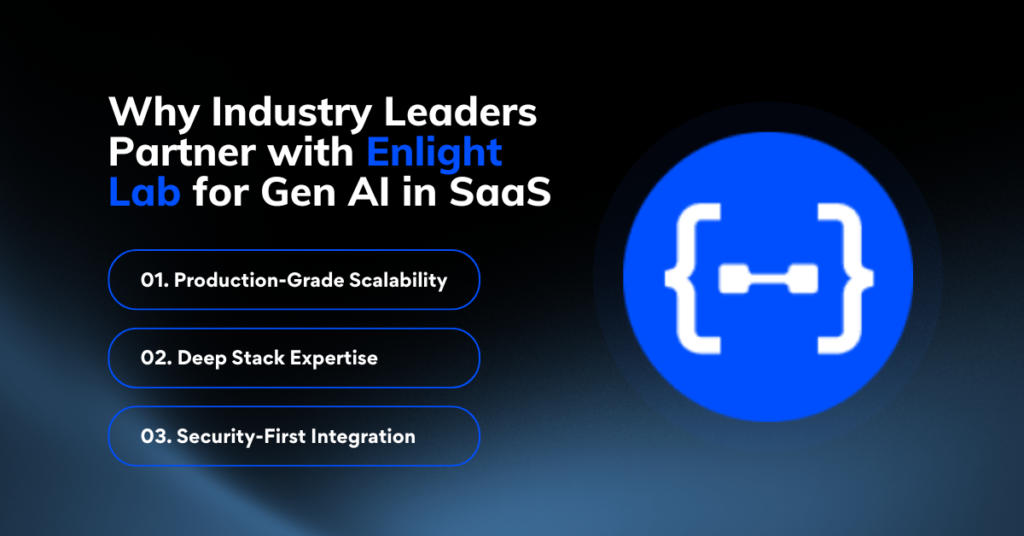
Why Industry Leaders Partner with Enlight Lab for Gen AI in SaaS
We don’t just “integrate” AI; we transition your SaaS platform from a passive tool into a proactive intelligence layer.
- Production-Grade Scalability: We move beyond “wrapper” solutions, building robust infrastructures capable of handling high-concurrency agentic workflows without latency degradation.
- Deep Stack Expertise: From optimizing RAG (Retrieval-Augmented Generation) pipelines to deploying fine-tuned, domain-specific SLMs (Small Language Models), our engineers handle the heavy lifting of the modern AI stack.
- Security-First Integration: We solve the primary barrier to enterprise adoption by implementing rigorous PII masking, SOC2-compliant data handling, and private model deployments.
Partner with us and let’s move your roadmap from “experimental” to “essential.”
Transform Your SaaS Architecture Today
Adopting generative AI in SaaS development is the most critical technical pivot your organization will make this decade. It dictates how efficiently you build, how deeply you engage your users, and how aggressively you can scale your market share.
Navigating LLM integration, securing RAG architectures, and maintaining tenant privacy requires specialized expertise. You do not have to build this future alone.
Contact Enlight Lab today for a technical consultation, and let us help you create a scalable, AI-driven SaaS platform that dominates your market.