Did you know that up to 95% of AI startups fail? That’s a much higher failure rate than other tech startups. Many founders think the problem is with their AI model, but the real reasons are often simpler. Most failures trace back to messy, unstructured data and technical shortcuts that cripple progress. There’s also a frequent underestimation of the work needed to turn a cool demo into a reliable, market-ready product.
When you venture into building an AI tool, you are not merely writing simple, predictable code. You are architecting complex, dynamic systems that can behave in unexpected ways if not constructed with meticulous care and foresight. These systems must learn, adapt, and reason, which introduces a level of complexity far beyond traditional software.
This guide will show you how outsourcing the development of your Minimum Viable Product (MVP) to an expert team can help you avoid these common mistakes. You will gain a clear understanding of the true costs of building an AI product, the critical steps to creating a resilient and scalable application, and how fractional technical leadership can empower you to grow your business without depleting your financial runway.
What is an AI MVP?
An AI Minimum Viable Product is very different from a traditional software MVP. A few years ago, an MVP might have been a basic website with a simple database. Today, an AI MVP has to handle all sorts of messy data, create smart responses on the fly, and connect smoothly with the tools your business already uses.
A common trap for founders is to build a simple “wrapper” around an AI service like OpenAI. You create a basic interface, connect it to a powerful model, and call it an AI product. But when real users start entering unpredictable information, the app often breaks.
A true AI MVP needs more than just a connection to an API. It needs a smart system to manage information (like a vector database), a way to organize your existing data so the AI can understand it, and strict rules (or “guardrails”) to prevent the AI from making things up or sharing private information.
Building this kind of intricate system demands a high level of specialized expertise in data engineering, machine learning operations (MLOps), and security. This is precisely why engaging an external team of specialists, such as Enlight Lab, is frequently the most strategic and safest choice for a startup.
The Core Benefits of Outsourcing Your AI MVP
Hiring a full-time, in-house team of AI experts is very expensive and takes a long time. Outsourcing gives you a smart alternative that saves money and gets your product to market faster.
You Can Control Your Budget
Building your own AI team can cost hundreds of thousands of dollars a year in salaries and benefits before you’ve even started building. When you outsource, you get:
- Predictable costs: Outsourcing allows you to work with a firm on a specific project with clear, upfront pricing. This eliminates the financial guesswork of long-term payroll.
- No overhead: You don’t have to worry about the extra costs of full-time employees, like health insurance, retirement plans, or office space.
- Pay for what you need: You get top-tier expertise exactly when you need it (during the development phase) without the long-term cost of a large, permanent team.
You Get Immediate Access to Senior Engineers
The best AI engineers are in high demand and are hard to hire, especially for an early-stage startup with limited resources and brand recognition. When you outsource, you get instant access to a team of veterans who have built and launched successful products before. They know how to avoid common problems and build a product that lasts.
You Can Launch Your Product Faster
For a startup, time is everything. A specialized development agency already has proven processes and tools in place. This allows them to build a working MVP in as little as eight weeks. By launching quickly, you can get feedback from real users and find more funding while your competitors are still figuring things out.
You Can Focus on Your Business
As a founder, your time is best spent talking to customers, improving your business plan, and raising money. You shouldn’t get bogged down in the technical details of running an AI. Outsourcing the technical work frees you up to focus on growing your company.
Key Things to Look for When Choosing an Outsourcing Partner
The decision to outsource is significant, and not all development agencies are created equal, especially when it comes to the unique challenges of AI. When evaluating potential partners for AI Consulting Services, you must look beyond a superficial portfolio or a low-ball price quote.
You Need a Strategic Partner, Not Just a Coder
You don’t just need a team to write code. You need a partner who will challenge your ideas and help you make smart decisions. The best outsourcing firms act like a part-time Chief Technology Officer (CTO). They help you define the problem you’re trying to solve and push back on features that aren’t necessary. This strategic guidance ensures your MVP solves a real business problem.
They Must Be Transparent About How They Handle Your Data
Your data is your most valuable asset. If a potential partner plans to send your private data to a public AI model without any protections, you should look elsewhere. A good partner will explain exactly how they will protect your data, keep it secure, and prevent any leaks of sensitive information.
- Demand a Data Governance Plan: If a potential partner has a vague plan to simply pipe your private, proprietary data to a public AI model like GPT-4 without robust protections, it’s a massive red flag.
- Security and Privacy Protocols: A reputable partner will provide a detailed explanation of their data handling protocols. This should include how they will anonymize or pseudonymize data, keep it secure in transit and at rest, and implement access controls to prevent leaks of sensitive information.
- Compliance Awareness: They should also demonstrate an understanding of relevant data privacy regulations like GDPR or HIPAA, if applicable to your industry.
They Must Focus on Security and Safety
AI models can sometimes make mistakes or “hallucinate” incorrect information. Ask potential partners how they handle this.
- Hallucination Mitigation Strategies: Ask potential partners how they plan to handle AI hallucinations. They should have a clear strategy that may include fact-checking outputs against a trusted data source, implementing confidence scoring, or flagging low-confidence answers for human review.
- Safety and Guardrail Implementation: They should be able to articulate their plan for setting up robust safety rules (guardrails) to prevent the model from generating inappropriate or biased content.
- Human-in-the-Loop Processes: For high-stakes applications, they should recommend and be able to implement a “human-in-the-loop” review process, where a person verifies or corrects the AI’s output before it is finalised.
A Step-by-Step Guide to the AI MVP Development Process
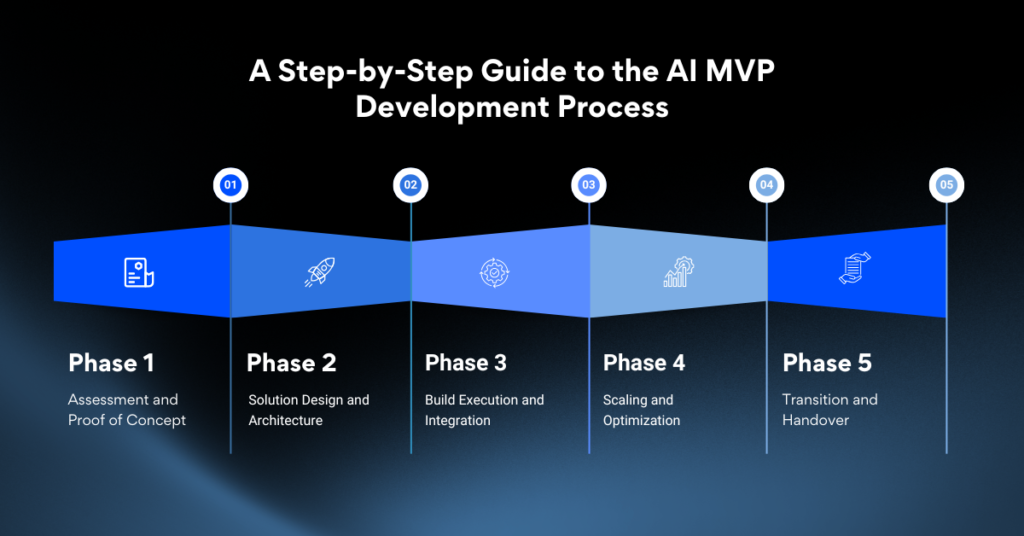
Building an AI product is a journey. Rushing into it is a surefire way to waste money. Here’s the step-by-step process that top technical consulting firms use.
Phase 1: Assessment and Proof of Concept
The first step is to see if your idea is technically possible. Can an AI model actually do the task you need it to do with your data?
- What happens: Engineers conduct a time-boxed experiment. They take a sample of your data and test the core hypothesis using existing models (like those from OpenAI, Anthropic, or open-source alternatives). They outline a high-level technical plan and, most importantly, identify any potential roadblocks or deal-breakers early.
- Duration: 2 to 4 weeks.
- Outcome: You receive a working demonstration that proves the concept is viable. This PoC provides the tangible evidence and confidence needed to proceed with a larger investment.
Phase 2: Solution Design and Architecture
Once you have confirmation that the core idea works, the team designs a detailed blueprint for the full MVP. This phase is about making critical architectural decisions that will balance performance, cost, and scalability.
- What happens: The team chooses the right technology stack (which models, databases, and cloud services to use), maps out the complete system architecture, and defines the data flow from user input to AI output. They create a detailed project plan and timeline.
- Duration: Typically 1 to 2 weeks.
- Outcome: A comprehensive architectural diagram and technical specification document that will guide the development process.
Phase 3: Build Execution and Integration
- This is the core development phase where your MVP is constructed. The team writes the code, sets up the infrastructure, and brings your product to life.
- What happens: Developers implement security protocols, build the data processing pipelines, create the user interface (UI), and integrate the AI model with any other software you use, such as Salesforce, Slack, or your internal databases. Rigorous testing is conducted throughout.
- Duration: Typically 6 to 10 weeks.
- Outcome: You get a fully working product deployed in a secure testing (staging) environment, ready for you and your first pilot customers to use and provide feedback on.
Phase 4: Scaling and Optimization
An MVP that works flawlessly for a handful of users might crash and burn when exposed to hundreds or thousands. This phase is dedicated to hardening the system for real-world traffic.
- What happens: The team stress-tests the application to identify bottlenecks. They fine-tune the system for performance, optimize database queries, and transition the infrastructure to a professional-grade setup (e.g., using Kubernetes for container orchestration) that can automatically scale with your user base.
- Duration: Ongoing, but an initial push may take 2 to 4 weeks post-launch.
- Outcome: A scalable, reliable, and cost-efficient production environment that can support your growth.
Phase 5: Transition and Handover
A successful outsourcing engagement always concludes with a smooth and comprehensive handover. The goal is to empower your team to take ownership of the product.
- What happens: The agency provides you with all source code, detailed technical documentation, and infrastructure credentials. They conduct training sessions with your team (or help you hire your first technical employee) and provide everything you need to manage, maintain, and build upon the product yourself.
- Duration: 1 to 2 weeks.
- Outcome: You have full control and ownership of your product, with the knowledge and resources to operate it independently.
Success Stories of Startups That Outsourced AI MVP Development to Enlight Lab
Partnering with an experienced team has helped many startups turn big ideas into reality. Here are a few examples.
Emblazer.ai
Emblazer.ai partnered with Enlight Lab to build an AI agent platform capable of understanding user intent before generating responses. The outsourced AI MVP was delivered as a robust, scalable system that worked smoothly from launch and supported rapid growth.
Huma
Huma, a leading digital health company, needed to build a robust application that would allow clinicians to monitor patients remotely. Given the highly sensitive nature of health data, security, data privacy, and regulatory compliance were critical requirements.
By outsourcing their AI MVP development to a specialized team at Enlight Lab, Huma ensured the platform was designed with strong security controls and compliance standards such as HIPAA in mind. The result was a reliable, scalable solution that supported remote care while maintaining the highest levels of safety and trust.
Common Technical Challenges And How to Overcome Them
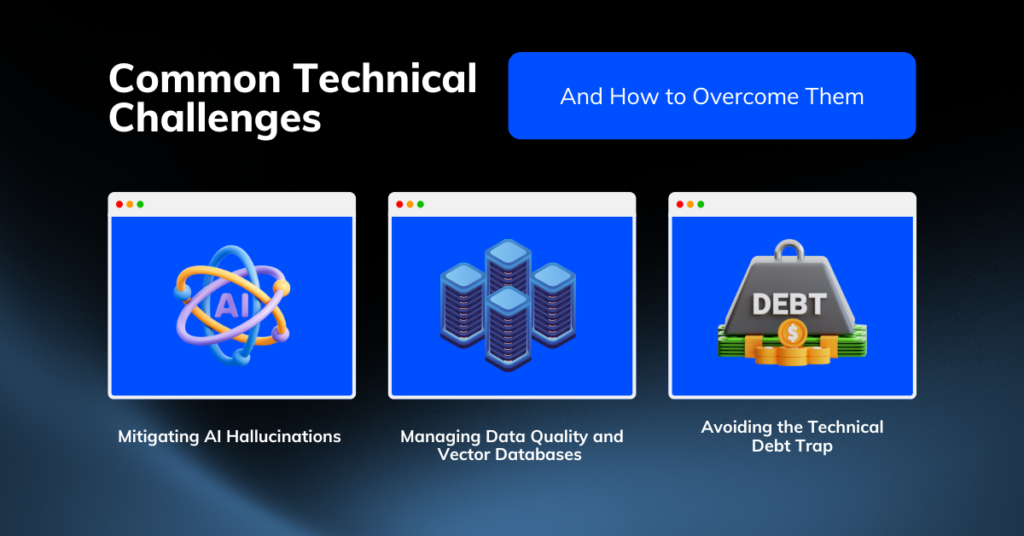
Building AI products comes with new kinds of risks. Experienced outsourcing partners know what to look for and how to solve these problems.
Mitigating AI Hallucinations
AI models, particularly large language models, have a known tendency to “hallucinate,” meaning they generate plausible but entirely fabricated information.
- The Problem: An AI that confidently provides incorrect facts can destroy user trust and, in some contexts, create serious legal or safety risks.
- The Solution: A skilled technical partner will implement a multi-pronged strategy. This includes Retrieval-Augmented Generation (RAG) to ground the AI’s responses in your verified data, building systems to log and review AI outputs, and setting up feedback loops where users can flag incorrect answers. This helps to retrain the model over time.
Managing Data Quality and Vector Databases
The performance of any AI system is dictated by the quality of the data it’s trained on. The principle of “garbage in, garbage out” is amplified with AI.
- The Problem: If you feed messy, inconsistent, or low-quality data into your AI, you will get unreliable and inaccurate results.
- The Solution: A strong engineering team will dedicate a significant portion of the project (often 20-30%) to data hygiene: cleaning, structuring, and organizing your data. They will establish robust data pipelines and choose the right vector database to ensure the AI can efficiently find and use the most relevant, high-quality information.
Avoiding the Technical Debt Trap
In the race to launch quickly, many startups take technical shortcuts. This creates “technical debt,” a messy, poorly architected, and unstable product that is difficult and expensive to improve or scale later on.
- The Problem: A product built on a foundation of technical debt will eventually become so fragile that adding new features becomes nearly impossible without breaking something else.
- The Solution: A good outsourcing partner prioritizes building your product on a solid, well-documented foundation. They make pragmatic choices to balance speed with quality, ensuring that the MVP is not a throwaway prototype but the first version of a scalable, long-lasting product.
Why Startups Choose Enlight Lab for AI MVP Development
At Enlight Lab, we understand that building an AI product is a major step for your business. With over 18 years of experience, we’ve helped hundreds of companies like yours go from an idea to a successful product.
What is the Enlight Lab difference?
- Fractional CTO Leadership: You get expert technical guidance without the high cost of hiring a full-time executive.
- Speed to Market: Our streamlined processes allow us to build products up to five times faster than an internal team.
- Focus on Results: We build reliable systems that solve real business problems and perform well as you grow.
- Transparent Predictability: We keep you in the loop every step of the way, ensuring every decision is aligned with your business goals.
Start Building Your AI MVP from Idea to Production with Enlight Lab
Adopting AI is more than just using a new tool. It’s about building intelligent systems into the core of your business. The challenges of building a safe, reliable, and compliant AI product are too great to leave to chance.
By outsourcing your MVP to an experienced team, you reduce financial risk, avoid costly mistakes, and launch a product that works. Don’t let technical worries hold your vision back.
Ready to turn your idea into a real product? Book a free discovery call with Enlight Lab today and let our senior engineers help you build the future.