In 2026, AI voice agents are no longer an experiment tucked away in an innovation lab. They are answering customer calls, qualifying leads, booking appointments, processing payments, and resolving issues at scale. In fact, up to 80% of routine customer interactions are now being handled by AI, and the global AI customer service market is projected to reach $15+ billion this year alone.
The shift happened faster than most leaders expected.
What started as basic IVR systems and scripted bots has evolved into intelligent voice agents that can understand intent, handle interruptions, respond with empathy, and complete tasks end to end. This evolution is being driven by urgency at the top. According to Gartner, 91% of customer service leaders report pressure from executives to implement AI as part of their service strategy.
At the same time, customer expectations have moved just as quickly. Customers now expect to talk to machines that sound natural, respond instantly, and actually solve their problems.
As a result, a new question sits on the desks of product leaders, CTOs, and CX heads everywhere:
Do we build our own AI voice agent, or do we buy an existing platform?
This decision may look technical on the surface, but in reality it is not technical at all. It shapes how fast you can move, how much control you retain, how differentiated your customer experience becomes, and how much flexibility you have two or three years down the line.
If you get this strategic business decision wrong, it will negatively impact:
- Speed to market
- Cost structure
- Customer experience
- Long-term scalability
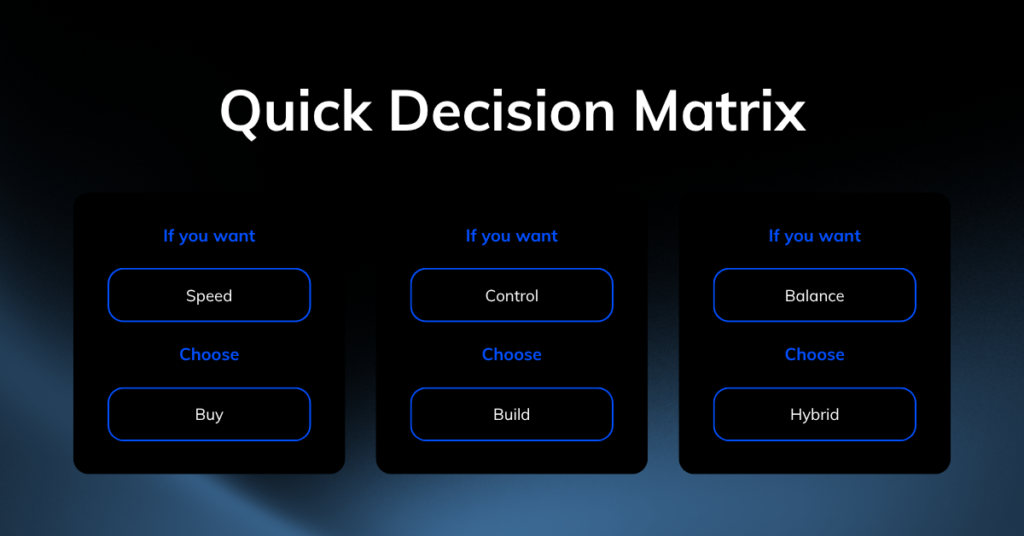
So, the truth is, the build vs buy AI voice agents decision is not about which option is “better.” It is about which option aligns with your business reality today and your strategy for tomorrow.
Buying gives you speed, reliability, and a lower barrier to entry. Building gives you control, ownership, and room to create something truly unique. Each comes with trade-offs that are often underestimated until it is too late.
This guide is designed for leaders who want to make that choice intentionally.
If you are a CEO balancing speed and long-term value, a CX leader rethinking voice-first support, or a CTO responsible for scaling AI responsibly, this article will help you approach the decision with clarity and confidence.
Most importantly, you will see why many successful companies in 2026 are choosing a third path. They buy what accelerates them today and build what differentiates them tomorrow.
Before diving into frameworks, costs, and architectures, let’s ground ourselves in the core takeaways.
Key Takeaways at a Glance
- AI voice agents are now core business infrastructure, not experimental technology
- The build versus buy decision is a strategic business choice, not just a technical one
- Buying prioritizes speed and simplicity, but often limits control and differentiation
- Building enables ownership and customization, but requires time, talent, and patience
- Cost dynamics change significantly at scale and over multi-year horizons
- Many teams succeed by combining both approaches through a hybrid or phased strategy
- The right choice depends on how critical voice is to your product, brand, and long-term vision
What Are AI Voice Agents?
AI voice agents are systems that understand spoken language, process user intent using AI models, and respond naturally in real time. They can also perform tasks such as booking, customer support, and lead qualification. In simple terms, they are an advanced version of traditional IVR systems like “Press 1, Press 2,” but far more conversational and efficient.
Today’s voice agents:
- Feel conversational
- Handle interruptions
- Integrate with CRMs and workflows
This shift from rigid automation to natural conversation is why voice AI has become a board-level discussion in 2026.
What Is Expected From AI Voice Agents in 2026
By 2026, businesses and customers alike have developed clear expectations. A voice agent that fails on these dimensions is seen as outdated, not innovative.
Natural conversation flow
Users expect smooth turn‑taking, minimal latency, and the ability to interrupt without breaking the conversation. Long pauses or robotic pacing are no longer tolerated.
Accent, language, and tone adaptability
Voice agents are expected to handle multiple languages, regional accents, and cultural nuances without losing accuracy. This is particularly critical for global enterprises and multilingual markets.
Context awareness and memory
Modern agents remember what was said earlier in the conversation and in previous interactions. Customers do not want to repeat themselves, and systems that force them to do so signal poor design.
Emotional intelligence, not just accuracy
In 2026, competence alone is not enough. Voice agents are expected to recognize frustration, urgency, or confusion and respond appropriately. A calm, empathetic tone matters as much as correct information.
Real‑time decision making
The best voice agents can reason during the call, choose the right next action, and adapt workflows dynamically rather than following fixed scripts.
These capabilities are rapidly becoming table stakes.
Defining the “Build vs Buy AI Voice Agents” Decision
By the time most leaders reach the build versus buy conversation, they already feel a sense of urgency.
Customer expectations are rising. Internal teams are asking for automation. Competitors are rolling out AI voice agents that sound polished and capable. The pressure to act is real.
But this is where many teams make their first mistake.
They rush to answer how to implement AI voice agents before clearly defining what build and buy actually mean in 2026.
Because today, these terms are far more nuanced than they used to be.
What “Building” an AI Voice Agent Really Means
Building an AI voice agent rarely means training foundational models from scratch. Instead, it requires assembling and managing a system of components that work together.
A true build approach typically involves:
- Designing custom conversation flows and logic
- Orchestrating speech‑to‑text, reasoning models, and text‑to‑speech layers
- Integrating deeply with internal systems like CRM, ERP, billing, or logistics platforms
- Creating monitoring, fallback, and escalation mechanisms
- Managing performance, accuracy, drift, and ongoing improvements
- Putting governance, security, and compliance controls in place
In other words, building is not just an engineering project. It is an operational commitment.
Teams that choose to build are effectively saying, “Voice is strategic enough for us to own this capability end to end.”
When You Should Build AI Voice Agents
Building makes sense but only in specific cases.
You should build if:
- AI voice is your core product
- You need deep customization
- You have a strong AI engineering team
- You require strict data control/on-premise systems
Making that choice can pay off, but only when you are ready for what comes with it.
The Real Cost of Building AI Voice Agents
Let’s break the myth:
“Building is cheaper.”
It’s usually not.
1. Upfront Development Cost
Estimated cost:
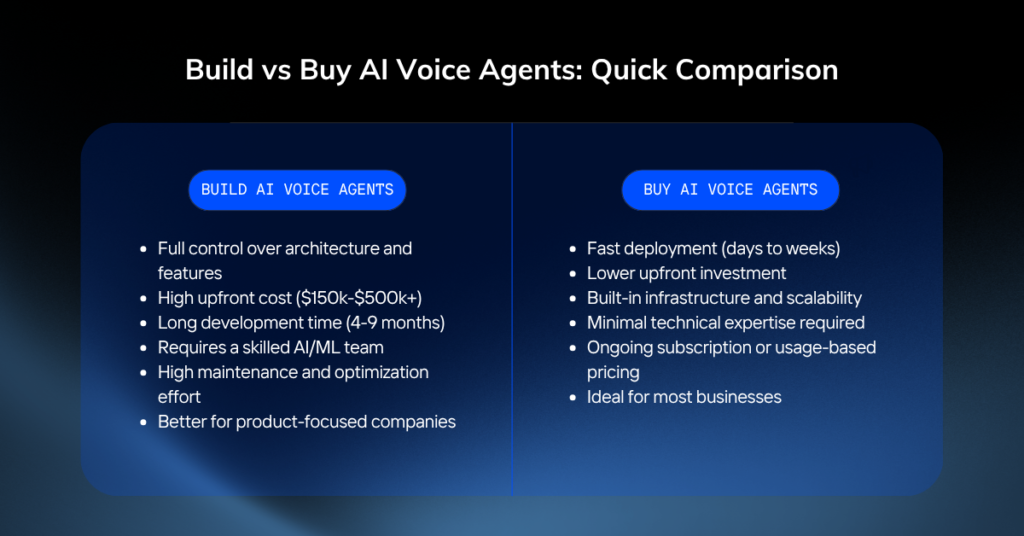
- $150,000 – $500,000+ in year one
To build a production-ready system, you need:
- Backend engineers
- AI/ML engineers
- DevOps specialists
2. Time to Market
- Build: 4–9 months
- Buy: 5–14 days
That gap is massive.
While you’re building:
- Competitors are already deploying
- Learning from real customers
- Improving their systems
3. Maintenance Cost
Basic systems require 10–20 hours/month maintenance.
Voice AI is not “set and forget.”
You’ll need:
- Continuous tuning
- Prompt optimization
- QA testing
4. Infrastructure & Compliance
You’re responsible for:
- Security
- Data privacy (GDPR, HIPAA, etc.)
- Logging and monitoring
This adds:
- Legal overhead
- Engineering complexity
5. Latency & Reliability Challenges
Real-time voice systems require:
- Fast processing
- Streaming pipelines
- Low latency (<0.5 seconds)
Without this, conversations feel unnatural.
What “Buying” an AI Voice Agent Looks Like Today
Buying, on the other hand, has become far easier and far more sophisticated than it once was. It usually means adopting a SaaS or platform-based AI voice solution that already:
- Handles speech recognition and synthesis
- Includes prebuilt conversational intelligence
- Offers analytics, monitoring, and reporting
- Provides compliance features out of the box
- Integrates with common business tools through APIs
For many teams, this feels like a relief. Instead of designing everything from scratch, they can configure workflows, customize prompts, and go live quickly.
When You Should Buy AI Voice Agents
Buying is often the right move if:
- You need fast deployment
- Voice AI is a tool, not your product
- Your use case is common (support, sales, booking)
- You lack a dedicated AI team
The Real Cost of Buying AI Voice Agents
Buying isn’t free but it’s predictable.
1. Pricing Models
Common models:
- Per minute
- Per call
- Per resolution
Costs scale with usage, not infrastructure.
2. Faster ROI
Instead of building AI voice agent, you start generating value immediately. This means faster automation and lower operational costs sooner
3. Reduced Complexity
Platforms handle:
- Infrastructure
- Scaling
- Updates
You focus on:
- Business logic
- Customer experience
4. Reduced Control
You may face:
- Limited customization
- Vendor dependency
But for most businesses, this trade-off is worth it.
Why the Build vs. Buy Choice Is Even More Critical in 2026
1) Elevated user expectations
As voice-enabled systems become part of everyday interactions, people have grown far less forgiving. Users now expect conversations with AI to feel natural, responsive, and seamless. Even minor delays or awkward responses can stand out immediately, making subpar experiences far more noticeable than before.
2) The hidden cost of bad voice interactions
A poorly designed voice experience doesn’t just frustrate users in the moment—it erodes confidence over time. Repeated friction can lead to declining customer loyalty, negative feedback, and long-term damage to brand reputation. The impact is cumulative and often underestimated.
3) Increasing complexity in compliance and scale
Organizations today must navigate strict regulatory environments, especially in sectors like finance, healthcare, and international operations. Voice solutions must not only perform well but also meet evolving standards for data protection, reliability, and global scalability. This adds a significant layer of complexity to the decision.
4) Balancing immediate speed with future control
Choosing an off-the-shelf solution can accelerate deployment and reduce upfront effort. However, building a custom system offers deeper flexibility and ownership over time. The real challenge lies in weighing short-term efficiency against long-term strategic advantage.
Build vs Buy AI Voice Agents: The Key Differences
| Factor | Build | Buy |
| Time to launch | 4–9 months | 1–2 weeks |
| Cost (year 1) | High ($150k–$500k+) | Lower upfront |
| Customization | Full control | Moderate |
| Maintenance | High | Low |
| Scalability | Complex | Built-in |
| Risk | High | Lower |
The 5-Step Decision Framework
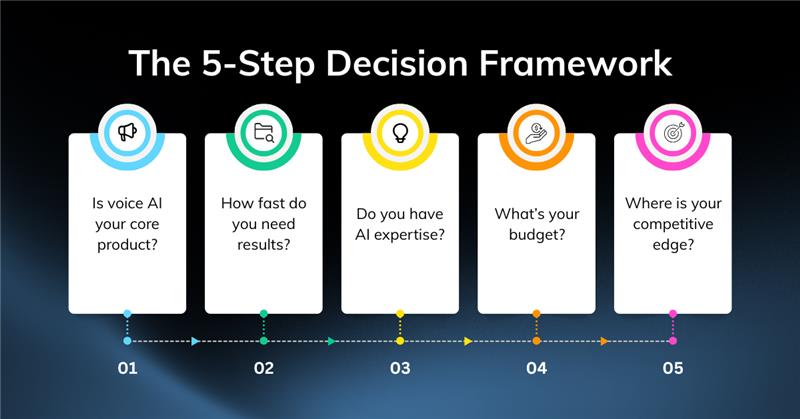
If you’re still unsure, answer these:
1. Is voice AI your core product?
- Yes → Build
- No → Buy
2. How fast do you need results?
- ASAP → Buy
- Can wait months → Build
3. Do you have AI expertise?
- Yes → Build possible
- No → Buy
4. What’s your budget?
- High upfront → Build
- Limited → Buy
5. Where is your competitive edge?
- Technology → Build
- Business process → Buy
How to Select the Right AI Voice Agent Development Partner
Picking a company to build your AI voice agent isn’t just a technical decision. It’s a long-term strategic move. While tools and platforms matter, the real success factor is the team behind them. Many organizations rush this step, only to face mismatched solutions, delays, and costly adjustments later.
Here’s how to evaluate an AI voice agent partner the right way:
- Understand your business operations
- Proven experience across real-world use-cases
- Keep an eye on flexibility and customization
- Take security and compliance seriously
- Always know what’s being built, how it works, and who owns what
- Capable of growing with you technically and operationally
- Acts like an extension of your own team, not just a service provider
At the end of the day, the choice isn’t about who markets themselves best. It’s all about alignment. When your AI agent development partner truly understands your business, the technology integrates smoothly. When they don’t, even the most advanced systems can fall short.
Build vs Buy AI Voice Agents: Make the Decision That Moves You Forward
By now, one thing should be clear: the decision to build vs buy AI voice agents is not just about technology. It is about momentum.
In 2026, speed, adaptability, and execution matter more than ever. The companies winning with AI voice are not the ones building the most complex systems. They are the ones making smart, strategic decisions and choosing the approach that aligns with their goals, resources, and timelines.
If AI voice is central to your product and you have strong technical expertise, building can give you long-term control and differentiation.
But for most businesses, the smarter path is to buy or adopt a hybrid approach. This allows you to launch faster, learn from real interactions, and improve continuously without getting stuck in long development cycles.
Do not let the decision slow you down. Always, choose the path that helps you move faster.
Whether you are exploring, evaluating, or ready to implement, the right AI voice strategy can transform how you engage with customers and scale operations.
Ready to make the smart move? Consult Enlight lab today and get started with the right strategy for building or buying AI voice agents.