Business operations have grown too complex for traditional, rule-based automation. For years, you probably relied on standard triggers to move data from one software to another.
You know the feeling. Your customer support queue is backed up, your sales team is buried in lead qualification tasks, and your operations managers are spending hours moving data between rigid software systems. You hire more people, but the bottlenecks remain. Scaling a business often feels like adding more friction instead of creating more flow.
But technology is fundamentally shifting. We are moving from basic automation tools to autonomous digital operators. By combining reasoning capabilities with natural speech, these systems handle ambiguity, make decisions, and execute multi-step processes across your entire organization.
According to Gartner, 40% of enterprise applications will feature task-specific AI agents by the end of 2026, up from less than 5% today. This is not just another minor software update. It is a complete redesign of how work gets done.
The combination of AI agents and Voice AI for enterprise workflow automation represents a profound opportunity for CTOs, founders, and business leaders. Instead of hiring massive support teams, you deploy intelligent systems that answer calls, qualify leads, and orchestrate complex background tasks instantly. Reading this guide will show you exactly how autonomous AI systems are giving your business the operational leverage to scale without inflating your headcount.
Understanding AI Agents in the Enterprise
To grasp the future of business operations, you first need to understand the engines driving it. Traditional automation simply follows rigid rules.
AI agents are autonomous software systems designed to achieve specific goals. Unlike basic chatbots that follow pre-written scripts, AI agents can think, adapt, and execute. They connect directly to your existing systems like Salesforce, Zendesk, or your proprietary databases to take action on your behalf.
Types of AI Agents
Enterprise AI agents fall into several distinct categories based on their role within your infrastructure:
-
- Intelligent reasoning agents: Systems that analyze unstructured data, validate context, and make routing decisions.
-
- Action-oriented agents: Systems connected directly to your APIs and software like your custom ERP that actively update records and trigger external workflows.
-
- Multi-agent systems: Networks of specialized agents that collaborate. One agent retrieves data, another validates compliance, and a third communicates the outcome to the user.
Core Functionalities of Enterprise AI Agents
-
- Using natural language processing and machine learning.
-
- Understanding context and evaluating multiple possible actions.
-
- Choosing the most effective path to solve a problem.
Evolution from Traditional RPA
Robotic Process Automation (RPA) was a massive leap forward for business efficiency. But RPA breaks the moment a user misspells a word or a website layout changes. AI agents solve this fragility. They possess reasoning capabilities.
If an API connection times out, an adaptive AI agent can troubleshoot the error or find an alternative route to complete the task, rather than just throwing an error code and waiting for a human to fix it.
The Rise of Voice AI in Enterprise Automation
Typing is slow. Navigating graphical user interfaces requires friction. Voice is the most natural, high-bandwidth communication method we possess, and it is finally ready for the enterprise.
Voice AI is a technology that enables machines to recognize, process, and respond to human speech through artificial intelligence. While text-based AI agents handle the backend logic, voice AI provides the human-facing interface.
Speech Recognition and NLU
Voice AI relies on deep Natural Language Understanding (NLU) to process spoken words. It translates audio signals into text, analyzes the intent behind the words, and generates an appropriate response.
The global AI customer service market is projected to exceed $15 billion by 2026, largely driven by breakthroughs in speech recognition.
Applications of Voice AI beyond virtual assistants
Voice AI now powers core business operations:
-
- Voice-activated CRM updates for field sales teams
-
- Hands-free inventory logging for warehouse workers
-
- Automated outbound calling campaigns for appointment scheduling and lead pre-qualification
How AI Agents and Voice AI for Enterprise Automation Are Evolving
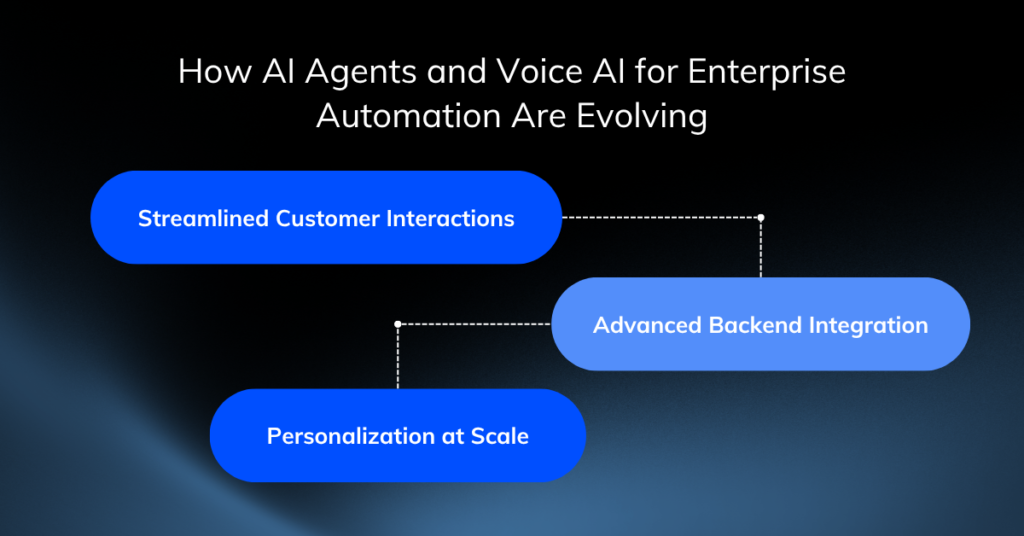
The landscape of enterprise automation is rapidly changing, and AI agents along with voice AI are at the forefront of this revolution. These technologies are not just enhancing efficiency, but they are also reshaping how businesses connect with their customers. Here’s how they are evolving:
Streamlined Customer Interactions
-
- AI-powered systems are now capable of understanding customer intent more accurately than ever before.
-
- Voice AI can handle increasingly complex conversations, ensuring a natural and seamless exchange.
-
- Enterprises can now offer real-time solutions, reducing wait times and increasing customer satisfaction.
Advanced Backend Integration
-
- AI agents are evolving to integrate with multiple systems simultaneously, enabling smoother workflows.
-
- These systems can retrieve, update, and adapt to backend data faster, ensuring real-time accuracy.
-
- Complex enterprise processes like billing, account updates, and inventory checks are becoming automated.
Personalization at Scale
-
- AI is becoming smarter in predicting user behaviors and preferences, tailoring interactions accordingly.
-
- Voice AI ensures every customer feels heard by adjusting tone, language, and responses dynamically.
-
- Enterprises can offer hyper-personalized experiences without sacrificing operational efficiency.
Together, AI agents and voice AI are empowering enterprises by simplifying complex processes, improving customer relationships, and making automation smarter, faster, and more adaptable. The future looks exciting as these technologies continue to evolve in tandem.
The Synergy of AI Agents and Voice AI for Enterprise Automation
The true magic happens when you combine voice AI with autonomous AI agents.
A voice AI model handles the natural conversation with a customer, while a backend AI agent securely retrieves account data, processes a refund, and updates the billing system.
When you choose this combined architecture, you can create a fully autonomous digital employee.
Voice as the Ultimate Interface
Voice AI serves as the front-end interface, while AI agents operate as the back-end brain. A customer calls your business. The Voice AI answers, understanding the frustration in their tone. It translates the spoken request (“My shipment is late”) and passes it to the AI agent. The AI agent checks the ERP system, finds the delayed package, re-books it on a faster carrier, and passes the updated tracking info back to the Voice AI, which verbally relays it to the customer. This entire loop happens in milliseconds.
Voice-Driven Supply Chain Management
Supply chain managers will rely on voice-activated intelligent automation to oversee global operations. Instead of clicking through complex dashboards, a logistics director will simply ask, “What is the status of the overseas freight?” The AI agent will compile the data, analyze potential port delays, and the Voice AI will deliver an audible briefing along with recommended actions.
AI-Powered Financial Reporting
In the financial sector, executives will use voice commands to generate instant reports. An AI agent hooked into your accounting software will understand verbal requests for quarterly revenue comparisons, instantly pull the data, format it, and securely email it to the board of directors.
Overcoming Integration Challenges
Connecting these systems requires expertise. You must handle complex telephony infrastructure, maintain ultra-low latency, and ensure strict data security. This is why partnering with an experienced AI agent development company is critical. An effective system must integrate deeply with your existing tech stack without vendor lock-in.
Impact on Key Enterprise Sectors by 2026
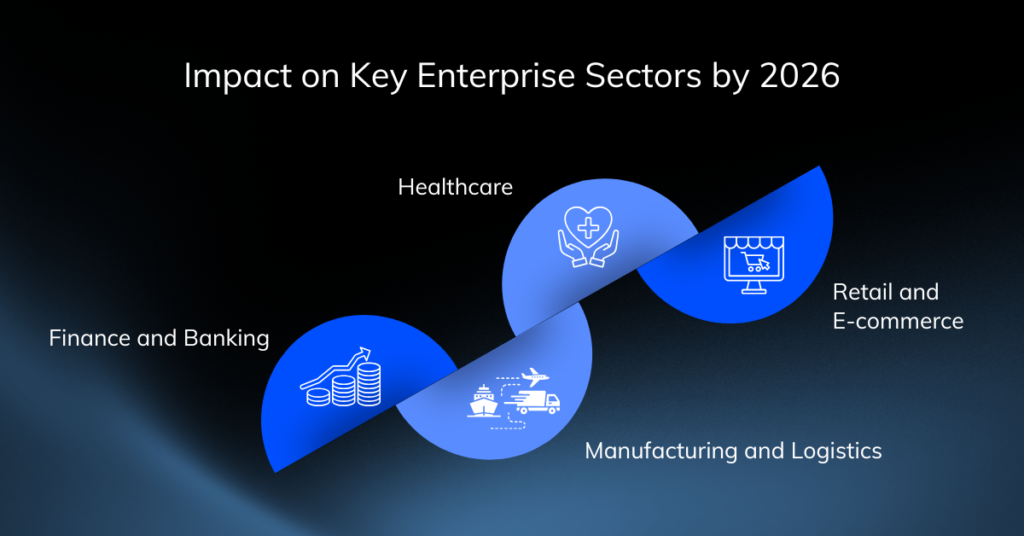
Different industries face unique bottlenecks. Here is how AI agents and Voice AI will specifically transform major sectors over the next few years.
Finance and Banking
Financial institutions face massive compliance and fraud detection overhead. AI agents provide continuous risk scoring and real-time anomaly detection, significantly reducing fraud exposure. Simultaneously, Voice AI handles routine customer banking queries, allowing human advisors to focus on high-value wealth management and relationship building.
Healthcare
The healthcare industry suffers from severe administrative bloat. Enlight Lab currently deploys voice agents that completely automate patient intake, reducing documentation time by 74%. By 2026, AI agents will routinely pre-check insurance claims and coordinate complex specialist appointments without a single human touching the phone.
Manufacturing and Logistics
Margins in logistics depend on efficiency. Voice-controlled robotics and AI agents will work together to orchestrate warehouse floors. AI agents will monitor machine health for predictive maintenance, automatically ordering replacement parts before a critical failure occurs, saving companies hundreds of thousands of dollars in eliminated downtime.
Retail and E-commerce
E-commerce brands lose money every time a customer abandons a cart due to a lack of support. AI voice agents handle order updates, returns, and exchanges end-to-end. By 2026, adaptive AI agents will analyze real-time market shifts to instantly adjust product pricing and digital marketing spend across multiple platforms.
Preparing Your Enterprise for the AI Automation: Implementation Strategies
Adopting this technology requires a strategic roadmap. Rushing into deployment without a clear plan leads to disjointed systems and wasted capital.
Assessing Current Infrastructure
Before writing a line of code or signing a vendor contract, you must map out exactly what tasks your AI agent will handle.
Identify the specific pain points and success metrics. If your internal data is messy and unorganized, your AI agent will be ineffective. Clean your data and ensure your APIs are accessible.
Piloting Solutions
Start small. Do not attempt to automate your entire enterprise at once. Pick a high-volume, low-complexity workflow—like tier-1 customer support or basic appointment scheduling. Deploy a voice agent to handle this specific bottleneck. Measure the call deflection rate, user satisfaction, and cost savings. Once you prove the ROI, scale the deployment.
Data Governance and Security
Your data must be protected. Choose solutions that offer deployment in your own Virtual Private Cloud (VPC) or on-premise environment. Ensure your AI partner enforces enterprise-grade encryption, SOC 2 compliance, and complete data isolation so your proprietary business information never trains public AI models.
Upskilling the Workforce
Automation does not mean eliminating your staff; it means elevating them. Train your teams to manage, monitor, and optimize these AI systems. Your support agents will transition into quality assurance roles, overseeing complex edge cases that the AI escalates to them.
Challenges and Ethical Considerations
With powerful technology comes significant responsibility. Leaders must navigate the ethical deployment of AI agents proactively.
Data Privacy Concerns
Voice interactions capture highly sensitive personal data. If a voice agent processes payments or health information, strict adherence to PCI-DSS, GDPR, or HIPAA is mandatory.
Ethical AI Decision-Making
AI agents act based on their training data. If that data contains historical biases, the agent will execute biased decisions. You must implement model explanation layers and automated policy guardrails. Regular conversation audits and interaction quality reviews are essential to ensure the AI behaves fairly and transparently.
The Future of Work
While AI agents drastically reduce manual effort, organizations must manage the cultural impact. Be transparent with your team about the goals of automation. Frame AI as a collaborative tool that removes administrative drudgery, allowing your employees to do the creative, strategic work they were actually hired to perform.
Why Partnering with Enlight Lab to Transform Your Enterprise Automation
Implementing a scalable AI solution requires deep expertise in AI architecture, data integration, and human-centered design. You need a partner with nuanced engineering and architectural foresight.
At Enlight Lab, we don’t just sell software. We work closely with you to design a custom AI automation strategy that integrates with your existing infrastructure. Our goal is to build a system that solves today’s problems and scales with you, preparing you for the automation, intelligence, and operational demands of tomorrow.
Ready to Deploy AI Agents & Voice AI Across Your Enterprise? Contact Us Today
The shift toward autonomous business operations is moving rapidly. By 2026, manual task execution and human-operated phone triage will be seen as massive operational liabilities. Integrating AI agents and Voice AI for enterprise automation allows you to scale efficiently, deliver flawless customer experiences, and dramatically lower your overhead costs.
The companies winning the next decade are not waiting for this technology to become mainstream; they are building their AI infrastructure today. Whether you need a fully custom multi-agent system or a production-ready voice assistant to handle your inbound calls, you need a partner who understands both the technology and your business objectives.
Stop losing revenue to missed calls and broken workflows. Book a free strategy consultation with Enlight Lab today, and let our CTO-led teams build the intelligent, automated workforce your enterprise needs to scale.