Customer expectations have shifted dramatically. Modern consumers do not just want answers; they want immediate, accurate, and highly contextual resolutions. Traditional support models, which rely entirely on human agents scrambling to manage overwhelming ticket queues, are no longer sustainable for growing startups or scaling enterprises.
Many CTOs and business founders see customer support as just another expense. You hire more people, buy more software seats, and still watch wait times creep up during peak seasons. AI agents for customer service change this dynamic entirely. Instead of simply deflecting tickets with rigid, keyword-based responses, these advanced systems resolve issues autonomously, turning customer support from an operational bottleneck into a scalable growth engine.
This comprehensive guide explores how autonomous AI tools operate, the tangible return on investment they offer, and how your business can deploy them to create frictionless, hyper-personalized customer experiences.
Key Takeaways
-
- Autonomous resolution: AI agents can reason through multi-step problems, successfully resolving up to 70% of customer queries without human intervention.
-
- Massive market growth: The AI customer service market is projected to surge from $12.06 billion in 2024 to $47.82 billion by 2030, according to a recent MarketsandMarkets report.
-
- Beyond basic chatbots: Unlike rigid, rule-based chatbots, AI agents understand semantic context, retain conversational memory, and execute actions across different software platforms.
-
- Measurable ROI: Organizations implementing AI agents report immediate decreases in operational costs paired with significant increases in customer satisfaction scores (CSAT).
How Did AI Customer Service Agents Evolve?
The journey from frustrating automated phone menus to intelligent digital problem-solvers did not happen overnight. Early iterations of automated support relied heavily on decision trees. If a customer typed a specific keyword, the bot triggered a pre-written response. This rigid architecture caused immense friction when customers asked nuanced questions.
The shift from basic chatbots to autonomous systems
Traditional chatbots required manual programming for every conceivable conversation path. Modern AI agents for customer service break free from these decision trees. According to Zendesk, 68% of consumers now believe chatbots should have the same level of expertise as highly skilled human agents. This demand pushed developers to integrate large language models (LLMs) into customer service software.
To clearly understand the operational shift, review the differences below:
| Feature | Legacy Chatbot | Agentic AI Agent |
| Routing method | Keyword matching and rigid decision trees | Natural language understanding and semantic intent |
| Problem solving | Answers FAQs with static links | Reasons through multi-step workflows and executes tasks |
| System integration | Siloed or limited API triggers | Deep read/write access to CRMs and billing software |
| Context retention | Forgets previous prompts easily | Maintains memory across long, multi-turn conversations |
Key technological breakthroughs
The leap forward stems from advancements in Natural Language Processing (NLP) and Deep Learning. These technologies allow an AI system to understand intent, recognize sentiment, and generate human-like text in real time.
Early adoption challenges and eventual triumphs
Initially, companies struggled with AI hallucinations—instances where the AI provided confident but incorrect information. However, by grounding these AI agents in strict corporate knowledge bases (a process known as Retrieval-Augmented Generation), organizations drastically reduced errors. Today, these systems function as reliable extensions of the brand.
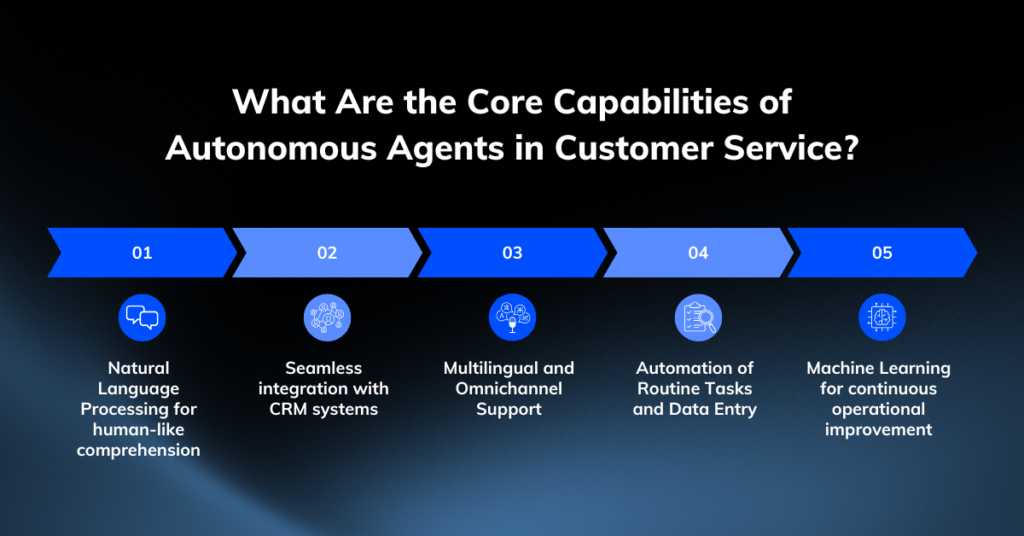
What Are the Core Capabilities of Autonomous Agents in Customer Service?
To understand why CTOs are aggressively adopting these systems, you must look at the underlying mechanics. AI agents do not just chat; they execute workflows.
Natural Language Processing for human-like comprehension
NLP enables the AI agent to parse complex sentence structures, slang, and typos. Instead of failing when a user says, “My package is MIA,” the AI recognizes the intent is identical to “Where is my order?” and fetches the tracking data immediately.
-
- Eliminates dependency on rigid keyword-based systems
-
- Accurately detects customer issues (e.g., billing, refunds, troubleshooting)
-
- Supports complex and conversational queries
An AI agent pulls historical data directly from your Customer Relationship Management (CRM) platform. When a high-tier client logs into the chat, the AI instantly knows their purchase history, previous complaints, and contract renewal date, allowing for highly contextual conversations.
-
- Connects with CRM, helpdesk, and knowledge bases
-
- Retrieves customer data instantly
-
- Executes backend operations without human involvement
Multilingual and Omnichannel Support
Modern AI agents can communicate fluently in dozens of languages, breaking down geographical barriers. They also maintain conversational context across different channels. A customer can start a query on a website’s chat, continue it via email, and receive SMS updates without having to repeat information.
-
- Provides real-time translation for global customer bases.
-
- Ensures a consistent experience whether on web, mobile, or social media.
-
- Consolidates all interactions into a single thread.
Automation of Routine Tasks and Data Entry
By connecting directly to backend systems via APIs, advanced AI customer service platforms can handle repetitive tasks autonomously. This frees up human agents to focus on more complex, high-value interactions.
-
- Manages returns, exchanges, and new purchases.
-
- Upgrades subscription plans or updates user information.
-
- Books appointments, demos, or onboarding calls without human intervention.
Machine Learning for continuous operational improvement
Machine learning algorithms allow AI agents to learn from every resolved ticket. If an AI notices that a specific troubleshooting step repeatedly fails to solve a software bug, it can flag the issue for human review or adjust its primary recommendation.
-
- Identifies recurring issues and customer behaviors.
-
- Suggests solutions based on historical success rates.
-
- Adapts its workflows and responses based on feedback and outcomes.
Why Should Businesses Implement AI Agents in Customer Service?
Deploying AI agents is a strategic financial decision. The return on investment manifests in reduced overhead and improved customer retention. The AI for customer service market is projected to grow from $12.06 billion in 2024 to $47.82 billion by 2030.
Enhanced efficiency and significant cost reduction
An AI agent works around the clock without fatigue. Trendsetting companies using AI dropped their first response times from over six hours to less than four minutes. By automating routine inquiries, businesses drastically reduce the cost per resolution.
Improved customer satisfaction metrics
Speed directly correlates with satisfaction. Customers no longer have to listen to hold music for 45 minutes to reset a password. Instant, accurate resolutions drive higher Customer Satisfaction (CSAT) scores and improve brand loyalty.
Scalability to handle fluctuating customer demand
If you run an e-commerce brand, Black Friday traffic spikes can cripple a human support team. AI agents scale infinitely and instantly. They can handle ten tickets or ten thousand tickets simultaneously without a drop in service quality.
Data-driven insights for strategic decision-making
Because AI agents process thousands of interactions, they act as powerful data aggregation tools. They can identify trending product defects, confusing user interface elements, or unclear pricing documentation, allowing leadership to address root causes proactively.
How Are Industries Using AI Agents for Seamless Customer Service?
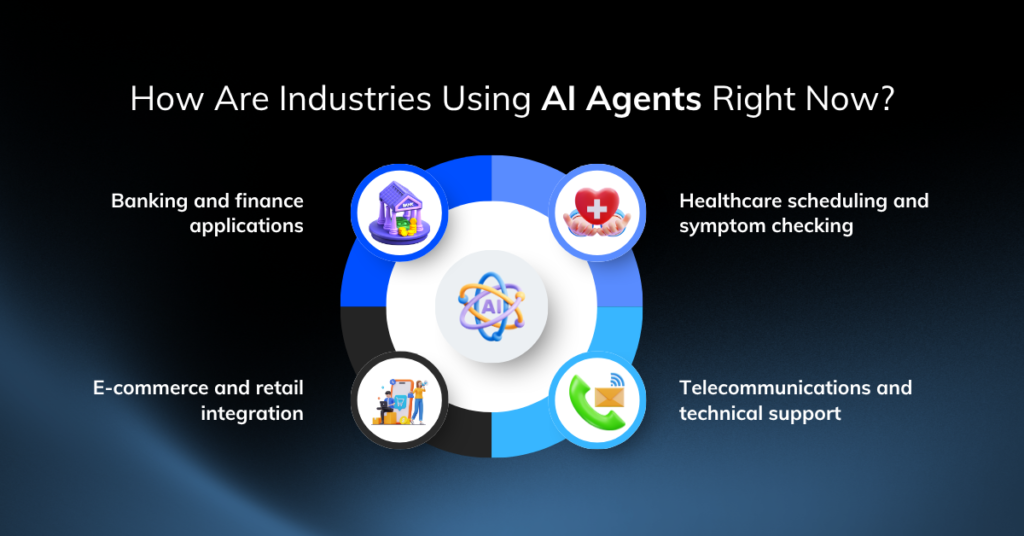
Different sectors leverage AI agents to solve unique operational bottlenecks. Here is how leading industries deploy these tools today.
Banking and finance applications
Financial institutions use AI agents to guide customers through daily banking tasks and enhance security. For example, an AI agent can explain mortgage application requirements, provide personalized budgeting advice based on spending habits, or help a user temporarily freeze a compromised credit card.
E-commerce and retail integration
In retail, AI agents serve as the first point of contact for customer inquiries. They help shoppers track orders, process refunds, and receive personalized product recommendations, improving the overall shopping experience.
Healthcare scheduling and symptom checking
Healthcare providers use AI agents to manage administrative tasks and guide patients. These agents can book appointments, send automated reminders, and provide preliminary symptom checking, which helps direct critical cases to human staff more quickly.
Telecommunications and technical support
Telecom companies use AI agents to handle high volumes of customer support queries. They assist users with common issues like router resets, process plan upgrades, and explain complex billing cycles, freeing up human agents to tackle more complex problems.
How Do AI Agents Drive Proactive Customer Experiences?
Great customer service anticipates the problem before the customer even reaches out. AI agents shift the support paradigm from reactive to proactive.
Moving beyond reactive support queues
Instead of waiting for a ticket to be submitted, AI agents can trigger conversations based on user behavior. If a SaaS user repeatedly clicks the “failed payment” banner, the AI can initiate a chat offering an alternative billing method.
Anticipating needs through behavioral data analysis
By analyzing website navigation paths, an AI agent can predict what a customer is trying to accomplish. If a user spends ten minutes on a pricing comparison page, the AI can offer a targeted discount code or a feature breakdown to assist the purchasing decision.
The role of sentiment analysis in personalizing interactions
Sentiment analysis evaluates the emotional tone of the customer’s text. If an AI agent detects high frustration or anger, it can instantly bypass standard troubleshooting steps and route the conversation directly to a senior human retention specialist.
How Do Human Agents and AI Collaborate Effectively?
A common fear among workforces is that AI will completely replace human jobs. In reality, the most successful organizations use AI to empower their staff, creating a hybrid support model.
Debunking the myth of total human replacement
AI handles volume; humans handle empathy and complexity. According to Zendesk, 75% of CX leaders see AI as a force for amplifying human intelligence, not replacing it. When routine tasks are removed from the queue, human agents experience less burnout and higher job satisfaction.
How AI agents free up human staff for complex issues
By deflecting password resets and order status checks, AI allows human agents to focus on high-value interactions. This includes:
-
- Complex technical troubleshooting
-
- Sensitive account disputes, and
-
- VIP customer onboarding
The human-in-the-loop model and seamless escalation
When an AI agent encounters a query it cannot resolve, it performs a warm handoff to a human agent. The AI summarizes the entire conversation and passes along the relevant CRM data, ensuring the customer never has to repeat themselves.
Empowering human agents with AI Copilots
Choose AI Copilots if your human agents struggle with ticket context but opt for autonomous AI Agents if your primary bottleneck is high-volume tier-1 queries. AI Copilots sit on the human agent’s dashboard, suggesting replies, summarizing long email chains, and retrieving knowledge base articles instantly.
How Can Businesses Overcome the Ethical Challenges of AI Agents?
Deploying AI at scale requires rigorous governance. As a CTO, you must build trust by implementing AI responsibly.
Keeping customer data safe
Your AI agents will be handling sensitive customer information. It’s on you to make sure this data is locked down tight and meets privacy rules like GDPR and CCPA. Think about it: would you want your personal details floating around?
Be upfront with your customers about what data you’re collecting, why you need it, and who sees it. Their trust is invaluable, so protect their data like it’s your own.
Being honest: is it a bot or a human?
Let’s be real: no one likes to be tricked. Customers deserve to know if they’re talking to a person or an AI. Hiding that fact can feel sneaky and break down the trust you’ve worked so hard to build. The best move is to be transparent.
Let customers know they’re interacting with an AI—it sets the right expectations and shows you respect them enough to be honest.
Mitigating algorithm bias
AI learns from the data it’s given. If that data has old biases, your AI could end up treating some customers unfairly. Imagine an AI giving better service to someone based on their accent or name—that’s a recipe for disaster.
It’s crucial to check your AI regularly for biases and make sure it provides fair and equal support to every single customer.
Advanced Strategies for Optimizing AI Agent Visibility
If your business provides an AI customer service platform, ensuring your target audience can find your product via search engines and AI generative engines is critical.
Integrating target keywords naturally
Content marketing for your AI tool should focus on long-tail intent. Use phrases like “how to automate e-commerce returns” rather than just “AI chatbot.”
Structuring content with clear technical subheadings
Organize your documentation and marketing materials using specific, descriptive headings. This allows generative AI engines to scrape and cite your platform’s capabilities accurately.
Providing comprehensive and authoritative case studies
Fact density builds authority. Share exact ROI metrics, implementation timelines, and CSAT improvements from your current clients to prove your software’s value to prospective buyers.
What Is the Future Landscape for AI Customer Service?
The technology is advancing rapidly. The AI agents of 2026 and beyond will look drastically different from the tools used today.
Advancements in emotional intelligence and empathy
Future AI models will read subtle contextual cues better, adjusting their conversational tone dynamically to match the user’s emotional state, delivering a much warmer interaction.
The rise of multimodal AI agents
Customer service is expanding beyond text. Multimodal AI agents will analyze screenshots sent by users, interpret video feeds for live hardware troubleshooting, and engage in fluid voice conversations over the phone.
Hyper-personalization and predictive service
AI will eventually predict hardware failures or software bugs before the user notices them. An AI agent might email a customer stating, “We noticed your smart home hub is losing connection; we have already shipped a replacement.”
Embracing AI Agents for Customer Service
AI agents are no longer a futuristic concept but an essential tool for modern businesses. They offer a clear path to reducing operational costs, scaling support on demand, and delivering the instant, seamless service customers now expect.
By integrating autonomous AI agents, you can free your human support team from repetitive tasks, allowing them to focus on complex issues and build stronger customer relationships. While this transition requires strategic planning and a focus on human-AI collaboration, the result is clear: customer service transforms from a cost center into a powerful engine for revenue and brand loyalty.
Ultimately, deploying AI agents transforms customer service from an unavoidable business expense into a powerful driver of revenue and long-term brand loyalty.
Choose Enlight Lab if implementing a seamless, secure, and highly capable AI agent matters more to your business than settling for off-the-shelf chatbot software. Build your own in minutes and revolutionize your support operations with our expert team.