Healthcare leaders and technical founders face a massive hurdle. You are trying to scale up your startup while managing severe clinical staff shortages, overwhelming data loads, and a rapidly expanding ecosystem of fragmented technology.
Your ER wait times are longer than your patience. Your administrative costs keep climbing. And somewhere between regulatory compliance, staffing shortages, and patient demand, you’re wondering is there a smarter way to run this?
There is. And it’s already working for thousands of healthcare organizations worldwide.
Implementing AI in healthcare operations offers a clear path forward. According to recent data from Carahsoft, nearly 80% of healthcare organizations now use AI within their electronic health record (EHR) systems. What started as experimental pilot programs has rapidly matured into core clinical infrastructure. AI is actively transforming how facilities schedule staff, process claims, and deliver patient care.
Whether you’re running a specialty clinic, a multi-location health network, or building a digital health startup, this guide is written specifically for you. We’ll walk you through how exactly artificial intelligence will reshape healthcare operations and clinical workflows. We will dive into administrative automation, diagnostic support, and emerging technologies.
You will also learn how partnering with tech consulting firms like Enlight Lab can help you deploy cost-effective, scalable AI solutions without drowning in technical debt.
Understanding AI in Healthcare Operations and Its Core Concept
When people talk about innovation in healthcare, they often think about advanced diagnostics. But the real transformation is happening behind the scenes, in the day-to-day operations that keep hospitals, clinics, and care systems running.
This is where AI in healthcare operations makes a difference.
It is all about helping your entire healthcare system work smarter, faster, and with less friction. AI acts like a digital operations engine. It takes over repetitive work, analyses large amounts of data, and helps your team make better decisions in real time.
At Enlight Lab, we often explain it this way: AI does not change what you do. It changes how efficiently you can do it.
Key Areas AI Impacts in Healthcare Operations
AI reshapes multiple layers of healthcare operations at once. It improves daily operations such as:
- Scheduling appointments
- Managing patient flow
- Handling billing and claims
- Automating documentation
- Allocating staff and resources
1. Administrative Workflows
AI automates routine tasks like appointment booking, billing, and claims processing. This reduces manual errors and frees up staff time for more meaningful work.
2. Clinical Workflow Support
Even though clinical care is human-led, AI supports it by handling documentation, assisting decisions, and improving coordination between teams.
3. Patient Flow and Hospital Management
AI helps predict patient demand, manage bed availability, and reduce waiting times. You get a smoother experience for both patients and staff.
4. Resource Allocation and Staffing
AI analyses historical and real-time data to optimize staffing levels. This ensures you are neither understaffed nor overstaffed during peak hours.
Explore the Key AI Technologies Powering Modern Healthcare
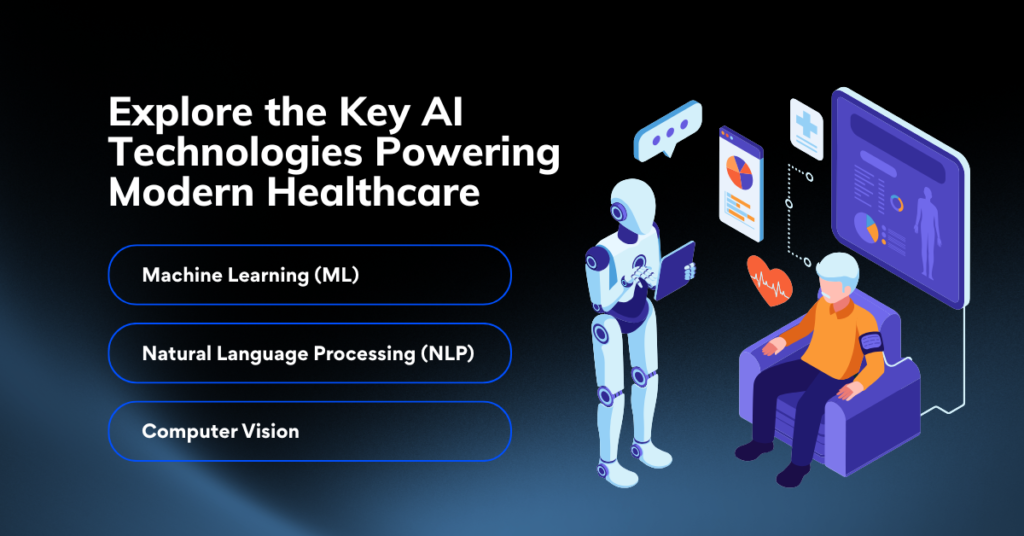
In the context of healthcare operations and clinical workflows, AI refers to a family of technologies each with distinct use cases:
1. Machine Learning (ML)
Machine learning algorithms analyze vast amounts of healthcare data to predict patient outcomes and identify risks.
- Predictive Models: Early detection of diseases like cancer or diabetes through predictive models trained on historical patient data.
- Risk Stratification: Identifying high-risk patient groups for targeted intervention.
- Clinical Trial Optimization: Matching patients to clinical trials based on health profiles and genomics.
2. Natural Language Processing (NLP)
NLP enhances healthcare operations by interpreting unstructured text data from medical records, research papers, and patient interactions.
- Medical Documentation Automation: Streamlining administration by converting spoken interactions into structured clinical notes.
- Sentiment Analysis: Evaluating patient feedback to assess care quality and outcomes.
- Text Mining: Extracting insights from large medical literature databases.
3. Computer Vision
Computer vision empowers AI-driven diagnostic imaging systems to interpret medical images faster and more accurately.
- Radiology Analysis: Detecting anomalies in X-rays, MRIs, and CT scans with precision.
- Pathology Support: Identifying cancerous cells in pathology slides with computer vision algorithms.
- Surgical Assistance: Enabling real-time imaging aids during robotic surgeries.
AI-Powered Virtual Health Assistants
Virtual health assistants improve patient engagement and operational efficiency across healthcare services.
- Chatbots for Triage: Supporting patients in assessing symptoms and determining appropriate care pathways.
- Medication Management: Reminding patients to take medications on schedule.
- Appointment Scheduling: Automating routine administrative tasks for clinics and hospitals.
Robotic Process Automation (RPA) in Healthcare Operations
RPA streamlines repetitive administrative tasks, allowing healthcare professionals to focus on higher-value activities.
- Claims Processing: Automating insurance claim submissions and status updates.
- Data Entry: Reducing errors in migrating information between disparate systems.
- Staffing Management: Optimizing shift rosters and resource allocation.
Each of these technologies amplify what your team can do. Think of it as giving your best people superpowers.
How Will AI Streamline Healthcare Operations In 2026?
For early-stage startups and healthcare facilities, operational efficiency dictates survival. Agentic AI systems are taking over repetitive tasks, allowing your engineering teams to focus on fast product iterations and letting clinicians focus on patients.
Administrative Automation for Resource Allocation
AI-powered scheduling systems analyze historical data to predict patient no-shows and optimize staff allocation. These tools automatically adjust calendars in real-time. Revenue cycle management also benefits heavily.
Natural language processing (NLP) algorithms parse medical notes to generate accurate billing codes. Nym Health reports that its AI can achieve over 96% accuracy in converting provider notes into medical codes, helping healthcare organisations improve billing accuracy and reduce claim denials. Furthermore, predictive maintenance algorithms monitor medical equipment.
By analyzing sensor data, these systems alert facility managers before a costly MRI machine breaks down, ensuring continuous care and preventing budget-draining emergency repairs.
Supply Chain Optimization for Inventory Management
Managing medical supplies requires deep precision. AI models optimize the supply chain by predicting inventory demands based on seasonal illness trends and historical usage.
GHX (2026) notes that AI in the healthcare supply chain is moving rapidly from proof-of-concept to enterprise adoption. These predictive systems prevent stockouts of critical medications and reduce the waste of expired supplies.
For startups building software in this space, creating scalable infrastructure to handle these supply chain data pipelines is essential.
Cybersecurity Protocols for Patient Data Management
As clinical systems become more interconnected, the risk of data breaches rises. AI-driven security tools monitor network traffic for anomalies, instantly isolating threats before they compromise patient records.
AI also bridges the gap in data interoperability. It maps disparate data formats into unified patient records, allowing different hospital systems to communicate securely.
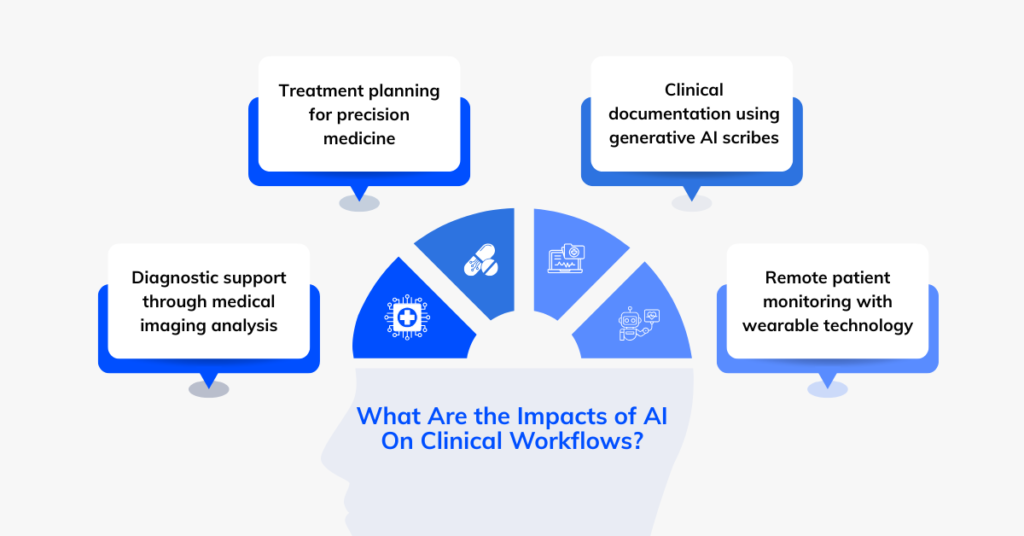
What Are the Impacts of AI On Clinical Workflows?
Clinical workflows are historically burdened by manual documentation. Generative AI fundamentally shifts this paradigm, empowering healthcare professionals to reclaim their time.
Diagnostic Support Through Medical Imaging Analysis
Radiology and pathology rely heavily on visual pattern recognition. Multimodal AI systems analyze X-rays, MRIs, and tissue samples to highlight microscopic anomalies that human eyes might miss. These tools act as a second pair of expert eyes. They assist in early disease detection and accurate risk assessment, significantly speeding up the diagnostic pipeline.
Treatment Planning for Precision Medicine
Precision medicine uses AI to tailor treatments to individual patients. By analyzing a patient’s genetic profile alongside massive medical databases, AI recommends highly specific pharmacogenomics protocols. Tempus Next identifies patients who should receive biomarker testing, prompting immediate action at the correct line of therapy. This level of personalized care reduces trial-and-error prescribing.
Clinical Documentation Using Generative AI Scribes
Physician burnout is a critical issue, largely driven by charting. Ambient AI scribes listen to patient-doctor conversations and generate structured SOAP (Subjective, Objective, Assessment, Plan) notes in under a minute.
A UCLA study published in NEJM AI found that AI scribes reduced documentation time by nearly 10% across 72,000 patient encounters. Native EHR integration means these notes populate directly into the system, bypassing clunky third-party extensions.
Remote Patient Monitoring with Wearable Technology
Wearable devices continuously stream patient vitals to cloud-based AI systems. These algorithms predict patient deterioration hours before adverse events occur. According to Feinstein Institutes for Medical Research, AI-powered wearables can predict patient deterioration an average of 17 hours in advance. This capability enhances virtual consultations, allowing doctors to make proactive, data-driven decisions remotely.
How Can Startups Navigate Healthcare AI Challenges and Ethics?
Building healthcare software means navigating a minefield of regulations and ethical considerations. A misstep here can drain your budget and stall your product launch indefinitely.
Data Privacy Frameworks Under HIPAA Regulations
Patient data is highly sensitive. Your infrastructure must comply with HIPAA in the US and GDPR in Europe. This requires AES-256 encryption, role-based access controls, and strict audit logging. Enlight Lab specializes in building resilient, HIPAA-compliant cloud architectures that scale securely, so your engineering team can focus on feature development rather than compliance headaches.
Algorithmic Fairness In Patient Treatment
AI models trained on skewed data will produce biased clinical recommendations. This can lead to unequal care for minority demographics. Startups must actively audit their training datasets and deploy bias-mitigation frameworks to ensure their algorithms provide fair, equitable care for all patient populations.
FDA Approval Pathways For Medical Algorithms
If your software influences clinical decisions, it may be classified as a Software as a Medical Device (SaMD). The FDA requires rigorous clinical validation before approval. Partnering with experienced technical consultants helps you architect your software to meet strict regulatory quality management systems from day one, reducing technical debt down the line.
Workforce Training Programs For Clinical Adoption
Technology is only useful if people actually use it. Up to 70% of AI pilot failures stem from process problems rather than the technology itself (DiMe Society, 2026). Developing intuitive user interfaces and providing clear workforce training is critical to ensure clinicians trust and adopt your tools.
Why Build a Collaborative AI-Human Ecosystem in Healthcare?
The goal of healthcare AI is not to replace doctors, but to augment their capabilities.
The Augmented Healthcare Professional Model
AI handles data processing, pattern recognition, and documentation. Humans handle empathy, complex physical examinations, and nuanced ethical decisions. This collaborative ecosystem allows clinicians to practice at the top of their license.
Patient Outcome Improvements and Accessibility
When administrative burdens fall, patient interaction time rises. Automated outreach programs identify care gaps and schedule preventive appointments. This proactive engagement keeps patients healthier and reduces emergency room visits.
Economic Impact and Infrastructure Cost Savings
For health systems and startups alike, AI drives massive cost savings. Deloitte (2026) reports that 98% of surveyed executives expect at least 10% cost savings from agentic AI implementations. By automating scalable solutions, startups can reduce their own infrastructure costs and pass those savings onto their healthcare clients.
The Barriers Healthcare Organizations Face And How to Overcome Them
AI adoption in healthcare comes with real friction. Here’s what we see most often and what actually works:
Barrier 1: Legacy EHR Integration
- Most AI tools now offer FHIR-compliant APIs that reduce integration complexity
- Start with point solutions that don’t require full EHR replacement
- Work with vendors who have demonstrated integrations with your specific EHR platform
- Budget integration time at 2–3x initial estimates — it’s always more complex than expected
Barrier 2: Clinical Staff Resistance
- Involve frontline clinicians in tool selection
- Pilot with enthusiastic early adopters before broad rollout
- Frame AI as a burden-reducer, not a replacement
- Measure and share early wins visibly across the organization
Barrier 3: Data Quality and Readiness
- Audit data completeness before selecting AI tools
- AI is only as good as the data it’s trained and operating on
- Invest in data governance before AI
- Work with vendors who provide data readiness assessments as part of onboarding
Barrier 4: Regulatory and Compliance Concerns
- FDA has released clearer guidance for AI/ML-enabled medical devices — review the 2024-2025 frameworks
- HIPAA compliance must be validated for any AI tool handling PHI
- Ensure model transparency – you need to explain AI recommendations to auditors and patients
- Document AI governance policies before deployment begins
How Enlight Lab Helps Healthcare Organizations Navigate AI Implementation
Here’s what we’ve learned from working with healthcare organizations across the spectrum from digital health startups to established hospital networks:
The organizations that succeed with AI don’t just buy technology. They build a strategy.
At Enlight Lab, we approach healthcare AI implementation through a framework we call the Clinical Intelligence Stack. This framework is a layered approach that ensures every AI initiative is grounded in:
- We identify which workflows are consuming the most staff time and generating the highest error rates before recommending any technology.
- We evaluate your current EHR, data infrastructure, and integration landscape to ensure AI tools will actually work in your environment.
- We help you build confidence with quick-win pilots before scaling because a failed big-bang rollout sets back AI adoption by years.
- Every recommendation we make accounts for HIPAA, FDA guidance, and your specific state regulatory environment.
We’re technology strategists who help healthcare organizations make the right choices even when the right choice is to wait.
Next Action Is Implementing AI In Healthcare Operations As It Is Not Optional Anymore
The integration of AI in healthcare operations is fundamentally changing how we deliver care. From generative AI scribes drafting clinical notes to agentic systems managing complex supply chains, the technology is proven, scalable, and ready for enterprise adoption.
For early-stage startups and technical decision-makers, the mandate is clear: build secure, cost-effective solutions that solve real clinical problems without accumulating paralyzing technical debt. Although the complexity of AI implementation is real, it’s manageable with the right guidance.
Enlight Lab provides the elite AI agent development services to launch future-ready healthcare solutions. Ready to optimize your healthcare ecosystem? You don’t have to figure it out alone. Book a free consultation with Enlight Lab today to discuss your product roadmap and turn AI potential into operational reality with strategy-first thinking and implementation expertise.