Hearing a phone ring in a busy office should signal new revenue, but for many businesses, it sounds like an operational bottleneck. Customers are tired of navigating endless phone menus. Front-desk teams are overwhelmed by routine inquiries. Every time a frustrated caller hangs up before reaching a human, your business loses a potential sale or damages a client relationship.
If you lead a growing enterprise, you already know that missed calls translate directly to missed opportunities. The decision of how to handle inbound communication is no longer just an IT concern—it is a critical business strategy. Tech decision-makers and startup founders are currently standing at a crossroads. You must choose between maintaining legacy phone trees or adopting intelligent automation.
Understanding the differences between an AI Voice Agent vs Traditional IVR Systems will define your operational success in 2026. This comprehensive guide breaks down the financial, technical, and customer-experience implications of both technologies. We will explore how Enlight Lab helps organizations navigate this exact transition, ensuring you deploy the right conversational AI tools to protect your revenue and empower your human workforce.
What Is An AI Voice Agent?
An AI voice agent is a conversational, AI-powered system that uses speech recognition, natural language understanding (NLU), and machine learning to understand spoken queries, respond intelligently, and perform tasks such as resolving support issues, booking appointments, or updating records without requiring rigid menu navigation.
How AI voice agents Work
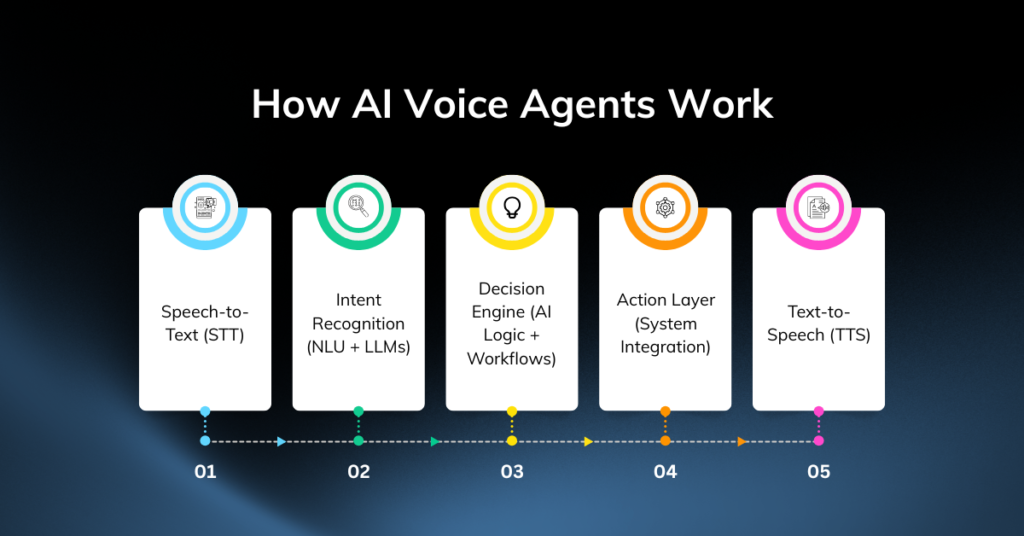
At an enterprise level, an AI voice agent operates as a real-time, multi-layered intelligence system:
- Speech-to-Text (STT): Converts customer speech into machine-readable text.
- Intent Recognition (NLU + LLMs): Understands what the customer actually means—not just keywords but full context.
- Decision Engine (AI Logic + Workflows): Determines the right response or action based on business rules and integrated data.
- Action Layer (System Integration): Executes actions like fetching data from CRM, updating tickets, or scheduling appointments.
- Text-to-Speech (TTS): Converts the response back into a natural, human-like voice.
Core Capabilities:
- Understands and responds to natural, conversational language.
- Completes complex, multi-step tasks (e.g., scheduling and billing in one call).
- Pivots between different topics fluidly within a single conversation.
- Resolves a majority of inbound inquiries without needing a human agent.
Real Enterprise Use Cases
AI voice agents are most impactful where volume and complexity intersect:
- Customer Support Automation
- Appointment Scheduling & Reminders
- Lead Qualification & Sales Calls
- Billing & Payment Interactions
- Outbound Engagement
What Is Traditional IVR?
Interactive Voice Response (IVR) is a phone system technology that allows callers to navigate a company’s departments using their telephone keypad. It follows a pre-programmed script and a fixed decision tree, acting as a basic sorting mechanism for incoming calls.
How Traditional IVR Systems Work
At its core, IVR operates on a linear decision-tree model:
- Call Initiation: The caller dials the business number and is greeted with a pre-recorded message.
- Menu Navigation: The system presents options: “Press 1 for billing, press 2 for support…”
- Input Recognition: The system detects keypad tones (DTMF) or limited voice commands.
- Transfers the call to a department
- Plays a recorded message (e.g., business hours)
- Moves to another menu level
- Call Routing or Information Playback: Based on the input, the system:
Every possible path must be pre-defined before deployment, making IVR inherently rigid.
Core Limitations:
- Cannot interpret spoken language or caller intent.
- Forces callers through rigid, often frustrating menu trees.
- Does not solve problems, only delays interaction with a human agent.
- Handles simple, single-intent requests poorly if they don’t fit the menu.
Common Enterprise Use Cases
Traditional IVR systems are best suited for structured, predictable interactions:
- Routing calls to support or sales teams
- Providing basic account information
- Appointment confirmations or reminders
- Collecting simple inputs (e.g., customer ID, callback number)
What Are the Core Differences Between Conversational AI And Traditional Routing?
Phone systems dictate the first impression a customer forms about your company. The technology you deploy handles that critical moment of contact.
Understanding Natural Language
Conversational AI can interpret and respond to natural, conversational language, allowing users to express their needs freely. Traditional routing, on the other hand, relies on rigid menu-based options that require specific inputs to proceed.
Seamless Multi-Tasking
Conversational AI handles complex, multi-step tasks within a single interaction, such as scheduling, billing, or account updates. Traditional routing typically handles one task at a time and may require multiple calls or transfers between departments for completion.
Topic Flexibility
Conversational AI pivots fluidly between different topics within the same conversation, offering a dynamic and adaptive experience. Traditional routing does not support this flexibility and often forces users to restart the interaction if they need to address a new issue.
Efficiency in Resolution
Conversational AI resolves a majority of inbound inquiries without human intervention by leveraging its advanced understanding and action capabilities. Traditional routing systems often pass unresolved inquiries to live agents, leading to longer resolution times.
User Experience Quality
IVR systems dictate the flow of conversation. The machine talks, the human listens, and the human presses a button. AI voice agents reverse this dynamic. The human speaks naturally, and the machine adapts. Voice AI handles interruptions gracefully and detects emotional cues, adjusting its tone if a caller sounds frustrated.
AI Voice Agent vs Traditional IVR Systems: Quick Comparison Snapshot
If you’re evaluating AI voice agent vs traditional IVR systems, the fastest way to understand the difference is this:
IVR routes calls. AI voice agents resolve them.
But for enterprise decision-makers, that simplicity hides a deeper operational shift. Let’s break it down with a clear, scannable comparison and then translate that into real business impact.
| Feature | AI Voice Agent | Traditional IVR System |
| Interaction Style | Natural, conversational dialogue | Predefined menu navigation |
| Understanding | Intent-based (context-aware) | Input-based (keypad/keywords) |
| Primary Function | Resolves queries end-to-end | Routes calls or provides basic info |
| Flexibility | Dynamic and adaptive | Fixed decision-tree logic |
| First-Call Resolution (FCR) | 85–95% | 65–75% |
| Containment Rate | 50–75% | 20–40% |
| Customer Effort | Low | High |
| Escalation Need | Minimal | Frequent |
| Scalability | Seamless with AI automation | Limited by predefined flows |
| Integration | Deep CRM / system integration | Limited or manual integration |
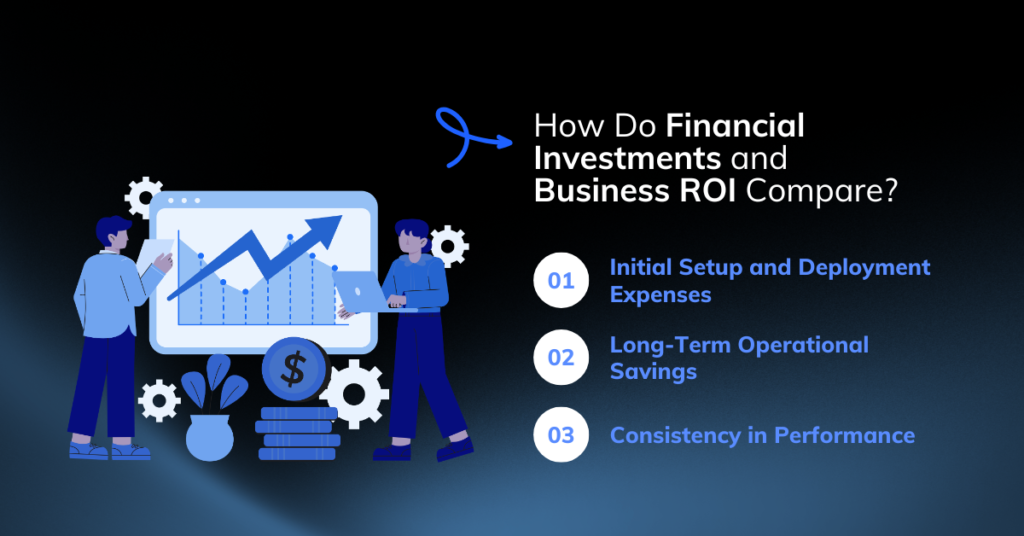
How Do Financial Investments and Business ROI Compare?
Cost is always a primary concern for startup founders and CTOs to evaluate new technology. You must weigh the upfront integration costs against the long-term impact on your profit margins.
Initial Setup and Deployment Expenses
Traditional IVR systems typically have lower initial setup costs because the technology is simple and highly commoditized. Building a phone tree requires minimal backend integration. In contrast, deploying an AI voice agent demands a larger upfront investment.
The AI platform must be securely connected to your Customer Relationship Management (CRM) software, calendar systems, or Electronic Health Records (EHR). However, modern implementations are becoming much faster.
According to industry data from Syntalith, basic AI voice solutions can now be deployed in as little as two to four weeks.
Long-Term Operational Savings
While IVR appears cheaper on day one, it generates significant hidden costs over time. IVR systems deflect calls to human staff, meaning your payroll expenses scale linearly with your call volume. An AI voice agent breaks this cycle. Because it handles unlimited simultaneous calls 24 hours a day.
Enterprises handling heavy call volumes often see a return on investment within the first two months, as the AI system resolves up to 80% of routine requests and entirely eliminates expensive hold-time abandonment.
Consistency in Performance
Human representatives, though skilled, can vary in performance due to factors like fatigue or mood. AI voice agents, on the other hand, deliver consistent interactions every time. They follow pre-designed scripts accurately, ensure uniform customer experiences, and eliminate any discrepancies caused by human error. This consistency is critical for building trust and reliability with customers over time.
Why Does Customer Experience Suffer Under Legacy Call Routing?
Customer patience is shorter than ever. When clients need answers, they expect immediate, personalized service.
Call Abandonment and Revenue loss
The most expensive call your business receives is the one that gets abandoned. A RXNT survey highlighted that 66% of patients face access challenges when trying to reach healthcare providers. When traditional IVR systems place callers in long hold queues, abandonment rates skyrocket.
A frustrated customer who hangs up rarely calls back; they simply call your competitor. AI voice agents eliminate the abandonment window completely. The AI answers every call on the first ring, ensuring no lead or appointment request is lost to a full voicemail box.
Resolution Speed and Intent Recognition
Customer satisfaction plummets when systems feel obstructive.
Traditional IVR creates “IVR fatigue,” where callers mash the zero key just to reach a human. AI voice agents excel because they focus on task resolution rather than simple routing.
If a customer calls an e-commerce brand to check an order status, the AI agent queries the database and reads the tracking information aloud.
According to Prosper AI [2026], their specialized voice agents resolve over 65% of healthcare calls end-to-end.
The conversation feels natural, the problem gets solved instantly, and the customer hangs up satisfied.
Which Specific Business Operations Benefit Most from An Upgrade?
Certain operational bottlenecks are perfectly suited for conversational AI. If your team is struggling with administrative debt, intelligent automation provides immediate relief.
High Volume Appointment Scheduling
Service-based businesses, clinics, and car rental agencies lose thousands of hours a year to basic scheduling. An AI voice agent integrates directly with your booking software. It can verbally negotiate dates with a caller, check availability in real time, and confirm the appointment. It also handles cancellations and reschedules automatically, freeing your front-desk staff to focus entirely on the people physically standing in your office.
Complex Workflow Automation
AI voice agents handle workflows that previously required skilled human intervention. For instance, in accounts receivable, AI agents can reach out to clients, verify identity, and secure payment promises. They can also execute complex inbound requests, such as a customer updating an address while simultaneously asking about a warranty claim. Traditional IVR completely breaks down under these multi-part scenarios, whereas an AI agent seamlessly manages the pivot.
Enhanced Customer Support Efficiency
AI voice agents dramatically improve customer support by handling high volumes of inquiries simultaneously without sacrificing service quality. They are available 24/7, offering immediate responses to frequently asked questions, processing returns, or troubleshooting technical issues, ultimately decreasing wait times and boosting customer satisfaction.
Improved Sales Follow-up
For sales teams, AI voice agents can be an essential tool for nurturing leads. They can schedule follow-up calls, send appointment reminders, and even cross-sell products based on customer preferences. This ensures that no potential opportunity is overlooked, helping businesses maintain consistent and effective communication with prospects.
How Should Tech Leaders Evaluate Migration Risks And Timelines?
Transitioning critical business infrastructure requires careful planning. Non-technical founders need assurance that moving away from legacy systems will not disrupt daily operations.
Plan A Phased Migration
A sudden switch from IVR to an AI voice agent can be risky. A phased rollout allows your team to adapt and ensures a smooth transition without disrupting daily operations.
- During the initial weeks, identify the most common questions your callers have.
- Build and train your new voice agent using real call recordings.
- Start by letting the AI handle after-hours calls or a small portion of daytime overflow.
- Once the system proves its accuracy and your team is comfortable, you can fully disable the old IVR menus.
Ensure Backend System Integration
An AI voice agent needs to access your existing data to be effective. Secure integration with your current tools is crucial for high resolution rates and a seamless customer experience.
- The platform must connect securely to your CRM and ERP software to read and write data.
- Your implementation partner should have the technical expertise to ensure the AI integrates flawlessly with your specific tech stack.
- Prioritize data security and compliance throughout the integration process.
Choose your AI implementation partner carefully. At Enlight Lab, our tech consultants provide hands-on execution, ensuring your AI voice agent integrates flawlessly with your specific tech stack without compromising data security or compliance.
When Should You Choose AI Voice Agents?
Choose AI Voice Agents If You:
- Handle high volumes of complex customer queries
- Are scaling without increasing headcount
- Treat customer experience as a competitive advantage
- Need real-time integration across systems
- Want to reduce cost without sacrificing quality
When Traditional IVR Still Makes Sense
Despite its limitations, traditional IVR systems are not entirely obsolete. In specific scenarios, they remain a practical and cost-effective solution.
Use Traditional IVR When:
- Your use case is simple and predictable
- Prioritising cost control over experience
- Call volumes are low to moderate
- You need a basic front-line filter
Strategic Decision Checklist for Enterprises
If you’re evaluating AI voice agents vs traditional IVR systems, this checklist will help you make a clear, business-aligned decision.
Ask Yourself These Questions:
- Are customers frequently frustrated with your current IVR system?
- Do calls often get transferred multiple times before resolution?
- Are your agents spending time on repetitive, low-value queries?
- Do you need to support customers outside of business hours?
- Are you losing leads or revenue due to delayed responses?
- Is your support team struggling to handle peak volume?
- Do you want to personalize interactions using CRM data?
Interpretation Guide:
- If your mostly answers are “Yes,” go with AI Voice Agents
- If most answers are “No”, IVR may still work effectively.
Choosing Between AI Voice Agents and IVR: A CX Strategy Decision
The shift toward intelligent automation is accelerating rapidly. Sticking with legacy phone menus will soon put your organization at a distinct competitive disadvantage.
When you analyze an AI Voice Agent vs Traditional IVR Systems, the choice becomes clear: modern enterprises must adopt technology that actually resolves customer problems rather than just routing them around the office.
Implementing conversational AI doesn’t have to be overwhelming. You do not need an in-house team of machine learning engineers to modernize your customer support.
As a strategic technology consulting firm, Enlight Lab provides the fractional leadership and end-to-end execution you need to deploy AI successfully. We help startups and growing businesses eliminate bottlenecks, build scalable automation, and stop losing revenue to missed calls.
Reach out to the experts at Enlight Lab today and let us build an AI voice strategy that drives your business forward.