Tech decisions are rarely easy, and deciding how to implement artificial intelligence into your business is currently the highest-stakes choice you face. You know you need AI to stay competitive, but the path forward looks murky. You are likely staring down two distinct paths: building a proprietary system from scratch or paying a monthly subscription for a ready-made platform.
The debate of custom AI agents vs. off-the-shelf solutions dominates boardroom discussions in 2026. Founders and Chief Technology Officers (CTOs) want to avoid technical debt, but they also cannot afford to bleed capital on unnecessary development. Both approaches have specific merits, and picking the wrong one can stall your growth for years.
This guide breaks down exactly how to navigate this decision. We will look at hard numbers, real-world industry applications, and specific decision criteria so you can confidently lead your team forward.
What Is the Difference Between Custom AI Agents And Off‑the‑shelf AI Solutions?
Custom AI agents are built specifically for your business using proprietary data, workflows, and integrations, while off-the-shelf solutions are pre-built tools designed for general use with faster deployment but limited customization.
- Custom = control, flexibility, scalability
- Off-the-shelf = speed, lower upfront cost, simplicity
Best choice depends on complexity, budget, and strategic goals
What Are Custom AI Agents?
Custom AI agents are bespoke software programs designed specifically for your organization’s unique workflows. Developers build these systems from the ground up to interact directly with your proprietary data, legacy software, and specific customer profiles.
Custom AI agents are often powered by advanced techniques like retrieval-based architectures and model adaptation strategies. If you’re exploring how these systems are built and trained, you can also read our detailed guide on RAG vs Fine-tuning for AI systems to understand which approach fits your use case.
Unlike generic chatbots, custom AI agents operate autonomously to execute complex tasks unique to your operational needs.
Advantages of building from scratch
Building a custom AI agent gives you complete control over the final product.
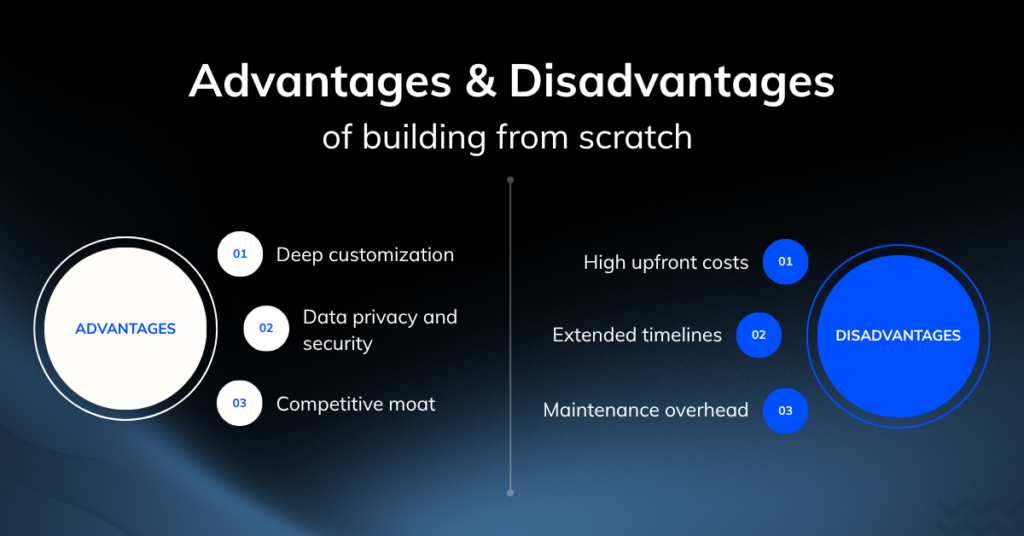
- Deep customization: You dictate the exact tools, policies, and context windows the AI uses.
- Data privacy and security: You own the infrastructure. The AI stores data according to your specific retention policies, and you do not risk leaking proprietary information to a public model.
- Competitive moat: A highly specialized AI agent becomes a valuable intellectual property asset that your competitors cannot simply purchase.
Disadvantages of bespoke systems
The primary drawbacks of custom AI agents relate to resource allocation.
- High upfront costs: AI agent development costs vary significantly based on complexity. Simple reflex agents are the most affordable, while advanced multi-agent systems require significantly higher investment due to coordination and infrastructure needs. A simple reflex agent costs between $10,000 and $30,000, while complex multi-agent systems cost $200,000 to $500,000+.
- Extended timelines: Time to market stretches from six to fifteen weeks for a basic build, delaying your return on investment.
- Maintenance overhead: Your internal team must manage continuous model optimization, bias prevention, and prompt fine-tuning.
Real-World Use Cases
Custom AI agents are most effective where generic tools fall short.
AI copilots for internal operations
- Automate tasks like:
- Internal knowledge search
- Ticket routing and resolution
- Meeting summarization and action tracking
- Acts as a digital teammate embedded in daily workflows
Complex supply chain/fintech workflows
- Example use cases:
- Inventory forecasting across multiple systems
- Fraud detection with real-time decision-making
- End-to-end insurance claims processing
These workflows require context-aware decisions across multiple stages, which generic tools struggle to handle.
How Do Off-the-Shelf AI Solutions Work?
Off-the-shelf AI solutions are pre-packaged, commercially available software products. Vendors design these platforms to solve common business problems across a wide variety of industries. You typically access them via a Software as a Service (SaaS) model, paying a recurring monthly or annual fee.
Common examples include:
- ChatGPT for conversational AI and content generation
- HubSpot AI for marketing and sales automation
- Zendesk AI for customer support workflows [forbes.com]
Advantages of ready-made tools
Off-the-shelf software removes the friction from AI adoption.
- Rapid deployment: You can configure and deploy these solutions in one to three weeks.
- Cost efficiency: Setup and configuration costs generally sit between $3,000 and $20,000, depending on complexity and integration requirements. The vendor absorbs the massive costs of model training and infrastructure maintenance.
- Reliable support: Established vendors offer dedicated customer success teams and robust community forums to help you troubleshoot issues.
Disadvantages of commercial platforms
Convenience often comes at the cost of flexibility.
- Generic performance: Because the vendor built the tool for a broad audience, it may struggle with your highly specialized terminology or niche workflows.
- Vendor lock-in: You rely entirely on the provider’s pricing model, update schedule, and data privacy policies.
- Integration friction: Connecting ready-made tools to older, legacy enterprise systems often requires clunky workarounds.
Ideal Use Cases
Off-the-shelf solutions perform best in predictable, repeatable, and low-complexity scenarios where standard functionality is sufficient.
Customer support automation
- AI chatbots handling FAQs and ticket routing
- Automated responses for common customer queries
- Reduces support workload without major configuration
Content generation
- Blog writing, ad copy, email drafts
- Social media content creation
- Quick turnaround for marketing teams
Basic workflow automation
- Lead qualification and routing
- Data entry and simple task automation
- Notifications and standard process triggers
Custom AI Agents vs. Off-the-Shelf Solutions: Head-to-Head Comparison
| Factor | Custom AI Agents | Off-the-Shelf Solutions |
| Deployment Time | Weeks–months | Hours–days |
| Customization | Fully tailored | Limited |
| Cost | High upfront, lower long-term | Low upfront, recurring costs |
| Data Control | Full ownership | Vendor-controlled |
| Integration | Deep, flexible | Limited to vendor ecosystem |
| Scalability | High (aligned to business) | Restricted |
| Maintenance | Managed internally | Vendor-managed |
When Should You Adopt Custom AI Agents?
Choose custom AI agents when:
- Your business requires highly specialized workflows or domain-specific intelligence
- You need deep integration with proprietary systems, APIs, or internal data sources
- Your processes are complex, dynamic, or decision-intensive
- Data privacy, compliance, and security are critical requirements
- You want greater control over model behavior, outputs, and automation logic
- Your goal is to build a long-term competitive advantage through AI
- Off-the-shelf solutions cannot meet your accuracy, scalability, or customization needs
- You have the technical resources or strategic commitment to support AI development and optimization
Custom AI agents deliver the most value when organizations need tailored intelligence, scalable automation, and AI systems aligned closely with unique business objectives.
When Should You Adopt Off-the-Shelf AI Solutions?
Choose off-the-shelf AI when:
- You need fast deployment and want solutions to be implemented within hours or days
- Your use case involves common business applications such as customer support automation, content generation, lead qualification, OCR, or standard analytics.
- You prefer predictable subscription-based or usage-based pricing over large upfront development costs.
- You are validating AI initiatives through pilot projects, MVPs, or experimentation before scaling.
- You lack in-house AI expertise and want the vendor to manage infrastructure, updates, and maintenance.
- Your workflows are standardized, simple, and predictable rather than highly specialized or proprietary.
Off-the-shelf AI solutions excel when your goal is to solve a problem quickly rather than build a long-term AI advantage. They deliver the most value for:
- Low-complexity, repetitive tasks
- Rapid operational efficiency improvements
- Teams focused on optimizing short-term productivity
How To Choose Between Custom AI Agents Vs. Off-the-shelf Solutions?
Evaluating custom AI agents vs. off-the-shelf solutions requires a pragmatic look at your current resources and long-term goals.
Choose off-the-shelf solutions if speed to market matters more than absolute precision. Choose custom AI agents if data security and specialized capabilities are non-negotiable requirements for your business model.
Decision Framework
| If You Need… | Choose |
| Speed & simplicity | Off-the-shelf |
| Custom workflows | Custom AI |
| Competitive differentiation | Custom AI |
| Budget-friendly start | Off-the-shelf |
| Long-term scalability | Custom AI |
The key criteria to consider
Analyze your business objectives
Identify the exact problem you need AI to solve. If you just need a standard customer support chatbot, buy it. If you need an AI that cross-references your proprietary supply chain data with real-time weather patterns, build it.
Evaluate your budget structures
Compare the total cost of ownership. Custom builds demand massive upfront capital but have lower marginal costs at scale. Off-the-shelf tools require low initial capital but scale linearly with usage fees.
Assess your talent pool
Do you employ experienced machine learning engineers? If not, you will need to partner with an external development firm, which increases project management complexity.
Review compliance requirements
If your industry faces strict regulatory oversight, custom environments allow you to implement granular role-based access controls and customized audit trails.
When Should You Use a Hybrid AI Approach?
Many tech leaders discover that a binary choice is unnecessary. A hybrid approach combines the speed of commercial AI models with the security of custom orchestration layers.
In a hybrid model, developers use pre-trained open-source models (like LLaMA 3 or Mistral) or API connections to proprietary models (like GPT-5) and wrap them in custom business logic. This strategy gives you tailored workflows without the multi-million dollar price tag of training a foundation model from scratch.
Best use cases for hybrid models
- Prototyping: Run a proof-of-concept using an off-the-shelf API. Once the workflow proves valuable, invest in a custom infrastructure.
- Compartmentalization: Use a cheap, ready-made AI for internal HR queries, but deploy a secure, custom-built AI agent for processing sensitive financial transactions.
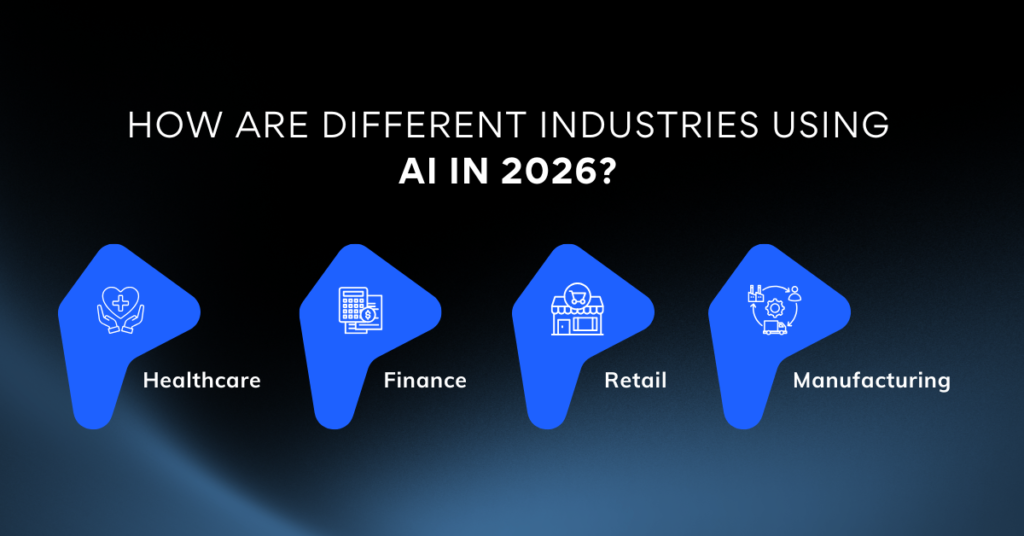
How Are Different Industries Using AI In 2026?
The right tech stack heavily depends on your specific sector. Different markets prioritize different outcomes.
Healthcare
- The priority: Precision, patient safety, and HIPAA compliance.
- The trend: Hospitals strongly favor custom AI solutions. An off-the-shelf tool cannot reliably navigate localized electronic health record (EHR) systems without hallucinating. Custom systems securely handle sensitive patient data while providing accurate diagnostic support.
Finance
- The priority: Security, fraud detection, and auditability.
- The trend: Financial institutions utilize highly specialized custom AI agents. The risk of exposing transaction data to third-party commercial vendors is too high. Custom systems allow banks to build explicit rollback logic and strict access controls.
Retail
- The priority: Hyper-personalization and rapid inventory turnover.
- The trend: E-commerce brands lean toward off-the-shelf solutions. Commercial AI platforms excel at standard recommendation engines and automated marketing campaigns, allowing retailers to focus on brand building rather than software engineering.
Manufacturing
- The priority: Operational efficiency and predictive maintenance.
- The trend: Manufacturers successfully employ hybrid models. They use off-the-shelf computer vision systems for basic quality control, but build custom logic agents to optimize their highly specific supply chain routes.
What Is the Future of AI Solutions Beyond 2026?
The AI landscape shifts constantly. Leaders who plan for 2027 and beyond will hold a distinct advantage.
Expect a strong shift toward Explainable AI (XAI). Regulators and consumers increasingly demand to know exactly how an AI system arrived at a specific decision. Custom AI agents have an inherent advantage here, as your engineers can build transparent decision-logging directly into the architecture.
Additionally, ethical AI frameworks are becoming mandatory. You must ensure your AI systems do not inadvertently discriminate against users based on biased training data. Conducting regular “red-teaming” (testing the AI for vulnerabilities and biases) will become a standard operating procedure for any business deploying custom models.
Custom AI Agents vs. Off-the-Shelf Solutions: Make the Right Choice
Selecting the right AI infrastructure defines your company’s operational trajectory. Rushing into a custom build without the required capital leads to half-finished, unusable software. Conversely, relying entirely on generic SaaS platforms limits your ability to truly differentiate your service.
Your job as a leader is to weigh your immediate need for speed against your long-term need for specialization. Start small. Validate your AI workflows with off-the-shelf tools where possible, and strategically invest in custom AI agents where they create a defensible competitive advantage.
The reality is, there is no one-size-fits-all answer when it comes to choosing between custom AI Agents and off-the-shelf solutions. All you need is to take a hard look at your 2026 product roadmap. Identify one high-friction workflow that AI could solve, run a cost-benefit analysis based on the numbers provided in this guide, and make your move.
If you are still looking to know which approach will deliver the most value for your business right now and scale with you over time, consult the Enlight Lab team.
We help you:
- Identify where off-the-shelf AI can deliver quick wins
- Pinpoint opportunities where custom AI creates a real competitive advantage
- Design a practical, phased AI roadmap that aligns with your business goals
- Build and deploy production-ready AI systems, not just prototypes
Talk to our AI experts and make the right call that works for your business today and tomorrow.