
This guide walks through the real differences, the architecture behind each option, and how to decide including when a data lakehouse might replace the either/or decision entirely.
What Is a Data Lake?
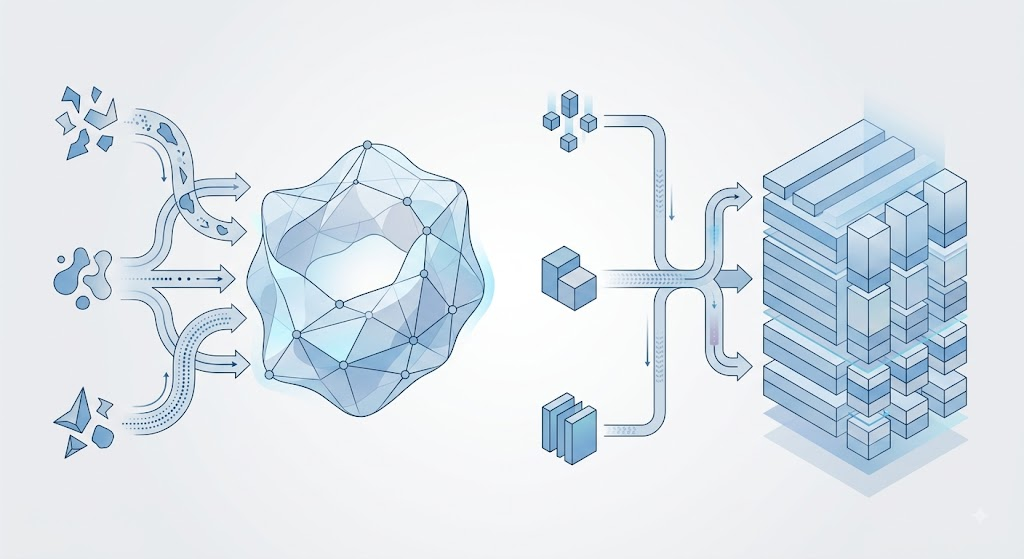
A data lake is a centralized repository that holds data in its native format structured tables, semi-structured JSON or logs, and unstructured files like images or documents without requiring a predefined schema before storage.
Data lakes use schema-on-read, meaning structure is applied when data is queried or processed, not when it’s written well suited to high-volume, high-variety data that hasn’t yet been fully defined for analytical use. They’re typically built on object storage such as Amazon S3 or Azure Data Lake Storage, keeping raw storage costs low relative to compute.
Consider a retailer capturing website clickstream events, application logs, customer records, product images, IoT sensor readings, and transaction data. Rather than deciding upfront how each dataset will be used, the retailer can land all of it in a data lake and let engineering and data science teams determine downstream use cases later.
What Is a Data Warehouse?
A data warehouse is a structured repository designed for fast, reliable SQL analytics data is cleaned, modeled, and loaded into predefined schemas before it’s queried, using a schema-on-write approach.
Data moves through an ETL or ELT pipeline, gets transformed into consistent tables, and lands in a warehouse like Snowflake, Amazon Redshift, or Google Big Query, where BI tools such as Power BI query it for dashboards and reports. Because schema is enforced before storage, warehouses deliver predictable query performance and strong data quality critical for financial reporting where a wrong number has real consequences.
A finance team building monthly revenue dashboards, or a sales team tracking pipeline conversion by region, is a textbook warehouse use case: the data is already structured, the questions are known in advance, and consistency matters more than flexibility. Despite the rise of lakes and lakehouses, warehouses remain the standard for governed, high-trust BI.
Data Lake vs Data Warehouse: Key Differences
| Dimension | Data Lake | Data Warehouse |
|---|---|---|
| Data types | Structured, semi-structured, unstructured | Structured only |
| Schema approach | Schema-on-read | Schema-on-write |
| Primary users | Data engineers, data scientists | Analysts, business users |
| Query patterns | Exploratory, ad hoc, ML-driven | Predictable SQL, dashboards |
| Storage | Low-cost object storage | Optimized analytical storage |
| Processing | Spark, distributed compute | SQL engine, ELT pipelines |
| Machine learning | Strong fit | Limited without extraction |
| BI/reporting | Requires additional tooling | Native strength |
| Governance | Harder to enforce | Built-in via schema |
| Scalability | Very high, cheap at scale | High, but compute costs rise with usage |
| Typical use case | Raw data archive, ML training, logs | Dashboards, financial reporting |
The practical difference is organizational as much as technical. A lake defers structure decisions to give engineering flexibility; a warehouse forces those decisions early, which is exactly why reliable BI comes faster out of a warehouse and flexible raw data comes faster out of a lake.
Data Lake vs Data Warehouse Architecture
Both follow a similar high-level flow:
Data Sources → Ingestion → Data Lake / Data Warehouse → Processing → Analytics / BI / ML → Business Decisions
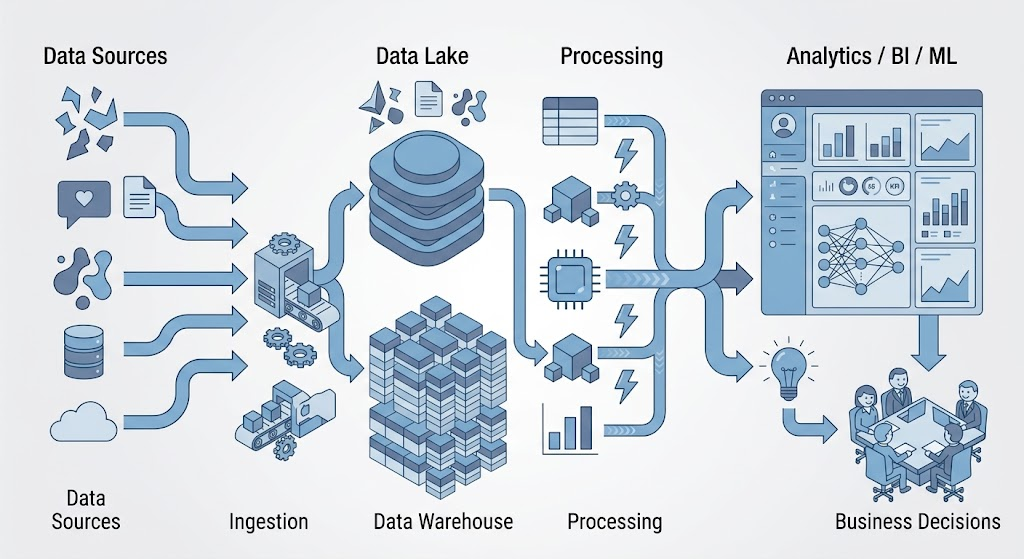
Data lake architecture typically layers data by refinement stage: raw “bronze” data lands as-is, “silver” data is cleaned and partially structured, and “gold” data is curated for specific analytics or ML use. Apache Spark commonly handles transformation between layers.
Data warehouse architecture moves data through ingestion and transformation into modeled analytical tables, often organized around a semantic layer that maps raw columns to business-friendly metrics, which BI tools query directly.
The lake’s layered approach adds engineering overhead but preserves raw data for future, unknown use cases. The warehouse’s modeled approach is faster to query but commits to structure earlier.
When Should a Business Choose a Data Lake?
A data lake fits best when data volume is large, data types are varied, and machine learning or exploratory analytics matter more than standardized reporting.
Good candidates include:
- ML model training on large, varied datasets
- IoT and sensor data at high volume
- Log and event analytics for engineering or security teams
- Exploratory, undefined data science analysis
- Long-term retention of raw data for unknown future use
The trade-offs are real. Without strong governance, a lake becomes a “data swamp” data nobody trusts or can find. Data quality isn’t enforced by the platform, so it has to be enforced by process, and lakes generally require more mature engineering resources than a warehouse. If your team spends most of its time building Power BI dashboards from structured sales and finance data, adopting a lake because it’s more scalable can add complexity without solving a problem you actually have.
When Should a Business Choose a Data Warehouse?
A data warehouse fits best when the organization runs on structured business data and needs consistent, trustworthy SQL analytics for reporting and decision-making.
Good candidates include:
- BI-heavy organizations with executive and departmental dashboards
- Financial reporting and compliance-driven analytics
- Sales, marketing, and operational reporting from structured systems
- Predictable, repeatable query patterns
- Teams with limited data engineering capacity needing a simpler operating model
Warehouses are often the more practical starting point precisely because they constrain scope. A modest engineering team can stand up a warehouse and deliver reliable dashboards faster than it could build and govern a lake from scratch even though the warehouse offers less flexibility for unstructured or exploratory workloads.
Data Lake vs Data Warehouse: Cost Comparison
Raw storage in a data lake is typically cheaper per gigabyte than warehouse storage, but total cost of ownership depends on far more than storage price.
Costs to weigh on both sides include storage, compute for processing and querying, engineering effort to build and maintain pipelines, governance tooling, ongoing maintenance, BI licensing, and data movement between systems. A lake’s cheap storage can be offset by the engineering hours needed to clean, catalog, and govern data before it’s usable. A warehouse’s higher per-query compute cost can be offset by lower engineering overhead, since transformation and modeling happen once, upfront.
Actual TCO depends on your cloud provider, data volume, query frequency, storage footprint, compute needs, engineering team size, and governance requirements. The cheapest storage option is rarely the cheapest architecture once engineering and governance costs are included cost comparisons should be done at the workload level, not the per-gigabyte level.
Data Lake vs Data Warehouse for AI and Machine Learning
Data lakes are generally better suited to AI and ML workloads because they can store the raw, high-volume, varied data text, images, logs, behavioral events that model training requires. Data warehouses remain important for curated, governed datasets used in feature engineering and any ML application that depends on clean, structured business data, like a customer lifetime value model built on transaction history. In practice, modern AI architectures frequently use both: raw data and experimentation happen in the lake, while governed, business-critical datasets live in or are exposed through the warehouse.
What Is a Data Lakehouse?
A data lakehouse combines the scalability and flexibility of a data lake with the governance, reliability, and analytical performance traditionally associated with a data warehouse.
Technologies like Delta Lake and Apache Iceberg add transactional consistency, schema enforcement, and versioning on top of lake storage, letting teams run both BI queries and ML workloads against the same data. Databricks built its platform around this lakehouse concept, and Microsoft Fabric offers a similar unified approach within Azure. The point isn’t to replace the lake-versus-warehouse decision with a single “best” product it’s to reduce the need to maintain two systems and copy data between them.
Data Lake vs Data Warehouse vs Data Lakehouse
| Dimension | Data Lake | Data Warehouse | Data Lakehouse |
|---|---|---|---|
| Primary purpose | Raw data storage at scale | Structured analytics | Unified analytics + ML |
| Data types | All types | Structured | All types, governed |
| BI support | Requires extra tooling | Native strength | Strong, improving |
| ML support | Strong | Limited | Strong |
| Governance | Weak by default | Strong by default | Strong, built-in |
| Complexity | High without discipline | Low to moderate | Moderate to high |
| Best-fit organization | Data-mature, ML-focused | BI-focused, structured data | Teams wanting one platform for both |
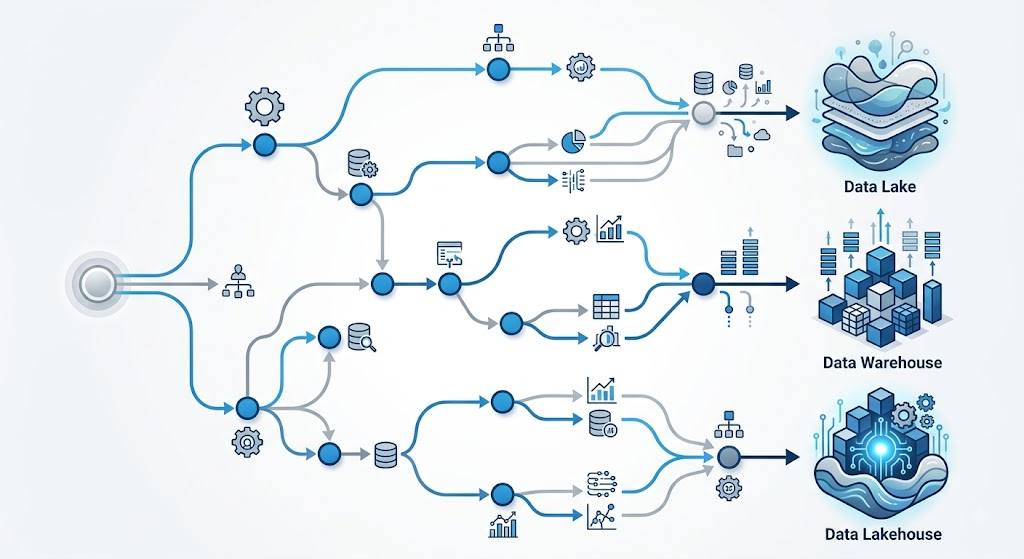
Organizations with heavy BI needs and limited engineering resources often do fine with a warehouse alone. Those with growing ML ambitions and diverse data sources may outgrow a warehouse-only setup. A lakehouse is worth evaluating when both needs exist simultaneously and maintaining two platforms has become a real operational burden.
Which Data Architecture Is Right for Your Business?
Use these scenarios as a starting point, not a rulebook your actual workloads and constraints should drive the final decision.
- Primarily executive dashboards and BI → data warehouse
- Primarily large-scale raw data storage and ML → data lake
- BI, data engineering, and ML on one platform → consider a lakehouse
- Heavily invested in the Microsoft ecosystem → evaluate Microsoft Fabric and related Azure services
- Need advanced Spark/ML and multi-cloud data engineering → evaluate Databricks
These are directional signals, not absolutes. Two companies with similar data volumes can land on different architectures based on team skill, existing tooling, and where the business is headed.
Common Mistakes When Choosing Between a Data Lake and Data Warehouse
- Choosing based only on storage cost. Cheap storage doesn’t offset expensive engineering and governance.
- Ignoring governance. A lake without ownership and cataloging becomes unusable within a year.
- Assuming a lake automatically fixes data silos. Consolidating storage doesn’t consolidate meaning or ownership.
- Building a lake without clear ownership. Someone has to own quality, access, and lifecycle.
- Choosing a warehouse while ML needs grow fast. Warehouses can hit real limits with unstructured, high-volume data.
- Choosing a lake without adequate engineering resources. Lakes require more sustained discipline than warehouses.
- Ignoring existing cloud and BI investments. The “best” architecture on paper may conflict with tools your team already knows.
How to Choose a Data Platform in 2026
- Identify business use case reporting, ML, exploratory analysis, or a mix.
- Classify data types and volumes structured vs. unstructured, current and projected scale.
- Map analytics and ML requirements repeatable queries vs. evolving, exploratory needs.
- Evaluate governance and engineering capabilities what your team can realistically operate.
- Calculate total cost of ownership storage, compute, engineering, and governance combined.
Platform selection should follow business requirements, not vendor popularity.
Conclusion
There’s no universal winner in the data lake vs data warehouse decision. Lakes prioritize flexibility, scale, and support for varied data and ML. Warehouses prioritize structured analytics, governance, and reliable BI. Lakehouses increasingly combine both, reducing the need to choose one system and abandon the other.
The right starting point is your actual workload, not the architecture that’s trending. If you’re evaluating data lake, data warehouse, or lakehouse options for your organization, Enlight Lab can help assess your current data environment and map out an architecture that fits where your business is headed.