
Launching a startup is exciting. But building the right tech foundation can quickly become overwhelming – especially if you are not from a technical background. Many founders struggle with product delays, poor developer management, rising tech costs, and scaling issues because they do not have the right technical leadership in place.
That is why learning how to hire a CTO for your startup is one of the most important decisions you will make early on.
A skilled CTO does far more than manage developers. They shape your product vision, choose the right technology stack, improve scalability, reduce technical risks, and help investors trust your business. Whether you are building an MVP, launching a SaaS platform, or scaling an existing product, the right CTO can directly impact your startup’s success.
But hiring the wrong CTO can cost you months of lost momentum and thousands of dollars.
In this guide, you will learn:
- When to hire a CTO
- How much a startup CTO costs
- Essential technical and leadership skills to look for
- Hiring models for different startup stages
- Smart hiring tips to avoid expensive mistakes
If you want to build a strong product and scale with confidence, this guide will help you make the right decision.
What Does a CTO Do in a Startup?
Before you hire a CTO for your startup, you need clarity on what this role truly means.
A startup CTO is not just a senior developer. They are the person responsible for turning ideas into a scalable, secure, reliable product.
Core Responsibilities of a Startup CTO
A strong CTO helps you:
- Product architecture and system design
- Technology stack selection
- Development team management
- Product scalability planning
- Cybersecurity and compliance
- Technical hiring
- DevOps and infrastructure decisions
- Long-term technology roadmap
In simple terms, your CTO ensures your startup does not collapse under its own technology as it grows. A great CTO also helps you avoid costly technical debt that can slow your startup later.
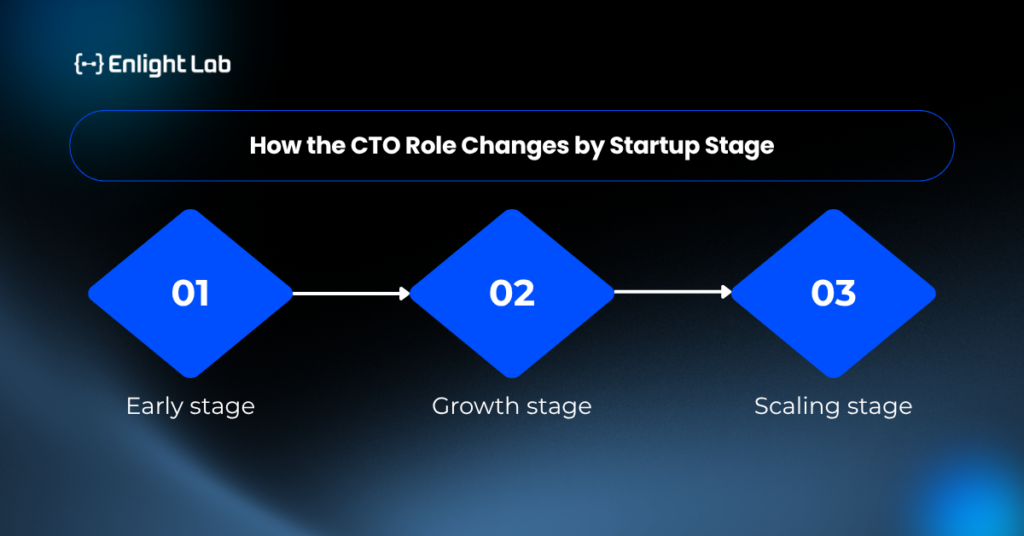
How the CTO Role Changes by Startup Stage
This is where many founders get confused.
Early Stage
- Hands‑on coding
- MVP development
- Fast experimentation
- Architecture decisions
Growth Stage
- Hiring engineers
- Scaling infrastructure
- Improving reliability
- Introducing processes
Scaling Stage
- Team leadership
- Security and compliance
- Long‑term technology planning
- Less coding, more strategy
When you hire a CTO for your startup, you must match the role to your current stage, not just your future dreams.
When Should You Hire a CTO for Your Startup?
Timing matters more than most founders realise. Hiring too early drains cash. Hiring too late creates chaos. The right timing changes everything.
Below are the clearest signs that you should plan for a CTO.
You Are No Longer Just Validating an Idea
In the early days, you can experiment with freelancers or small dev teams. But once your idea gains traction, technology stops being optional.
If you are moving from idea to execution, you need someone who can:
- Define a realistic technical roadmap
- Choose the right tech stack for scale
- Avoid shortcuts that will break later
At this stage, a CTO helps you turn vision into a buildable, scalable product, not just a quick prototype.
You Are Building an MVP That Needs to Scale
An MVP is not about building fast. It’s about building right.
If your MVP is expected to:
- Support real users
- Handle data securely
- Grow without full rewrites
then you need strong technical leadership. A CTO ensures your MVP is designed for iteration, performance, and future growth, not just a demo.
You Are a Non‑Technical Founder Making Technical Decisions
If you are choosing frameworks, approving architectures, or trusting every technical decision blindly, you are carrying unnecessary risk.
You should bring in a CTO when:
- You cannot confidently evaluate developer decisions
- You rely too much on vendors without transparency
- You feel unsure whether your product is being built “the right way”
A CTO gives you clarity, control, and confidence without forcing you to become technical yourself.
Your Development Costs Are Rising Without Clear Progress
If money is going out but progress feels slow, scattered, or inconsistent, that is a leadership gap, not a coding problem.
This is the point where you need a CTO to:
- Optimise team productivity
- Remove unnecessary complexity
- Create alignment between business goals and engineering tasks
Good CTO leadership often reduces costs by fixing decision‑making, not by pushing teams harder.
Investors Start Asking Hard Technical Questions
When investors come in, your tech is no longer invisible.
If you are preparing for fundraising, you need a CTO when:
- Investors ask about scalability, security, or architecture
- Due diligence reviews your code and infrastructure
- You need credibility beyond slides and pitch decks
A CTO turns your technology into a strength that investors trust, not a risk they question.
Technology Is Becoming Core to Your Competitive Advantage
Once your product relies on:
- AI, ML, or complex data flows
- High‑availability systems
- Custom platforms rather than off‑the‑shelf tools
technology becomes your differentiator. At this stage, not having a CTO slows innovation and increases risk.
A CTO ensures your tech strategy actively supports growth, speed, and market positioning.
You Need Strategic Guidance, Not Just Code
If you already have developers but still feel unsure about what to build next, how fast to move, or what risks to take, that’s a signal.
You hire a CTO when:
- You need strategic input, not daily coding
- Product and business decisions depend on technology
- You want to future‑proof your startup
At this point, a CTO becomes your technology decision partner, not just a manager.
Why Hiring a CTO is Crucial for Your Startup in 2026
In 2026, technology is no longer a support function. It is your product, your growth engine, and often your biggest risk. Whether you are building a SaaS platform, an AI‑driven application, or a data‑heavy product, the complexity of modern tech decisions makes CTO leadership critical much earlier than before.
Here is why you cannot afford to ignore this role anymore.
Technology Decisions Are Now Business Decisions
In 2026, every major business decision is influenced by technology.
When you choose:
- AI models or automation workflows
- Cloud infrastructure and cost controls
- Security, privacy, and compliance frameworks
you are making decisions that directly affect revenue, scalability, and trust. A CTO ensures these choices support your business goals, not just short‑term development speed.
Without this leadership, you risk building features that cannot scale or systems that become expensive to maintain.
AI, Data, and Automation Raise the Stakes
AI and data capabilities are no longer optional add‑ons. They are becoming standard expectations from customers and investors alike.
If you are leveraging:
- AI or machine learning models
- Large datasets and real‑time analytics
- Automation across operations and product features
you need a CTO to guide architecture, ethics, performance, and long‑term sustainability. In 2026, wrong AI decisions are not easy to undo.
Speed Without Direction Is a Hidden Risk
Startups still need to move fast. But moving fast without direction is more dangerous than moving slowly.
A CTO helps you:
- Prioritise what truly matters
- Avoid over‑engineering or under‑building
- Balance speed with stability
In a competitive market, execution speed only works when it is paired with sound technical strategy.
Investors Expect Technical Maturity Much Earlier
In today’s funding environment, investors expect technical clarity even at early stages.
They look for:
- A clear technical roadmap
- Scalable architecture decisions
- Evidence that risks are understood and managed
A CTO gives you credibility during pitches, due diligence, and growth discussions. In 2026, technical depth often determines whether confidence is built or lost.
Talent Needs Direction, Not Just Tasks
Great developers do not just want tickets to close. They want leadership, clarity, and purpose.
A CTO:
- Aligns engineering teams with product vision
- Sets standards for quality and performance
- Creates an environment where strong talent stays
Without this leadership, you may still hire developers, but output and morale suffer quietly over time.
The Cost of Getting It Wrong Is Higher Than Ever
Rebuilding systems, fixing architecture mistakes, or switching tech stacks has become more expensive than in the past.
In 2026:
- Cloud costs scale fast
- AI mistakes compound quickly
- Security and compliance failures carry real consequences
Hiring a CTO early enough helps you avoid silent, compounding technical debt that can slow or even kill otherwise strong startups.
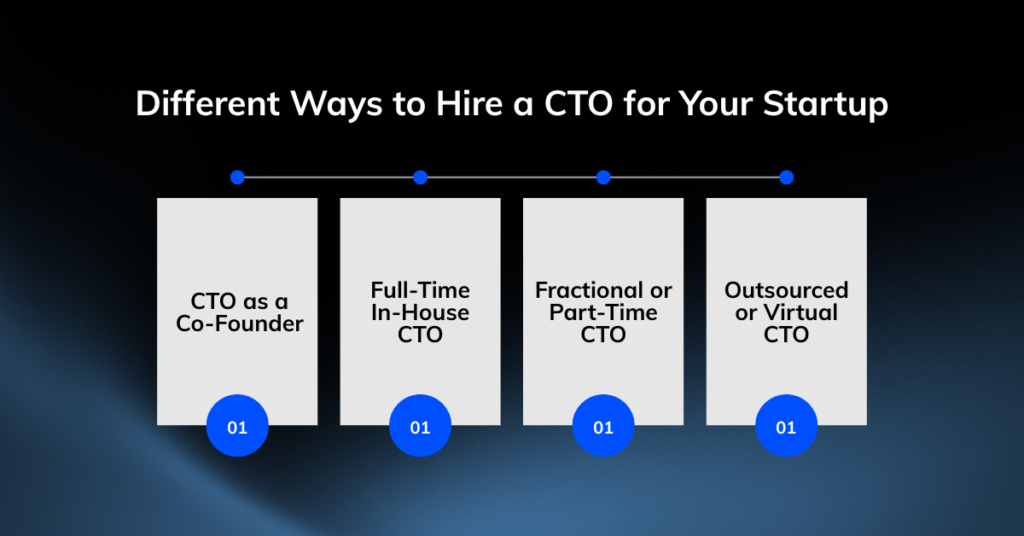
Different Ways to Hire a CTO for Your Startup
Not every startup needs the same CTO model. Choosing the wrong one often leads to frustration and wasted resources.
CTO as a Co‑Founder
This is common in early startups.
Pros
- Deep commitment
- Strong alignment with vision
- Lower cash burn
Cons
- Equity dilution
- Risk of mismatch
- Difficult to replace later
This works best when mutual trust already exists.
Full‑Time In‑House CTO
This is ideal for startups entering growth or scale.
Pros
- Full ownership
- Strong leadership
- Long‑term strategy
Cons
- High salary cost
- Hiring takes time
Fractional or Part‑Time CTO
A flexible option for early‑stage or budget‑conscious startups.
Pros
- Lower cost
- Strategic guidance
- Fast onboarding
Cons
- Limited availability
- Not ideal for rapid scaling
Outsourced or Virtual CTO
Often used when founders need experience without full commitment.
Pros
- Immediate expertise
- No long‑term contracts
- Cost efficient
Cons
- Less emotional ownership
- Requires clear communication
At Enlight Lab, we often recommend fractional or virtual CTO models for startups that need clarity before committing to a full‑time hire.
Should You Hire an In-House or Outsourced CTO?
This depends on your goals, timeline, and budget.
| In-House CTO | Outsourced CTO |
| Full-time leadership | Flexible engagement |
| Higher cost | Lower cost |
| Deep company involvement | Faster onboarding |
| Long-term scaling | Early-stage guidance |
For many startups, outsourced CTO services offer the best balance between expertise and affordability.
How Much Does It Cost to Hire a CTO for Your Startup?
Budget is often the biggest concern when founders decide to hire a CTO for your startup.
Average CTO Cost by Hiring Model
- Co‑founder CTO: Equity (10%–35%)
- Full‑time CTO (US): $150k–$300k+ annually
- Fractional CTO: $5k–$20k per month
- Outsourced CTO: Project‑based or retainer
Cost Varies by Location
Hiring globally can significantly reduce cost without reducing quality if done correctly.
Hidden Costs Founders Miss
- Rewriting bad code
- Infrastructure rework
- Missed timelines
- Lost investor trust
- Team burnout
Hiring cheap without strategy often becomes the most expensive mistake.
Key Skills to Look for When You Hire a CTO for Your Startup
Skills matter more than titles.
Technical Skills That Matter
Your CTO should understand:
- Scalable system design
- Cloud infrastructure (AWS, Azure, GCP)
- Security fundamentals
- Backend technologies relevant to your product
- DevOps and deployment pipelines
They do not need to know everything, but they must know what questions to ask.
Business and Strategic Skills
Great CTOs can:
- Translate business goals into tech decisions
- Balance speed with quality
- Control development costs
- Communicate clearly with non‑technical founders
Leadership and Communication Skills
This is often overlooked.
A strong CTO should:
- Hire and mentor engineers
- Create a healthy engineering culture
- Explain complex ideas simply
- Take ownership during crises
If you cannot understand your CTO, your investors and team will struggle too.
How to Hire a CTO for Your Startup: Step‑by‑Step Guide
This is where strategy meets action.
Step 1: Define Your Needs Clearly
Ask yourself:
- What problems do I need solved now?
- What will break if we grow 10x?
- What skills are non‑negotiable?
Step 2: Choose the Right CTO Model
Match cost, availability, and risk to your current stage.
Step 3: Write a Clear Job Description
Clarity attracts the right candidates and filters the wrong ones.
Step 4: Where to Find CTO Candidates
- Founder networks
- Startup communities
- Referrals from investors
- Trusted consulting partners like Enlight Lab
Step 5: Interview for Thinking, Not Just Experience
Focus on how candidates think, not just what they have built.
Step 6: Test Alignment Before Commitment
Start with advisory, contract, or trial periods when possible.
Common Mistakes Founders Make When Hiring a CTO & How to Avoid Them
Rushing the Hire Before You Know What You Need
Hiring a CTO too quickly often leads to misalignment and regret.
What goes wrong: You bring someone in before your product, roadmap, or risks are clearly defined.
What to do instead: First get clarity on why you need a CTO. Strategy, architecture, leadership, or all three. Hire with intent, not urgency.
Chasing Big Names Instead of Startup Fit
A strong brand on a résumé does not guarantee startup success.
What goes wrong: Experience from large enterprises may not translate to ambiguity, speed, and ownership.
What to do instead: Look for someone who has built with constraints, operated without safety nets, and thrives in early‑stage uncertainty.
Being Vague About Your Vision and Expectations
CTOs cannot execute what they do not clearly understand.
What goes wrong: Misaligned priorities, rework, and frustration on both sides.
What to do instead: Communicate your product vision, growth goals, and non‑negotiables early and often. Clarity upfront saves months later.
Skipping a Real‑World Trial
Interviews alone rarely reveal how someone thinks and decides.
What goes wrong: You commit before seeing real problem‑solving in action.
What to do instead: Start with a small, paid engagement. Observe decision‑making, communication, and ownership before going long‑term.
Treating the CTO Role as Transactional
Technical leadership is a partnership, not a contract.
What goes wrong: Poor trust, misaligned values, and fragile working relationships.
What to do instead: Ensure strong emotional and strategic alignment. You are choosing a long‑term collaborator, not just a technical hire.
Avoiding these mistakes is extremely essential and about being intentional. When you hire a CTO with clarity, alignment, and the right expectations, you set up not just your team, but your entire startup journey, for lasting success.
Alternatives If You Cannot Yet Hire a CTO for Your Startup
If budget or timing is tight, consider:
- Fractional CTO services
- Technical advisors
- Trusted development partners
- Interim CTO models
At Enlight Lab, we often help founders transition smoothly from outsourced leadership to full‑time CTO hiring.
Strategic Questions to Ask Your Potential CTO
Smart interview questions help you identify strong candidates faster. Here are some smarter questions that help uncover both technical depth and leadership ability:
- Can you describe a startup product you helped scale and the biggest technical challenge involved?
- How do you decide whether to build a custom solution or use existing third-party tools?
- What steps do you take to create a strong and collaborative engineering culture?
- How do you stay informed about emerging technologies like AI, automation, and cloud innovation?
- Have you worked closely with non-technical founders before?
- What would your first 90 days look like if you joined our startup?
- How do you balance fast product launches with code quality and long-term scalability?
Final Checklist Before You Hire a CTO for Your Startup
Before you sign anything, confirm:
- Clear role and expectations
- Budget and equity alignment
- Stage‑appropriate experience
- Strong communication
- Long‑term commitment mindset
This checklist alone can save you months of regret.
Hiring the Right CTO for Your Startup with Confidence
Choosing to hire a CTO for your startup is one of the most emotional and strategic decisions you will ever make as a founder. Do not rush it. Do not buy out. Do not hire blindly. Hire with clarity.
The best CTOs do more than manage development. They help shape your product, scale your technology, and support long-term business growth. Take time to evaluate both technical expertise and business alignment before you hire a CTO for your startup.
Start with a fractional or virtual CTO before committing a full-time hire. At Enlight Lab, we offer CTO-as-a-service to help startups build strong tech foundations with strategic CTO guidance, MVP planning, and scalable product development support.
If you need guidance, structure, or a trusted technical partner, consult us and make your CTO decisions with confidence, clarity, and long‑term success in mind.