
Most enterprise AI projects don’t fail because the model is bad. They fail because there’s no reliable way to move that model out of a data scientist’s notebook and into the real world—and keep it running once it’s there.
That gap has a name: MLOps. It’s the operational backbone that connects data science to production software engineering. Without it, models get built, demoed, celebrated, and then quietly abandoned when nobody can maintain them.
This post breaks down what MLOps actually is, why it matters more than most leaders realize, and how to build it into your AI strategy. You’ll learn the core components, the common pitfalls, and a practical way to assess whether your organization is ready to scale AI beyond the pilot stage.
What is MLOps, in plain terms?
MLOps, short for Machine Learning Operations, is a discipline that combines machine learning, DevOps, and data engineering to deploy and maintain ML models in production reliably and efficiently.
Think of it as the plumbing for AI. Data scientists build the models. MLOps makes sure those models can be deployed, monitored, updated, and trusted at scale. It borrows heavily from DevOps—the software practice of automating how code moves from development to production—but adds the messy realities that come with data and models.
Here’s the key difference. Traditional software behaves predictably: the same input produces the same output every time. Machine learning models don’t. Their performance depends on data that changes constantly, which means a model that works perfectly today can quietly degrade next month. MLOps exists to catch and correct that drift before it damages the business.
Why do so many enterprise AI projects stall?
Industry analysts have repeatedly found that a large share of AI and machine learning projects never reach production. The reasons are rarely about the algorithms themselves.
Here’s what typically goes wrong:
- The “notebook to nowhere” problem. A data scientist builds a working model in a Jupyter notebook. It performs beautifully in testing. But there’s no automated path to turn that experimental code into a hardened, scalable service. The model sits idle.
- No ownership after launch. A model ships, then the team moves on. Six months later, its predictions are unreliable and nobody notices—because nobody is watching.
- Reproducibility breaks down. Someone asks, “Which data and code produced this model?” and no one can answer. Without version control for data, features, and models, results can’t be reproduced or audited.
- Data and engineering teams work in silos. Data scientists optimize for accuracy. Engineers optimize for stability. When these groups don’t share tools and processes, handoffs become bottlenecks.
MLOps addresses each of these problems directly. It’s less a single tool than a system for making machine learning repeatable, observable, and maintainable.
What are the core components of MLOps?
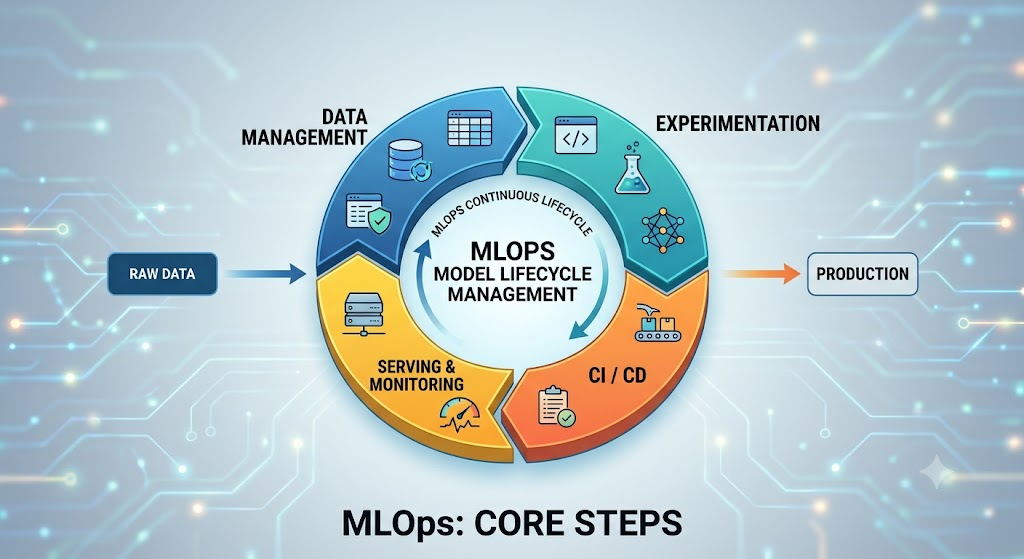
A mature MLOps practice covers the full model lifecycle. These are the building blocks worth understanding.
Data and feature management
Everything starts with data. MLOps introduces version control for datasets and a feature store—a central repository where engineered features are stored, shared, and reused across teams. This prevents the common problem of different teams calculating the same metric in slightly different ways.
Model training and experimentation
Data scientists run dozens or hundreds of experiments. MLOps tools track every run—the parameters used, the data version, and the results—so teams can compare approaches and reproduce the best one. This is often called experiment tracking, and tools like MLflow and Weights & Biases are common here.
Continuous integration and deployment (CI/CD)
Borrowed from DevOps, CI/CD pipelines automate testing and deployment. When a model is ready, it moves through automated checks and into production without manual, error-prone handoffs. MLOps extends this to include continuous training (CT)—automatically retraining models when new data arrives.
Model deployment and serving
Deployment is where the model starts making real predictions. MLOps supports different serving patterns, including real-time predictions through an API and batch predictions run on a schedule. Containerization tools like Docker and orchestration platforms like Kubernetes are frequently used to make this reliable.
Monitoring and observability
This is the component teams most often skip—and it’s the most important. Once a model is live, MLOps monitors two things:
- Operational health: Is the service fast and available?
- Model performance: Are predictions still accurate? Has the incoming data drifted away from what the model was trained on?
When performance degrades, the system alerts the team or triggers automatic retraining.
Governance and compliance
For regulated industries like finance and healthcare, MLOps provides the audit trail regulators demand: who deployed which model, trained on what data, and why. This traceability is quickly becoming a legal necessity, not just a nice-to-have.
How is MLOps different from DevOps?
MLOps and DevOps share the same philosophy—automate everything, ship reliably, monitor constantly—but they solve different problems.
DevOps manages code. Code is deterministic: it either works or it doesn’t, and its behavior doesn’t change unless someone changes the code. Testing is relatively straightforward.
MLOps manages code plus data plus models. This adds layers of complexity DevOps never had to handle:
- Data changes constantly. A model’s inputs shift over time, so the model itself must be treated as something that decays and needs refreshing.
- Testing is probabilistic. You can’t check a model against a single “correct” answer. You evaluate it statistically, against thresholds.
- Three artifacts must be versioned together. DevOps versions code. MLOps versions code, data, and the trained model—and must keep them in sync.
Choose a dedicated MLOps approach over standard DevOps whenever your product depends on models that learn from changing data. If your team is shipping static software with no learning component, traditional DevOps is enough. The moment predictions drive real decisions, you need MLOps.
What business value does MLOps actually deliver?
MLOps isn’t an academic exercise. It produces measurable outcomes that leaders care about.
Faster time to value. Automated pipelines shrink the gap between “we built a model” and “it’s making money.” Instead of weeks of manual deployment work, models can move to production in a fraction of the time.
More reliable AI. Continuous monitoring catches model drift before it produces bad predictions. In practice, this means fewer costly mistakes—a fraud detector that keeps working, a recommendation engine that stays relevant.
Lower maintenance costs. Automation reduces the manual firefighting that consumes data science teams. Engineers spend less time re-deploying models by hand and more time building new capabilities.
Scalability. With MLOps, running one model and running one hundred models follow the same repeatable process. This is what separates companies with a single AI pilot from companies with AI woven through their operations.
Regulatory readiness. Built-in governance means you can answer auditors’ questions with confidence, which matters enormously in finance, insurance, and healthcare.
How do you know if your organization needs MLOps now?
Not every company needs a full MLOps platform on day one. But there are clear signals it’s time to invest.
You likely need MLOps if:
- You have models built but stuck in testing, unable to reach production.
- You’ve deployed models but can’t tell whether they’re still performing well.
- Different teams can’t reproduce each other’s results.
- You’re preparing to scale from one AI use case to many.
- You operate in a regulated industry and need audit trails.
If you’re running a single experimental model with no production dependency, you can wait. But if AI is meant to become core to how your business operates, MLOps stops being optional.
How to start building MLOps capability
You don’t need to boil the ocean. A staged approach works best.
Start with the biggest pain point. If models never reach production, focus first on deployment automation. If deployed models fail silently, start with monitoring. Solve the problem that’s actually hurting you.
Standardize your tooling. Pick a consistent set of tools for experiment tracking, version control, and deployment so teams stop reinventing the wheel. Popular open-source options include MLflow for tracking and Kubeflow for orchestration.
Bridge the teams. MLOps succeeds when data scientists and engineers share processes. Create shared ownership of models in production rather than throwing them over a wall.
Automate incrementally. Begin with a manual but documented pipeline. Automate one step at a time—testing, then deployment, then retraining—until the whole cycle runs with minimal intervention.
Measure what matters. Track how long it takes to move a model to production and how quickly you detect performance issues. Improvement in these numbers proves the investment is working.
The layer that makes enterprise AI real
The excitement around AI focuses almost entirely on models—which one is smartest, which one writes best, which one predicts most accurately. But a brilliant model that can’t be deployed, monitored, and maintained delivers exactly zero business value.
MLOps is the layer that closes that gap. It turns experiments into products and pilots into infrastructure. For enterprise leaders, the practical takeaway is simple: if you’re investing in AI without investing in the operations to sustain it, you’re building on sand.
Start small. Identify where your AI projects stall today, apply MLOps practices to that specific bottleneck, and expand from there. The organizations that treat MLOps as seriously as they treat the models themselves will be the ones whose AI actually ships and keeps working long after the launch demo ends.