TL;DR: MVP development costs range from $20,000 to $150,000 or more, depending on complexity, platform, team structure, and feature scope. Simple web MVPs typically cost $20,000 to $40,000. Mid-complexity products with marketplace or SaaS features run $40,000 to $80,000. AI-powered and enterprise MVPs start at $80,000 and scale significantly from there. Timelines range from 8 to 20 weeks.
| MVP Type | Cost Range | Typical Timeline |
|---|---|---|
| Simple Web MVP | $20,000 to $40,000 | 8 to 10 weeks |
| Medium Complexity (SaaS, marketplace basics) | $40,000 to $80,000 | 10 to 14 weeks |
| Complex SaaS or AI MVP | $80,000 to $150,000 | 14 to 18 weeks |
| Enterprise MVP | $150,000+ | 18 to 24 weeks |
Before you request proposals, open a spreadsheet, or hire your first engineer, you need a working model of what MVP development actually costs in 2026, and why. This guide gives you that model.
Most cost guides bury the numbers in vague ranges and hedge everything with “it depends.” That is not useful when you are deciding whether to raise a pre-seed round, allocate runway, or choose between an agency and a freelancer. This guide is structured for decision-making. You will find specific pricing ranges, real cost drivers, a working cost formula, team comparisons, and startup examples across industries. You will also find an honest account of the hidden costs that destroy budgets and the mistakes that force expensive rebuilds.
The one misconception worth correcting before you read further: the cheapest build is almost never the cheapest outcome. Technical debt, wrong architecture, and underbuilt products consistently cost more to fix than they saved in the first place. That framing matters throughout everything that follows.
What Is MVP Development? How Does It Differ from a Prototype, PoC, and Version 1?
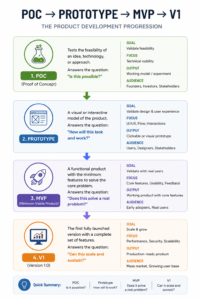
Direct answer: An MVP (Minimum Viable Product) is a functional product built with enough features to acquire early users, test core assumptions, and generate real feedback. It is not a demo, a mockup, or a finished product. Confusing these terms leads to misaligned budgets.
Founders routinely confuse four distinct concepts, and each carries a different cost and purpose:
| Term | Purpose | Cost Signal | What It Produces |
|---|---|---|---|
| Proof of Concept (PoC) | Test technical feasibility | $5,000 to $15,000 | Evidence that the core idea works |
| Prototype | Visualize and test UX | $8,000 to $25,000 | Clickable mockup, no real backend |
| MVP | Validate market demand | $20,000 to $150,000+ | Working product with real users |
| Version 1 (V1) | Scale validated assumptions | $100,000 to $500,000+ | Polished, market-ready product |
A PoC answers “can we build this?” A prototype answers “how should this feel?” An MVP answers “will people pay for this?” Version 1 answers “can we grow with this?” Each stage has distinct cost logic. Paying for V1 features at the MVP stage is one of the most common budget mistakes startups make.
How Much Does MVP development Cost in 2026?
Direct answer: MVP development in 2026 costs between $20,000 and $150,000 for most startups, with AI-native and enterprise products frequently exceeding that ceiling. The range is wide because scope, platform, team geography, and feature complexity each multiply cost independently.
Regional pricing adds another variable. The same MVP built with a US-based team costs two to three times more than one built by a well-managed offshore team, without any difference in output quality if the team and process are right.
| Region | Hourly Rate | $60,000 MVP Equivalent Output |
|---|---|---|
| United States / Canada | $120 to $200/hr | 300 to 500 hours |
| Western Europe | $80 to $150/hr | 400 to 750 hours |
| Eastern Europe | $40 to $80/hr | 750 to 1,500 hours |
| South Asia | $25 to $55/hr | 1,100 to 2,400 hours |
| Latin America | $35 to $70/hr | 860 to 1,700 hours |
Rate alone does not determine value. A $40/hour team with weak communication and unclear specifications will consistently deliver late, over budget, and below quality. The right question is not “what is the cheapest rate?” It is “which team can deliver the right product at a predictable cost?”
What Is the Average MVP Cost by Product Complexity?
Direct answer: Complexity is the single largest cost driver in MVP development. Simple products with one user type and no integrations cost a fraction of what AI-native, marketplace, or compliance-heavy products cost.
| Product Type | Estimated Cost | Key Cost Drivers |
|---|---|---|
| Simple Web App (single user type, basic CRUD) | $20,000 to $40,000 | Frontend, backend, authentication |
| Marketplace (two-sided, payments, listings) | $45,000 to $90,000 | Dual user roles, payment processing, search |
| Healthcare MVP | $60,000 to $130,000 | HIPAA compliance, EHR integration, security |
| AI SaaS MVP | $70,000 to $150,000 | Model integration, RAG pipeline, inference costs |
| FinTech MVP | $75,000 to $160,000 | Compliance, banking APIs, fraud detection |
| Enterprise SaaS MVP | $100,000 to $250,000 | SSO, role-based access, admin panel, audit logs |
Healthcare and FinTech MVPs cost more not because they are more feature-rich, but because regulatory requirements add non-negotiable engineering and compliance work. Founders who budget these categories like a standard SaaS MVP consistently face mid-project budget crises.
How Does Platform Choice Affect MVP development Cost?
Direct answer: Platform choice affects both initial build cost and long-term maintenance cost. Web MVPs are cheapest and fastest. Cross-platform mobile development cuts cost by 30 to 50% compared to building native iOS and Android separately.
| Platform | Cost Range | Timeline | Best For |
|---|---|---|---|
| Web App | $20,000 to $80,000 | 8 to 14 weeks | SaaS, dashboards, B2B tools |
| iOS Only | $30,000 to $90,000 | 10 to 16 weeks | Consumer apps targeting Apple users |
| Android Only | $25,000 to $80,000 | 10 to 16 weeks | Broader consumer reach, emerging markets |
| Cross-Platform (React Native / Flutter) | $40,000 to $120,000 | 12 to 18 weeks | Mobile MVPs with limited budget |
| Desktop App | $35,000 to $100,000 | 12 to 18 weeks | Enterprise tools, productivity software |
| AI-Native Product | $70,000 to $200,000+ | 14 to 24 weeks | AI workflows, automation, intelligent assistants |
For most startups, the correct MVP platform is web. Web is faster to build, cheaper to iterate, and easier to share with early users for feedback. Mobile adds complexity, app store approval timelines, and additional QA cycles. Unless your core use case requires a mobile device (camera, GPS, push notifications in a mobile context), validate on web first.
What Does MVP development Cost by Industry?
Direct answer: Feature scope, backend complexity, third-party integrations, compliance requirements, and team structure are the five factors that have the greatest individual impact on total MVP cost. Each one is a variable you can control before development begins.
Features and Scope
Every feature adds design time, development time, and QA time. A scoping session that cuts five non-essential features at the start saves more money than any discount negotiated with a development team.
High-cost features to defer in an MVP include: advanced analytics dashboards, AI recommendations, multi-language support, complex admin panels, and real-time collaboration. Include these in your roadmap, not your MVP.
UI/UX Design
Design is not decoration. Poor UX produces poor user retention data, which means your MVP cannot validate what you need it to validate. Budget $8,000 to $25,000 for MVP-quality design depending on screen complexity.
Backend Architecture
A well-designed backend for an MVP costs more upfront but saves significantly more in rework costs later. Shortcuts in backend architecture are the primary source of technical debt that forces partial or full rebuilds at the Series A stage.
Cloud Infrastructure
AWS, Google Cloud, and Azure all offer comparable pricing for MVP-stage workloads. Budget $500 to $2,000 per month for a typical MVP in production. AI-native products with inference workloads can exceed $5,000 per month depending on usage volume.
Security and Authentication
Authentication (single sign-on, multi-factor authentication, OAuth) adds $3,000 to $8,000. End-to-end encryption, secure data handling, and penetration testing add $5,000 to $15,000. For regulated industries, these are not optional line items.
Payment Gateway Integration
Stripe is the standard for MVP-stage payment integration. Budget $5,000 to $10,000 for a basic Stripe integration with subscription logic. Marketplace payment splitting (Stripe Connect) adds another $5,000 to $12,000.
AI and Machine Learning Features
AI features are the most variable cost in any 2026 MVP. Simple chatbot integration costs $10,000 to $20,000. RAG-based knowledge systems cost $20,000 to $50,000. Custom AI agent workflows cost $40,000 to $100,000. Model inference costs continue as an ongoing operational expense after launch.
Compliance and Regulatory Requirements
HIPAA compliance adds $15,000 to $40,000. SOC 2 preparation adds $20,000 to $50,000. PCI DSS compliance for payment processing adds $10,000 to $30,000. These are one-time build costs, not ongoing fees, but they must be planned for before development begins.
What Does an MVP development Cost Breakdown Look Like?
Direct answer: Most MVP budgets divide across eight categories. Understanding what each category costs helps you evaluate proposals accurately and identify where agencies pad margins or cut corners.
| Budget Category | % of Total Budget | Example ($80,000 MVP) |
|---|---|---|
| Product Discovery and Research | 8 to 12% | $6,400 to $9,600 |
| UX/UI Design and Wireframes | 10 to 15% | $8,000 to $12,000 |
| Frontend Development | 20 to 25% | $16,000 to $20,000 |
| Backend Development | 25 to 30% | $20,000 to $24,000 |
| QA and Testing | 8 to 12% | $6,400 to $9,600 |
| Cloud Setup and DevOps | 5 to 8% | $4,000 to $6,400 |
| Project Management | 8 to 10% | $6,400 to $8,000 |
| Deployment and Launch | 3 to 5% | $2,400 to $4,000 |
Post-launch maintenance typically runs 15 to 20% of the initial build cost annually. A $60,000 MVP should carry a $9,000 to $12,000 annual maintenance budget for bug fixes, dependency updates, security patches, and minor feature work.
In-House Team vs. Agency vs. Freelancers: Which Is Right for Your MVP?
Direct answer: Each option has a different risk and cost profile. Agencies provide the most predictable outcomes for startup MVPs. Freelancers offer the lowest cost with the highest coordination risk. In-house teams make sense only when you have the time and capital to hire before your product is validated.
| Factor | In-House Team | Agency | Freelancers |
|---|---|---|---|
| Cost | Highest (salary + benefits + equity) | Medium to high (fixed or hourly) | Lowest hourly rate |
| Risk | High (hiring wrong people is costly) | Low to medium (accountability built in) | High (coordination, quality variance) |
| Timeline | Slowest (3 to 6 months to hire) | Fastest (start in days to weeks) | Variable |
| Quality | Variable (depends on hiring) | Consistent (process-driven) | Variable |
| Scalability | Difficult early-stage | Easy (scope adjustments) | Very difficult |
| Post-launch Support | Excellent | Good (with retainer) | Difficult to maintain |
| Best Use Case | Post-Series A, product-market fit achieved | MVP stage, pre-seed to Seed | Very simple builds or specific modules |
Founders who hire full-time engineers before validating their product consistently over-invest in the wrong direction. An agency that delivers a tested MVP in 12 weeks gives you validation data faster than building an in-house team that will not be productive for six months.
One pattern we see repeatedly: founders choose freelancers to save money, encounter coordination problems mid-project, bring in an agency to rescue the build, and end up spending 40 to 60% more than an agency would have cost from the start.
What Are the Hidden MVP Costs Most Founders Ignore?
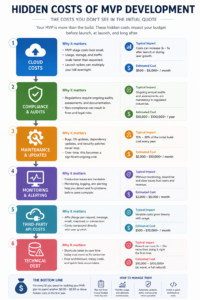
Direct answer: The listed price of an MVP rarely reflects the total cost of bringing a product to market. Hidden costs accumulate before launch, at launch, and in the first year of operation. Ignoring them produces budget shortfalls at the worst possible moment.
Technical debt repayment. Shortcuts taken during MVP development cost real money later. A study by McKinsey (2023) found that technical debt represents approximately 40% of technology balance sheets in software companies. Cutting architecture corners to save $10,000 in MVP development often costs $50,000 to $150,000 to fix before a Series A.
Cloud costs at scale. MVP-stage cloud bills look manageable. Production-scale cloud costs after a launch spike frequently surprise founders. Budget for three to five times your initial cloud estimate if you are planning any kind of launch event or paid acquisition campaign.
Third-party API fees. Twilio for SMS, Stripe for payments, Google Maps, Sendgrid for email, Auth0 for authentication, and AI model APIs all carry per-usage costs that compound with growth.
App Store fees. Apple charges a 15 to 30% commission on in-app purchases. Google Play charges the same. Annual developer program fees ($99 for Apple, $25 for Google) are minor, but the commission model fundamentally changes your unit economics.
Bug fixing and monitoring. Production bugs are inevitable. Budget $2,000 to $5,000 per month for a monitoring and incident response retainer, or accept that production issues will wait until your next sprint.
Compliance audits. Initial compliance costs are well understood. Annual audit costs are not. SOC 2 Type II audits cost $30,000 to $100,000 annually. HIPAA risk assessments cost $5,000 to $20,000 per year. These costs begin the year your product enters production.
Analytics and tracking. Mixpanel, Amplitude, or Segment cost $100 to $2,000 per month depending on event volume. Without analytics, you cannot interpret your MVP results, which defeats the purpose of building one.
How Much Does an AI Startup MVP Cost in 2026?
Direct answer: AI startup MVPs cost significantly more than traditional software MVPs because they carry both standard development costs and AI-specific infrastructure costs that do not exist in conventional products. Budget $70,000 to $200,000 for a production-ready AI MVP.
AI-specific cost components include:
| AI Component | Cost Range | Notes |
|---|---|---|
| RAG pipeline development | $15,000 to $40,000 | Document ingestion, chunking, retrieval |
| LLM API integration (OpenAI, Anthropic, Google) | $5,000 to $15,000 | Integration + prompt engineering |
| Vector database setup (Pinecone, Weaviate, pgvector) | $3,000 to $8,000 | Setup + indexing pipeline |
| AI agent development | $20,000 to $60,000 | Tool use, multi-step workflows |
| Voice AI integration | $15,000 to $35,000 | STT, TTS, real-time streaming |
| Custom fine-tuning | $25,000 to $80,000 | Dataset preparation + training runs |
| Monitoring and observability | $5,000 to $15,000 | LLM observability, drift detection |
| GPU infrastructure (if self-hosted) | $3,000 to $10,000/month | Varies by model size and traffic |
Beyond build costs, AI MVPs carry ongoing inference costs. A product processing 10,000 AI interactions per day using GPT-4o or Claude Sonnet can generate $3,000 to $15,000 per month in model API costs at scale. This must be modeled into your unit economics before you set pricing.
The most common mistake in AI startup MVPs: building a complex multi-agent system before validating whether users trust a simple chatbot. Start with the smallest AI feature that tests your core hypothesis. Add complexity only when user behavior demands it.
What Does a Realistic MVP development Timeline Look Like?
Direct answer: A realistic MVP timeline runs 10 to 16 weeks for most products. Eight-week builds are possible but require extremely tight scope, experienced teams, and no integration complexity.
| Week | Phase | Key Deliverables |
|---|---|---|
| 1 to 2 | Discovery | Requirements, user stories, technical architecture, scope lock |
| 3 to 4 | Design | Wireframes, UI design, design system, prototype |
| 5 to 10 | Development | Frontend, backend, integrations, database, authentication |
| 11 to 12 | QA and Testing | Functional testing, security testing, performance testing |
| 13 | Deployment | Staging, production deployment, monitoring setup |
| 14+ | Optimization | User feedback, bug fixes, early iteration |
Scope creep is the primary cause of timeline overruns. Every added feature after scope lock extends the timeline by one to three weeks and typically costs $5,000 to $15,000 in unbudgeted development time.
How Can You Reduce MVP development Cost Without Sacrificing Quality?
Seven decisions made before development begins determine whether your MVP comes in at budget or over it. Most cost reduction happens in planning, not execution.
Prioritize ruthlessly. Map every proposed feature against the single core hypothesis your MVP needs to test. Features that do not directly test that hypothesis belong in V2.
Validate before you build. No-code tools (Webflow, Bubble, Glide) can test demand for $5,000 to $15,000 before you commit to a $60,000 build. A Typeform survey with a landing page has validated product hypotheses for less than $500.
Invest in product discovery. A structured two-week discovery phase ($8,000 to $15,000) consistently reduces total build cost by 20 to 30% by eliminating ambiguity before development begins.
Choose cross-platform over native. React Native or Flutter for mobile saves 30 to 50% compared to building separate iOS and Android codebases.
Use existing APIs instead of building from scratch. Authentication (Auth0), payments (Stripe), email (Sendgrid), and SMS (Twilio) are solved problems. Building custom versions of these adds cost and introduces risk without adding competitive advantage.
Use managed cloud services. AWS RDS, Google Cloud SQL, and Azure Database eliminate the infrastructure management overhead that adds weeks to deployment timelines.
Choose the right partner. A development agency with direct startup MVP experience will scope, price, and deliver more predictably than one that primarily builds enterprise software or agency websites.
What Are the Most Common MVP Budgeting Mistakes?
The six most common MVP budgeting mistakes all follow the same pattern: spending money on the wrong things too early, without sufficient validation to justify the investment.
Overbuilding. The average startup includes 60% more features in their initial MVP scope than the market actually requires to validate the product. Cut features before you cut budget.
Choosing the wrong tech stack. A technology stack chosen for scalability at 10 million users costs significantly more to build than one optimized for 1,000 beta users. Pick the stack that gets you to validation, not the one that will handle your Series B traffic.
Hiring full-time engineers before product-market fit. A senior engineer costs $150,000 to $200,000 per year in the US. At the MVP stage, that same budget funds a complete agency build with room for six months of iteration. Hire permanently after you know what you are building.
Ignoring UX. MVPs built with minimal design investment consistently generate inconclusive user data because bad UX confounds the experiment. You cannot tell whether users rejected your idea or your interface.
Ignoring analytics from day one. An MVP without analytics cannot answer the questions it was built to ask. Instrumentation is not a post-launch task.
No post-launch roadmap or budget. Founders who spend their entire budget on the build with nothing reserved for iteration cannot respond to what users tell them. A standard allocation is 70% for the build and 30% for post-launch iteration.
Real Startup MVP Cost Examples
Direct answer: The following scenarios reflect realistic cost profiles for five common MVP types in 2026. These are not outliers. They represent the mid-range of what competent teams charge for well-scoped projects.
Healthcare startup. A telemedicine platform with patient onboarding, video consultations, prescription management, and HIPAA-compliant data storage. Scope: web and mobile. Cost: $90,000 to $130,000. Timeline: 16 to 20 weeks. Primary cost drivers: HIPAA compliance, EHR integration, video infrastructure.
Two-sided marketplace. A freelance services marketplace with buyer and seller profiles, service listings, messaging, Stripe Connect payments, and reviews. Scope: web. Cost: $55,000 to $85,000. Timeline: 12 to 16 weeks. Primary cost drivers: dual user roles, payment splitting, search and filtering.
B2B SaaS. A project management tool with team workspaces, task management, file uploads, role-based access, and usage analytics. Scope: web. Cost: $50,000 to $75,000. Timeline: 10 to 14 weeks. Primary cost drivers: multi-tenant architecture, permission system, admin panel.
AI startup. A customer support automation platform using RAG over company documentation, conversation history, escalation routing, and analytics. Scope: web with API access. Cost: $85,000 to $140,000. Timeline: 14 to 18 weeks. Primary cost drivers: RAG pipeline, LLM API integration, knowledge base management.
Travel startup. A trip planning platform with destination search, itinerary builder, booking API integration, and social sharing. Scope: web and iOS. Cost: $65,000 to $100,000. Timeline: 14 to 18 weeks. Primary cost drivers: third-party booking APIs, map integration, cross-platform build.
How Do You Calculate MVP development Cost?
MVP cost can be calculated using a structured formula that accounts for each major development category. The formula will not give you a final invoice, but it will give you a reliable range for planning.
MVP Cost Formula:
MVP Cost = Features (hours x rate) + Platforms + Integrations + Security + QA (15% of dev cost) + Cloud Setup + Maintenance Reserve (20% of build cost)
Variable explanations:
Features. List every feature in the MVP scope. Estimate the development hours for each feature (discovery will do this precisely). Multiply by your team’s hourly rate.
Platforms. Add $10,000 to $20,000 for each additional platform beyond web (iOS, Android, desktop).
Integrations. Budget $3,000 to $10,000 per third-party integration depending on API quality and documentation.
Security. Authentication, encryption, and basic security testing: $5,000 to $15,000. For regulated industries, add compliance costs on top.
QA. Quality assurance should run 12 to 18% of total development cost. Cutting QA is the fastest way to launch a product that fails.
Cloud Setup. Infrastructure setup, CI/CD pipeline, and monitoring configuration: $3,000 to $8,000 for a typical MVP.
Maintenance Reserve. Set aside 20% of the build cost for the first six months of post-launch fixes, performance issues, and early iteration.
Example calculation for a $70,000 B2B SaaS MVP:
- Features (800 hours at $65/hr average): $52,000
- Web platform: included
- Integrations (Stripe, Auth0, Sendgrid): $9,000
- Security: $5,000
- QA (15% of dev): $7,800
- Cloud setup: $3,500
- Maintenance reserve (20%): $14,000
- Total realistic budget: $91,300
This is why fixed-price proposals from agencies often appear below the number founders eventually spend. The maintenance reserve and iteration budget are real costs that appear after the invoice is paid.
Should You Build In-House or Hire an MVP Development Company?
For most pre-seed and seed-stage startups, hiring an experienced MVP development company is the faster and more capital-efficient path to a validated product. Build in-house only if technical co-founders are already on the team.
Use this decision framework:
Choose an agency if:
- You do not have a technical co-founder.
- You need to launch within four to six months.
- Your runway is limited and speed to validation is critical.
- Your MVP requires specialized expertise (AI, FinTech compliance, healthcare integrations).
Choose in-house if:
- Technical co-founders are already committed and equity-compensated.
- You are building highly proprietary technology that cannot be shared with an outside team.
- You have twelve or more months of runway to invest in the hiring and ramp-up period.
Choose freelancers if:
- The MVP is extremely simple (under $25,000 scope).
- You have a technical team member who can coordinate and review work.
- You need a specific module built, not a full product.
One factor founders consistently underestimate: a well-chosen agency brings product thinking alongside technical execution. The best MVP development companies have built dozens of products and will push back on scope decisions that would hurt your launch. That institutional knowledge has real dollar value.
Checklist: What Should You Confirm Before Budgeting an MVP?
Use this checklist before requesting proposals or committing budget:
- Core hypothesis is written in one clear sentence
- Target user persona is defined with specific characteristics
- MVP features are ranked by validation priority, not founder preference
- Non-MVP features are documented in a V2 roadmap
- Platform choice (web, mobile, cross-platform) is confirmed
- Industry compliance requirements are identified (HIPAA, PCI DSS, SOC 2)
- Third-party integrations are listed and API documentation reviewed
- Success metrics for the MVP are defined in advance
- Analytics and tracking plan is specified before development begins
- Budget includes post-launch maintenance reserve (minimum 20%)
- Team structure decision is made (agency, freelancer, in-house)
- Timeline has been validated against investor or launch commitments
- Cloud infrastructure provider is selected
- Authentication approach is confirmed (Auth0, Firebase, custom)
- IP ownership, NDA, and code handover terms are clear in any agency contract
- Post-MVP iteration budget is separately reserved and protected
- At least two agency or team references have been checked
- A technical review of proposals has been completed (internal or by a fractional CTO)
Skipping this checklist produces vague proposals, unclear contracts, and misaligned expectations. Completing it takes two to three hours and saves weeks of miscommunication.
Think About MVP Cost as ROI, Not an Expense
The cheapest MVP is almost never the cheapest outcome. This is the single most important reframe for startup founders evaluating development proposals.
A $35,000 MVP that is poorly scoped, poorly built, and produces unusable user data costs far more than a $65,000 MVP that generates clean validation signals within twelve weeks. The difference is not just the money already spent. It is the three to six months of founder time, the investor conversations affected, and the rebuild cost when the first version proves untenable.
When evaluating MVP cost, calculate it against three outcomes: validation achieved on schedule, runway preserved for iteration, and a codebase that can support V1 without a full rewrite. The best MVP investments score well on all three. The cheapest ones rarely score well on any.
Enlight Lab works with startup founders, SaaS teams, and enterprise innovation groups to scope, design, and build production-ready MVPs across web, mobile, and AI-native products. If you are mapping out your MVP budget and want an experienced team to review your scope, assess your architecture options, or provide a structured proposal, reach out at enlightlab.com. The conversation starts with your goals, not a sales process.
Frequently Asked Question (FAQ)
A basic MVP with a single user type, simple CRUD functionality, and no third-party integrations typically costs $20,000 to $40,000. Add $5,000 to $15,000 for each meaningful integration or user role beyond the simplest configuration.
Yes, but scope must be minimal. No-code tools (Bubble, Webflow, Glide) can produce functional MVPs for $5,000 to $15,000 for simple workflows. Custom-coded MVPs under $20,000 are possible but typically limited to a single core feature, one user type, and no complex integrations. For most SaaS products, $20,000 is a floor, not a realistic target.
Eight to sixteen weeks is the realistic range for most MVPs. Simple web applications can be delivered in eight to ten weeks with an experienced team and locked scope. AI-native products, healthcare platforms, and enterprise MVPs typically require fourteen to twenty weeks. Eight-week builds are achievable only when scope is extremely tight and no new requirements enter after week one.
Most agency quotes include product discovery, UX/UI design, frontend development, backend development, QA testing, and deployment. What is frequently not included: post-launch maintenance, ongoing cloud costs, third-party API fees, app store fees, and compliance audits. Always ask for a written breakdown before signing.
An AI MVP costs 40 to 80% more than a comparable traditional MVP. The additional cost comes from RAG pipeline development, vector database setup, LLM API integration, prompt engineering, and ongoing inference costs. A traditional SaaS MVP at $60,000 becomes $90,000 to $110,000 with meaningful AI features added.
Yes, with the right conditions: scope is locked before development begins, the team has prior experience with the required tech stack, no compliance requirements apply, and no complex third-party integrations are needed. Most eight-week MVPs are web-only, single-user-type products. Add any of the above complications and the realistic timeline extends to ten to fourteen weeks.
Reserve 20 to 25% of your build budget for the first six months after launch. A $60,000 MVP should carry $12,000 to $15,000 in post-launch budget for bug fixes, performance optimization, early feature iteration, and user feedback response. Founders who spend their entire budget on the build and have nothing left for iteration cannot act on what users tell them.
Agencies typically charge 20 to 40% more per hour than individual freelancers. In practice, agencies deliver projects on time more reliably, require less founder coordination time, and produce more complete handover documentation. Freelancers offer the best value for narrow, well-defined tasks with clear specifications and an internal technical reviewer.
Yes. Most experienced agencies apply AI-specific rate premiums for teams with RAG, LLM, and AI agent expertise. Expect AI-native MVPs to carry rates 15 to 30% above standard development rates, in addition to the higher feature scope that AI products require.
Overbuilding. The typical startup includes features their first 100 users will never use. Reducing scope to the single core feature set required to test your hypothesis consistently cuts MVP cost by 30 to 50%. The second biggest mistake is allocating no post-launch budget, which makes it impossible to respond to the user feedback the MVP was built to gather
Yes, significantly. React plus Node.js or Python backends are the fastest and cheapest to build with because of available talent and library maturity. Niche or proprietary stacks command higher rates and reduce the number of available developers. Choose your stack based on your team’s existing expertise and the technology’s ecosystem maturity, not on which framework is trending.
HIPAA compliance adds $15,000 to $40,000 to an MVP build. PCI DSS for payment processing adds $10,000 to $30,000. SOC 2 preparation adds $20,000 to $50,000. These are not optional for regulated industries, and they represent real engineering work, not administrative overhead. Budget for them before development begins.