Every week, a new artificial intelligence tool promises to revolutionize your business. As a startup founder or technical decision-maker, you face a barrage of vendors pitching generative models, conversational interfaces, and intelligent orchestrators. The noise makes it incredibly difficult to figure out where you should actually invest your capital.
Most businesses make a critical mistake during this phase: they buy a conversational interface when their actual problem is fragmented data. They invest in complex data retrieval systems when they really just need to eliminate manual data entry. You end up with a fragmented technology stack that increases complexity instead of reducing it.
Answering the question of “RAG, Chatbots, or Workflow Automation” requires stepping away from the hype. It requires a hard look at how your team currently operates, where your customers experience friction, and which operational bottlenecks are bleeding your revenue.
This guide will break down exactly how these three technologies function, where they deliver the highest return on investment, and how you can map them to your specific operational goals.
What Are the Core Differences Between These AI Technologies?
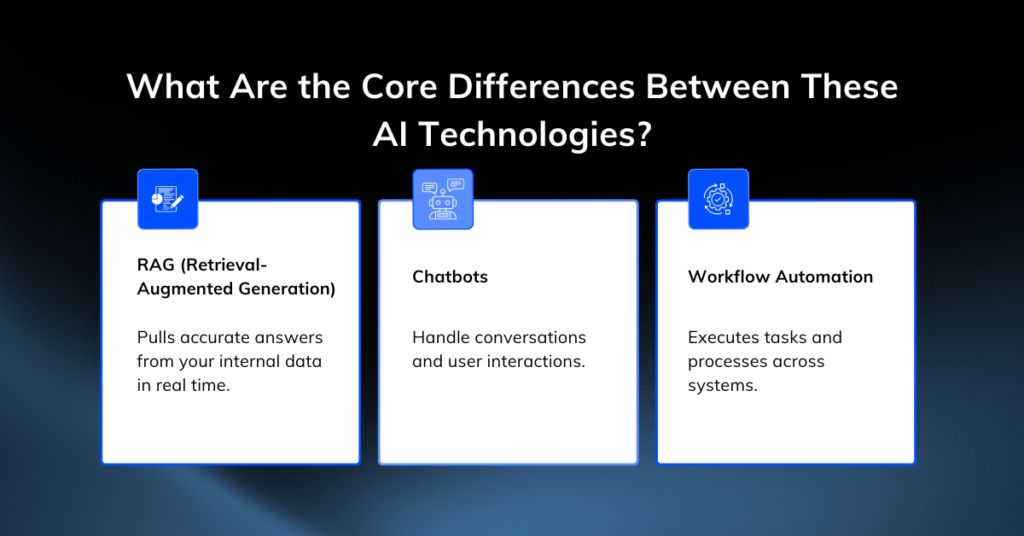
- RAG (Retrieval-Augmented Generation): Pulls accurate answers from your internal data in real time
- Chatbots: Handle conversations and user interactions
- Workflow automation: Executes tasks and processes across systems
These specialized AI tools are designed for entirely different jobs. To make an informed technical decision, you need to understand the distinct mechanics and capabilities of each approach.
What Is Retrieval-Augmented Generation (RAG)?
RAG: Built for Knowledge Accuracy
RAG systems are designed to retrieve and deliver precise, context-aware information from your internal or external data sources. Instead of “guessing,” they pull relevant data at query time and generate grounded responses.
It operates as a highly secure, incredibly fast research assistant. Standard large language models (LLMs) rely on public data they were trained on, which means they cannot answer questions about your proprietary company policies, customer history, or internal documentation. RAG solves this by connecting an LLM directly to your private databases.
When a user asks a query, the RAG system searches your internal documents, retrieves the exact factual context, and feeds that context to the AI to generate a precise, grounded answer.
Think of RAG as:
- Your enterprise knowledge brain
- A system that answers complex, data-driven questions
- A way to reduce hallucinations and improve trust
Core Use Cases
- Transforming massive compliance manuals into instantly searchable databases.
- Enabling customer support teams to retrieve specific warranty policies based on a user’s serial number.
- Synthesizing years of internal research and financial analysis into actionable summaries.
Primary Advantages
- Dramatically reduces AI hallucinations by forcing the model to cite your private data.
- Keeps information perfectly up-to-date without requiring expensive model retraining.
- Maintains strict access controls and data privacy.
Potential Drawbacks
- Requires clean, well-structured data to function effectively.
- The initial setup for vector databases and indexing can be technically demanding for teams without dedicated AI engineers.
What Are Chatbot Interfaces and Conversational Agents
Chatbots: Built for Interaction
Chatbots act as the interface between users and your system. They focus on conversations, engagement, and guiding users through journeys.
Chatbots represent the interactive front door to your business. While early chatbots relied on rigid, frustrating decision trees, modern conversational agents leverage natural language processing (NLP) to understand human intent, context, and sentiment. Their primary job is to simulate human interaction and manage communication at a scale.
Think of chatbots as:
- A digital front desk
- A conversational interface for support, onboarding, or sales
- A way to scale communication across users
However, without integration (like RAG), chatbots rely on static knowledge and can provide incorrect or incomplete answers.
Core Use Cases
- Handling high volumes of basic tier-one customer support inquiries.
- Qualifying inbound sales leads before routing them to human representatives.
- Providing internal HR support for common employee questions regarding benefits or time off.
Primary Advantages
- Delivers instant, 24/7 availability to users across the globe.
- Scales infinitely during traffic spikes without requiring additional headcount.
- Reduces operational costs associated with baseline customer service.
Potential Drawbacks
- Stand-alone chatbots lack the ability to perform complex, multi-step actions in external systems.
- Poorly mapped intent recognition can trap users in frustrating conversational loops.
What Is AI-Driven Workflow Automation?
Workflow Automation: Built for Execution
Workflow automation is where real business impact happens. It focuses on executing tasks, processes, and decisions across systems.
Workflow automation serves as the invisible hands of your operation. Instead of generating text or holding conversations, AI workflow automation connects to disparate software applications to execute specific tasks.
It moves data, triggers approvals, and updates records across your Customer Relationship Management (CRM) platform, Enterprise Resource Planning (ERP) software, and communication tools.
According to internal deployment data at Enlight Lab, implementing custom AI agents for workflow automation can reduce manual task execution by up to 92%.
Think of automation as:
- Your digital operations engine
- A system that completes tasks, not just explains them
- A way to remove manual work and enforce consistency
Core Use Cases
- Extracting data from incoming vendor invoices and automatically updating accounting software.
- Triggering complex employee onboarding sequences across IT, HR, and payroll systems.
- Monitoring supply chain logistics and automatically reordering inventory when thresholds are met.
Primary Advantages
- Eliminates human error associated with repetitive data entry.
- Accelerates cross-departmental operations and approval times.
- Frees highly skilled employees to focus on strategic, revenue-generating initiatives.
Potential Drawbacks
- Requires comprehensive mapping of existing business processes before implementation.
- Significant changes to underlying APIs or software platforms can temporarily break automated flows.
Quick Comparison: RAG vs Chatbots vs Workflow Automation
To choose the right AI approach, you need a clear, side-by-side view of how each technology differs in purpose, capability, and business impact. The table below gives you a decision-ready comparison:
| Factor | RAG (Retrieval-Augmented Generation) | Chatbots | Workflow Automation |
| Core Function | Knowledge retrieval and accurate answers generation from data | Hassle-free user interaction | Task execution without any disruptions |
| Best For | Accurate answers | Conversations | Process automation |
| Best Use Case | Internal knowledge, support queries, documentation | FAQs, onboarding, customer support | Business processes, approvals, integrations |
| Data Usage | Uses real-time and external/internal data sources | Uses trained data or predefined logic | Uses structured rules, triggers, and workflows |
| Output Type | Accurate, context-aware information | Conversational responses | Completed actions like tasks, approvals, and updates |
| Key Strength | High accuracy and reliability | Easy user interaction at scale | Eliminates manual work and improves efficiency |
| Limitation | Does not execute tasks | Limited accuracy without RAG | Limited flexibility without AI intelligence |
| Business Impact | Builds trust in information | Enhances customer experience | Drives operational efficiency |
Whenever you evaluate an AI use case, ask yourself:
- Do you need better answers? → Use RAG
- Do you need better conversations? → Use a chatbot
- Do you need tasks done automatically? → Use workflow automation
And if your use case involves all three, connect with Enlight Lab to design a system that combines them from day one.
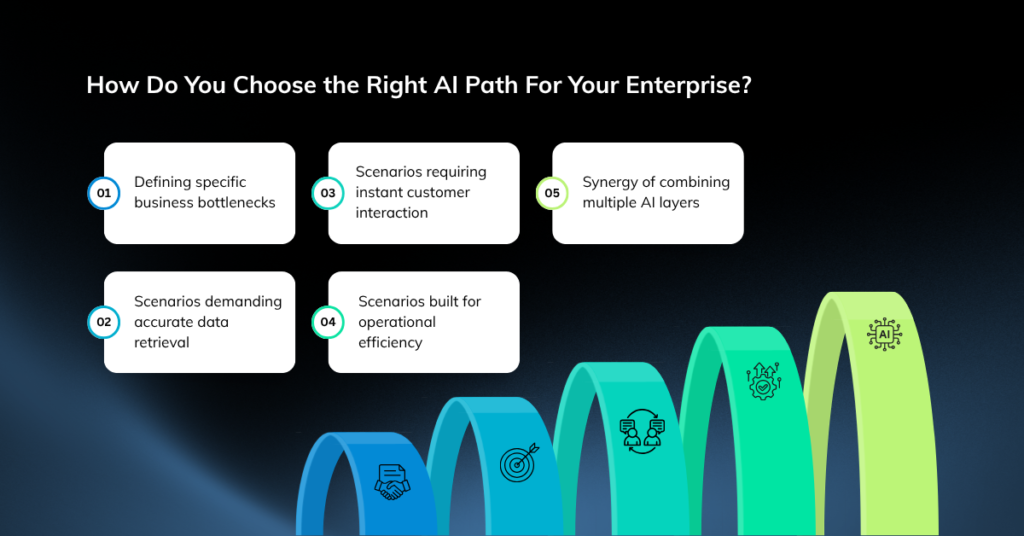
How Do You Choose the Right AI Path For Your Enterprise?
Selecting the right technology demands a problem-first approach. Do not start by asking what the AI can do; start by identifying where your business is breaking down.
Defining Specific Business Bottlenecks
Conduct a thorough audit of your current operations. Determine your exact pain points, establish clear metrics for success, and evaluate your available technical resources.
- Choose RAG if your team spends hours hunting for internal information.
- Choose Chatbots if your customer support queue is backlogged with repetitive questions.
- Choose Workflow Automation if your operations are stalled by manual data transfers between incompatible software tools.
Scenarios Demanding Accurate Data Retrieval
RAG shines brightest in environments where factual accuracy is non-negotiable. Legal firms, financial institutions, and healthcare providers benefit massively from RAG because guessing is unacceptable.
If your primary goal is empowering your team to make faster, data-rich decisions based on proprietary knowledge, RAG is your optimal starting point.
Scenarios Requiring Instant Customer Interaction
Chatbots become your most valuable asset when interaction volume outpaces human capacity. E-commerce brands facing seasonal traffic spikes or SaaS companies managing thousands of basic troubleshooting requests need scalable communication.
If your goal is improving user experience through instant responsiveness, prioritize a conversational AI interface.
Scenarios Built For Operational Efficiency
Workflow automation transforms businesses constrained by administrative bloat. If your highly paid engineers are spending their afternoons updating Jira tickets, or your sales team spends more time updating Salesforce than talking to prospects, you have an execution bottleneck.
Implement workflow automation when efficiency, speed, and error reduction are your primary organizational goals.
Synergy Of Combining Multiple AI Layers
The most successful tech leaders do not choose just one approach. They combine them into a unified, autonomous AI agent. Think of this synergy as a complete digital employee.
- The Chatbot acts as the front door, listening to the user’s request in natural language.
- The RAG system acts as the brain, searching your company database to find the correct policy or answer.
- Finally, Workflow Automation acts as the hands, executing the necessary actions like processing a refund in Stripe or updating a ticket in Zendesk.
At Enlight Lab, we specialize in building these collaborative, multi-agent systems. This collaborative intelligence brings clarity to complexity, empowering your organization with solutions that feel cohesive and remarkably efficient.
Where Businesses Go Wrong and Why It Costs You
Most organizations don’t fail because of picking out bad AI models. They fail because they misclassify the problem.
Here are the most common mistakes:
1. Using Chatbots for Knowledge Problems
You deploy a chatbot to answer complex customer queries, but without RAG, it relies on limited training data.
The Result:
- Inconsistent answers
- Customer frustration
- Lost trust
2. Using RAG for Process Problems
You build a powerful RAG system but expect it to handle approvals, workflows, or system actions.
The Result:
- Great answers, but no execution
- Manual work still exists
- Limited business impact
3. Ignoring Automation Entirely
Many teams invest heavily in “smart AI” but ignore workflow automation entirely.
The Result:
- AI tells you what to do
- Humans still have to do it
This gap between “knowing” and “doing” is where most AI ROI is lost.
What Are the Practical Steps to Implement Your Chosen AI Approach?
Moving from theoretical strategy to shipped software requires technical discipline and operational alignment.
Pilot Projects And Iterative Development
Never attempt to automate your entire business in a single sprint. Start small to validate your assumptions. Identify a single, highly measurable use case such as automating HR onboarding documents or triaging support tickets.
By deploying a scoped pilot project, you can measure the tangible business impact, refine the model’s behavior, and secure organizational buy-in before scaling to more complex departments.
Data Infrastructure as the Core Foundation
AI cannot compensate for broken data architecture. Whether you are deploying RAG or workflow automation, the quality of your output depends entirely on the cleanliness, accessibility, and security of your inputs.
You must audit your databases, eliminate silos, and ensure strict compliance with security standards like SOC 2. Your proprietary data should never be used to train public models; ensure your AI engineering firm deploys solutions within your own secure virtual private cloud (VPC).
Team Adoption and Change Management
The best technology in the world will fail if your human workforce refuses to adopt it. Deploying AI requires intentional change management. Educate your employees on how these tools will make their jobs easier, not replace them. Involve key stakeholders in the design process so the AI solves their actual daily frustrations.
When your team views the AI agent as a collaborative teammate rather than a threat, utilization and ROI will skyrocket.
Accelerate Your Business with The Right AI Approach
Deciding between RAG, Chatbots, or Workflow Automation is ultimately a question of operational maturity. Understanding the distinct capabilities of each allows you to stop chasing trends and start solving actual business problems.
The path to scale requires moving beyond fragmented tools and embracing unified, intelligent systems. Building these systems, however, requires specialized engineering talent and strategic oversight that many growing companies simply do not have in-house.
If you are ready to transition your startup from manual operations to an autonomous, AI-powered workforce, Enlight Lab is here to execute. Through our CTO-as-a-Service model and elite AI agent development, we embed experienced technology leaders alongside skilled execution teams to transform your vision into working, scalable software.
Start with a Free Consultation today and let us build the exact AI architecture your business needs to deliver measurable impact across operations, customer experience, and decision-making workflows. Start shipping faster with strategy and scaling smarter with confidence.