Here’s how remote tech teams help companies scale faster:
- Reduce hiring time from months to weeks
- Provide access to specialised global talent
- Enable faster product development cycles
- Lower operational and infrastructure costs
- Allow flexible scaling based on demand
Let’s be honest about the situation most founders and CTOs are in right now.
You have a product to build and a business to scale. The challenge is finding the right expertise at the right time to do both effectively.
You’ve tried posting local job listings. The candidates are either unavailable, overpriced, or both. Meanwhile, a competitor you launched alongside just shipped three major updates. You’re not sure if you’re falling behind or just standing still while the world moves forward.
Deadlines slip. Hiring takes longer than expected. Costs keep rising. And your internal team, no matter how talented, starts hitting capacity limits.
This is the moment where remote development teams stop being a “nice-to-have” and start being a competitive lifeline.
By 2026, over 72% of companies prefer hiring remote developers, highlighting how distributed engineering is becoming a default model for software teams.. The shift isn’t about cost-cutting anymore. It’s about speed, access to AI-era talent, and the flexibility to move like a company twice your size without the overhead to match.
“The best developers are rarely in your city, and in 2026, they don’t need to be.”
In this guide, we’ll walk you through exactly how companies from early-stage startups to scaling SaaS businesses are using remote engineering teams to outbuild their competition. You’ll get real frameworks, relevant data, hiring criteria, management strategies, and a clear view of what it takes to do this right.
Why 2026 Changed Everything for Remote Development Teams
Remote work was already normalized before 2023. But something bigger happened between 2024 and 2026 that fundamentally shifted the equation, and it’s not what most people think.
The RTO Backlash Reshuffled the Talent Market
When Amazon, Dell, and a wave of mid-size tech companies enforced Return-to-Office (RTO) mandates in 2024–2025, something unexpected happened: senior developers quit in droves, not just from the companies enforcing RTO but from the industry mindset that equated presence with productivity.
The engineers who stayed remote didn’t settle for less. They went to companies that trusted them. Companies that were already remote-first. And many of them went global, offering their skills to companies across borders, on their terms.
For businesses willing to hire remotely, this created a rare window. The talent pool expanded while in-person supply shrank.
AI Tools Made Remote Teams Measurably More Effective
In 2022, remote dev teams faced a real criticism: async communication created delays, context got lost, and junior developers struggled without senior mentorship nearby. In 2026, AI has solved most of that.
- GitHub Copilot and Cursor generate boilerplate, catch errors, and suggest completions, reducing junior dependency on senior availability
- Claude Code explains entire codebases in plain English, cutting onboarding from weeks to days
- AI meeting summaries mean nothing gets lost in async communication
- Automated code review tools flag issues before human review
The result? A well-run remote development team in 2026 ships 35–40% faster than an equivalent in-house team did in 2022.
Global Talent Hotspots in 2026
The developer talent landscape is more geographically distributed than ever. The strongest hiring regions for quality, speed, and cost-efficiency are:
- India (Tier-2 cities) – Pune, Hyderabad, Ahmedabad, producing elite AI/ML and full-stack talent
- Eastern Europe – Poland, Romania, Ukraine diaspora offering strong systems engineers
- LATAM – Colombia, Mexico, Brazil, with nearshore time-zone overlap for US companies
- Southeast Asia – Vietnam and the Philippines are surging in mobile and product engineering
Remote Development Teams vs In-House Teams
Let’s make this practical.
| Factor | Remote Development Teams | In-House Teams |
| Hiring speed | Fast | Slow |
| Cost | Flexible | Fixed |
| Talent pool | Global | Local |
| Scalability | High | Limited |
| Time-to-market | Faster | Slower |
Why Forward-Thinking Companies Are Choosing Remote Teams – The Real Benefits
The cost angle gets mentioned first in every article about remote hiring. And yes, it’s real. But if cost savings were the only benefit, companies would offshore everything and call it done. They don’t because smarter companies know what else is on the table.
Access to AI-Native Specialists You Can’t Find Locally
Today’s most in-demand skills, like LLM fine-tuning, RAG pipeline architecture, AI agent development, and edge ML deployment, are globally distributed. They don’t cluster in San Francisco anymore.
A developer in Warsaw or Bangalore who has spent the last two years working on production AI systems is often more qualified than a local hire with a bigger salary expectation and less hands-on AI experience.
Remote hiring is frequently the only practical way to access this talent at speed.
Cost Efficiency
One of the biggest advantages of remote development teams is the ability to optimize costs without sacrificing quality. By hiring talent globally, companies can reduce recruitment expenses, office overhead, and infrastructure costs while still accessing highly skilled developers. This approach allows businesses to invest resources where they matter most, accelerate growth, and build high-performing teams without the financial burden of traditional hiring models.
Let’s put real figures on this instead of vague claims:
| METRIC | IN-HOUSE | REMOTE TEAM |
| Senior dev annual cost | $155K–$180K | $40K–$80K |
| Time to hire | 8–14 weeks | 5–12 days |
| Team scale-up time | 3–6 months | 1–3 weeks |
| Office + benefits overhead | +35–45% on top | Minimal / none |
| AI tool productivity multiplier | 1× | 1.4–1.6× |
Time-Zone Advantage
Counter-intuitively, having your team spread across three time zones means your product never fully sleeps. A US-based startup with an async-first remote team in Eastern Europe and LATAM can have code reviewed, tested, and merged while their founders sleep. Continuous development without burning your team out.
Scalability Without Legal Complexity
Need to go from 4 developers to 20 in two months because you just closed a Series A? With EOR (Employer of Record) platforms like Deel and Remote.com, you can do this across 5+ countries without touching a single local employment contract yourself. The platform handles payroll, tax compliance, and benefits automatically.
In-house scaling doesn’t work like this. It never has.
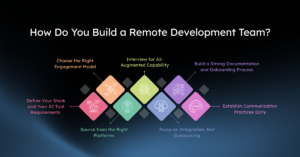
How Do You Build a Remote Development Team?
Most companies get this wrong in the first 30 days, not because they hired the wrong people, but because they set up the wrong structure.
Here’s how to do it right.
1. Define Your Stack and Your AI Tool Requirements
Don’t just list React, Node.js, and Python. Specify which AI tools your team must be proficient in. This single filter eliminates the 40% of applicants who claim AI familiarity but can’t use it in production.
2. Choose the Right Engagement Model
There are four flexible engagement models.
- Dedicated Teams: Long-term teams fully aligned with your product
- Staff Augmentation: Plug specific skills into your existing team
- Project-Based Teams: Fixed scope delivery
- Outcome-Based Contracts: Pay per shipped milestone.
Match the model to your stage and budget.
3. Source from the Right Platforms
The best pre-vetted remote developer platforms are:
- Arc.dev (AI-screened)
- Toptal (top 3% network)
- Turing (AI skill-matched)
- Gun.io, and Contra
for independent senior specialists. Avoid generic freelance platforms for product-critical roles.
4. Interview for AI-Augmented Capability
A strong interview assesses:
- How they use AI tools in their daily workflow
- How they critically review AI-generated code
- How they communicate asynchronously
One challenge many companies overlook is poor asynchronous communication. Over time, it can significantly impact a remote team’s productivity and collaboration.
5. Focus on Integration, Not Outsourcing
The most successful remote teams don’t operate as external vendors. They become an extension of your organization, working closely with your in-house team and contributing to shared business goals. When remote developers are fully integrated into your workflows, communication improves, accountability increases, and projects move forward more efficiently.
6. Build a Strong Documentation and Onboarding Process
Give new team members easy access to documentation, codebase knowledge, and recorded training materials from day one. A structured onboarding process helps remote developers understand your product faster, contribute sooner, and start delivering meaningful work within their first week.
7. Establish Communication Practices Early
Set expectations from the start. Ensure team members have at least a few hours of overlapping work time each day for discussions and collaboration. Keep everyone aligned with regular project updates and maintain a shared workspace where important decisions are documented and easy to access.
Companies that struggle with remote work often don’t fail because of hiring. They fail because they lack clear processes and structure.
At Enlight Lab, every remote team we build is evaluated on AI tool fluency before technical skill level. An engineer who can’t use AI coding tools effectively is operating at roughly 60% of the output of one who can. It’s that material that makes a difference.
Managing Remote Development Teams at Scale – What Actually Works
Hiring is only half the equation. The companies that get the most from their remote tech teams are the ones that manage differently.
Here’s what high-performing distributed engineering teams look like from the inside.
Async-First Is Not Optional – It’s the Architecture
One of the biggest mistakes companies make with remote teams is trying to recreate the office experience online. When team members work across different time zones, too many live meetings can disrupt productivity rather than improve collaboration.
An async-first approach allows people to contribute on their own schedules while keeping everyone aligned. Important decisions are documented, project updates are shared in writing or recorded videos, feedback is provided within agreed timelines, and clear processes ensure issues are addressed quickly. This helps teams stay productive without relying on constant meetings.
Measure Output, Not Hours
If you’re tracking when your remote developers log in, you’ve already lost. The gold standard for remote engineering performance is DORA metrics:
- Deployment frequency – how often code reaches production
- Lead time for changes – from commit to deploy
- Change failure rate – percentage of deploys causing incidents
- Mean time to recovery – how fast issues are resolved
These metrics tell you whether your team is performing. Clock-in data tells you nothing.
Building Culture Without a Physical Office
Remote culture requires intentional effort. Successful remote companies bring teams together in person when possible, celebrate achievements openly, encourage knowledge sharing, and provide clear opportunities for career growth. When employees feel recognized, connected, and supported, they are more likely to stay engaged and contribute their best work.
Security and IP Protection
This is non-negotiable and more complex than it was three years ago. With the EU AI Act, India’s DPDP Act, and stricter US AI-related executive guidance all in force, your remote team contracts must address:
- Data residency requirements and which jurisdictions data can touch
- IP ownership of AI-generated code produced on company time
- NDA clauses that cover AI training data usage
- Access control policies for production environments
Challenges of Remote Development Teams and How to Solve Them
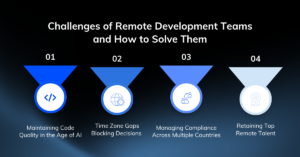
Challenge 1: Maintaining Code Quality in the Age of AI
AI coding tools can help developers work faster, but they can also introduce errors, security vulnerabilities, or inefficient code that may not be obvious at first glance.
Solution: Strengthen Your Code Review Process
Use AI-powered code review tools to identify potential issues before they reach production. Pair automated reviews with clear coding standards and oversight from experienced developers to ensure code quality, security, and consistency across the team.
Challenge 2: Time Zone Gaps Blocking Decisions
When developers have to wait hours for decisions or approvals, progress slows down, and delivery timelines can quickly slip. Over time, these delays can have a significant impact on project momentum and productivity.
Solution: Create Clear Decision-Making Processes
Document important decisions in a shared workspace so everyone has access to the information they need. Establish clear guidelines for when team members can move forward independently. Also, ensure there is some overlap in working hours each day for collaboration and faster issue resolution.
Challenge 3: Managing Compliance Across Multiple Countries
Hiring talent across different countries can create complex payroll, tax, and employment law requirements. For growing companies, managing these obligations internally can become time-consuming and difficult to scale.
Solution: Use Employer of Record (EOR) Services
Employer of Record (EOR) providers handle local employment, payroll, tax compliance, and benefits administration on your behalf. This allows your team to hire globally while reducing administrative complexity and compliance risk.
Challenge 4: Retaining Top Remote Talent
In a remote-first world, skilled professionals have more opportunities than ever. Even highly engaged employees may be approached with attractive offers from other companies, making retention an ongoing challenge.
Solution: Create Reasons to Stay Beyond Compensation
Competitive pay is important, but long-term retention often depends on more than salary alone. Clear career growth opportunities, meaningful recognition, ownership of impactful work, and a strong sense of belonging can help build loyalty and keep top talent engaged over time.
Need to Scale Your Product? Hire Remote Development Teams
Scaling isn’t just about adding more people. It’s about removing friction from how your team operates.
Remote development teams give you:
- Speed without delays
- Flexibility without risk
- Access to talent without limits
More importantly, they give you control over your growth trajectory.
The real question is: are you building a system where remote engineering teams can perform at their ceiling? That means the right hiring model, the right AI-era tooling, the right async structure, and the right culture for distributed people to feel ownership over what they build.
The companies that treat remote development teams as a strategic architecture are the ones shipping faster, retaining better talent, and outpacing competitors who are still waiting for the “right time” to try it.
There is no right time left to wait for. The window is now.
If you’re serious about scaling your product, reducing bottlenecks, and delivering faster, it’s worth rethinking how your team is structured.
Enlight Lab connects startups and scaling companies with vetted, experienced remote tech teams that are fully onboarded and ready to contribute in under two weeks.
Are you ready to move faster with a remote development team? Get a free team strategy call and walk away with a clear action plan.