In 2026, organizations are racing to launch AI-powered products, intelligent assistants, internal copilots, automated workflows, and customer support agents. Yet many companies are discovering a painful reality: the DevOps practices that worked perfectly for traditional software are no longer enough for AI systems.
A website behaves predictably. An AI model does not. A mobile application follows predefined logic. A large language model continuously produces probabilistic outputs.
If you’re building an AI product today, you’re facing a silent problem that most teams don’t talk about early enough.
The product works perfectly in demos. It impresses stakeholders and even gets an initial traction. But then something breaks very quietly.
- Responses start changing without code updates
- Costs begin to spiral without clear reasons
- Outputs degrade even though your pipeline is intact
And suddenly, your “AI product” feels unpredictable. This is the moment when you being founders or CTOs, realize: DevOps was never designed for AI systems. It was in fact built to manage software code.
Modern AI products require businesses to manage prompts, models, vector databases, datasets, evaluation frameworks, hallucinations, compliance requirements, and model performance simultaneously.
This is where LLMOps (Large Language Model Operations) enter the picture. It’s becoming the default way AI products are built and run.
For CTOs, startup founders, and business leaders, understanding LLMOps is quickly becoming the difference between launching a successful AI product and watching an expensive AI initiative fail after deployment.
In this guide, we’ll explore why LLMOps is replacing DevOps, what enterprises need to know in 2026, and how businesses can build and run reliable, production-ready AI systems.
What Is LLMOps And Why It Matters Now More Than Ever
LLMOps (Large Language Model Operations) is the discipline of managing, deploying, monitoring, optimizing, and scaling AI applications powered by large language models.
Unlike traditional DevOps, LLMOps focuses on:
- Prompt management
- Model evaluation
- AI observability
- Hallucination monitoring
- Dataset versioning
- Vector database management
- Security and governance
- Cost optimization
- Continuous AI improvement
LLMOps enables businesses to build reliable and production-ready AI products while maintaining quality, compliance, and performance.
Core Areas LLMOps Covers
- Prompt engineering and versioning
- Retrieval pipelines (RAG systems)
- Output evaluation and quality scoring
- Cost and token usage management
- Monitoring hallucinations and behaviour drift
- Continuous optimisation loops
Why LLMOps Has Become Critical in 2026
- AI systems are now customer-facing and revenue-critical
- Small changes in prompts or data can impact outcomes massively
- Enterprises are scaling AI across multiple functions
The challenge is no longer building AI but also running AI product reliably at scale.
Why DevOps Fails for AI Products
For over a decade, DevOps transformed software development. The philosophy was simple:
- Build faster
- Deploy faster
- Automate infrastructure
- Improve reliability
And it worked. However, AI products introduce an entirely different set of challenges. DevOps is no longer enough to overcome those challenges.
Here’s why it fails:
Traditional DevOps Assumes Stability
DevOps is built around a simple assumption:
If your code doesn’t change, your system won’t change either.
And for years, that assumption worked perfectly. When you deploy APIs, SaaS platforms, or web applications, you expect predictable behaviour. You test, release, and monitor with confidence that what worked before will keep working.
But when you bring AI into the picture, that foundation starts to crack.
Because in an AI-driven system, you’re not only shipping code but also shipping behaviour. And behaviour can shift even when your code stays untouched. That’s where DevOps begins to fall short, and where things start to feel out of control.
AI Systems Are Non-Deterministic
Here’s what makes AI fundamentally different and often frustrating.
Even if you do everything right, your AI product can:
- Generate different outputs for the same input
- Change behaviour when the model provider updates something behind the scenes
- Fail silently without triggering errors
So, while your infrastructure might look healthy, your product experience may already be degrading. This creates a gap most teams don’t see coming early enough:
- DevOps tells you your system is running
- LLMOps tells you whether your system is actually working
And in AI-powered products, that difference is everything.
Key Limitations of DevOps for AI
When you try to run AI products using a DevOps mindset, you start hitting invisible walls.
You’ll notice that:
- You have no structured way to version and manage prompts, even though they directly impact outcomes
- You can’t evaluate response quality at scale, so decisions are often based on gut feeling
- There’s no visibility into hallucinations or bias, which can quietly damage user trust
- You lack clarity on inference-level costs, and expenses can grow without warning
- Most importantly, there’s no continuous feedback loop, meaning your AI doesn’t actually improve over time
And that’s the real problem.
Without LLMOps, your AI product doesn’t evolve. It only reacts. Which means instead of building a system that gets smarter, you end up constantly with firefighting issues that feel unpredictable.
LLMOps vs DevOps: The Fundamental Shift
| Aspect | DevOps | LLMOps |
| Focus | Code & infrastructure | AI behaviour & outputs |
| Output type | Deterministic | Probabilistic |
| Monitoring | Logs, uptime, latency | Quality, correctness, hallucination |
| Versioning | Code | Prompts + models + context |
| Feedback loop | Bug fixes | Continuous optimisation |
| Cost model | Infrastructure-based | Token-based usage |
How You Can Build a Future-Proof AI Products
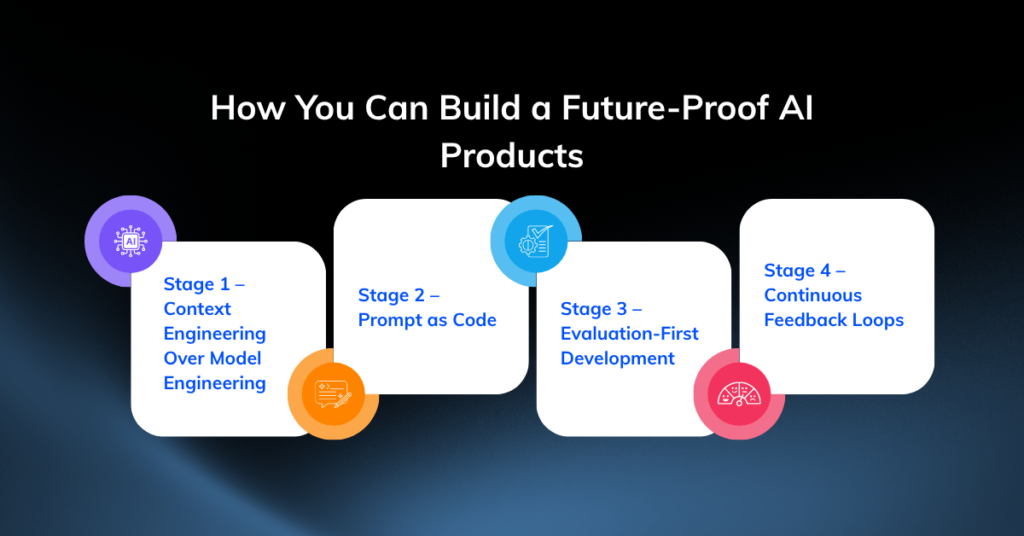
Stage 1 – Context Engineering Over Model Engineering
In 2026, you are not starting by training models. You are starting by designing the right context around them. Instead of building models from scratch, you focus on creating systems that give the AI the exact information it needs to produce reliable results.
That is why approaches like RAG become central. You are not asking the model to “know everything.” You are helping it access the right knowledge at the right time.
What changes for you:
- Instead of training models, teams build context systems
- RAG pipelines become core infrastructure
- Data quality directly impacts output quality
The better your context, the better your AI performs.
Stage 2 – Prompt as Code
In an LLMOps-driven approach, prompts are no longer just inputs. They become a core part of your product logic. You start treating them like code that needs structure, control, and continuous improvement.
A small change in wording can shift outputs in a big way. That is why you need a system to manage, test, and refine prompts over time.
What this means in practice:
- Prompts are version-controlled like code
- A/B testing becomes part of your workflow
- Prompt updates are rolled out carefully
Instead of guessing, you start making data-driven decisions around AI behaviour.
Stage 3 – Evaluation-First Development
Instead of building first and evaluating later, you flip the approach. You define what “good” looks like before your AI reaches users.
This means your system does not rely on intuition or manual checks. Every output is tested against clear quality standards.
What you start doing differently:
- You set benchmarks for accuracy, relevance, and safety
- AI outputs are scored using defined metrics
- Automated evaluation pipelines run continuously
- Quality is monitored before and after deployment
This changes how you build products. With LLMOps, you have a measurable way to prove it.
Stage 4 – Continuous Feedback Loops
Launching your AI product is not the end. It is the beginning of continuous improvement. Every interaction your users have with the system becomes input for making it better.
Instead of static releases, your product evolves over time based on how it is actually used.
What this looks like for you:
- Real user interactions feed improvements back into the system
- AI systems evolve continuously
- Product becomes smarter with actual data usage and more aligned over time
The more your product is used, the more valuable it becomes.
Key priorities to consider when building AI Product
- Avoid dependency on a single model provider.
- Evaluate infrastructure before scaling deployment.
- Implement security and compliance from day one.
- Track spending at every layer.
- Continuous optimization for ongoing improvement.
Organizations that embrace these principles are better positioned to scale successfully.
How AI Products Will Be Run in 2026
Continuous Monitoring of AI Behaviour
Running an AI product is not about checking if your system is live. It is about understanding how your AI behaves in real-time. You need visibility into how responses evolve, where things go wrong, and how user experience is impacted.
What you actively monitor:
- Hallucinations that can mislead users
- Inconsistent responses across similar inputs
- Silent failures that do not trigger system errors
The key shift is simple. You stop asking, “Is my system running?” and start asking, “Is my AI behaving the way it should?”
Cost Optimization at Scale
As your AI product grows, costs can increase faster than you expect. Every interaction has a cost, and without control, scaling becomes expensive very quickly.
LLMOps helps you stay in control by making cost efficiency part of your system design, not an afterthought.
How you manage costs effectively:
- Track token usage at a granular level
- Route queries to the most efficient models
- Use caching to avoid repeated processing
This ensures your product scales sustainably, without unexpected financial pressure slowing you down.
AI Observability Becomes Core Infrastructure
In traditional systems, observability focuses on logs and performance metrics. In AI systems, that is not enough. You need to understand how every output is generated and why.
This becomes a core part of your infrastructure, not an optional layer.
What strong observability looks like:
- Full traceability of every AI response
- Clear understanding of how outputs are generated
- Data-driven debugging instead of guesswork
When things go wrong, you do not rely on assumptions. You have the data to diagnose and fix issues with confidence.
Risk and Governance Layer
As AI becomes part of core business workflows, risk and governance move to the centre of your strategy. You cannot afford unpredictable behaviour, compliance gaps, or security risks.
LLMOps ensures that your AI operates within defined boundaries at all times.
What you put in place:
- Guardrails to control outputs and prevent unsafe responses
- Compliance checks aligned with business and regulatory needs
- Security enforcement to protect data and user interactions
This is what builds trust, not just internally, but with your customers.
Why Enterprises Are Investing Heavily in LLMOps
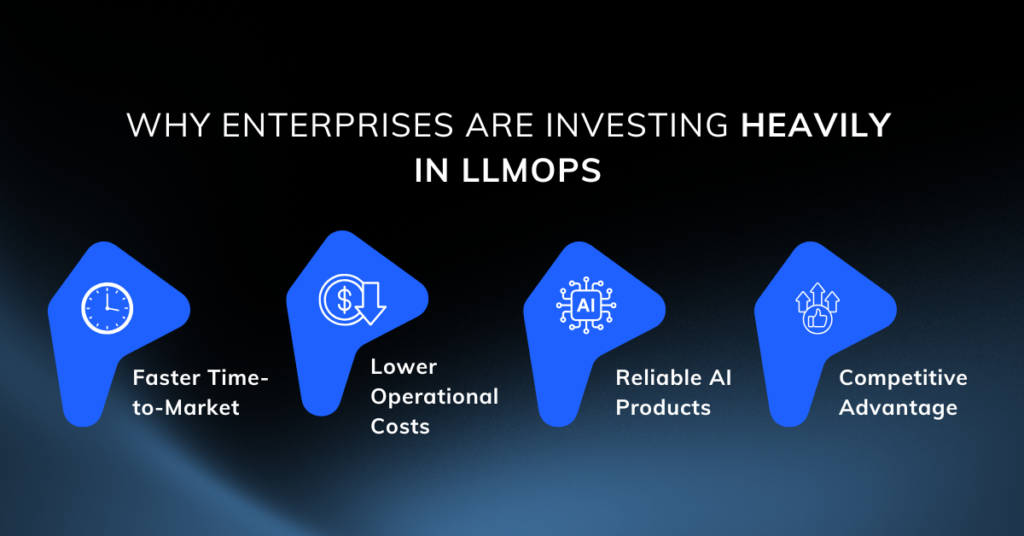
Faster Time-to-Market
With LLMOps, you no longer need to rebuild infrastructure every time you develop an AI product. Instead of dealing with fragmented tools and unstable pipelines, you get a structured approach that helps you move from idea to production much faster.
More importantly, you can iterate based on real user feedback, allowing your product to improve continuously rather than waiting for long development cycles.
- Build AI products without reinventing infrastructure
- Iterate rapidly based on feedback
Lower Operational Costs
AI costs can quickly become unpredictable if you do not have the right control in place. Token usage and model calls can increase without clear visibility. LLMOps helps you understand where your resources are going and how to optimize them. By managing model usage efficiently, you reduce waste and build a system that scales without unnecessary financial pressure.
- Avoid uncontrolled token usage
- Optimize model calls
Reliable AI Products
When your AI behaves inconsistently, users lose confidence almost immediately. LLMOps helps you bring structure to that uncertainty. By reducing hallucinations and improving output consistency, you create a more dependable experience. Over time, this reliability becomes the foundation of user trust and long-term product success.
- Reduce hallucination risks
- Ensure consistency
Competitive Advantage
Adding AI features is no longer enough to stand out. What truly differentiates you is how well your system performs over time. LLMOps allows your product to evolve and improve as it learns from real usage. This means you are not just launching a feature, you are building an intelligent system that grows stronger and more valuable, giving you a lasting competitive edge.
- Deliver smarter, evolving systems
- Build trust through reliability
Common LLMOps Mistakes Enterprises Make
Treating AI Like a Feature Instead of a System
Many enterprises approach AI as just another feature to add into an existing product roadmap. This mindset works for traditional software, but it breaks quickly with AI.
When you treat AI as a feature, you overlook the fact that it requires continuous monitoring, evaluation, and improvement to stay useful. The result is a product that performs well in controlled demos but becomes unpredictable in real-world usage.
To build reliable AI systems, you need to think beyond feature delivery and design for long-term behaviour control and system evolution.
Ignoring Evaluation Frameworks
A common and costly mistake is relying on subjective judgement to assess AI performance.
If you are not measuring output quality through structured evaluation frameworks, you have no reliable way to understand how your system is performing. This creates blind spots where quality issues, inconsistencies, and risks go unnoticed until they affect users.
High-performing AI teams define clear benchmarks, continuously evaluate outputs against them, and use those insights to improve the system over time. Without this discipline, scaling AI becomes guesswork rather than strategy.
Focusing Only on Model Selection
Enterprises often assume that choosing the best model will solve most of their challenges. While model selection is important, it is rarely the deciding factor in real-world performance. The quality of your prompts, context design, data pipelines, and evaluation processes has a far greater impact on outcomes.
When teams focus only on models, they miss the broader system design that makes AI reliable and scalable. The real advantage comes from how effectively you orchestrate the entire ecosystem around the model.
Neglecting Human Feedback
AI systems improve fastest when they are shaped by real user interactions, yet many organisations fail to capture and use this feedback effectively. Without human input, your system lacks visibility into edge cases, user expectations, and real-world scenarios. This leads to a gap between how the system is designed and how it is actually experienced.
Incorporating structured feedback loops allows your AI to evolve continuously and align more closely with business needs and user behaviour.
Waiting Too Long to Implement Governance
Governance is often delayed until AI adoption reaches scale, but this approach introduces unnecessary risk. From the moment your AI interacts with users or handles sensitive data, it requires clear boundaries, monitoring, and control mechanisms.
Without governance, issues related to compliance, security, and trust can emerge quickly and become harder to manage later.
Building governance early ensures that your system operates responsibly from the start, protecting both your users and your organization as you scale.
When Should You Adopt LLMOps?
You should consider LLMOps if
- You’re building AI-powered products
- You rely on LLM APIs
- You have user-facing AI features
- Your AI outputs impact business decisions
The Future: From LLMOps to Autonomous AI Systems
Rise of AgentOps
As organizations move beyond standalone AI models, AgentOps is emerging as the operational framework for managing AI agents at scale. Unlike traditional LLMOps, which focus on deploying and monitoring individual models, AgentOps governs how multiple AI agents interact, make decisions, share context, and execute tasks across business processes.
This shift enables more sophisticated automation, where specialized agents collaborate to complete complex workflows.
Self-Improving AI Systems
Future AI systems will be designed to continuously learn from interactions, outcomes, and feedback. Rather than relying solely on periodic model updates, self-improving systems can identify performance gaps, refine workflows, and adapt to changing business requirements over time.
This evolution will help organizations maintain AI effectiveness in dynamic environments while reducing the need for constant manual intervention.
AI-First Organizations
As AI becomes a core business capability, organizations are transitioning toward AI-first operating models where intelligence is embedded into everyday workflows. Rather than treating AI as a standalone technology initiative, businesses are integrating it across customer service, operations, finance, supply chain management, and decision-making processes.
This approach enables faster execution, better insights, and greater organizational agility.
Building AI Products That Actually Work in the Real World
By now, one thing should be clear:
LLMOps is no longer optional. It is the foundation that transforms AI from an impressive demonstration into a scalable, production-ready product. More importantly, it bridges the gap between AI that merely shows promise and AI that consistently delivers measurable business value.
Your competitors are scaling AI. Are you?
In 2026, the winning companies won’t be the ones with the most powerful models.
They’ll be the ones who:
- Control AI behaviour
- Optimize performance continuously
- Build systems that evolve with users
That’s what LLMOps enables. From prompt management and model evaluation to observability, governance, and cost optimization, LLMOps provides the framework businesses need to build reliable, scalable, and trustworthy AI products.
At Enlight Lab, we partner with founders, CTOs, and enterprise teams to build AI-powered systems that work in the real world.
If you’re:
- Struggling to scale AI beyond MVP
- Seeing inconsistent outputs
- Facing rising infrastructure costs
Book a free discovery call with us to get an expert guidance on building AI products that perform beyond the prototype stage. Let’s begin to design a production-ready LLMOps strategy tailored to your business.