Finding the right talent is arguably the most complex challenge modern businesses face. You post a job, wait for applications, manually sift through hundreds of resumes, and spend weeks coordinating interviews. By the time you finally make an offer, your top candidate has already accepted a role elsewhere.
This slow, manual process drains company resources and leaves critical projects severely understaffed. The global demand for specialized tech skills continues to outpace the available talent pool. To keep up, companies need smarter, faster ways to build capable teams without compromising on quality.
That is exactly why AI staff augmentation has rapidly moved from a futuristic concept to a daily operational standard. This integration of artificial intelligence into the contingent workforce model allows you to identify, vet, and onboard top-tier professionals with unprecedented speed.
In this post, we will explore exactly how AI staff augmentation works, why traditional methods are failing, and the actionable steps you can take to implement these intelligent hiring systems into your own business.
What Is AI Staff Augmentation And How Does It Work?
AI staff augmentation refers to the strategic use of artificial intelligence tools to enhance, automate, and optimize the process of hiring external, specialized talent. This model does not replace human recruiters or HR managers. Instead, it provides them with a powerful suite of technological tools to make faster, data-backed decisions.
To understand how this functions, you need to look at the underlying technologies driving these platforms:
- Natural Language Processing (NLP): NLP allows AI systems to read, understand, and interpret human language. Instead of simply looking for exact keyword matches on a resume, NLP evaluates the context of a candidate’s experience, assessing whether their past projects align with your current needs.
- Machine Learning (ML): ML algorithms analyze historical hiring data to recognize patterns of success. Over time, these systems learn which traits, backgrounds, and technical skills correlate with high-performing employees in your specific organization.
- Predictive Analytics: By evaluating vast amounts of data, predictive analytics can forecast future talent shortages within your company and predict how likely a specific candidate is to succeed in a given role.
The global IT staff augmentation market was valued at $299.3 billion in 2023 and is projected to reach $857.2 billion by 2031. This massive growth is largely fueled by the integration of these AI capabilities, enabling businesses to scale their teams dynamically based on real-time project demands.
AI Staff Augmentation vs Traditional Hiring: Comparison Snapshot
| Factor | Traditional Hiring | AI Staff Augmentation |
| Time to hire | Weeks/months | Days |
| Flexibility | Low | High |
| Cost model | Fixed | On-demand |
| Skill access | Limited | Global |
Why Are Traditional Hiring Methods Struggling In 2026?
Relying on legacy recruitment workflows creates massive bottlenecks for growing companies. Traditional hiring is inherently reactive; you only start looking for talent after a vacancy opens up, leaving your team burdened with extra work in the interim.
Current data highlights exactly why these outdated methods are no longer viable:
- Extended time-to-hire: The average time to hire across U.S. industries currently ranges from 30.7 to 44.7 days. For highly specialized tech roles, this timeline frequently extends past 60 days.
- Escalating financial costs: The average cost to hire a new employee in the United States hovers around $4,700 [SHRM, 2024]. This figure excludes the hidden costs of lost productivity and manager training time.
- High failure rates: Traditional interviews are notoriously poor predictors of long-term job performance. Unconscious biases often lead recruiters to hire candidates based on “culture fit” rather than objective skill alignment, resulting in costly employee turnover.
When you manage large digital transformation initiatives, you cannot afford to wait two months to fill a critical software engineering role. You need immediate access to vetted professionals.
How Does AI Staff Augmentation Revolutionize the Recruitment?
Artificial intelligence fundamentally rebuilds the hiring lifecycle, injecting speed and objective analysis into every single phase of recruitment. Here is a breakdown of how AI transforms the candidate journey from initial sourcing to final onboarding.
Proactive Sourcing and Attraction
AI completely changes how you find potential candidates. Instead of waiting for active job seekers to find your company, AI-powered systems proactively scour the web to find the perfect match.
- Intelligent talent marketplaces: AI platforms continuously scan professional networks, GitHub repositories, and online portfolios to build pre-qualified talent pools.
- Predictive targeting: Algorithms analyze labor market trends to identify passive candidates who possess the exact skills you need and are statistically likely to be open to new opportunities.
- Personalized outreach: Generative AI tools help recruiters draft highly personalized outreach messages at scale, significantly improving response rates from highly sought-after tech professionals.
Automated Screening and Assessment
Manual resume screening is both time-consuming and prone to human error. AI systems handle this heavy lifting instantly, ensuring that no qualified candidate slips through the cracks.
- Contextual resume analysis: AI tools instantly compare thousands of resumes against your specific job requirements, surfacing the most qualified individuals in seconds.
- Automated preliminary interviews: Conversational AI chatbots engage with candidates immediately after they apply, asking preliminary screening questions and evaluating their baseline communication skills.
- Bias reduction algorithms: Advanced AI platforms can strip identifying information (like names, ages, and educational institutions) from candidate profiles. This forces the system to evaluate individuals purely on their skills and experience, actively mitigating unconscious bias.
Enhanced Interviewing and Evaluation
The interview stage is where human intuition often overrides objective data. AI provides structured, analytical support to ensure fair and accurate evaluations.
- Structured interview frameworks: AI assistants generate customized, standardized interview questions based on the specific technical requirements of the role.
- Behavioral and sentiment analysis: During video interviews, specialized AI tools can analyze speech patterns, vocabulary, and problem-solving approaches to provide recruiters with a comprehensive behavioral profile.
- Real-time interviewer assistance: AI transcription tools take real-time notes during interviews, allowing the human hiring manager to remain fully engaged in the conversation rather than distracted by documentation.
Streamlined Onboarding and Integration
A successful hire does not end at the offer letter. AI ensures that augmented staff members integrate into your existing team smoothly and rapidly.
- Customized onboarding pathways: AI systems analyze a new hire’s existing skill set and automatically generate a personalized training program to bridge any immediate knowledge gaps.
- Workflow integration: AI project management tools instantly assign appropriate access rights, introduce the new hire to key stakeholders via communication platforms, and provide them with relevant project documentation.
- Retention prediction: By monitoring early engagement metrics and communication patterns, predictive models can alert managers if a new hire is struggling to integrate, allowing for proactive human intervention.
Who Benefits from AI Staff Augmentation?
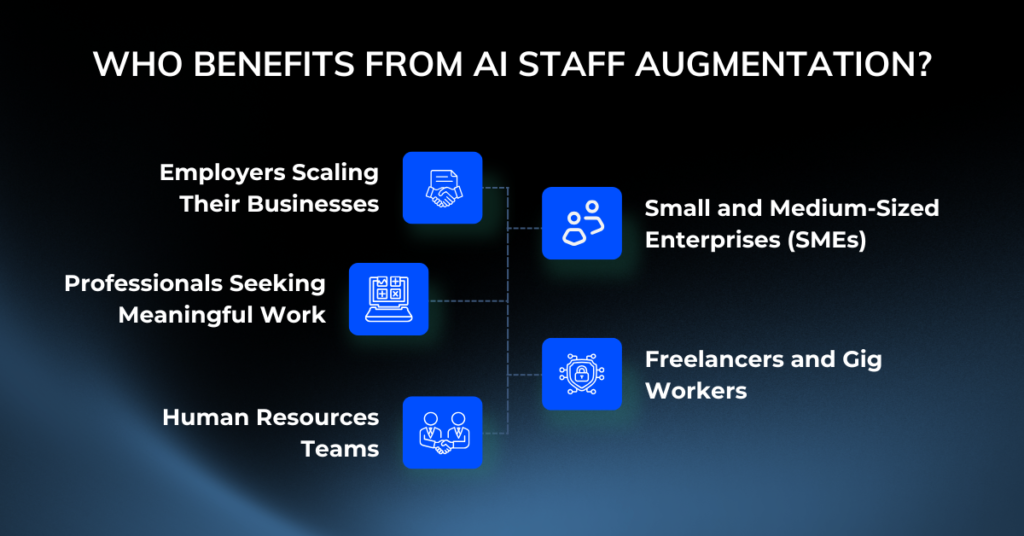
The integration of intelligent systems into the contingent workforce model creates a profound ripple effect. It fundamentally improves the daily realities of both the employers scaling their businesses and the professionals seeking meaningful work.
Human Resources Teams
HR teams utilize AI-driven tools for enhanced talent acquisition, onboarding, and performance management. This improves the recruitment process, identifies the best-fit candidates, and supports employee development through continuous monitoring and feedback.
Small and Medium-Sized Enterprises (SMEs)
SMEs gain from AI staff augmentation by accessing scalable and affordable tools that were traditionally available only to larger corporations. These tools allow SMEs to compete in a data-driven, technology-driven business environment.
Employers Scaling Their Businesses
Employers benefit from AI staff augmentation by gaining access to advanced analytical tools and automation, which streamline workflows, reduce operational costs, and enhance decision-making. This enables them to scale efficiently while maintaining high productivity and quality standards.
Professionals Seeking Meaningful Work
For professionals, AI staff augmentation opens up opportunities for more engaging and impactful roles. By automating repetitive or mundane tasks, employees can focus on creative, strategic, and value-driven work, fostering career growth and job satisfaction.
Freelancers and Gig Workers
Freelancers and gig workers leverage AI systems to identify opportunities that align with their skills, negotiate better contracts, and manage their time and projects more effectively. This creates a more balanced and fulfilling work experience.
Key Advantages for Employers Leveraging AI Staff Augmentation
For business leaders and HR professionals, AI staff augmentation delivers immediate, measurable return on investment.
Reduced Time-to-Hire
Automation cuts out weeks of administrative delays, allowing companies to secure top talent faster. For example, Chipotle’s AI virtual assistant, “Ava Cado,” reduced their average hiring time from 12 days to just 4 days.
- Automated screening: AI instantly reviews resumes and applications against job criteria, identifying qualified candidates in minutes rather than hours.
- 24/7 engagement: AI-powered chatbots can engage with candidates, answer FAQs, and schedule interviews around the clock, accelerating the process.
- Streamlined workflows: Integration with HR systems means less manual data entry and fewer administrative bottlenecks, moving candidates through the pipeline more quickly.
Enhanced Diversity and Inclusion
By focusing purely on data and skills, AI can dramatically improve workforce diversity. Unilever’s use of AI in their sourcing process led to a 16% increase in talent diversity.
- Bias-free screening: AI algorithms can be designed to ignore demographic information like name, gender, or age, focusing solely on qualifications and skills.
- Wider talent pools: AI can search across a broader range of platforms and sources to find candidates from underrepresented backgrounds.
- Standardized assessments: Using AI for initial skills tests ensures every candidate is evaluated on the same objective criteria.
Lower Operational Costs
Reducing manual screening time and bad hires directly impacts your bottom line. This means less spending on external recruitment agency fees and minimizing the financial impact of high employee turnover.
- Reduced agency fees: Powerful in-house AI tools lessen the reliance on expensive third-party recruitment agencies.
- Improved quality of hire: Data-driven matching leads to better-fit candidates, which reduces turnover and the associated costs of re-hiring and training.
- Optimized resource allocation: HR teams can spend less time on repetitive administrative tasks and more time on strategic initiatives.
Data-Driven HR
Human resources transforms from a reactive administrative function into a proactive, strategic partner, capable of forecasting talent needs before shortages impact project deliverables.
- Predictive analytics: AI analyzes workforce data to predict future hiring needs, skills gaps, and potential turnover risks.
- Talent mapping: HR can use AI to map out talent within the organization and identify internal candidates for promotion or new roles.
- Performance insights: Continuous data analysis provides insights into team performance, helping to inform strategic decisions about talent management and development.
Key Advantages for Candidates
The hiring process is notoriously stressful for job seekers. AI helps create a fairer, more transparent, and highly efficient experience for candidates.
Faster Feedback Loops
Candidates no longer send resumes into a “black hole.” AI chatbots provide immediate application confirmations and rapid updates regarding their status in the hiring pipeline.
Fairer Evaluations
Because AI focuses on objective skill metrics, candidates from non-traditional educational backgrounds receive fairer consideration based on their actual abilities rather than their pedigree.
Better Job Matching
AI algorithms ensure that professionals are paired with projects that genuinely align with their long-term career goals and current skill levels, leading to higher job satisfaction.
Reduced Bias in Recruitment
By relying on data-driven analysis, AI minimizes unconscious biases that may influence hiring decisions. This promotes a more inclusive workforce, ensuring candidates are evaluated solely on their qualifications, skills, and experience.
What Ethical Challenges Does AI in Recruitment Face?
While the benefits are substantial, you cannot blindly hand your hiring processes over to algorithms. Deploying AI requires a careful, ethical approach to avoid introducing new risks into your organization.
- The trust deficit: A recent survey revealed that 66% of adults in the United States would refuse to apply for a job if they knew AI was making the hiring decisions [DemandSage]. Overcoming this skepticism requires deep transparency about how you use these tools.
- Algorithmic bias: If an AI model is trained on historical company data that contains human biases (e.g., heavily favoring male engineers), the AI will rapidly replicate and scale that exact same bias.
- The “Black Box” problem: Many complex machine learning models do not clearly explain why they rejected or recommended a specific candidate. This lack of transparency makes it difficult for HR teams to audit the system for fairness.
- Data privacy concerns: AI platforms require massive amounts of candidate data to function effectively. You must ensure that your data storage and processing protocols strictly adhere to global privacy regulations.
How Should Your Company Implement AI Hiring Tools?
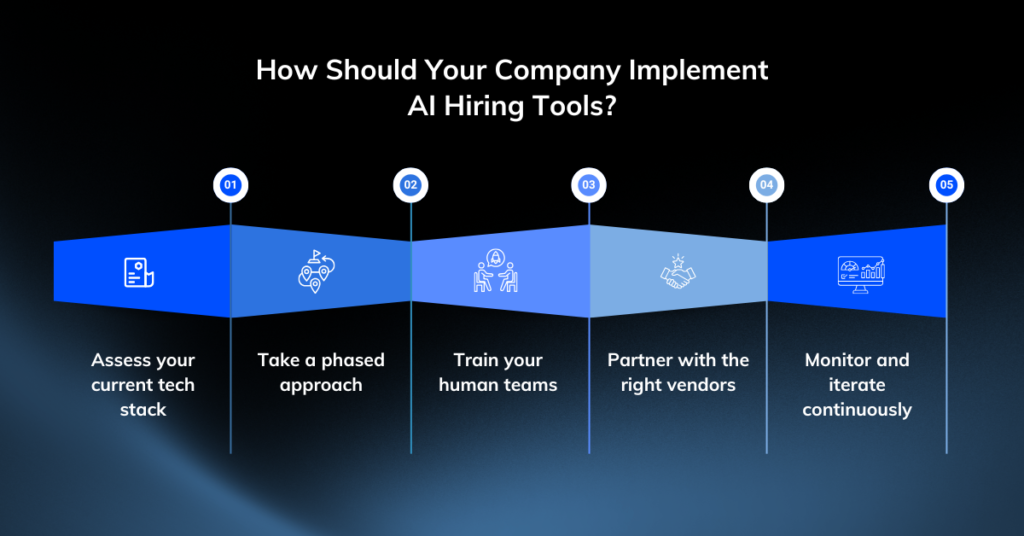
Transitioning to an AI-driven staffing model is a strategic journey. You cannot simply purchase a software license and expect immediate results. Follow this roadmap to ensure a successful, sustainable implementation.
- Assess your current tech stack: Before buying new tools, audit your existing applicant tracking system (ATS) and HR workflows. Identify exactly where your biggest bottlenecks are – whether that is sourcing top-tier developers or spending too much time on initial phone screens.
- Take a phased approach: Do not attempt to automate your entire HR department overnight. Start small. Implement an AI resume parsing tool first, measure its impact, and then gradually introduce chatbot screeners or predictive talent mapping.
- Train your human teams: Your recruiters must understand how to collaborate with AI. Train your HR team to interpret AI data, audit algorithms for bias, and focus their saved time on building deeper interpersonal relationships with candidates.
- Partner with the right vendors: Choose AI staff augmentation partners who prioritize ethical AI guidelines. Demand transparency regarding how their algorithms are trained and what steps they take to mitigate bias.
- Monitor and iterate continuously: AI models drift over time. Set up quarterly reviews to audit your AI hiring outcomes. Check if your new hires are performing well, evaluate your diversity metrics, and adjust the algorithms if you detect any emerging biases.
Securing Your Future with AI in Staff Augmentation
The digital landscape of 2026 demands agility. As technology evolves at a breakneck pace, your ability to execute complex projects relies entirely on your access to top-tier talent.
AI staff augmentation represents a fundamental shift in how businesses build capacity. It strips away the administrative bloat of traditional recruitment, allowing you to instantly connect with the exact skills you need, exactly when you need them.
However, it is vital to remember that AI is an enabler, not a replacement for human judgment. The most successful organizations use artificial intelligence to handle the heavy lifting of data analysis, freeing up their human leaders to focus on empathy, cultural alignment, and strategic vision. By embracing this synergistic approach, you will build a more resilient, dynamic, and capable workforce for the future.
Take the next step in transforming your organization with Enlight Lab. Discover how our cutting-edge AI solutions can empower your team to achieve more, faster, while maintaining the human touch that drives true innovation. Consult us today and unlock the full potential of your workforce!