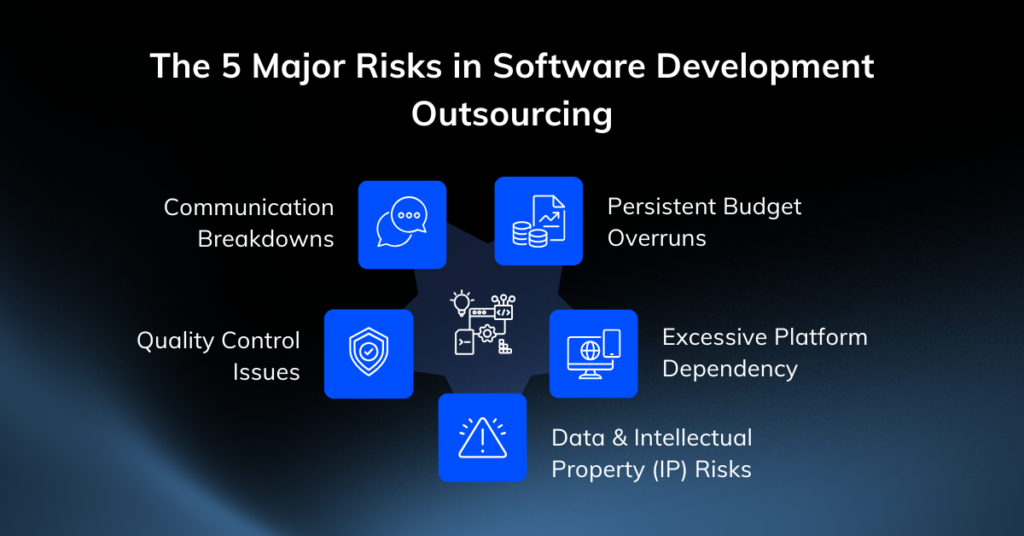
The 5 Major Risks in Software Development Outsourcing
Before you can effectively protect your product, you need to understand exactly what causes external projects to fail.
Communication Breakdowns
When your team operates across different continents, a simple misunderstanding can compound into weeks of wasted effort. Language barriers and drastic timezone differences often lead to delayed feedback loops, meaning a developer might spend three days building a feature incorrectly before you even have a chance to review it.
- Poor communication and language barriers
- Missed deadlines and schedule slippage
- Lack of transparency in project management
Quality Control Issues
Entrepreneurs often have a crystal-clear vision in their heads, but translating that vision into technical requirements is notoriously difficult. If you rely on vague descriptions rather than detailed wireframes and technical documentation, external teams will fill in the blanks with their own assumptions.
- Building the wrong features
- Failing to grasp core user needs
- Misinterpreting market direction
Data & Intellectual Property (IP) Risks
When you share your proprietary algorithms, customer data, and source code with a third party, you expose your startup to severe risks. Without the right legal frameworks and technical guardrails in place, you risk intellectual property theft or disastrous data breaches.
- Loss of intellectual property
- Data breaches due to weak security protocols
- Non-compliance with regulations like GDPR or HIPAA
Excessive Platform Dependency
Relying entirely on a single vendor for your proprietary technology creates a single point of failure. If the agency uses obscure proprietary frameworks or refuses to provide comprehensive documentation, bringing the project in-house later becomes nearly impossible.
- Poor code quality and technical debt
- Architectural flaws that hinder scalability
- Security vulnerabilities and data leaks
- Failure to follow industry best practices
Persistent Budget Overruns
Choosing the cheapest hourly rate often leads to the highest total cost of ownership. Vendors may lowball the initial estimate to win the contract, only to charge exorbitant fees for standard revisions, bug fixes, or minor scope adjustments.
- Uncontrolled budget overruns
- Hidden costs in the contract
- Pricing models that don’t align with deliverables
Hidden Costs of Outsourcing Nobody Plans For But Always Pays For
Most outsourcing budgets focus on hourly rates.
But real damage happens in hidden, compounding costs, the ones that don’t show up in your initial estimate.
The hidden cost breakdown at a glance:
| Hidden Cost | What It Actually Looks Like | Business Impact |
| Rework Costs | Requirements are unclear, missing, or constantly changing mid-project | Extra development sprints, Delayed launch timelines |
| Knowledge Dependency (Bus Factor Risk) | Only 1–2 developers understand critical systems or architecture | Project stalls if someone leaves, Costly onboarding & recovery |
| Opportunity Costs | Delays push releases beyond ideal market timing | Lost revenue, Missed competitive advantage |
The Four-Phase Framework for De-Risking Outsourced Tech Development
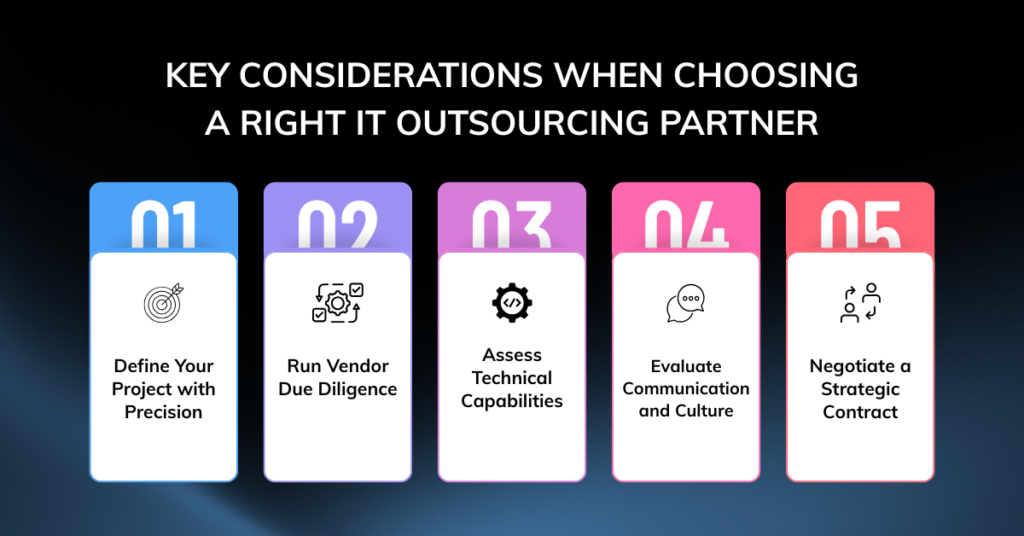
Phase 1: Right Vendor Selection Before You Sign In
Outsourcing is not a cost decision. It’s a risk transfer decision.
The absolute best way to protect your investment is to hire the right partner from day one. Proper vetting requires moving beyond slick sales presentations and digging into operational reality.
- Project Definition: Solidify your MVP scope, user stories, and acceptance criteria.
- Due Diligence: Check references, review their portfolio, and assess their financial stability.
- Technical Assessment: Conduct a technical interview to verify their expertise aligns with your needs.
- Contract Negotiation: Secure an MSA with clear terms on IP ownership, SLAs, and exit clauses.
Phase 2: Integration & Collaboration During the Project
Once the contract is signed, focus on integrating the external team with your internal operations.
- Establish Clear Communication Protocols: Use dedicated tools like Slack and Jira and schedule regular video calls. Centralize all project communication.
- Implement Project Management Transparency: Demand full access to the vendor’s project management boards to prevent delays from snowballing.
- Schedule Regular Progress Reviews: Mandate weekly sprint demos to see working software, not just status updates.
- Foster a Collaborative Environment: Treat the outsourced team as an extension of your own. Share user feedback and business context to help them build a better product.
Phase 3: Quality & Security Protecting Your Asset
Enforce quality and security at the code level.
- Define Quality Standards Upfront: Establish strict coding standards and test coverage requirements before work begins.
- Implement Continuous Testing: Automate your testing pipeline with CI/CD to catch bugs early.
- Enforce Strict Security Protocols: Restrict production data access and enforce multi-factor authentication (MFA).
- Protect Your Intellectual Property (IP): Host your own code repositories (e.g., on GitHub) and grant the team access. Your contract must state that you own all IP.
Phase 4: Financial & Operational Oversight
Maintain control by tying payments to verifiable deliverables.
- Choose a Transparent Pricing Model: Use a Fixed-Price model for well-defined MVPs or a Dedicated Team (Time and Materials) model for evolving products.
- Track Your Budget Relentlessly: Audit hours and expenses weekly to prevent budget overruns.
- Monitor Key Performance Metrics: Track sprint velocity, code churn, and defect density to gauge project health.
- Plan for Business Continuity: Require the vendor to maintain off-site backups of your codebase and database.
IT Outsourcing Risk Mitigation Checklist
- Evaluate Vendor Reputation: Check reviews, references, and past projects to ensure reliability.
- Data Security Protocols: Confirm that the vendor follows stringent security measures to protect your sensitive information.
- Scalability Assessment: Ensure their processes can adapt to future growth or changes in your project.
- Legal Compliance: Verify that the vendor adheres to local and international regulations relevant to your industry.
- Backup and Recovery Plans: Confirm robust systems are in place for data backups and disaster recovery.
- Clear Communication Channels: Establish regular updates and access to key contacts to avoid miscommunication.
- Exit Strategy Preparation: Plan for a smooth transition, with legally-binding terms ensuring the handover of all assets.
What to Look for in an IT Outsourcing Partner in 2026
As the software development landscape shifts, what you need from an outsourcing partner is changing too. For 2026 and beyond, businesses should look for more than just a service provider; they need a strategic ally who can drive innovation and create long-term value.
Here are the key traits to prioritize when choosing a software outsourcing partner for the future:
Forward-Thinking Technical Expertise
The best partners in 2026 won’t just be skilled—they’ll be ahead of the curve. Look for firms with deep expertise in emerging technologies relevant to your industry. They should offer solutions tailored to your specific market challenges, not generic, one-size-fits-all services. A strong and diverse portfolio is a good indicator of their versatility.
Adaptive Scalability
Your business needs will evolve, and your partner must be able to keep pace. The ideal partner for 2026 will offer true agility, capable of scaling teams up or down and adjusting project scopes on the fly. This flexibility will be crucial for staying competitive.
Radical Transparency
In a successful partnership, trust is everything. Your partner in 2026 must champion open and transparent communication. Expect regular, honest updates and proactive problem-solving that keeps both teams perfectly aligned, no matter the distance or time zone.
Proactive Security and Compliance
With cybersecurity threats becoming more sophisticated, a reactive approach to security is no longer enough. A reliable 2026 partner will be obsessed with data protection, adhere to the strictest compliance standards, and actively work to mitigate risks before they become problems.
A Focus on Shared Growth
The most valuable partners are those invested in your long-term success. Look for a firm that brings innovative ideas to the table, continuously trains its teams, and is motivated to grow with you. This creates a mutually beneficial relationship that delivers sustained value.
By selecting an outsourcing provider with these future-focused qualities, you can build a partnership that not only delivers projects but also paves the way for sustainable growth in the complex tech ecosystem of 2026.
Risky vs De-Risked Outsourcing Approach
| Factor | Risky Approach | De-Risked Approach |
| Vendor Selection | Cheapest option | Proven expertise + cultural fit |
| Scope | Vague requirements | Clearly defined outcomes |
| Communication | Ad-hoc | Structured + documented |
| Quality | End-stage testing | Continuous validation |
| Control | Low visibility | Full transparency |
How Enlight Lab Simplifies Risk-Free Software Development Outsourcing
At Enlight Lab, we prioritize mitigating the challenges often associated with software development outsourcing. Our focus is on creating seamless, transparent, and efficient partnerships to ensure your success. Here’s how we deliver:
- Enhanced Transparency: Clear communication channels and real-time project tracking keep you informed at every stage.
- Agile Development Methodologies: Our adaptive processes help deliver high-quality solutions, even as requirements evolve.
- Rigorous Talent Selection: We handpick top-tier professionals to match your specific project needs.
- Robust Risk Management: Comprehensive planning and proactive approaches prevent delays and unexpected challenges.
- Commitment to Long-Term Success: We emphasize scalable solutions designed to grow with your business.
By tackling these key areas, Enlight Lab guarantees a reliable and low-risk outsourcing experience.
Outsourcing Is a Strategy, Not a Gamble! Risk-Free IT Outsourcing with Enlight Lab
Outsourcing your product isn’t risky. It is the poor planning. When you de-risk software development outsourcing through meticulous vendor vetting, airtight contracts, and transparent engineering practices, you unlock the ability to scale rapidly without burning through your runway.
By treating quality assurance and communication as daily requirements rather than afterthoughts, you position your startup to reap the rewards of global talent.
At Enlight Lab, we believe that true technical partnerships are built on transparency, shared goals, and relentless execution. Take the time to implement these strategies, protect your intellectual property, and watch your product vision become a reality.
We help you:
- Validate your idea before development
- Build risk-proof outsourcing frameworks
- Deliver scalable, high-quality software with confidence
Let’s talk about your project before risks become expensive mistakes.