Building a software product from scratch is hard enough without worrying about where to find the right engineering talent. You know your market, you understand your customers, and you have a vision. But when it comes to executing that vision, local hiring often drains your runway faster than you can secure your next round of funding.
That is exactly why founders look beyond their own borders. Understanding the latest offshore software development trends helps you make smarter hiring decisions, optimize your tech budget, and protect your intellectual property. The global outsourcing landscape shifts rapidly. Strategies that worked three years ago might leave you with technical debt today.
This guide breaks down the data-backed trends shaping global engineering in 2026. You will learn exactly how to structure your distributed teams, which geographic hubs offer the best talent, and how Enlight Lab can help you turn these industry shifts into a massive competitive advantage for your startup.
What Is Offshore Software Development Trends in 2026
Offshore software development refers to the outsourcing of software development tasks to teams located in a different country, often to leverage cost efficiency, access global talent, and maintain around-the-clock productivity. It’s a modern solution for businesses looking to innovate and scale rapidly in an increasingly competitive market.
How Offshore Development Has Evolved
Offshore software development has undergone a major transformation over the past decade—and by 2026, it looks very different from what most businesses still assume.
Then (Old Offshore Model)
- Focused mainly on cost reduction
- Transactional relationships with vendors
- Limited communication and visibility
- Basic development tasks (coding, QA)
Now (2026 Offshore Model)
- Built for innovation, speed, and scalability
- Strategic partnerships, not just vendors
- Fully integrated with in-house teams
- Expertise in advanced technologies (AI, cloud-native, DevOps)
Offshore vs Nearshore vs Onshore (Quick Comparison Table)
| Type | Location | Cost | Time-Zone Alignment | Best Use Cases |
| Offshore | Different country, often far away | Low | Limited overlap | Cost savings, access to global expertise |
| Nearshore | Neighboring or nearby countries | Moderate | High overlap | Collaborative work, cultural alignment |
| Onshore | Same country as the business | High | Full alignment | High-quality control, fast communication |
Why is Offshore Development Growing in 2026?
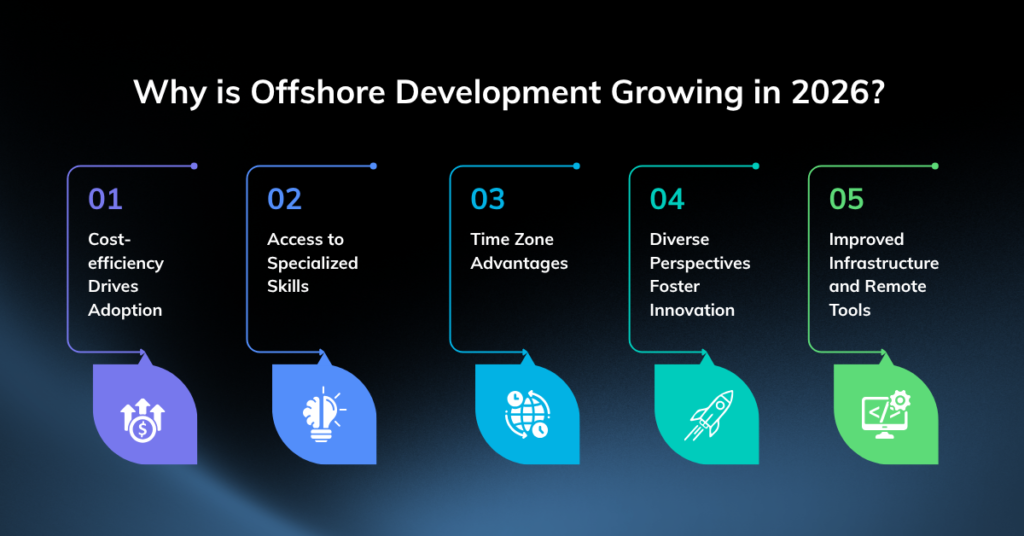
The global landscape for software development continues to evolve, and offshore development has seen tremendous growth in 2026. Here’s how:
Cost-Efficiency Drives Adoption
With the rising labor costs in regions like North America and Western Europe, offshore development offers a budget-friendly alternative. Companies can get access to top-tier talent at a fraction of the price, making offshore teams an essential part of competitive strategy.
Access to Specialized Skills
Offshore hubs have become centers of excellence in fields like AI, cybersecurity, blockchain, and big data. Startups seeking niche expertise can quickly connect with experienced professionals without the delays of local hiring.
Time Zone Advantages
Distributed teams now leverage “follow-the-sun” workflows to maintain continuous progress on critical projects. Offshore development ensures faster delivery times, especially for businesses operating on tight deadlines.
Diverse Perspectives Foster Innovation
Working with offshore teams introduces fresh perspectives and innovative ideas. By collaborating across borders, companies can develop products that cater to broader, global markets.
Improved Infrastructure and Remote Tools
Advancements in remote collaboration tools, cloud infrastructure, and secure data-sharing solutions have made offshore development more seamless and efficient than ever.
Offshore development’s rapid growth in 2026 stems from a blend of economic, technological, and practical factors, positioning it as a vital strategy for businesses aiming to scale in a global market.
The Rise of AI in Offshore Development
Artificial intelligence is fundamentally changing how distributed teams write, test, and deploy code. It is, therefore, transforming offshore development by driving unprecedented efficiency and innovation. Here’s how:
- Automation of Repetitive Tasks: AI handles routine work like code reviews and testing. This allows development teams to concentrate on complex, value-driven activities.
- Enhanced Collaboration: AI-powered tools bridge communication gaps caused by different time zones and cultures.
- Smarter Development: AI algorithms can identify optimization opportunities and streamline processes.
For companies leveraging offshore talent, incorporating AI is not just a choice. It is in fact imperative. By harnessing its power, you can achieve faster delivery times, lower operational costs, and create scalable solutions that drive your business forward.
The Top 7 Offshore Software Development Trends
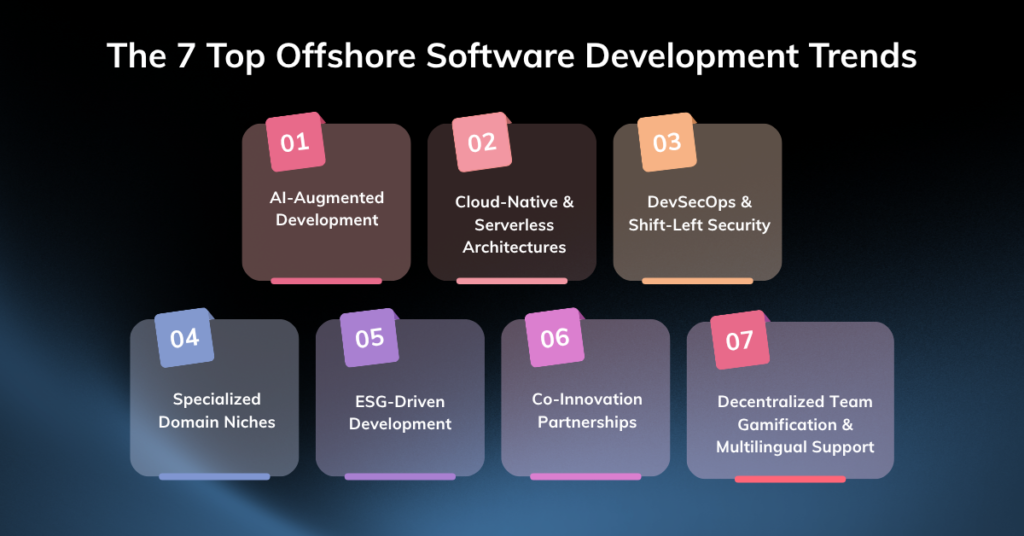
Trend 1. AI-Augmented Development
Artificial intelligence is revolutionizing software development by automating repetitive tasks, optimizing workflows, and enhancing code quality. Offshore developers increasingly rely on AI-powered tools to accelerate project delivery, identify bugs, and predict user needs, driving efficiency across the board.
Key Features:
- AI-powered code completion
- Automated testing
- Predictive analytics
- Intelligent debugging
Business Impact:
- Faster time-to-market
- Reduced development costs
- Improved code quality
- Enhanced developer productivity
Trend 2. Cloud-Native & Serverless Architectures
The demand for scalable, cost-efficient solutions is pushing offshore teams to adopt cloud-native and serverless models. These architectures enable startups to deploy resilient applications faster while minimizing infrastructure management overhead, ensuring businesses remain agile and responsive to market changes.
Key Features:
- Microservices
- Containerization (Docker, Kubernetes)
- Serverless functions (AWS Lambda, Azure Functions)
Business Impact:
- Lower operational costs
- Greater scalability and flexibility
- Faster deployment cycles
- Increased application resilience
Trend 3. DevSecOps & Shift-Left Security
Security is a top priority and integrating it early in the lifecycle has become crucial. Offshore teams are adopting DevSecOps practices and focusing on shift-left security to identify vulnerabilities upfront.
Key Features:
- Automated security scanning
- Continuous integration/continuous delivery (CI/CD) pipeline security
- Threat modeling
Business Impact:
- Reduced risk of security breaches
- Improved compliance with regulations (like GDPR)
- Enhanced customer trust
- Lower costs for fixing vulnerabilities
Trend 4. Specialized Domain Niches
Offshore developers are carving out expertise in specialized domains such as healthcare tech, fintech, and autonomous systems. Startups benefit from this targeted knowledge, gaining access to skilled teams.
Key Features:
- Industry-specific compliance knowledge (e.g., HIPAA in healthcare)
- Deep understanding of market-specific user needs
- Pre-built domain-specific frameworks
Business Impact:
- Faster development of compliant products
- Higher market fit
- Competitive edge through specialized expertise
Trend 5. ESG-Driven Development
Environmental, Social, and Governance (ESG) criteria are influencing software strategies. Offshore development firms are aligning with ESG principles by prioritizing sustainable practices, enhancing workplace diversity, and contributing to community-focused tech initiatives.
Key Features:
- Green coding practices
- Ethical AI development
- Diverse and inclusive hiring policies
- Community engagement programs
Business Impact:
- Improved brand reputation
- Better alignment with investor and customer values
- Enhanced employee satisfaction and retention
Trend 6. Co-Innovation Partnerships
Collaborative innovation is reshaping offshore development. Startups and offshore teams are forming co-innovation partnerships, jointly designing tailored solutions to tackle complex challenges and deliver exceptional products for end-users.
Key Features:
- Joint R&D initiatives
- Shared intellectual property models
- Agile and collaborative workflows
Business Impact:
- Access to a broader talent pool and fresh perspectives
- Accelerated innovation cycles
- Creation of unique, market-disrupting solutions
Trend 7. Decentralized Team Gamification & Multilingual Support
To enhance productivity and morale, offshore teams are utilizing gamification techniques within decentralized setups. Additionally, multilingual support allows diverse teams to collaborate seamlessly, ensuring inclusivity across global projects.
Key Features:
- Performance leaderboards
- Reward systems for milestones
- Multilingual communication tools
- Virtual team-building activities
Business Impact:
- Increased developer engagement and motivation
- Improved team cohesion in remote settings
- Better cross-cultural collaboration leading to more inclusive products
How to Navigate These Offshore Development Trends as a Non-Technical Founder
As a non-technical founder, navigating the IT outsourcing techniques can feel overwhelming, especially with the rapid pace of change. However, with the right approach and strategies, it is entirely possible to leverage these trends effectively to build successful projects.
Below are actionable insights to guide non-technical founders.
1. Understand the Basics of Software Development
While you don’t need advanced technical expertise, having a basic understanding of software development processes can go a long way. Familiarize yourself with agile methodologies, project management tools, and key concepts such as minimum viable product (MVP) development. This will help you communicate your vision more effectively and set realistic expectations for your development team.
2. Choose the Right Offshore Partner
When selecting an offshore development partner, focus on factors like their expertise, past projects, communication skills, and client reviews. Conduct thorough due diligence to ensure their team aligns with your project goals and values.
- Inquire specifically about their AI-augmented workflows.
- How do they use AI to accelerate development, improve code quality, and enhance testing?
A forward-thinking partner will have clear, demonstrable answers.
Look for partners who offer transparency, regular updates, and a collaborative approach to decision-making.
3. Foster Clear Communication and Collaboration
Language barriers and time zone differences can pose challenges, but with proper planning, you can overcome these obstacles.
- Set up structured communication channels
- Define project milestones in advance
- Establish regular progress updates
Tools like Slack, Zoom, and Jira can facilitate seamless interaction between teams.
4. Leverage Multilingual and Global Support Tools
To ensure inclusivity and avoid miscommunication, utilize multilingual team collaboration tools. These tools allow for smoother interactions across diverse cultural backgrounds and help incorporate diverse perspectives into your product’s design and functionality.
5. Monitor KPIs and Milestones Consistently
Tracking progress is essential for any project.
- Define clear key performance indicators (KPIs)
- Regularly review milestones with your offshore team
Monitoring these metrics will help you identify potential bottlenecks early and ensure that the project stays on schedule.
By applying these strategies, non-technical founders can effectively manage offshore development projects, turning challenges into opportunities for innovation and growth.
Partnering with Enlight Lab: Your Strategic Ally for 2026
At Enlight Lab, we don’t just follow trends. We understand that the decision to offshore is all about your vision, your funding, and your future. That’s why our entire model is built on the principles of transparency, security, and strategic partnership.
Here’s how we align with the future of offshore development:
- AI-Augmented Workflows: We leverage AI for automated testing and predictive analytics, building your product faster, smarter, and with greater accuracy.
- Ironclad IP Security: Your intellectual property is your most valuable asset. We protect it with rigorous, multi-layered security protocols and strict NDAs, giving you complete peace of mind.
- Strategic Partnership, Not Just Outsourcing: We act as an extension of your team, sharing both the risks and the rewards. For one recent partner, our transparent framework and dedicated product strategist didn’t just get their roadmap on track. We helped them secure their next funding round three months ahead of schedule.
Embracing Offshore Software Development Trends for Future Growth
The offshore software development trends defining 2026 prove that global engineering is more sophisticated, secure, and critical to startup success than ever before.
The days of treating offshore development as a risky gamble are over. Founders are moving away from treating offshore developers as isolated code factories. Instead, they integrate these professionals as core members of their product teams.
When you partner with experts who understand these listed offshore software development emerging trends, you gain direct access to world-class talent, robust DevOps pipelines, and continuous delivery cycles. These trends even
Enlight Lab specializes in helping early-stage startups and scaling enterprises navigate this complex landscape. We move your vision from idea to product to scale by providing highly specialized, seamlessly integrated engineering teams.
Stop letting local talent shortages slow down your roadmap. Consult us today to leverage the effective offshore strategies and build the product your market is already waiting for.