
Your startup has a working product. Customers are signing up, your engineering team is growing, and new opportunities are appearing.
But technical decisions are becoming harder.
Developers disagree about architecture. Product releases take longer than expected. Your infrastructure costs are increasing, and you’re unsure whether the next step is hiring more engineers, rebuilding part of your product, or improving existing systems.
You know your company needs stronger technical direction.
But does it need a full-time CTO?
Not necessarily.
A startup should consider hiring a fractional CTO when it needs experienced technical leadership for architecture, engineering delivery, scalability, or technology strategy but doesn’t yet require, or cannot justify a full-time CTO.
For growing SaaS and AI companies, a fractional CTO can help bridge the gap between an early-stage engineering team and the technical leadership required for sustainable growth.
Let’s explore seven signs that indicate it may be time to bring one in.
What Is a Fractional CTO?
A fractional Chief Technology Officer (CTO) is an experienced technology leader who works with a company on a part-time, contractual, or ongoing advisory basis.
Unlike a full-time CTO, a fractional CTO provides senior technical leadership without becoming a permanent executive employee.
Their responsibilities may include:
- Defining technology strategy and architectural direction
- Reviewing existing software architecture
- Improving engineering processes and delivery
- Evaluating technical debt and scalability risks
- Supporting engineering hiring and vendor selection
- Guiding cloud infrastructure and security decisions
- Aligning technical investments with business priorities
The exact responsibilities depend on the startup’s stage, team structure, and technical challenges.
A fractional CTO isn’t simply a senior developer who writes code occasionally. The primary value comes from helping founders make better technical decisions and ensuring the engineering team can execute them effectively.
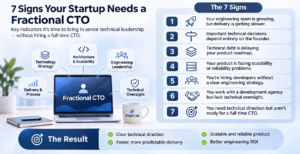
7 Signs Your Startup Needs a Fractional CTO
1. Your Engineering Team Is Growing, but Delivery Is Getting Slower
Your startup began with two developers who could release features quickly.
Now you have six engineers, but development seems slower.
Features require more coordination. Technical decisions take longer. Developers spend increasing amounts of time reviewing, fixing, or rewriting existing work.
The natural response might be to hire another developer.
However, adding more engineers doesn’t automatically solve delivery bottlenecks.
The underlying issue could be unclear technical ownership, inconsistent development practices, or an architecture that makes parallel work difficult.
How a fractional CTO helps:
A fractional CTO can assess the development workflow, identify bottlenecks, establish engineering standards, and clarify responsibilities.
They can also help introduce more effective planning, code review, and delivery practices.
The goal isn’t simply to make developers work faster. It’s to create an engineering environment where the team can deliver predictably.
2. Important Technical Decisions Depend Entirely on the Founder
Many SaaS founders manage technology decisions during the early stages of their business.
This can work when the product is relatively simple.
But as the company grows, decisions become more complicated.
Should you migrate to a different cloud infrastructure?
Does your application need microservices?
Is it time to modernize the database?
Should your team build an AI feature internally or integrate an existing solution?
Without experienced technical leadership, founders may rely entirely on developers, vendors, or incomplete information.
That creates uncertainty around decisions with long-term consequences.
How a fractional CTO helps:
A fractional CTO provides an independent technical perspective.
They evaluate available options, explain trade-offs, and help founders understand the business implications of engineering decisions.
This is particularly valuable for non-technical founders who need confidence that technology investments support their business goals.
3. Technical Debt Is Delaying Your Product Roadmap
Your MVP was built to validate a business idea.
It wasn’t necessarily designed to support every requirement your company would encounter after gaining traction.
As the product evolves, temporary solutions can become difficult to maintain.
Developers may struggle with tightly connected components, missing tests, outdated dependencies, or poorly documented systems.
Eventually, simple features require unexpected effort.
Technical debt begins affecting release schedules and customer experience.
How a fractional CTO helps:
A fractional CTO can help evaluate technical debt and prioritize improvements based on business impact.
Rather than recommending a complete rebuild, they may identify specific components that need refactoring, better testing, or architectural changes.
They can also help balance modernization work with the delivery of new features.
This allows the startup to improve its technical foundation without unnecessarily interrupting product development.
4. Your SaaS Product Is Facing Scalability or Reliability Problems
A system that performs well for your first few hundred customers may encounter challenges as usage increases.
You might notice slower application performance, recurring production incidents, rising cloud costs, or deployment failures.
These issues become especially important when enterprise customers begin depending on your platform.
At this stage, technical problems can affect revenue, customer retention, and sales opportunities.
However, founders may not know whether the solution requires infrastructure upgrades, database optimization, architectural changes, or better operational processes.
How a fractional CTO helps:
A fractional CTO can review the existing architecture and help identify the most significant performance and reliability risks.
They can guide infrastructure planning, monitoring, DevOps improvements, and scalability decisions.
Importantly, they can help distinguish between problems that require immediate attention and improvements that can wait.
The objective is to build a reliable system that supports realistic growth requirements without unnecessary engineering complexity.
5. You’re Hiring Developers Without a Clear Engineering Strategy
Hiring engineers becomes more challenging as a startup grows.
You need to determine which skills are missing, which roles should be prioritized, and whether candidates have the experience required for your product.
Without technical leadership, hiring decisions may focus heavily on programming languages or years of experience.
But building a successful engineering team requires more than technical skills.
It also requires clear ownership, collaboration, architectural understanding, and alignment with the product roadmap.
How a fractional CTO helps:
A fractional CTO can assess existing capabilities and identify genuine skill gaps.
They may help define engineering roles, evaluate candidates, establish onboarding practices, and create a more effective team structure.
They can also help founders decide when to hire internally and when external engineering support makes more sense.
This reduces the risk of expanding headcount without addressing the company’s actual technical needs.
6. You’re Working With a Development Agency but Lack Technical Oversight
Outsourcing software development can help startups access specialized engineering expertise.
However, founders still need to evaluate whether the work meets their business and technical requirements.
A development agency may deliver features on schedule while important questions remain unanswered.
Is the architecture maintainable?
Are security requirements being addressed?
Is the code properly documented?
Can another engineering team take over the product later?
Without independent technical oversight, founders may struggle to evaluate delivery quality.
How a fractional CTO helps:
A fractional CTO can support vendor selection, review technical proposals, evaluate architecture decisions, and establish delivery expectations.
They can also help assess code quality, documentation, and project risks.
This provides founders with a clearer understanding of what they’re purchasing and whether the implementation supports long-term product ownership.
7. Your Startup Needs Technical Direction but Isn’t Ready for a Full-Time CTO
A full-time CTO can be an important leadership investment.
However, not every startup needs an executive-level technology leader working full-time.
You may already have capable developers who can manage day-to-day implementation.
What you lack is someone to guide major technical decisions, review architecture, and help establish engineering priorities.
Hiring a full-time CTO before the role requires full-time attention can create unnecessary financial pressure.
How a fractional CTO helps:
A fractional CTO offers a more flexible engagement model.
The company can access senior leadership for specific responsibilities, such as technology strategy, engineering assessments, architecture reviews, or ongoing technical oversight.
As the startup grows, the engagement can evolve.
Eventually, the company may decide to hire a permanent CTO or promote an internal engineering leader.
Fractional CTO vs. Full-Time CTO: What’s the Difference?
Both roles provide technical leadership, but their engagement models and responsibilities differ.
| Factor | Fractional CTO | Full-Time CTO |
|---|---|---|
| Engagement | Part-time or contractual | Permanent executive |
| Availability | Agreed hours or scope | Full-time leadership |
| Cost structure | Retainer, hourly, or project-based | Salary, benefits, potentially equity |
| Best suited for | Startups needing focused senior guidance | Companies requiring continuous executive ownership |
| Typical responsibilities | Strategy, architecture, oversight, mentoring | Strategy, team leadership, execution, organizational accountability |
| Flexibility | Scope can change with business needs | Long-term organizational commitment |
A fractional CTO is often appropriate when the startup has an engineering team capable of handling daily development but needs experienced strategic oversight.
A full-time CTO becomes more appropriate when technology leadership requires continuous involvement in hiring, management, product strategy, operations, and executive decisions.
Neither option is universally better.
The right choice depends on how much technical leadership the company needs and how frequently that leadership must be available.
How Much Does a Fractional CTO Cost?
Fractional CTO pricing varies depending on the leader’s experience, location, responsibilities, engagement duration, and required availability.
Common pricing structures include:
Hourly consulting: Suitable for focused technical reviews, architecture discussions, or specific decisions.
Monthly retainer: Appropriate when the startup needs recurring technical leadership, engineering oversight, or strategic planning.
Project-based engagement: Useful for defined work such as an architecture assessment, technology roadmap, or vendor evaluation.
When evaluating cost, founders should consider more than the monthly fee.
Ask what responsibilities are included, how many hours are available, whether hands-on implementation is covered, and how outcomes will be measured.
A lower-cost engagement may not provide enough involvement to address complex engineering challenges.
Conversely, a startup with limited technical needs may not require an extensive monthly commitment.
The best approach is to define the required outcomes before comparing proposals.
How to Decide Whether Your Startup Needs a Fractional CTO
Before hiring, evaluate your company’s current situation.
Ask yourself five questions:
- Do we have clear ownership of important technical decisions?
- Are engineering bottlenecks affecting our roadmap or customer experience?
- Does our team have the experience required for upcoming scaling challenges?
- Can we independently evaluate the quality of external engineering work?
- Do we need ongoing executive leadership or focused technical guidance?
If several answers reveal significant gaps, a fractional CTO may be worth considering.
However, not every technical problem requires a CTO.
A clearly defined development task may be better handled by a senior engineer or specialist consultant.
A fractional CTO is most valuable when the problem involves multiple technical decisions, organizational trade-offs, or ongoing leadership responsibilities.
What Should You Expect From a Fractional CTO Engagement?
A productive engagement should begin with understanding the business, product, engineering team, and existing challenges.
Typical early activities may include reviewing architecture, examining delivery processes, discussing the product roadmap, and identifying technical risks.
From there, the fractional CTO should help establish priorities and define measurable outcomes.
These might include clearer technical ownership, fewer recurring production issues, improved deployment reliability, or a prioritized modernization roadmap.
Founders should also clarify decision-making authority, communication expectations, documentation, and knowledge transfer.
The objective is to strengthen the company’s technical capabilities, not create permanent dependence on an external advisor.
How Enlight Lab Supports Startups With Fractional CTO Services
At Enlight Lab, we help growing SaaS and AI startups make informed technical decisions through senior-led engineering and technical leadership.
Our Fractional CTO and engineering capabilities support founders navigating architecture decisions, delivery challenges, technical debt, modernization, and scaling.
We focus on understanding the product’s current stage, identifying meaningful engineering risks, and aligning technical priorities with business objectives.
Whether your startup needs architectural guidance, technical oversight, or a clearer engineering roadmap, the starting point is understanding which decisions matter most.
Final Thoughts
Technical leadership becomes increasingly important as a startup grows.
More customers introduce reliability requirements. Larger engineering teams need clearer coordination. New product opportunities create architecture and infrastructure decisions with long-term consequences.
But hiring a full-time CTO isn’t always the immediate answer.
A fractional CTO can provide experienced guidance during the stage when your startup needs stronger technical direction but isn’t ready for a permanent executive hire.
The right time to hire a fractional CTO is when the cost of unclear technical decisions begins to outweigh the cost of experienced leadership.
Need Senior Technical Leadership Without Hiring a Full-Time CTO?
Enlight Lab helps growing SaaS and AI startups navigate engineering challenges, evaluate architecture decisions, and establish clearer technical direction.
Book a 30-minute technical discussion
Explore Enlight Lab: https://enlightlab.com