
Your SaaS product is growing. Customers are signing up, revenue is increasing, and your team is expanding to meet demand.
Everything seems to be moving in the right direction.
But your engineering team is experiencing something unexpected.
Features that once took a week now take three. Developers spend more time fixing bugs than building new functionality. Deployments become stressful, and even small product changes require lengthy discussions.
You hire more developers, expecting delivery to improve.
Yet development continues to slow down.
This is a common challenge for growing SaaS companies. As products become more complex, the engineering practices that worked during the MVP stage may no longer support the business effectively.
SaaS development typically slows when technical complexity, operational overhead, and coordination demands grow faster than the team’s ability to manage them. Common causes include technical debt, architecture limitations, manual deployments, changing priorities, and unclear technical leadership.
Understanding these bottlenecks is essential before investing in more engineering resources.
Let’s explore seven reasons SaaS development slows as startups grow and what founders can do to address them.
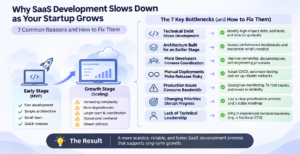
1. Technical Debt Starts Affecting Development Speed
During the early stages of a startup, speed is essential.
Founders want to validate ideas, launch features, and attract customers without spending months perfecting the underlying technology.
Developers often make practical compromises to meet these goals.
They may postpone automated testing, use temporary integrations, or build features around immediate requirements rather than long-term flexibility.
These decisions aren’t necessarily wrong.
However, problems arise when temporary solutions remain unchanged as the product grows.
Over time, developers may encounter poorly documented code, tightly connected components, outdated dependencies, and recurring bugs.
A small feature update can unexpectedly affect several other parts of the application.
As a result, engineers spend more time understanding existing code and less time delivering new functionality.
How to fix it
Start by identifying technical debt that directly affects development speed, reliability, or customer experience.
Not every piece of imperfect code needs to be rewritten.
Prioritize components responsible for recurring incidents, delayed releases, or excessive maintenance work.
Introduce automated tests where they reduce risk, improve documentation, and allocate engineering capacity to addressing high-impact issues.
Technical debt becomes dangerous when maintaining yesterday’s decisions prevents your team from building tomorrow’s product.
2. Your SaaS Architecture Was Built for an Earlier Stage
The architecture that helped launch your MVP may not be suitable for your next phase of growth.
Initially, your application might have served a few hundred users with relatively simple workflows.
As customers increase, the system must handle more requests, larger datasets, additional integrations, and complex business operations.
This can expose architectural limitations that weren’t visible during the early stages.
Common warning signs include:
- Application performance deteriorating during peak usage
- Database queries taking longer to execute
- Background processes affecting user-facing functionality
- New features requiring changes across multiple components
- Increasing infrastructure costs without corresponding improvements
Founders sometimes assume these issues mean the entire application needs to be rebuilt.
That isn’t always the case.
How to fix it
Begin with a technical assessment based on actual system performance.
Identify where bottlenecks occur and determine whether they result from database design, inefficient queries, infrastructure configuration, or application architecture.
For example, optimizing database queries or implementing appropriate caching may solve performance problems without introducing unnecessary complexity.
Avoid adopting microservices, new frameworks, or infrastructure technologies simply because larger companies use them.
The right architecture depends on your product’s requirements, growth patterns, and engineering capabilities.
Good SaaS architecture should support business growth without creating unnecessary engineering overhead.
3. More Developers Create More Coordination Requirements
When product delivery slows, hiring additional engineers often seems like the logical solution.
More people should mean more development capacity.
However, engineering productivity doesn’t always increase proportionally with team size.
As teams expand, communication becomes more complicated.
Developers must coordinate changes, review each other’s work, understand shared components, and agree on technical decisions.
Without clear responsibilities, teams may experience conflicting implementation approaches, duplicated work, and delays caused by dependencies.
A feature that one developer previously handled independently may now require coordination across several people.
This doesn’t mean hiring is a mistake.
It means additional headcount works best when the engineering organization is prepared to support it.
How to fix it
Before expanding your team, examine how work moves through development.
Ask whether developers have clear ownership of components, whether requirements are understood, and whether important decisions are made promptly.
Identify tasks that repeatedly wait for approvals, reviews, or clarification.
Improve documentation, establish engineering standards, and assign responsibility for architectural decisions.
For growing teams, experienced technical leadership can help create consistency across development activities.
Hiring more developers adds capacity. Clear engineering processes determine how effectively that capacity is used.
4. Manual Deployments Make Every Release More Difficult
Building a feature is only part of software development.
The feature must also be tested, deployed, monitored, and maintained.
In some growing SaaS companies, releasing software remains a heavily manual process.
Developers may need to configure environments, execute tests, coordinate deployment windows, and monitor applications after every update.
When deployments are unpredictable, teams become cautious about releasing changes.
Instead of shipping smaller improvements regularly, they may combine multiple updates into larger releases.
This increases complexity and makes failures harder to investigate.
Over time, the release process itself becomes a major engineering bottleneck.
How to fix it
Evaluate your existing DevOps and deployment practices.
Look for opportunities to introduce or improve continuous integration and continuous delivery (CI/CD), automated testing, environment consistency, and deployment monitoring.
Establish clear rollback procedures so teams can recover when releases introduce problems.
Start by automating repetitive steps that consume engineering time or frequently cause errors.
A reliable deployment process allows developers to focus more on building improvements and less on managing release risks.
Engineering speed matters only when teams can deliver working software to customers consistently.
5. Production Issues Consume Your Engineering Capacity
As a SaaS business grows, more customers depend on the product for their daily operations.
Even minor reliability problems can become significant when they affect a large number of users.
Developers may begin spending increasing amounts of time investigating errors, fixing recurring bugs, responding to incidents, and handling urgent support requests.
These interruptions reduce the time available for planned development.
Eventually, teams enter a cycle where production problems delay improvements, and delayed improvements allow existing problems to continue.
Founders may interpret this as poor developer productivity when the underlying issue is operational instability.
How to fix it
Measure how much engineering time goes toward planned work compared with unplanned incidents and maintenance.
Identify recurring failures and investigate their root causes rather than repeatedly applying temporary fixes.
Improve application monitoring, logging, alerting, and automated testing where appropriate.
Track practical reliability indicators such as incident frequency, recovery time, and repeated defect categories.
Create space in the roadmap for reliability improvements instead of treating every production issue as an isolated emergency.
The objective is to reduce unnecessary interruptions so engineers can focus on delivering customer value.
6. Changing Priorities Disrupt Engineering Progress
Not every development challenge originates in the codebase.
Sometimes the biggest bottleneck is how product decisions are made.
As startups grow, founders receive requests from customers, sales teams, investors, and internal stakeholders.
Each request may appear important.
Without a clear prioritization process, engineers can find themselves switching constantly between new features, bug fixes, integrations, and urgent customer requirements.
Frequent changes create unfinished work and additional context switching.
Developers may spend substantial time understanding new priorities instead of completing existing tasks.
This can make delivery unpredictable even when the engineering team is technically capable.
How to fix it
Establish a consistent process for evaluating product requests.
Before committing development resources, ask:
- What customer or business problem does this solve?
- What is the expected impact?
- How urgent is the requirement?
- What technical effort and risks are involved?
- Which existing priorities will be affected?
Involve engineering leadership in roadmap discussions so technical dependencies and delivery risks are understood.
A stable roadmap doesn’t mean refusing to adapt.
It means making deliberate trade-offs instead of treating every request as an emergency.
Engineering teams move faster when priorities are clear and decisions remain consistent long enough for work to be completed.
7. Your Startup Lacks Clear Technical Leadership
During the MVP stage, founders often manage product direction while developers focus on implementation.
This arrangement can work effectively when the product and engineering team are small.
However, growth introduces decisions that require broader technical judgment.
Should the company modernize its architecture or continue improving the existing system?
Is the infrastructure ready for enterprise customers?
Which technical debt should be addressed first?
Should the startup hire additional developers or improve its current processes?
How should AI capabilities be introduced without compromising reliability?
Without experienced technical leadership, these decisions may be delayed or handled independently by different developers.
The result can be inconsistent engineering practices and a lack of long-term technical direction.
How to fix it
Establish clear ownership of architecture, engineering standards, technical planning, and delivery risks.
Depending on the company’s needs, this responsibility may sit with an experienced engineering lead, a full-time CTO, or a fractional CTO.
A fractional CTO can be particularly useful for startups that need senior technical guidance but aren’t ready to hire a permanent executive.
The objective is not to add another management layer.
It’s to ensure engineering decisions support the company’s product strategy and business goals.
How to Identify the Real Bottleneck in Your SaaS Development Process
Before making major changes, founders should conduct a focused engineering assessment.
Start by examining five areas.
Development workflow: Where does time go between defining a requirement and releasing it?
Technical debt: Which components repeatedly cause bugs, rework, or development delays?
Architecture: Are performance and scalability problems supported by measurable evidence?
Operational reliability: How frequently do incidents and deployment issues interrupt planned work?
Technical ownership: Who is responsible for major architectural and engineering decisions?
The answers can help distinguish between problems that require process improvements, targeted modernization, additional engineering capacity, or stronger technical leadership.
This assessment should guide investment decisions rather than assumptions about what a growing startup needs.
When Should SaaS Startups Consider External Engineering Support?
Not every growing startup needs to build a large internal engineering organization immediately.
External expertise can help when a company faces challenges that its existing team doesn’t have the capacity or experience to address.
Examples include architecture modernization, DevOps improvements, technical debt reduction, production AI implementation, and technical strategy.
However, external support should strengthen the existing engineering team rather than create unnecessary dependencies.
A good engagement begins by understanding the problem, evaluating available options, and defining measurable outcomes.
For some companies, a focused technical assessment may be enough.
Others may benefit from ongoing engineering support or fractional CTO leadership.
How Enlight Lab Helps Growing SaaS Companies
At Enlight Lab, we help SaaS and AI startups build, scale, and modernize software through senior-led engineering and technical leadership.
Our capabilities include:
Custom Software Engineering: Building and improving SaaS platforms, web applications, mobile applications, and custom software products.
Software Modernization: Addressing technical debt, architecture limitations, cloud infrastructure, DevOps, and reliability challenges.
AI Engineering: Developing practical AI agents, automation workflows, and AI-enabled product capabilities.
Fractional CTO Services: Helping founders evaluate technical decisions, establish engineering direction, and align development with business priorities.
Our approach focuses on understanding the underlying challenge before recommending additional resources or architectural changes.
Final Thoughts
Growing a SaaS business naturally introduces engineering complexity.
More customers create infrastructure demands. More features increase dependencies. Larger teams require stronger coordination and clearer technical ownership.
These challenges don’t automatically mean your developers are underperforming or your product needs a complete rebuild.
Often, meaningful improvements come from addressing technical debt, strengthening delivery processes, clarifying priorities, and introducing experienced technical leadership.
The goal isn’t simply to build software faster. It’s to create an engineering foundation that can continue delivering as your business grows.
Is Your SaaS Growing Faster Than Your Engineering Team Can Keep Up?
If your startup is experiencing delivery bottlenecks, scaling challenges, technical debt, or unclear engineering direction, Enlight Lab can help you evaluate your options.
Book a 30-minute technical discussion
Explore Enlight Lab: https://enlightlab.com