You’ve spent months planning. The team is ready. Stakeholders are aligned. And then on launch day, something breaks. Data vanishes. Systems go dark. Customers can’t log in. Sound familiar? You’re not alone. Here’s what’s really going wrong in 2026, and how to stop it before it costs you everything.
Not cyberattacks. Not bad products. Not even poor hiring. A poorly executed data migration can wipe out months of revenue, shatter customer trust, and leave your entire team firefighting instead of building.
And yet, in 2026, more companies than ever are attempting migrations. They are moving from legacy systems to the cloud, switching ERPs, merging acquired company data, and rebuilding their infrastructure to become AI-ready. The stakes have never been higher.
The global data migration market is on a near-vertical growth curve, projected to explode from $10.55 billion in 2025 to $30.70 billion by 2034. That’s not a trend, that’s a mandate. Organizations across every industry are being forced to modernize, and the migrations are happening whether teams are ready or not.
The problem? 83% of data migration projects fail, blow past their budgets, or cause significant business disruption. That means if you walk into a migration without a clear plan, the odds are stacked against you before you even begin.
If you’ve been promised a “quick” migration or are modernizing aging systems, this guide is for you. We’ll cover what actually happens and how to avoid costly mistakes.
If you’ve been promised a “quick” migration or are modernizing aging systems, this guide is for you. We’ll cover what actually happens and how to avoid costly mistakes. We’re going to break down every major data migration challenge you’ll face in 2026 and give you the practical fixes that actually work.
Why Migrations Are More Complex in 2026 Than Ever Before
Five years ago, a migration meant moving a database from one server to another. Clean, contained, and manageable. Today? It’s a completely different beast.
Modern businesses operate across multi-cloud environments, hybrid on-premise setups, real-time data pipelines, and AI-integrated platforms all simultaneously. Moving data isn’t just a technical exercise anymore. It’s a business continuity operation that touches finance, compliance, security, and operations all at once.
There’s also a hard deadline looming for thousands of companies: SAP is decommissioning SAP ECC by 2027, forcing enterprises to migrate to SAP S/4HANA whether they feel ready or not.
Add the relentless pressure to become “AI-ready” which requires clean, structured, governed data and you have a perfect storm of complexity.
The feasible reasons behind data migration are more challenging:
- You are not moving data from one place to another.
- You have higher expectations for data
- Poorly migrated data
- Operate data across multiple platforms like SaaS, cloud, on-premises systems, and edge environments.
Migration is no longer a one-time project. The companies winning in 2026 treat it as an ongoing, cross-functional capability. The ones struggling? They’re still treating it like an IT side project.
“Migration isn’t just IT moving data anymore. It’s about Finance needing predictable costs, Security requiring compliance built in from day one, and every business unit demanding zero downtime.”
The 8 Biggest Data Migration Challenges and Their Real Fixes
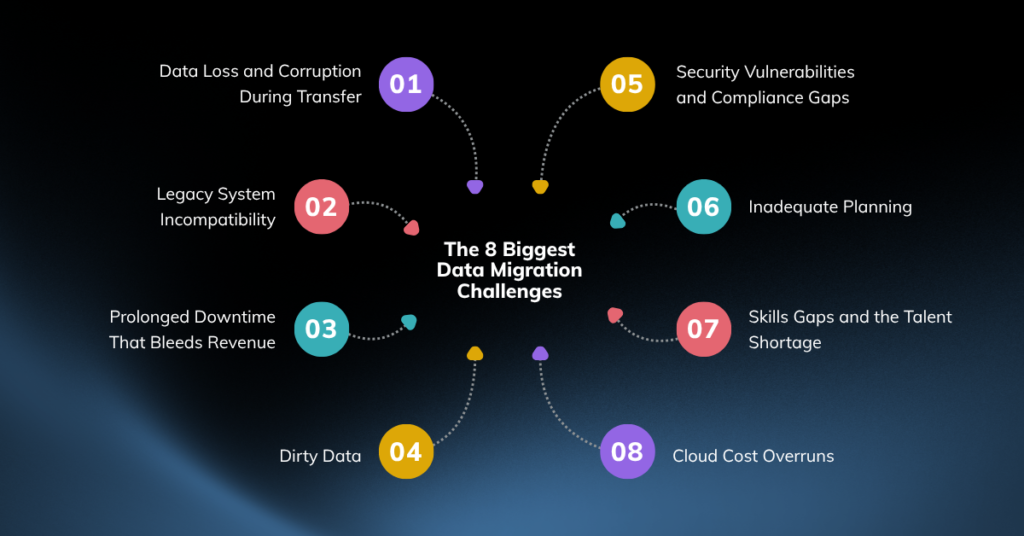
Let’s get into the specifics. Each challenge below includes what it is, why it’s happening, the real-world cost if you ignore it, and a concrete fix you can start implementing today.
1. Data Loss and Corruption During Transfer
Data loss rarely announces itself. Sometimes it’s just a handful of missing records or a field value that’s quietly incorrect. By the time you notice, the damage is done: corrupted customer records, distorted analytics, broken downstream processes.
It often happens during the Extract, Transform, Load (ETL) process, when data moves between systems, is reformatted, and lands in a new environment. Network interruptions, format incompatibilities, and transformation errors are the usual culprits. And the scale of modern data makes it exponentially harder to catch in real time.
23% of organizations experience data loss during migration, exposing them to lost records, compliance violations, and operational chaos. Even a 2% loss in a CRM migration can distort customer segmentation models and invalidate entire quarters of sales forecasting.
The Proven Solution
- Implement checksum validation and hash comparisons at every ETL stage – not just at the end
- Run trial migrations with smaller representative datasets first to surface problems early
- Set up automated reconciliation reports that compare row counts, field values, and record states between source and target
- Maintain a comprehensive, tested rollback plan – not one that exists only on paper
- Never start a full migration without a verified backup that’s been restored at least once in a test environment
2. Legacy System Incompatibility
Legacy systems are the skeletons in every enterprise’s closet. They’ve been running for decades, often maintained by people who’ve long since left the company, with documentation that hasn’t been updated since 2009.
Outdated systems often come with poor documentation, obsolete data schemas, inconsistent data quality, and limited API support. As a result, engineering teams must build custom extraction methods that introduce new failure points.
The Proven Solution
- Conduct a pre-migration legacy audit to fully document data schemas, dependencies, and data owners
- Use schema-mapping tools to automatically identify mismatches between source and target systems
- Build ETL middleware layers that handle translation between legacy and modern formats
- Prioritize a “strangler fig” approach, migrate components incrementally rather than all at once
- Identify which legacy data is actually needed vs. what should be archived before you move anything
3. Prolonged Downtime That Bleeds Revenue
The Clock Is Always Ticking
Here’s a scenario that plays out in boardrooms every week: the migration is scheduled for a “quiet Sunday night.” Two hours, max. By Monday morning, the team is still scrambling as network slowdowns hit, transformation jobs fail, and rollback procedures activate. The two-hour window has stretched to 14 hours. It’s now business hours. Customers are locked out. Revenue is hemorrhaging.
Migration-related downtime costs businesses an average of $5,600 per minute. Complex migrations can cause 24–72 hours of disruption. That’s a potential bill of over $8 million for a single weekend migration gone wrong.
The Proven Solution
- Use phased cutover strategies by migrating in stages rather than a single “big bang” switch
- Implement blue-green deployment: run old and new systems in parallel until you’re confident
- Schedule during true low-traffic windows based on actual analytics, not assumptions
- Build automated rollback triggers that activate the moment KPIs fall outside acceptable thresholds
- Engage professional migration services. They can reduce downtime by 60–80% compared to in-house-only execution
4. Dirty Data
Migrating Garbage Gets You Garbage
This is the migration challenge that nobody wants to talk about, because it means confronting uncomfortable truths about the state of your existing data. Duplicates. Inconsistent date formats. Null values in critical fields. Customer records with five different spellings of the same company name.
The dangerous assumption? “We’ll clean it up after we migrate.” That’s not how it works. Dirty data doesn’t become cleaner during migration; it only gets amplified. Every downstream process, every report, every AI model you feed this data to will inherit and multiply those errors.
Poor data quality costs the average enterprise $12.9 million per year, according to Gartner. And that figure is almost always worse after a migration if cleansing is skipped.
The Proven Solution
- Make data profiling and cleansing a mandatory Phase 0 before a single record is migrated
- Establish data quality rules and validation logic that run automatically during ingestion
- Deduplicate, standardize, and enrich records at the source, not the destination
- Assign data owners who are accountable for the quality of their domain’s records
- Archive cold, low-value historical data rather than migrating data that will never be used
5. Security Vulnerabilities and Compliance Gaps
Data in Transit Is Data at Risk
The moment your data starts moving between systems, it enters a vulnerability window. Sensitive customer records, financial data, and health information are all exposed during transit in ways that data stored in a secured database is not.
And in 2026, the regulatory landscape will never be more complex. GDPR, HIPAA, CCPA, and a growing patchwork of regional data sovereignty laws mean that a compliance failure during migration isn’t just a technical problem. It’s a legal and reputational catastrophe.
31% of enterprise migrations expose sensitive data during transit. The average cost of a migration-related data breach is $4.45 million per incident, plus regulatory fines on top.
The Proven Solution
- Implement end-to-end encryption for all data in transit and at rest throughout the migration
- Build a complete data lineage map before migration begins to know exactly where every sensitive record lives
- Apply role-based access controls (RBAC) so only authorized team members can touch sensitive data
- Run jurisdiction-specific compliance checks for every region your data touches
- Conduct a security review at go/no-go stage not as an afterthought at go-live
6. Inadequate Planning
Winging It Is Not a Strategy
If you ask post-mortem reports what went wrong in failed migrations, this shows up in almost every one: the team started moving data before they fully understood what they were moving, where it was going, or what success looked like.
Skipping proper scope definition, timeline planning, architecture design, and stakeholder alignment doesn’t save time. It creates a project that has no guardrails and no clear way to know when it’s done.
Over 80% of data migration projects exceed their original budget or timeline due to unforeseen complexities that proper discovery would have surfaced weeks earlier.
The Proven Solution
- Run pre-migration discovery workshops involving stakeholders, including IT, finance, compliance, and operations
- Define measurable success KPIs upfront: data completeness percentage, acceptable downtime, and rollback triggers
- Create a documented runbook that every team member can follow independently
- Get stakeholder sign-off on scope and timeline before any technical work begins
- Build contingency buffers of 20-30% into every timeline estimate
7. Skills Gaps and the Talent Shortage
You Can’t Migrate What You Don’t Understand
Data migration requires a rare blend: deep knowledge of source systems, expertise in target architectures, data engineering skills, and enough security awareness not to create new vulnerabilities in the process. Finding all of that in one team, especially at a startup or mid-market company, is nearly impossible.
By 2026, more than 90% of organizations worldwide are experiencing an IT skills gap. The engineers who know your legacy systems are often the same ones who are most in demand elsewhere.
The Proven Solution
- Invest in upskilling your internal team 6–12 months before the migration begins not during it
- Partner with specialized migration consultants who have done this exact type of migration before
- Leverage AI-assisted migration tooling to reduce manual effort and compensate for skill gaps
- Document institutional knowledge from long-tenured employees before they leave or before migration begins
- Consider a hybrid model: core internal team for domain knowledge + external specialists for execution
8. Cloud Cost Overruns
The Cloud Isn’t Cheap If You’re Not Careful
One of the most common misconceptions about cloud migration is that moving to the cloud automatically saves money. It can, but only if you’re thoughtful about what you migrate, how much storage you actually need, and how you architect workloads post-migration.
Organizations that migrate everything without first cleaning, archiving, or right-sizing their data often discover that their cloud bill is significantly higher than expected. Finance teams are now scrutinizing every migration decision and rightly so.
In 2026, 38% of enterprises waste over 30% of their cloud spending related to migration, paying to store and transfer data they never needed to move in the first place.
The Proven Solution
- Build a cloud cost model before migration, not after, using your actual data volumes and access patterns
- Right-size workloads: don’t provision for peak usage if your average usage is a fraction of that
- Archive cold data (not accessed in 2+ years) to low-cost storage before transfer, not after
- Audit data that can be deleted entirely, migrating junk is paying twice for the same mistake
- Set up cloud cost monitoring from day one of the new environment, with budget alerts
The 5-Phase Migration Framework That Changes the Outcome
Most migrations fail because they skip phases. This framework is built around the data migration challenges and solutions that actually prevent the disasters described above.
Discover & Data Audit
Catalog every data source, document schemas, map dependencies, identify sensitive data, and surface legacy complexity before touching anything.
Plan & Scope
Define success metrics, build your runbook, set rollback triggers, confirm stakeholder alignment, and build in contingency buffers.
Data Cleanse & Prepare
Profile, deduplicate, standardize, and validate your data at the source. Archive cold data. Establish quality rules before migration begins.
Migrate in Phases
Execute in stages, starting with lower-risk data. Validate at each checkpoint. Use parallel-run environments to ensure continuity.
Validate & Monitor
Run post-migration reconciliation reports, monitor system performance, validate business processes, and maintain rollback capability for 30+ days.
Best Practices to Avoid Data Migration Failures
- Treat migration as a strategic initiative, not a technical task
- Automate validation and testing wherever possible
- Engage business stakeholders early
- Use incremental migration instead of big-bang approach
- Always plan for rollback
Emerging Trends in Data Migration (2026 and Beyond)
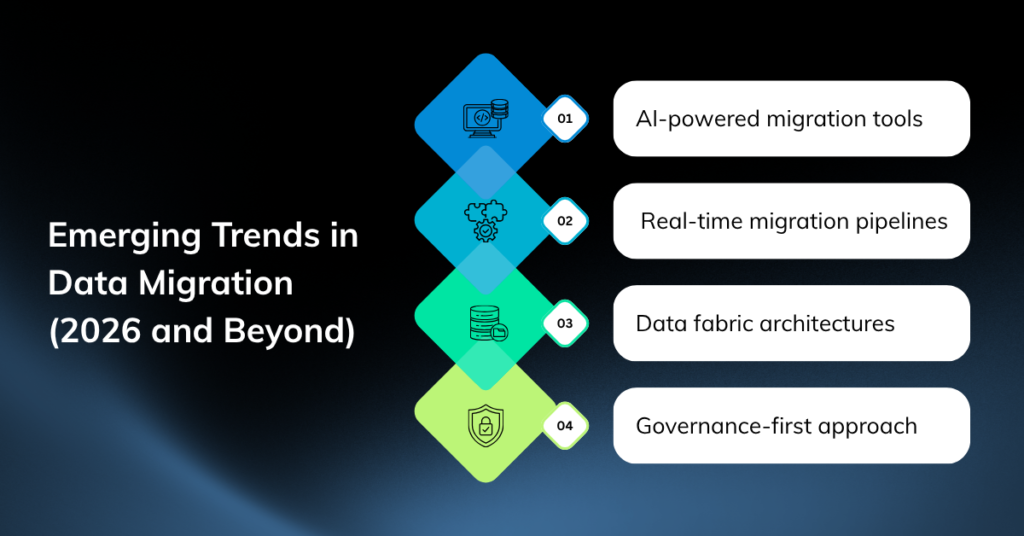
AI-Powered Migration Tools
AI-powered migration tools are changing how organizations approach complex data transfers. Instead of relying heavily on manual effort, these tools automatically analyse data structures, detect inconsistencies, and generate mappings between source and target systems. They also help with validation and error detection in real time, reducing human mistakes and accelerating the overall migration process.
This shift is especially valuable for businesses dealing with large, messy datasets where manual intervention can slow everything down and introduce risk.
Real-Time Migration Pipelines
Real-time migration pipelines are helping organisations move away from traditional batch-based migrations that often cause downtime. Instead of transferring data in large chunks at once, these pipelines continuously sync data between systems as changes happen. This allows businesses to keep operations running smoothly while migration is in progress.
Data Fabric Architectures
Data fabric architectures are becoming essential as organisations manage data across multiple platforms and cloud environments. Instead of centralising all data in one location, a data fabric creates a unified layer that connects and integrates data across systems. This makes it easier to access, govern, and use data regardless of where it resides. As a result, migration becomes less about physically moving everything and more about enabling seamless data access across environments, which aligns with modern enterprise strategies.
Governance-First Approach
In 2026, organisations are prioritising governance from the very beginning of the migration process. Rather than treating compliance and data policies as an afterthought, businesses are embedding governance frameworks into every stage of migration. This ensures that data security, privacy regulations, and audit requirements are met consistently. For decision-makers, this approach reduces risk significantly and builds confidence that migrated data will remain accurate, secure, and compliant as systems evolve.
Turn Data Migration Challenges into a Competitive Advantage
Data migration challenges are real. They are complex, expensive, and risky. But here is the truth most companies miss.
They are also predictable and avoidable. If you approach migration with the right strategy, tools, and mindset, it can become a turning point for your business. Not a disruption. A transformation.
At Enlight Lab, we have seen this first-hand. Companies that treat migration as a strategic move unlock faster insights, cleaner data, and stronger decision-making.
If you are planning a migration and want to avoid costly mistakes, it is worth taking a step back and getting the strategy right before execution begins. Because in 2026, data is not just an asset. It is your competitive advantage.
Stop treating data migration as an IT Project. All you need is to plan more, rush less, and validate everything. Start making conversation with a single call and be in the 17% that succeed on time and on budget.