Artificial intelligence has never been easier to demonstrate.
Connect a large language model to a clean dataset, add a polished interface, and you can create something impressive in a few weeks. It may summarize documents, answer questions, generate reports, recommend actions, or automate part of a workflow.
Then real users arrive.
The data is incomplete. The output is inconsistent. Employees do not trust it. Integrations fail. Response times increase. Token costs climb. Security raises concerns. The team discovers that the impressive prototype cannot be safely connected to the systems where the actual work happens.
The AI did not suddenly stop working. The MVP was simply designed for a demonstration-not for reality.
This is why strong AI MVP development is not primarily about choosing the most powerful model. It is about proving that an AI-enabled workflow can create measurable value under real operating conditions.
Why Do AI Startups Fail?
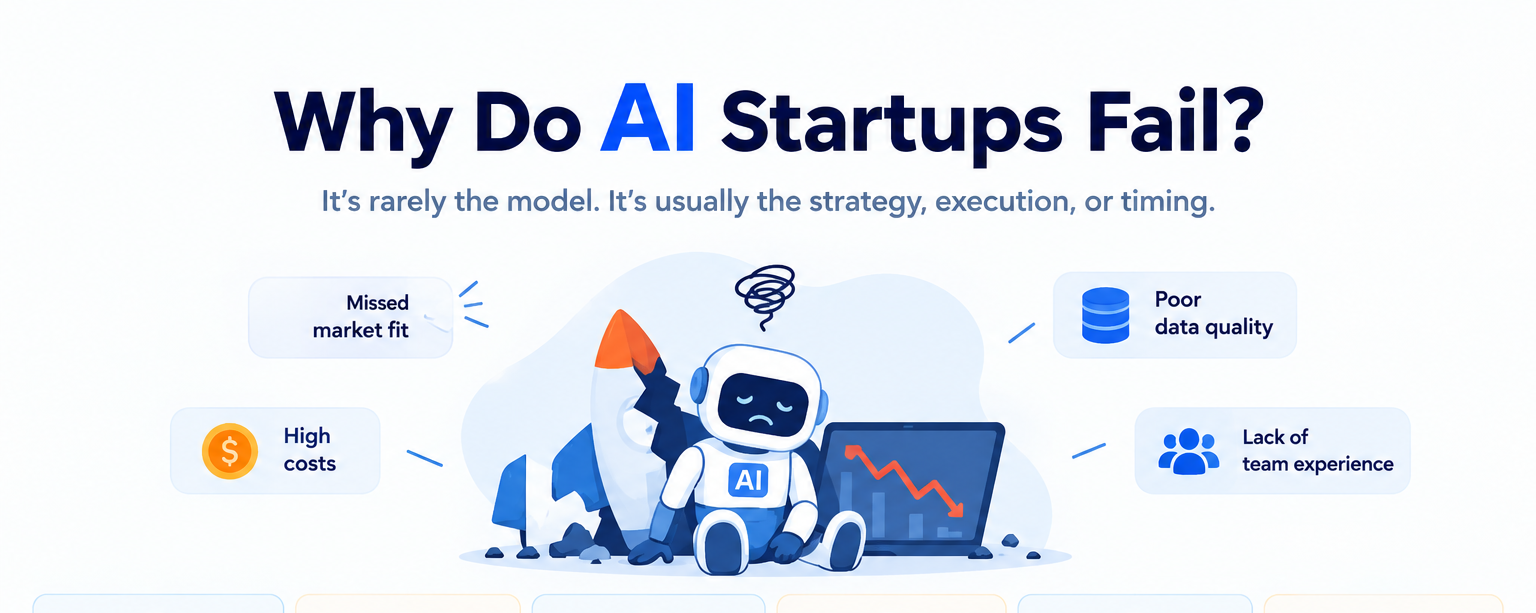
AI startups often fail because they build technically impressive products before validating whether the product solves a specific, valuable, and repeatable customer problem. Other common causes include poor data quality, unclear success metrics, weak workflow integration, unpredictable model behaviour, high operating costs, security risks, and a lack of user trust.
The wider AI market illustrates this gap between adoption and impact.
According to Stanford University’s 2025 AI Index, 78% of surveyed organizations reported using AI in 2024, up from 55% in 2023. However, most organizations reporting financial benefits said those gains remained relatively small. In many business functions, reported cost savings were below 10%, while the most common revenue increase was below 5%. Stanford HAI: 2025 AI Index-Economy
The lesson is simple: adopting AI is not the same as creating business value with AI.
An AI MVP Is Not a Smaller Version of the Final Product
A traditional minimum viable product usually tests whether users want a product and whether its core workflow is useful.
An AI MVP must test more.
It needs to establish:
- Whether the problem is suitable for AI
- Whether the necessary data is available and reliable
- Whether the output is accurate enough for the intended use
- Whether users understand and trust the system
- Whether failures can be detected and managed
- Whether the workflow produces measurable business value
- Whether the solution remains financially sustainable as usage grows
A chatbot that produces convincing answers is not automatically a viable AI product. It becomes viable only when it performs a meaningful task reliably enough, safely enough, and affordably enough to improve a real business outcome.
That distinction is where many AI MVPs begin to fail.
1. The Team Starts With AI Instead of the Business Problem
One of the most common mistakes in AI MVP development is beginning with a capability:
“We want to build an AI agent.”
The better starting point is a business problem:
“Our support team spends 30 hours every week categorizing repetitive tickets, and we want to reduce that time by 50% without increasing routing errors.”
The first statement describes a technology. The second defines a problem, a baseline, a user, a constraint, and a measurable outcome.
When a team starts with the technology, it often adds AI to a process that does not need it. The result may look innovative, but the value remains difficult to explain.
How to fix it
Before selecting a model or designing the interface, document five things:
- The user: Who experiences the problem?
- The task: What are they trying to complete?
- The friction: What currently makes the task slow, costly, or unreliable?
- The baseline: How is the process performing today?
- The target: What measurable improvement would make the MVP worthwhile?
If the expected value cannot be expressed as a measurable change in cost, time, accuracy, risk, conversion, or customer experience, the use case is not ready for development.
2. The MVP Tries to Automate Too Much
An early AI product often becomes overloaded with ambitions.
It needs to answer questions, search company data, generate content, update the CRM, send emails, create reports, and make recommendations-all in the first release.
Every additional capability introduces more data sources, integrations, permissions, failure modes, and evaluation requirements. What appears to be one AI feature quickly becomes a complex distributed system.
How to fix it
Reduce the MVP to one narrow, high-value workflow.
For example, instead of building an autonomous customer-support agent, start with:
- Classifying incoming tickets
- Retrieving relevant knowledge-base articles
- Drafting a response for human review
- Escalating low-confidence cases
This version still creates value, but it limits the cost of an incorrect output. It also gives the team measurable evidence before more autonomy is introduced.
A good AI MVP does not prove everything the product may eventually do. It proves the smallest valuable behaviour that justifies the next investment.
3. The Data Looks Better in Development Than It Does in Reality
An AI prototype is usually developed with a limited, cleaned, or carefully selected dataset.
Production data is different.
It contains duplicates, outdated records, missing fields, conflicting information, poor formatting, access restrictions, scanned documents, inconsistent terminology, and information distributed across multiple systems.
In retrieval-augmented generation applications, even a powerful model will struggle if the retrieval layer returns incomplete or irrelevant context. In predictive systems, biased or unrepresentative data can produce unreliable outcomes.
How to fix it
Conduct a data-readiness assessment before committing to the MVP scope.
Review:
- Where the required data is stored
- Who owns it
- Whether the team is permitted to use it
- How frequently it changes
- Whether it is complete and representative
- Whether sensitive information must be removed or protected
- How the system will retrieve the correct information
- What happens when the required information is unavailable
Test the MVP using difficult, incomplete, ambiguous, and real-world inputs-not only ideal examples.
4. Success Is Defined as “The AI Works”
AI output cannot be evaluated with a single vague question.
A response might be factually correct but too slow. It might be helpful but expose confidential information. It might perform well in most cases but fail on the small percentage of cases that carry the greatest business risk.
Without predefined evaluation criteria, teams end up debating whether an output “looks good.” That is not a dependable launch decision.
How to fix it
Create an evaluation scorecard before development begins.
Depending on the use case, the scorecard may include:
- Task-completion rate
- Factual accuracy
- Retrieval relevance
- Hallucination or unsupported-claim rate
- Response latency
- Cost per completed task
- Human correction rate
- Escalation rate
- User satisfaction
- Security and policy compliance
- Business outcome improvement
The thresholds should reflect the risk of the workflow.
A marketing-draft assistant can tolerate more variation because a person reviews the output. An AI system used for financial, legal, healthcare, or access-control decisions requires much stricter controls.
5. Human Oversight Is Added Too Late
Many AI MVPs are designed around full automation because autonomy makes the demonstration more impressive.
In practice, the safest and fastest path to value is often human-in-the-loop AI.
Human oversight is not simply a temporary limitation. It generates feedback, reveals edge cases, improves trust, and prevents uncertain outputs from becoming business actions.
How to fix it
Define three zones of AI behaviour:
- Act: Low-risk, high-confidence tasks the system may complete automatically
- Review: Tasks that require human approval before execution
- Escalate: Ambiguous, sensitive, or high-risk situations the system should not attempt
Also give users a clear way to correct the AI. Corrections should become structured feedback that the product team can analyze-not disappear into chat histories.
6. The AI Is Not Designed Around the Existing Workflow
Even an accurate AI product can fail if it creates more work for the people expected to use it.
If employees must leave their primary tool, copy information into another application, inspect the answer, correct the formatting, and manually update the original system, the AI may add friction instead of removing it.
This is an adoption problem, but it begins as a product-design problem.
How to fix it
Map the workflow from trigger to outcome:
- What starts the task?
- Where does the required information come from?
- What decision must be made?
- What action follows the decision?
- Which system records the result?
- When does a human need to intervene?
The AI should fit into the point where work already happens-such as a CRM, help desk, internal dashboard, document system, or communication platform.
The goal is not to make users visit an AI tool. The goal is to make an existing workflow faster, safer, or more effective.
7. Security and Governance Are Treated as Post-Launch Tasks
Security concerns frequently appear late in AI MVP development.
Only after the product is nearly ready does the team ask:
- Can the model provider retain our prompts?
- Can one customer retrieve another customer’s data?
- What information is being logged?
- Who can access the AI-generated output?
- Can the system execute actions outside its permitted scope?
- How do we audit a decision?
- What happens if a prompt injection attempt succeeds?
If the architecture cannot answer these questions, the MVP may never receive approval to launch.
How to fix it
Build minimum governance into the first version:
- Role-based access controls
- Data isolation between customers or departments
- Encryption in transit and at rest
- Prompt and output logging with appropriate redaction
- Approved model and data-processing policies
- Tool-level permissions for AI agents
- Audit trails for sensitive actions
- Clear data-retention rules
- Human approval for high-impact actions
- Incident and rollback procedures
Governance should match the risk of the use case, but it should never be absent.
8. The Team Underestimates AI Infrastructure Costs
A prototype with a few internal users may appear inexpensive. Production introduces a different cost profile.
Expenses may include:
- Model inference
- Embedding generation
- Vector database storage
- Search and reranking
- Data processing
- Observability
- Evaluation pipelines
- Third-party APIs
- Human review
- Cloud infrastructure
- Engineering support
Long prompts, repeated model calls, agent loops, and poorly controlled context windows can increase costs quickly.
At the same time, lower model prices do not automatically solve poor unit economics. Stanford’s 2025 AI Index reported that the inference cost of a system performing at approximately GPT-3.5 level fell more than 280-fold between November 2022 and October 2024. Stanford HAI: 2025 AI Index Report
AI has become cheaper to access. It still needs to be economically designed.
How to fix it
Calculate the expected cost per successful outcome-not merely the cost per API call.
A useful formula is:
AI unit economics = Total monthly AI operating cost ÷ Number of successfully completed business tasks
Compare that figure with the current cost of completing the task manually and the value created by the improvement.
Then test how the economics change at 10, 100, and 1,000 times the MVP’s expected usage.
9. The Architecture Is Built for a Demo, Not for Change
AI models, providers, regulations, and user expectations evolve quickly.
An MVP built tightly around one model can become difficult to improve. Even worse, business logic may be buried inside long prompts that are not versioned, tested, or monitored.
How to fix it
Use a modular architecture that separates:
- User experience
- Business rules
- Model access
- Prompt management
- Retrieval
- External tools and integrations
- Safety controls
- Evaluation
- Monitoring
This allows the team to test different models, update prompts, replace components, and introduce new controls without rebuilding the entire product.
The 6D AI MVP Launch Readiness Framework
Before launching an AI MVP, evaluate it across six dimensions:
| Dimension | Question to answer | Minimum evidence required |
| Demand | Does the product solve a valuable, recurring problem? | Customer interviews, workflow evidence and a measurable baseline |
| Data | Is the necessary data available, accurate, permitted and representative? | Data audit and real-world test set |
| Dependability | Does the AI perform reliably within defined limits? | Evaluation results, confidence thresholds and edge-case testing |
| Design | Does the solution fit the user’s actual workflow? | Usability tests and task-completion evidence |
| Defence | Are security, privacy and failure risks controlled? | Permissions, audit logs, escalation rules and rollback plan |
| Dollars | Does the product create value at a sustainable operating cost? | Cost per successful task and scale projection |
Citable takeaway: An AI MVP is launch-ready only when it demonstrates demand, usable data, dependable performance, workflow fit, operational safeguards, and sustainable unit economics. Model capability alone is not proof of product viability.
A Practical AI MVP Development Process
A more reliable development process follows seven stages.
Step 1: Validate the problem
Interview the people who currently perform or manage the workflow. Measure the existing cost, time, error rate, and business impact.
Step 2: Define one valuable outcome
Select a narrow outcome that can be evaluated within weeks-not an open-ended vision requiring several departments and integrations.
Step 3: Assess data and system readiness
Verify data quality, ownership, privacy requirements, APIs, user permissions, and technical dependencies.
Step 4: Establish the evaluation baseline
Create a representative test set and define acceptable thresholds before optimizing the model.
Step 5: Build the smallest end-to-end workflow
The MVP should complete one real task from beginning to end, including the necessary integration and human-review step.
Step 6: Pilot with controlled users
Launch with a small group, limited permissions, clear support, and close monitoring. Capture failures and corrections systematically.
Step 7: Scale based on evidence
Increase usage or autonomy only after the MVP demonstrates measurable value, predictable costs, and controlled risk.
How Long Should AI MVP Development Take?
A focused AI MVP can often be developed in approximately four to twelve weeks, depending on data readiness, integration complexity, compliance requirements, and the level of autonomy involved.
The fastest projects typically have:
- One defined workflow
- Accessible and reasonably clean data
- Existing APIs
- Limited user roles
- Human review
- Clear success metrics
Projects take longer when they involve regulated data, legacy systems, multiple integrations, custom model training, complex agentic actions, or high-stakes decisions.
A short timeline should come from disciplined scope-not from skipping production requirements.
Build Evidence Before You Build Scale
The difference between an AI demo and a viable AI product is not how impressive it looks in a controlled presentation.
It is whether the system continues to deliver value when the data is messy, users behave unpredictably, integrations are imperfect, and a wrong answer has a real consequence.
Effective AI MVP development reduces uncertainty in the right order:
Validate the problem. Narrow the workflow. Audit the data. Define success. Control failure. Prove the economics. Then scale.
At Enlight Lab, we help businesses turn AI ideas into production-ready solutions through AI strategy, rapid MVP development, data engineering, system integration, evaluation, and scalable architecture.