The demo went well.
Your AI agent understood the request, retrieved the right information, and completed the task in seconds.
Your team was impressed. Stakeholders saw the potential. Someone suggested rolling it out to customers next month.
Then the difficult questions started.
What happens when the agent receives incomplete information? What if an external API stops responding? Can it access sensitive customer data? Who intervenes when it makes the wrong decision?
These questions reveal the difference between an impressive AI demonstration and a dependable software product.
A production-ready AI agent is an AI-powered system that can perform defined tasks within controlled boundaries, handle failures, protect sensitive information, and operate with measurable reliability in real-world environments.
Building an agent that works once is relatively straightforward. Building one that customers can depend on requires considerably more engineering.
What Is a Production-Ready AI Agent?
An AI agent is a software system that uses an AI model to interpret information, make decisions within defined boundaries, and perform tasks through connected tools or applications.
Unlike a conventional chatbot that primarily generates responses, an agent may retrieve records, update databases, interact with APIs, or execute multi-step workflows.
For example, a customer support agent might identify a customer’s account, review their subscription history, investigate a billing issue, and recommend an appropriate resolution.
In a demonstration, the agent might complete this workflow perfectly.
In production, it must also handle expired authentication, missing records, conflicting instructions, service outages, and requests it isn’t authorized to fulfill.
That is where AI agent development becomes a software engineering challenge rather than simply a model integration exercise.
1. Define What Your AI Agent Should and Shouldn’t Do
One of the earliest mistakes businesses make is giving an AI agent an overly broad objective.
Consider the instruction:
“Handle customer support automatically.”
It sounds useful, but what does handling support actually mean?
Can the agent issue refunds? Cancel subscriptions? Change account details? Access confidential information?
Without clearly defined responsibilities, an agent may attempt actions that exceed its intended authority.
A better approach is to define a specific operational boundary.
For example, a customer support agent could be authorized to:
- Answer questions using approved documentation.
- Retrieve information belonging to an authenticated customer.
- Categorize incoming support requests.
- Recommend solutions for common problems.
- Escalate sensitive or unusual requests to a human.
Refunds, account deletion, and other consequential actions could require additional approval.
Before developing an AI agent, document its permitted actions, prohibited actions, required permissions, and escalation conditions.
An effective AI agent doesn’t need unlimited autonomy. It needs enough autonomy to solve the intended problem safely.
2. Build an Architecture That Doesn’t Depend Entirely on the AI Model
A common assumption is that choosing a more powerful AI model will solve most reliability problems.
Better models can improve reasoning and response quality, but they cannot replace reliable software architecture.
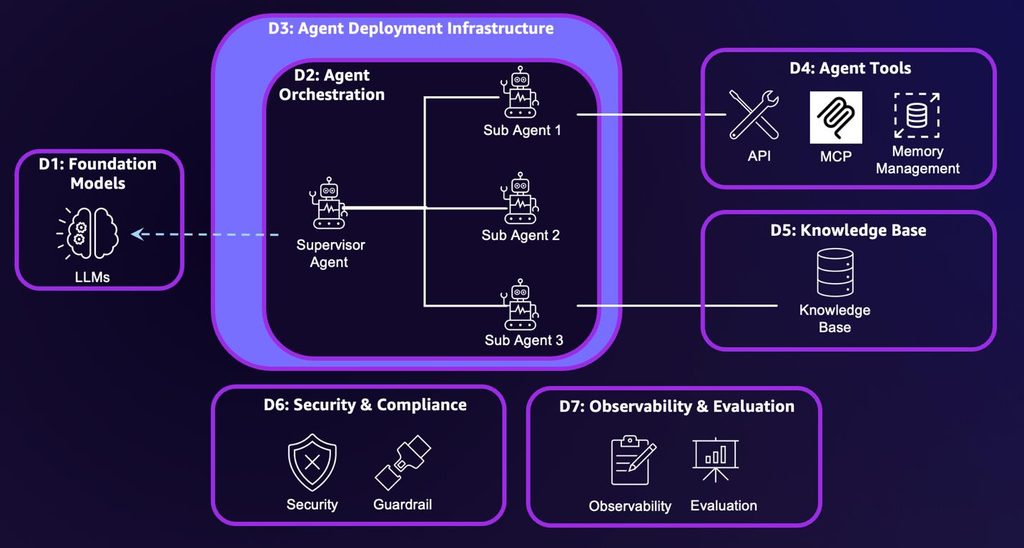
A production-ready AI agent typically requires several supporting components:
AI model: Interprets requests and generates decisions or responses.
Orchestration layer: Coordinates workflows, tool calls, and execution steps.
Knowledge retrieval: Provides access to relevant, authorized information.
Integration layer: Connects the agent with databases, APIs, and business applications.
Security controls: Enforces permissions, validates inputs, and restricts sensitive actions.
Observability layer: Records execution details, performance, and failures.
These components work together to create a dependable system.
For example, if an agent generates an instruction to update a customer record, the application should independently verify that the requested action is permitted.
The AI model should not be the final authority on access control.
Separating reasoning from execution gives engineering teams greater control over how agents interact with business systems.
3. Connect AI Agents to Reliable Business Data
An AI agent is only as useful as the information it can access and interpret.
Imagine an AI sales assistant that retrieves outdated pricing information and shares it with a prospective customer.
The response may sound professional and convincing, but the business outcome is still wrong.
Production AI agents need access to relevant, accurate, and appropriately authorized data.
This is where retrieval-augmented generation, commonly known as RAG, can help.
RAG allows an AI system to retrieve relevant information from approved sources before generating a response.
These sources might include product documentation, internal knowledge bases, customer records, or company policies.
However, implementing RAG doesn’t automatically guarantee accurate answers.
Teams must also consider document freshness, retrieval quality, conflicting information, and access permissions.
A reliable AI agent should recognize when the available information is insufficient instead of confidently inventing an answer.
For multi-tenant SaaS products, customer data must remain isolated so that one customer’s request cannot retrieve another customer’s confidential information.
Data quality and governance are foundational requirements for production AI systems.
4. Design for Failures Before They Happen
During development, teams naturally focus on successful workflows.
But real-world systems rarely behave perfectly.
External services become unavailable. Authentication tokens expire. Customers submit unexpected requests. AI models produce invalid outputs.
A production-ready AI agent needs a plan for these situations.
Consider an agent responsible for scheduling appointments.
It successfully interprets the customer’s request and attempts to create a booking through an external API.
The API times out.
Did the booking fail, or was it created successfully before the connection was interrupted?
If the agent blindly retries the request, it could create duplicate appointments.
A dependable system should check the operation’s status before attempting it again.
Engineering teams can improve failure recovery through:
- Controlled retry policies and timeouts.
- Structured output validation.
- Duplicate-action prevention.
- Alternative execution paths.
- Human escalation mechanisms.
- Clear error messages and execution logs.
These practices are especially important when agents perform actions involving payments, customer records, or operational workflows.
The real test of an AI agent is not how it behaves when everything works. It’s how it behaves when something doesn’t.
5. Evaluate AI Agent Performance Beyond Demo Accuracy
A successful demonstration proves that an AI agent can complete a particular task under specific conditions.
It doesn’t establish how consistently the agent will perform across thousands of different requests.
Production AI agents need systematic evaluation.
Start by creating a representative collection of test scenarios that reflect actual customer behavior.
Include straightforward requests, ambiguous instructions, incomplete information, unauthorized actions, and integration failures.
Measure outcomes using indicators such as:
Task completion rate: How often does the agent achieve the intended outcome?
Response accuracy: Are its answers supported by reliable information?
Tool execution success: Does it use connected systems correctly?
Escalation accuracy: Does it recognize when human involvement is necessary?
Response latency: How long does it take to complete a task?
Cost per successful task: What does the business spend to achieve a useful outcome?
Evaluation should continue after deployment.
Changes to prompts, models, tools, or knowledge sources can affect performance in unexpected ways.
Maintaining repeatable evaluation tests helps teams detect regressions before they reach customers.
6. Make AI Agent Security Part of the Architecture
AI agents often interact with systems that contain sensitive business information.
That makes security a core engineering requirement.
An agent may have access to customer records, internal documents, CRM platforms, or financial workflows.
If permissions are too broad, a mistake can have consequences beyond an incorrect response.
Prompt injection is another important consideration. Untrusted instructions embedded in user messages, documents, or retrieved content may attempt to manipulate an agent’s behavior.
Security controls should operate independently of the AI model.
Important practices include:
- Applying least-privilege access to connected tools.
- Validating requests before executing actions.
- Separating customer and tenant data.
- Protecting credentials and API keys.
- Requiring approval for high-impact operations.
- Maintaining appropriate audit logs.
Sensitive information should also be protected throughout the data lifecycle, including retrieval, processing, storage, and logging.
For additional security guidance, engineering teams can refer to the OWASP GenAI Security Project and the NIST AI Risk Management Framework.
7. Introduce Observability and Human Oversight
When an AI agent gives an unexpected response, can your engineering team explain what happened?
Can they identify which information was retrieved, which tools were called, and where the workflow failed?
Without observability, investigating agent failures becomes difficult.
A production monitoring strategy should provide visibility into request processing, model usage, tool execution, errors, latency, and operational costs.
Teams should also establish meaningful alerts rather than monitoring every minor variation.
For example, a sudden increase in failed tool calls or unauthorized action attempts may require immediate investigation.
Human oversight is equally important.
Not every workflow should be fully autonomous from the beginning.
A practical rollout might start with the agent recommending actions for human approval. Once evaluation demonstrates acceptable reliability, selected low-risk tasks can become autonomous.
Higher-risk decisions can continue requiring human authorization.
This gradual approach allows businesses to learn from real usage while maintaining operational control.
AI Agents vs. Traditional Automation: Which Is Better?
Not every business workflow needs an AI agent.
Traditional automation is often more predictable when tasks follow clearly defined rules.
| Traditional Automation | AI Agents |
|---|---|
| Follows predefined rules | Interprets variable inputs |
| Suitable for repetitive workflows | Suitable for context-dependent tasks |
| Generally easier to test | Requires broader evaluation |
| Predictable execution paths | May follow different execution paths |
| Often lower operational complexity | Requires additional monitoring and controls |
For example, sending a payment reminder three days before an invoice is due may only require conventional automation.
Investigating a customer complaint across multiple systems may benefit from AI-assisted reasoning.
Many effective solutions combine both approaches: AI interprets the request, while deterministic software validates and executes the permitted action.
The goal is to solve the business problem, not introduce AI where simpler technology would work better.
How Enlight Lab Helps Businesses Build Production-Ready AI Agents
At Enlight Lab, we help SaaS companies and growing businesses develop AI-powered solutions with maintainability, reliability, and business requirements in mind.
Our approach combines AI engineering with senior-led software development and technical leadership.
Depending on the project, our capabilities can support:
- AI agent architecture and workflow development.
- Business application and API integrations.
- Retrieval-augmented generation systems.
- Evaluation, monitoring, and failure recovery.
- Cloud infrastructure and deployment.
- Technical strategy through Fractional CTO services.
We believe AI implementation should begin with understanding the business problem, identifying operational risks, and determining whether an agent is the right solution.
A successful AI implementation should deliver measurable business value beyond an impressive demonstration.
Final Thoughts
An AI agent that performs well during a demonstration is a promising starting point.
But customers don’t experience demonstrations.
They experience real systems with imperfect data, unexpected requests, integration failures, and changing business requirements.
Building production-ready AI agents requires more than selecting a powerful model or writing effective prompts.
It requires thoughtful architecture, clear boundaries, reliable integrations, systematic evaluation, and experienced engineering.
Before asking how much more autonomy your AI agent can have, ask how much responsibility your system is ready to handle.
That is where sustainable AI implementation begins.
Ready to Move Your AI Agent From Prototype to Production?
Enlight Lab helps SaaS founders and growing businesses evaluate, build, and improve AI-powered software through experienced engineering and technical leadership.
Book a 30-minute technical discussion to explore your AI implementation requirements.