Guessing your development budget will bleed your runway dry. In 2026, custom web app development costs depend less on the amount of code written and more on how well the system is designed to perform, scale, and evolve over time.
When you jump into building a custom web application without a precise understanding of what you are actually paying for, you risk misallocating your budget and running out of capital before your product ever reaches the market.
This usually happens because you are forced to make decisions based on incomplete or misleading estimates. As a result, you tend to fall into one of two traps. You may either choose the lowest quote, only to discover later that the application cannot support growth, meet security standards, or integrate modern AI systems. Or else, overspend on highly customized builds that look impressive at launch but drain capital through unnecessary complexity and high ongoing maintenance.
The landscape of web development has shifted, driven by new privacy regulations, rising cloud infrastructure costs, and the widespread integration of artificial intelligence. Core features like data management and basic workflows are now faster and easier to implement. The real cost driver today is making sure the application is flexible, secure, and ready to work alongside AI-driven tools and automated processes.
Relying on outdated pricing models is a massive financial risk. Whether you are planning your next major release or modernizing an existing platform, having accurate, up-to-date cost estimates is critical to making informed decisions. In this guide, we’ll explore what it actually costs to develop a custom web application in 2026, the hidden factors that drive up your final bill, and how you can architect a solution that maximizes your return on investment.
What is a Custom Web Application, and Why It is Your Strategic Choice in 2026
A custom web application is software built specifically for your unique operational requirements. It runs on a web server and is accessed through a browser, offering the power of a desktop application with the accessibility of a website.
While anyone can subscribe to standard software, building a custom web application gives your business a unique advantage. By investing in a custom architecture, you secure full ownership of your data, eliminate recurring third-party licensing fees, and develop an agile system that evolves alongside your business. This is why the trend toward custom development is accelerating.
At Enlight Lab, we approach web applications as long-term business assets, not short-term projects. Every decision is made with one question in mind. Will this reduce operational effort or strengthen the company’s position in the market?
Key Factors Influencing Your Web App Development Budget
No two web applications are alike. Each project comes with its own set of requirements, challenges, and costs. Treating development as a one-size-fits-all service often leads to technical debt and costly redesigns down the line.
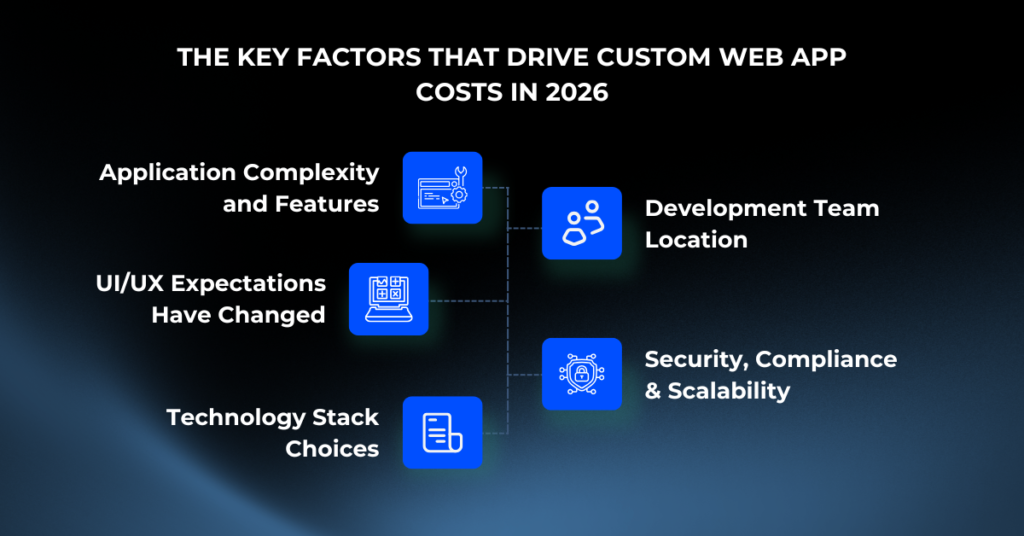
Here are the five primary factors that influence the final price tag of building your web application.
Application Complexity and Features
Every feature adds cost not linearly, but exponentially. A simple application with basic user authentication and a static dashboard will keep your budget manageable. But if your product requires real-time data processing, advanced machine learning algorithms, or complex third-party API integrations, your costs will scale accordingly. Every custom feature requires specialized logic, rigorous security testing, and ongoing maintenance.
Low‑complexity apps:
- Login/signup
- Basic CRUD operations
- Simple dashboards
Higher‑complexity apps:
- Role‑based access control
- Real‑time data (WebSockets)
- AI integrations or recommendations
- Payment gateways and compliance
- Multiple third‑party APIs
If a feature impacts multiple users, permissions, or workflows, it costs more than it looks on paper.
Technology Stack (Frontend, Backend, Database)
Your tech stack shapes both initial cost and future flexibility. Choosing the wrong technology stack guarantees future scalability issues. The combination of frameworks, programming languages, and database structures you select directly impacts your initial build cost and long-term hosting fees. Modern frameworks like React or Next.js for the frontend, paired with Node.js or Python on the backend, offer high performance but require specialized developers who command premium rates.
Design and User Experience (UI/UX)
A poorly designed application will struggle to retain users. If your app is confusing, difficult to navigate, or visually unappealing, users will quickly abandon it in favor of more polished alternatives. While it may be tempting to cut costs by using a premade design template, this approach often backfires with complex workflows or niche functionality.
Custom UI/UX design requires deep user research, wireframing, interactive prototyping, and extensive usability testing. Investing in a clean, intuitive interface may cost more upfront, but it pays dividends in user retention, reduced customer support queries, and overall satisfaction. A well-designed app not only improves customer loyalty but also enhances your brand’s credibility.
Users compare your app experience to:
- Notion
- Linear
- Stripe dashboards
Good UX requires:
- User research
- Wireframing and prototyping
- Design systems
- Accessibility and responsiveness
Skipping UX to “save cost” often results in:
- Poor adoption
- Expensive redesigns later
Development Team and Location
The expertise and location of your development team can have a significant impact on your budget. Hiring a top-tier custom web development agency provides businesses with faster communication, industry expertise, and strong regulatory compliance, though it often comes at a premium cost. Conversely, working with offshore teams can reduce hourly rates, but often introduces time zone friction and project management hurdles.
At Enlight Lab, we focus on providing elite architectural guidance that balances cost-efficiency with uncompromising quality.
Maintenance and Post-Launch Support
Launching your application is the starting line, not the finish line. Ignoring post-launch costs will blindside your operational budget. Cloud hosting providers like AWS and Google Cloud are expected to increase infrastructure pricing by 20% to 30% in 2026. You must allocate roughly 15% to 20% of your initial development budget annually for server costs, security patches, bug fixes, and feature updates.
Cost Breakdown by Development Phase
To understand where your capital goes, you must break the development lifecycle into distinct, measurable phases. Here is what you can expect to spend at each stage of a standard mid-market application in 2026.
Discovery and Planning
Estimated Cost: $3,000 to $10,000+
Moving too quickly without proper architectural design always leads to structural failure. The discovery phase involves defining technical requirements, mapping user journeys, and selecting the optimal technology stack.
UI/UX Design
Estimated Cost: $5,000 to $15,000+
Your users will not tolerate friction. This phase transforms your technical requirements into visual prototypes. Designers map out every screen, button, and interaction to ensure the product is intuitive.
Frontend Development
Estimated Cost: $10,000 to $30,000+
This is the code your users see and interact with. Frontend developers take the approved UI designs and build the responsive, interactive elements of your application using HTML, CSS, and modern JavaScript frameworks.
Backend Development
Estimated Cost: $15,000 to $50,000+
The backend is the engine of your application. If your backend is poorly structured, your application will crash under heavy traffic. This phase involves setting up servers, building databases, writing the core business logic, and creating APIs.
Quality Assurance and Testing
Estimated Cost: $5,000 to $15,000+
Deploying untested software is a massive security and reputational risk. QA engineers rigorously test the application across different devices and browsers, actively hunting for vulnerabilities, bugs, and performance bottlenecks.
Deployment and Launch
Estimated Cost: $2,000 to $5,000+
Pushing the application to live servers requires careful orchestration. This includes setting up CI/CD pipelines, configuring domain names, acquiring premium SSL certificates, and ensuring cloud infrastructure is optimized for launch day traffic.
By providing this extended breakdown, you gain a more nuanced understanding of how factors like feature complexity, design, and technology choices influence development costs. Planning strategically and staying informed can help you build a custom web app that delivers maximum value for your investment.
Average Cost Estimates for 2026
Based on current market trajectories and rising developer rates, here is a realistic look at total project costs for 2026.
Small to Medium Applications
Estimated Range: $30,000 to $60,000
These applications typically serve a single, specific business function. They include basic user roles, standard dashboards, and minimal third-party integrations. Think of internal employee portals or simple SaaS MVPs (Minimum Viable Products).
Enterprise-Level Applications
Estimated Range: $80,000 to over $250,000
These are mission-critical systems designed to handle massive data loads, high concurrent user traffic, and complex security compliances (like HIPAA or SOC 2). They feature advanced automation, custom analytics, and deep integrations with legacy enterprise software.
Factors That Force Budget Fluctuations
Your baseline cost will swing based on regulatory requirements and data complexity. Implementing multi-tenant architectures, biometric security protocols, or real-time video streaming will immediately push your project into the higher pricing tiers.
Estimated Cost by Business Type for Custom Web Application Development
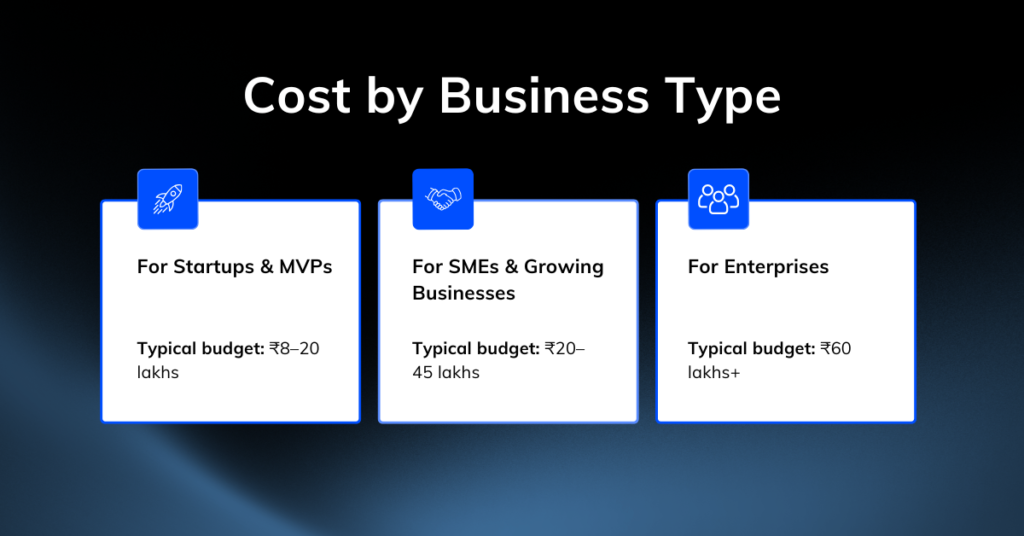
| Business Type | Typical Web App Requirements | Estimated Development Cost | Best for |
| Startup / Small Business | MVP development, basic features, simple UI/UX, limited integrations | $10,000 – $50,000 | Validating ideas, launching quickly, early-stage businesses |
| Small to Medium Business | Custom workflows, user dashboards, API integrations, scalable architecture | $50,000 – $120,000 | Growing businesses needing tailored functionality |
| Enterprise | Advanced security, complex integrations, large databases, automation, analytics | $120,000 – $500,000+ | Large organizations with high traffic and operational complexity |
| E-Commerce Business | Product catalog, payment gateways, inventory management, customer accounts | $30,000 – $150,000 | Online stores and marketplace platforms |
| SaaS Business | Subscription billing, multi-user access, cloud hosting, recurring payments | $60,000 – $300,000+ | Software platforms offering services online |
| Healthcare / FinTech | Compliance requirements, secure data storage, encryption, user authentication | $80,000 – $400,000+ | Regulated industries requiring strict security and compliance |
| Marketplace Platform | Buyer-seller interactions, payment systems, messaging, admin dashboard | $70,000 – $250,000+ | Platforms connecting multiple user groups |
Hidden Development Costs Most Businesses Miss
Hidden costs don’t show up in initial quotes but affect ROI massively:
- Ongoing maintenance (10–20% of dev cost annually)
- Cloud usage as traffic scales
- Feature creep
- Security updates
- Technical debt from rushed builds
Planning for these upfront separates successful products from stalled ones.
How AI Is Impacting Web App Development Costs
- Faster Development: AI tools automate coding, testing, and debugging, reducing development time.
- Lower Labor Costs: Automation minimizes repetitive tasks, allowing developers to focus on complex work.
- Improved Productivity: AI-assisted workflows help teams build and deploy applications more efficiently.
- Enhanced User Experience: AI supports features like personalization, chatbots, and intelligent recommendations.
- Higher Initial Investment: Adding AI-powered capabilities may increase costs due to data processing and specialized expertise.
- Reduced Long-Term Costs: AI can streamline maintenance, monitoring, and performance optimization over time.
- Scalable Solutions: AI helps businesses build smarter applications that can adapt to growing user demands.
Overall, AI can reduce operational and development costs for standard projects while increasing budgets for applications that rely heavily on machine learning or intelligent automation.
Maximizing ROI on Your Custom Web Application
Spending six figures on an application that users abandon is a catastrophic failure. To guarantee a high return on investment, you must approach development with militant discipline.
Strategic Planning and Goal Setting
Define your success metrics before a single line of code is written. If you cannot articulate exactly how this application will increase revenue or reduce operational overhead, you are not ready to build. Map out your core user flows and ruthlessly cut any feature that does not directly serve your primary business objective.
Agile Development Methodologies
Building your entire application in the dark and praying the market likes it is a recipe for disaster. Adopt an Agile development framework. Build a Minimum Viable Product (MVP) containing only your most critical features. Launch it to a small segment of your audience, gather hard data, and use those insights to dictate your next phase of development.
Scalability and Future-Proofing
A cheap, rigid architecture will buckle the moment your business grows. You must build with scalability in mind from day one. Utilize microservices and cloud-native architectures that allow you to expand server capacity instantly. When you architect for the future, you avoid the devastating cost of having to rebuild your entire platform from scratch two years down the line.
Make Smarter Investment Decisions for Custom Web App Development Costs
Building a custom web application in 2026 requires serious capital, but the cost of relying on inadequate software is far higher. A well-architected application transforms raw, fragmented processes into streamlined, scalable operations. It creates a proprietary asset that drives enterprise value and outright eliminates technical bottlenecks.
You now know what drives the costs, where the risks lie, and how to structure your project for maximum return. The next step is execution.

If you are ready to stop burning through capital on inefficient tools and start building a digital product that scales, you need elite architectural guidance. At Enlight Lab, we help founders and technical leaders map out exact development strategies that align with their business goals.
Book a consultation with our experts today to uncover the hidden inefficiencies in your current process and get a definitive, fixed-price roadmap for your custom web application. We don’t just give you a quote; we give you a roadmap to market leadership.