Every week, another AI tool promises to transform your business. Most of them are generative AI products with a redesigned interface and limited additional functionality. But a fundamentally different class of AI is now emerging, one that doesn’t just answer your questions. It executes tasks, adapts on the fly, and gets things done without you micromanaging every step. That’s agentic AI.
If you’re a founder, CTO, or tech decision-maker trying to figure out where to invest in your AI strategy, this distinction matters enormously.
Choosing the wrong approach doesn’t just slow you down, it means building on a foundation that can’t scale with your ambitions.
This guide breaks down the agentic AI vs generative AI debate in simple, practical terms. We’ll explore how each technology works, where they deliver the most value, and how forward-thinking startups are combining both to create unique advantages that are difficult to replicate.
By the end, you’ll know exactly what each technology does, why the difference matters for your business, and how to make a confident, informed decision about which to prioritize.
What Is Agentic AI and Why Is It Fundamentally Different?
Defining Agentic AI
Agentic AI refers to AI systems that operate autonomously to pursue defined goals through multi-step, iterative action cycles. Rather than responding to a single prompt, an agentic AI system perceives its environment, reasons about what actions to take, executes those actions using available tools, evaluates the results, and then decides what to do next, all without requiring human input at each step.
Think of it this way: generative AI is a brilliant analyst you consult. Agentic AI is a capable team member you assign a project to.
The Architecture Behind Agentic AI
Andrew Ng, one of the world’s leading AI researchers and co-founder of Google Brain, identified four foundational design patterns that define agentic workflows:
- Reflection: The AI reviews and critiques its own outputs, iterating to improve quality before delivering results.
- Tool use: The AI accesses external systems like web browsers, APIs, databases, and code executors to gather information and take action.
- Planning: The AI breaks a complex goal into sub-tasks, sequences them logically, and works through them systematically.
- Multi-agent collaboration: Multiple specialized AI agents work in parallel or sequence, each handling specific parts of a larger task.
This architecture enables agentic AI to handle tasks that would be impossible for a single-turn generative model. A generative AI can draft an email. An agentic AI can research a prospect, draft a personalized outreach email, schedule the send, monitor the open rate, and trigger a follow-up all autonomously.
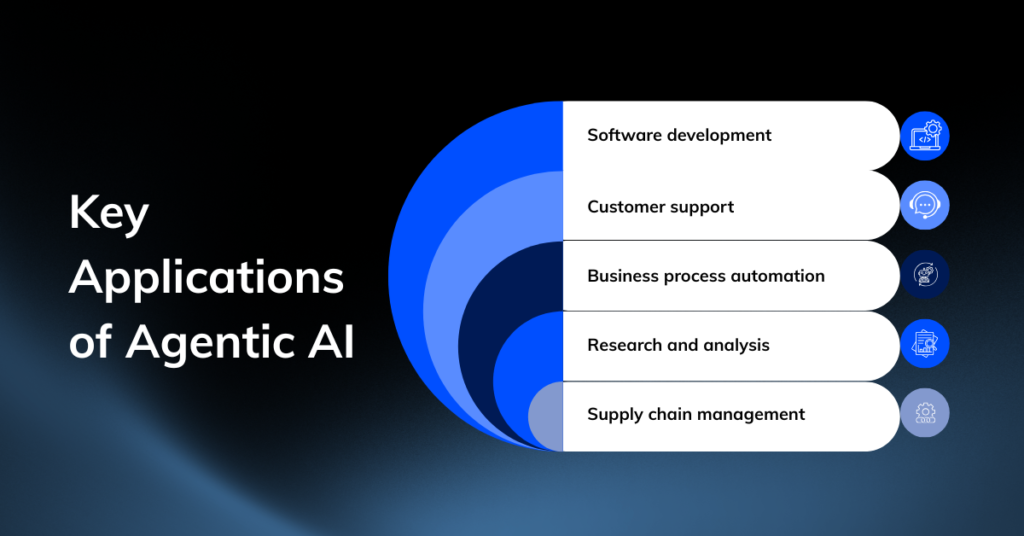
Key Applications of Agentic AI
Agentic AI is transforming operations across industries:
- Software development: AI agents like Devin (by Cognition Labs) can autonomously write, test, debug, and deploy code, functioning as an AI software engineer.
- Customer support: Agentic AI for customer support enables end-to-end resolution by not only answering queries but also accessing CRM data, processing refunds, and escalating complex issues when needed.
- Business process automation: Agents can manage multi-step workflows across tools like Salesforce, Jira, Slack, and Google Workspace without human orchestration.
- Research and analysis: Agents can autonomously browse the web, synthesize data from multiple sources, and produce comprehensive reports.
- Supply chain management: Agentic systems monitor inventory levels, predict demand shifts, place orders, and coordinate with logistics partners autonomously.
Real-world Examples Of Agentic AI
Salesforce Agentforce deploys autonomous AI agents that handle sales prospecting, customer case resolution, and pipeline management without constant human oversight. AutoGPT was one of the first open-source demonstrations of agentic behavior. Users set a goal, and the system autonomously plans and executes a sequence of actions. Microsoft’s Copilot Studio lets enterprises build custom agentic workflows embedded in their existing tooling.
The market is taking notice. According to Mordor Intelligence, the global agentic AI market is valued at approximately $9.89 billion in 2026 and is projected to grow at a CAGR of 42.14%, reaching $57.42 billion by 2031. A separate analysis by Market.us projects even more aggressive growth, forecasting the market to hit $196.6 billion by 2034.
These aren’t speculative numbers. They reflect where enterprise investment is already flowing.
What Is Generative AI and How Does It Actually Work?
The Core Idea Behind Generative AI
Generative AI refers to machine learning systems trained to produce new content, such as text, images, audio, video, or code, based on patterns learned from vast datasets. At its heart, generative AI is a sophisticated prediction engine. Given a prompt, it predicts the most contextually appropriate output.
The technical backbone is the transformer architecture, introduced by Google researchers in their landmark 2017 paper “Attention Is All You Need.” Transformers power today’s most influential large language models (LLMs), including OpenAI’s GPT-4, Google’s Gemini, and Anthropic’s Claude.
These models learn statistical relationships across billions of data points, enabling them to generate surprisingly coherent, contextually aware outputs.
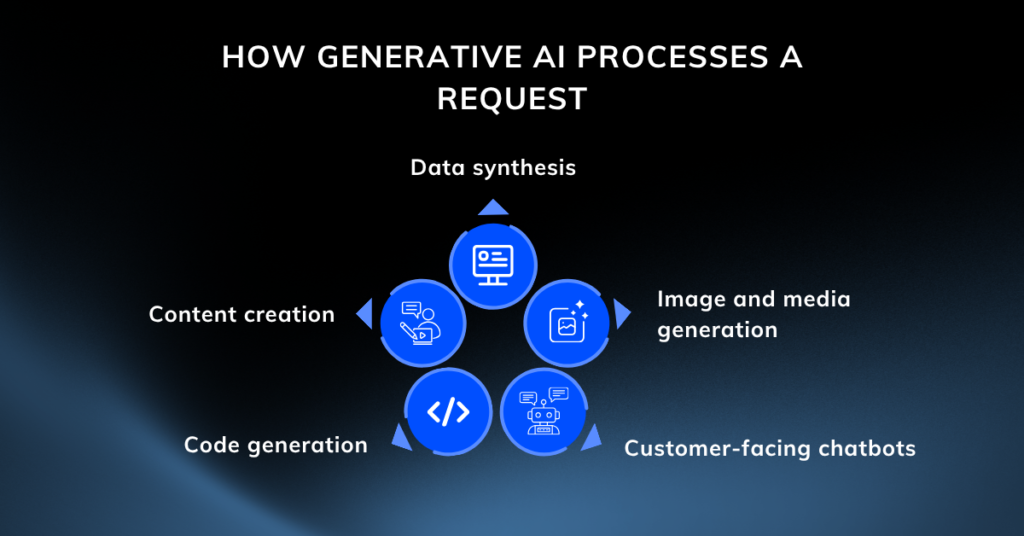
How Generative AI Processes A Request
The process is largely single-turn: you provide a prompt, the model processes it, and returns a response. It doesn’t retain memory between sessions by default. It doesn’t take external actions. It generates and then stops.
This makes generative AI extremely powerful for a specific class of tasks:
- Content creation: Writing blog posts, marketing copy, product descriptions, and social media captions
- Code generation: Producing boilerplate code, debugging, and generating unit tests
- Data synthesis: Summarizing reports, extracting insights from unstructured data
- Image and media generation: Creating visuals from text descriptions (DALL-E, Midjourney, Stable Diffusion)
- Customer-facing chatbots: Answering FAQs, routing support queries, drafting responses
Real-world Examples of Generative AI In Action
The most recognizable example is ChatGPT by OpenAI, which crossed 100 million users faster than any application in history, according to UBS in 2023. GitHub Copilot helps developers write code faster. GitHub reported that developers using Copilot complete tasks up to 55% faster. DALL-E 3 enables non-designers to create high-quality visuals from text prompts in seconds.
These tools are genuinely valuable, but they all share a critical limitation: they wait for your next instruction. They don’t pursue goals independently or adapt their approach when they hit a roadblock. That’s the ceiling of generative AI, and it’s where agentic AI begins.
Agentic AI vs Generative AI: The Key Differences Explained
Understanding the distinction clearly is essential for any business making AI investment decisions. Here’s a detailed breakdown:
| Dimension | Generative AI | Agentic AI |
| Primary role | Content creation and synthesis | Goal execution and task completion |
| Interaction model | Prompt → Response | Goal → Plan → Action → Evaluate → Iterate |
| Human involvement | Required at each step | Minimal; human sets goals, AI executes |
| Output type | Static content (text, images, code) | Dynamic outcomes (completed tasks, system changes) |
| Memory | Limited or no persistent memory | Often maintains context across sessions |
| Tool access | Limited | Extensive (APIs, browsers, databases, apps) |
Operational Mechanisms
Generative AI operates through a single inference loop: you provide input, the model runs one forward pass through its neural network, and it returns output. The interaction ends there.
Agentic AI operates through a continuous perception-action loop. It:
- Receives a high-level goal
- Decomposes the goal into actionable steps
- Executes each step using available tools
- Evaluates whether the outcome matches expectations
- Adjusts the plan and continues until the goal is achieved
This loop can run for minutes, hours, or even days, depending on the complexity of the task. It’s a fundamentally different computational model, not just a more powerful version of generative AI.
Output And Real-world Impact
Generative AI produces artifacts: a draft, a design, a script, a summary. These artifacts require a human to evaluate, approve, and act on them. The AI’s role ends at the point of delivery.
Agentic AI produces outcomes: a task completed, a process automated, a decision executed. The AI remains involved throughout the execution chain. This distinction is critical for businesses evaluating where AI can drive operational efficiency versus where it serves primarily as a productivity tool.
Autonomy vs. Guidance
Generative AI relies on human guidance to refine its outputs and ensure accuracy, operating within predefined parameters.
Agentic AI, on the other hand, operates with a higher degree of autonomy, managing tasks end-to-end with minimal human intervention.
Complexity of Integration
Generative AI typically integrates into workflows as standalone tools or assistants, requiring manual input and oversight.
Agentic AI demands deeper integration into existing systems and processes, as it must interact with and execute tasks within broader operational ecosystems.
Decision-Making Scope
Generative AI supports decision-making by providing insights, recommendations, or drafts for humans to consider.
Agentic AI progresses further by executing decisions on behalf of the user, often leveraging pre-programmed logic or adaptive algorithms to take action based on evolving data inputs.
Use Cases and Industries Where Each Excels
Generative AI is the better fit when you need to:
- Produce high volumes of content quickly (marketing, documentation, communications)
- Accelerate developer productivity through AI-assisted coding
- Generate synthetic data for testing or training purposes
- Create first drafts that human experts then refine
Agentic AI is the better fit when you need to:
- Automate complex, multi-step business workflows end-to-end
- Build AI-powered products that take actions on behalf of users
- Scale operations without scaling headcount proportionally
- Integrate AI decision-making across multiple business systems
Choose agentic AI if autonomous execution and scalable process automation matter more than creative content generation. For many startups reaching product-market fit, agentic AI represents the more transformative investment.
How Generative AI and Agentic AI Work Better Together
The most powerful AI architectures don’t choose between generative and agentic AI, they use both. Generative AI functions as the cognitive engine that understands language, reasons through problems, and produces outputs. Agentic AI provides the execution framework that deploys those capabilities toward real-world goals.
Consider a startup building an AI-powered sales development representative (SDR). The system might work like this:
- An agentic layer monitors a prospect database, identifies new leads matching an ideal customer profile, and triggers a workflow
- A generative AI layer drafts a personalized outreach email based on the prospect’s LinkedIn profile, recent company news, and past interactions
- The agentic layer sends the email, monitors opens and replies, and triggers follow-up sequences or hands off to a human sales rep when engagement crosses a threshold
Neither AI type could deliver this outcome alone. Together, they create a system that operates continuously, scales effortlessly, and consistently outperforms purely manual processes.
This synergy is exactly what sophisticated AI implementations are building toward. The companies capturing disproportionate value from AI aren’t just using ChatGPT to write content. They’re building agentic systems with generative AI at their core.
The Future Landscape: Where Autonomous AI Is Headed
The trajectory is clear. Generative AI democratized access to AI capabilities. Agentic AI is now enabling AI to operate as a genuine participant in business processes—not just a tool you consult, but a system that executes alongside your team.
Several trends are accelerating this shift:
- Multimodal Capabilities: Modern AI systems can see, read, and reason across text, images, and data simultaneously, dramatically expanding the scope of tasks agents can handle autonomously.
- Improved Long-Horizon Reasoning: Models are becoming more reliable at planning and executing complex, multi-step tasks without drifting from the original goal.
- Tool Ecosystem Maturity: The infrastructure for connecting AI agents to enterprise software (CRMs, ERPs, databases, communication platforms) is maturing rapidly, lowering the barrier to deployment.
- Cost Reduction: As model inference costs decline, running continuous agentic workflows becomes economically viable even for early-stage startups with constrained budgets.
The businesses building agentic workflows today are compressing years of operational scaling into months. The gap between early adopters and late movers in AI automation will be difficult to close once established.
Making the Right AI Choice to Unlock the Future of Automation
The agentic AI vs generative AI question isn’t really about picking one over the other. Generative AI gives you a powerful cognitive tool. Agentic AI gives you an autonomous execution layer.
The highest-value AI strategies combine both, using generative AI to power reasoning and content, and agentic AI to turn that intelligence into action.
For startups and scaling enterprises, the key is knowing which problems to solve with each approach and having the technical architecture in place to support both.
That’s exactly what Enlight Lab helps you build. As one of the top tech consulting firms for early-stage startups and scaling enterprises, Enlight Lab specializes in helping teams move from idea to product to scale with ultimate AI strategy and appropriate implementation at the center.
Whether you’re evaluating your first AI integration or architecting an agentic workflow that automates a core business process, we bring the expertise to get it right. Book a free consultation with us today and start building AI systems that actually work for your business. Get instant clarity on the right AI approach for your product and growth stage.