Choosing the wrong AI chatbot development partner costs far more than the initial contract value. It costs customer trust, operational efficiency, and future flexibility. The right partner builds a production-ready system that integrates with your business processes, scales with demand, and delivers measurable outcomes.
The AI for customer service market was valued at over $12 billion in 2024 and is projected to reach nearly $48 billion by 2030 (MarketsandMarkets, 2024). Roughly 70% of large organizations have already deployed some form of AI chat or copilot system. A 2023 Intercom study found 58% of support leaders saw improved CSAT scores after deploying AI automation.
Most failed chatbot projects don’t fail because of bad ideas. They fail because the wrong partner was chosen on too little evidence. This guide gives you the frameworks, evaluation criteria, and questions to use before selecting any AI chatbot development company.
Why the Right AI Chatbot Development Partner Changes Everything
A custom AI chatbot is not a software feature. It is operational infrastructure that touches your customers, your data, and your revenue every day.
When implemented correctly, organizations running RAG-based systems achieve containment rates of 70% to 90% — meaning most customer issues resolve without a human agent. Poorly implemented chatbots do the opposite: they erode customer trust, flood support queues with escalations, and create compliance exposure in regulated industries.
At Enlight Lab, we’ve seen the pattern consistently: the demo that impressed a team in week two can’t handle real traffic in month six. This guide is built to close that gap before you sign a contract.
Agency vs Freelancer vs In-House: Which Build Path Is Right?
| An agency builds for you. A freelancer builds with you. An in-house team builds around you. For most production deployments, an agency is the fastest path to launch. |
| Option | Typical Cost | Best For | Biggest Risk |
|---|---|---|---|
| AI chatbot agency | $30,000 – $500,000+ per project | Production systems, regulated industries, tight deadlines | Higher upfront cost |
| Freelance developer | $50–$200/hr ($10K–$80K/project) | MVPs, prototypes, narrow scope | Single point of failure |
| In-house team | $150K–$500K+/year fully loaded | Long-term AI roadmap, core product | Slow to hire, expensive to retain |
AI Chatbot Development Agency
Best for: production-grade systems on a deadline, regulated industries, or teams without senior AI talent in-house. You get AI engineers, integration specialists, compliance knowledge, and project management under one roof with post-launch support built in.
Freelance AI Developer
Best for: validating an idea, building an internal FAQ bot, or testing a narrow use case. The risk is a single point of failure — if your freelancer disappears, your project stops.
In-House Development Team
Best for: AI as a core product differentiator with a funded multi-year roadmap. Most companies aren’t here yet. Many growing businesses use a hybrid path: an agency builds the first production system, then trains an in-house owner to maintain and extend it.
Define Your Business Objectives Before Evaluating Any Vendor
Before requesting a single proposal, define what success looks like. Without requirements, vendor selection becomes a comparison of demos rather than capabilities.
Answer these questions first:
- What is the primary use case? Customer support deflection, lead qualification, or internal helpdesk?
- Which channels must the chatbot operate on? Website, mobile app, WhatsApp, Slack, or voice?
- What are your measurable KPIs? A support-focused bot typically targets 60–80% containment or 30% reduction in human-handled tickets.
- What compliance frameworks apply? HIPAA for healthcare, SOC 2 and GDPR for financial data, PCI-DSS for payments.
- What is your integration landscape? Which CRMs, ERPs, ticketing tools, and databases must the chatbot connect to?
How to Evaluate Technical AI and LLM Expertise
Not every company offering AI chatbot development services has genuine production experience. Any vendor can call an API. What separates a capable partner is whether they understand how AI models behave at scale and whether they have the architecture to manage them.
LLM (Large Language Model): The AI engine that generates human-like text. GPT-4, Claude, and Gemini are examples — the brain writing the chatbot’s answers.
LLM Orchestration: The system managing which model to use, how to route requests, and how to chain steps together — the traffic controller that keeps your AI running efficiently and affordably.
Questions to ask every vendor:
- Which LLMs have you deployed in production, and for which use cases?
- How do you select between GPT-4, Claude, Gemini, and open-source models like Llama or Mistral?
- What orchestration framework do you use and how do you manage token costs at scale?
- How do you defend against prompt injection — the number one OWASP-ranked AI security risk?
What Is RAG and Why It Determines Chatbot Accuracy?
 Standard AI models generate answers from training data that can be outdated or invented. RAG pipelines pull relevant information from your verified sources — technical docs, FAQs, policy documents, product catalogs — and ground every answer in that content. The result is fewer hallucinations, more accuracy, and responses your team can audit.
RAG uses vector databases — specialized storage that finds information by meaning rather than exact keyword match. A customer asking “Can I get my money back?” still surfaces your refund policy, even if those words don’t appear verbatim.
RAG systems reduce AI hallucinations by 70–90% compared to standard models (Makebot.ai, 2024). For industries where a wrong answer carries legal or safety consequences — healthcare, insurance, financial services — RAG is not optional.
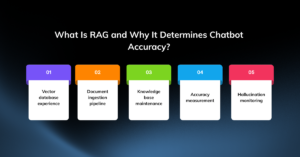
| RAG Capability | What to Ask the Vendor |
|---|---|
| Vector database experience | Which databases have you deployed in production? (Pinecone, Weaviate, Chroma, pgvector) |
| Document ingestion pipeline | How do you load, split, chunk, and index knowledge sources at scale? |
| Knowledge base maintenance | How are knowledge base updates pushed to the chatbot after launch? |
| Accuracy measurement | How do you measure retrieval relevance and improve answer quality over time? |
| Hallucination monitoring | How do you detect and reduce hallucinations in production? |
Integration Capabilities: Where AI Chatbot Projects Go Over Budget
Integration is where most chatbot projects blow past budget and miss deadlines. Connecting a chatbot to your CRM, ERP, HRMS, and ticketing system is real engineering work — not a configuration task.
A production chatbot typically needs to connect with:
- CRM systems (Salesforce, HubSpot)
- ERP and ticketing platforms (SAP, Zendesk, ServiceNow)
- Internal databases and authentication systems
- Knowledge bases and document repositories
Questions every vendor must answer before you sign:
- Which integrations have you delivered previously at production scale?
- How do you handle legacy systems with limited or no API access?
- How is conversation context preserved during human handoff?
- What access controls govern the chatbot’s connection to internal systems?
Multi-channel deployment adds another layer. A chatbot on your website is a different engineering challenge from one on WhatsApp, Slack, or a mobile app. Verify your vendor has shipped cross-channel deployments — not just planned them.
Why Industry Experience Matters in AI Chatbot Development
Generic AI expertise does not transfer automatically to regulated industries. A vendor with no healthcare deployments doesn’t understand what a Business Associate Agreement (BAA) means in practice.
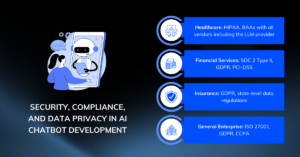
| Industry | What a Qualified Partner Demonstrates |
|---|---|
| Healthcare | Patient triage, appointment scheduling, HIPAA compliance, BAA execution with every vendor including the LLM provider |
| Insurance | Policy Q&A, claims status flows, GDPR-compliant data processing, state-level data regulations |
| Real Estate | Lead qualification logic, property recommendations, calendar integrations for booking viewings |
| Financial Services | 24/7 account support, fraud alert flows, loan guidance, SOC 2 Type II, PCI-DSS |
| E-commerce | Product discovery, order tracking, returns processing, architecture built for peak-traffic volume |
Security, Compliance, and Data Privacy in AI Chatbot Development
AI chatbots process sensitive data at scale. Security and compliance must be designed into the architecture from the start – retrofitting is 3–5x more expensive and rarely complete.
Prompt injection is when a malicious user tricks a chatbot into ignoring its rules — for example, to reveal private data or bypass safety controls. OWASP ranks it the #1 security risk for AI applications.
Security capabilities every vendor must demonstrate:
- Encryption at rest and in transit
- Role-based access control and data masking
- Full audit trails for all chatbot interactions
- Input sanitization and output filtering against prompt injection
- Data residency options for geographic data regulations
- Incident response and breach notification procedures
Scalability: Building AI Chatbot Architecture for Growth
A chatbot handling 1,000 conversations today may need to support 50,000 in eighteen months. Production architecture and demo architecture are fundamentally different things.
Scalability factors to evaluate with every vendor:
- Concurrency: How many simultaneous conversations can the system handle without degrading?
- Multi-language: Can new languages be added without a full rebuild?
- Multi-channel expansion: Is adding a new channel weeks of engineering or a configuration change?
- Model flexibility: Is the architecture model-agnostic, or locked to a single LLM provider?
- Cost at scale: How do AI usage costs behave as volume grows? Is caching or optimization in place?
Post-Launch Support: Where AI Chatbots Quietly Fail
Launch day is the start, not the finish. An unmonitored AI chatbot degrades. Data shifts. User behavior evolves. Knowledge bases go stale. A chatbot at 85% containment on day one drifts to 60% within months without active maintenance.
A credible post-launch support model includes:
- Performance drift monitoring with automatic alerts when containment drops below threshold
- Regular knowledge base updates and retraining cycles
- Human review of low-confidence conversations
- Quarterly reporting tied to your original KPIs
- A defined SLA for critical incident response and bug fixes
Ask vendors to show you live monitoring dashboards from existing deployments. A vendor who can’t demonstrate ongoing performance tracking hasn’t built the infrastructure to support you after launch.
AI Chatbot Development Pricing: What Does It Actually Cost?
| Project Scope | Typical Cost Range | Typical Timeline |
|---|---|---|
| FAQ chatbot or MVP | $5,000 – $30,000 | 2–6 weeks |
| LLM-powered with integrations | $30,000 – $150,000 | 2–4 months |
| Custom enterprise deployment | $150,000 – $500,000+ | 5–12 months |
| Pricing Model | How It Works | Best For | Watch Out For |
|---|---|---|---|
| Fixed-price | One agreed price for defined scope | Well-scoped first builds | Change requests get expensive fast |
| Dedicated team | Monthly fee for assigned team | Evolving scope, ongoing roadmap | You manage direction; higher commitment |
| Usage-based | Pay per conversation or token | Variable volume, pay-as-you-grow | Costs can spike without caps |
| Hybrid | Fixed build + usage or retainer | Most production systems | Terms must be spelled out explicitly |
Red Flags: When to Walk Away from an AI Chatbot Vendor
- No case studies with real metrics from your industry — only demos and architecture slides
- Defaults to one LLM for every project with no rationale
- Vague or absent answers about RAG, vector databases, and knowledge base maintenance
- No documented post-launch monitoring or SLA
- Compliance quoted at the same price as a non-regulated deployment
- No clear escalation model or human handoff design
- Inability to explain prompt injection risks or defenses
- No references from clients at a similar scale or industry or human handoff design
- Inability to explain prompt injection risks or defenses
- No references from clients at a similar scale or industry
Vendor Evaluation Scorecard
Use this scoring framework when comparing providers. Apply a 1–5 score for each criterion, multiply by the weight, and total across vendors.
| Evaluation Criteria | Weight | Why It Matters |
|---|---|---|
| LLM and RAG technical depth | 25% | Determines accuracy, scalability, and cost control in production |
| Industry experience | 20% | Reduces compliance risk and accelerates time to deployment |
| Integration capability | 15% | Where most projects go over budget and over time |
| Security and compliance | 15% | Non-negotiable in regulated industries; expensive to retrofit |
| Post-launch support model | 10% | Unmonitored chatbots degrade — support determines long-term ROI |
| Scalability architecture | 10% | What handles today’s volume may not handle next year’s |
| Pricing transparency | 5% | Unclear pricing signals unclear project management |
Questions to Ask in Every Vendor Conversation
Technical Capability
- Which LLMs have you deployed in production, and why did you choose them for those use cases?
- Walk me through a RAG implementation you built — architecture, vector database, and how accuracy was measured.
- How do you defend against prompt injection and adversarial inputs?
- What orchestration framework do you use and how do you manage token costs at scale?
Integration Experience
- Which CRMs, ERPs, and ticketing systems have you integrated natively?
- Describe a legacy system integration that required custom middleware.
- How does your escalation model preserve conversation context during human handoff?
Compliance and Security
- Have you signed BAAs with LLM providers for healthcare clients?
- Show me how you’ve handled data residency requirements in a past deployment.
- What is your incident response process if a data breach occurs post-launch?
Post-Launch Support
- Can you show me a monitoring dashboard from a live deployment?
- What triggers a retraining cycle and who initiates it?
- What is your SLA for critical incidents after launch?
Final Thoughts
The AI chatbot market is crowded and every vendor demos well. The gap that matters is between what a vendor can build in a controlled environment and what they can sustain in your production environment — with real customers, legacy systems, and compliance requirements.
Evaluate on the evidence that matters: case studies from your industry with real containment numbers, a concrete RAG and integration approach, security credentials that match your compliance requirements, and a post-launch support model with measurable SLAs.
At Enlight Lab, we’ve built production AI chatbot systems across healthcare, financial services, insurance, and e-commerce. We’re happy to show you the numbers behind them — and we expect you to hold us to the same standard this guide describes.