
Large language models do not remember conversations. Each request is stateless by default. The moment a session ends, the model retains nothing. For a single-turn Q&A tool, that limitation is manageable. For an enterprise AI agent handling multi-step workflows, personalized customer interactions, or clinical decision support across thousands of patients, it is a foundational failure mode.
AI memory systems solve this problem. They are the infrastructure layer that enables models to access relevant context at inference time whether that context is five minutes old or five years old. Getting this layer right determines whether your AI application delivers consistent, personalized, and accurate outputs at scale.
This guide covers the full architecture of AI memory systems short-term and long-term alongside the technologies, enterprise use cases, best practices, and common mistakes that separate production-ready implementations from expensive prototypes.
What Are AI Memory Systems?
Without a memory layer, every LLM interaction starts from zero. The model has no knowledge of who the user is, what they asked last week, or what your organization’s specific policies are. Memory systems solve this by providing a structured mechanism for context retrieval, persistence, and injection.
There are two primary categories:
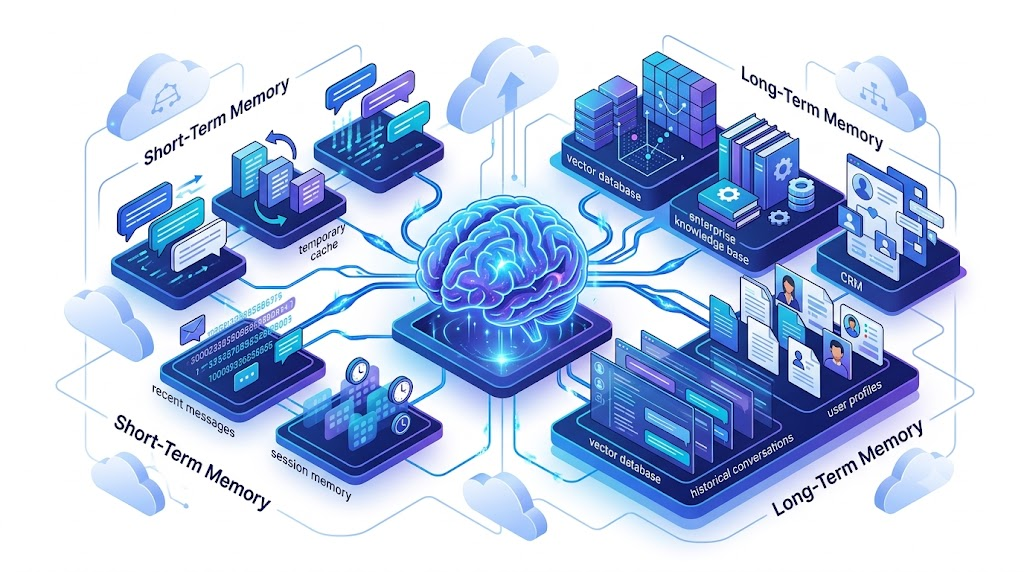
- Short-term memory: Context available within a single session, bounded by the model’s context window
- Long-term memory: Persistent storage that survives across sessions, typically implemented with vector databases, CRM systems, and knowledge bases
Most enterprise applications require both. The design challenge is knowing what to store, how long to retain it, when to retrieve it, and how to rank what gets injected into the model’s context.
Why Modern AI Needs Memory
LLMs are stateless by design. Every inference call is independent. Without an external memory system, an enterprise AI agent cannot recall previous interactions, personalize responses, or access organizational knowledge making it unsuitable for any workflow that spans more than one exchange.
Why LLMs Forget: The Stateless Architecture Problem
Standard LLM inference sends a prompt, receives a response, and discards everything. The model does not store user preferences, prior decisions, or conversation history. If you call the same model twice in a row with different session IDs, it behaves as if it has never encountered the user before.
This is not a limitation of model intelligence. It is a deliberate architectural property. Stateless inference simplifies scaling, reduces latency, and eliminates privacy risks from cross-user contamination. The trade-off is that all context management moves to the application layer which is exactly where memory systems live.
Context Window Limits and Why They Matter
Every LLM operates within a token limit: the maximum amount of text the model can process in a single inference call. Anthropic’s Claude models support context windows large enough to process entire contracts or policy manuals in a single interaction, according to Anthropic’s technical documentation. OpenAI’s GPT-4 and Google’s Gemini similarly offer extended context windows.
However, context window size does not eliminate the need for memory architecture. Three practical constraints remain:
- Cost: Sending large context windows on every request multiplies token costs significantly at production volume
- Latency: Larger prompts produce slower responses
- Persistence: Context window contents disappear when the session ends
Memory architecture addresses all three. Rather than injecting an entire knowledge base into every prompt, a well-designed memory system retrieves only the most relevant context at inference time.
Production Examples That Illustrate the Stakes
Consider a financial services chatbot deployed to handle client inquiries. Without long-term memory, the assistant asks returning clients for their account number and portfolio preferences on every call. With a properly implemented memory layer, the assistant retrieves the client’s history, preferences, and recent interactions before generating a response. One approach creates friction. The other builds trust.
The same principle applies to healthcare AI, enterprise knowledge assistants, and sales copilots. The value of memory grows proportionally with the duration and complexity of the user relationship.
Understanding Short-Term Memory in AI Systems
Direct Answer: Short-term memory in AI systems refers to the context available within a single inference session. It is bounded by the model’s context window and does not persist once the session ends. It includes the current conversation, injected instructions, retrieved documents, and any other information present in the active prompt.
Core Components of Short-Term Memory
Context Window
The context window is the total token budget available for a single LLM inference call. Everything the model “knows” during a response is contained within this window: the system prompt, conversation history, retrieved documents, and the current user message. Once the window limit is reached, older content must be truncated or compressed.
Session Memory
Session memory stores the active conversation state during a single user interaction. It captures message sequences, intermediate reasoning steps, and tool call results within one session. Session memory lives in the application state typically Redis, in-memory caches, or session stores and is discarded when the session ends.
Prompt Memory
Prompt memory refers to information explicitly included in the system prompt at the start of each session. This includes static instructions, persona definitions, organizational policies, and user-specific configurations loaded at session initialization. Prompt memory is deterministic and developer-controlled.
Conversation History
Conversation history is the sequential record of user and assistant turns within the current session. Managing this correctly requires truncation strategies when conversations exceed context limits. Naive implementations that dump entire conversation histories into every prompt quickly exhaust token budgets and inflate costs.
Token Limits and Context Management
Every token inserted into the context window has a cost and latency implication. At production scale thousands of concurrent sessions context window management becomes a significant engineering concern. Common strategies include sliding window truncation (dropping the oldest turns), summarization (compressing older turns into a paragraph), and selective retrieval (only injecting relevant history segments).
Advantages of Short-Term Memory
- Zero-latency retrieval: no external database lookup required
- Full fidelity: everything in the context window is immediately accessible to the model
- Simple implementation: requires no vector infrastructure
- Well-suited for single-session workflows: document review, code generation, form completion
Limitations of Short-Term Memory
- No persistence: context is lost when the session ends
- Token cost scales with history length
- Bounded capacity: complex tasks with many steps can exhaust available token budget
- No cross-session personalization or continuity
Understanding Long-Term Memory in AI Systems
Direct Answer: Long-term memory in AI systems is persistent storage that retains information across sessions. It is implemented through vector databases, embeddings, knowledge bases, CRM systems, and user profile stores. Long-term memory enables AI agents to recall past interactions, access organizational knowledge, and personalize responses based on accumulated history.
Core Components of Long-Term Memory
Persistent Memory
Persistent memory stores information that outlasts individual sessions. When a user completes an interaction, key facts, preferences, decisions, entities mentioned, prior resolutions are written to persistent storage and retrieved in future sessions. This is what enables an enterprise AI agent to say “Based on the configuration you set last month…” rather than starting from scratch every time.
Vector Database
A vector database stores information as high-dimensional numerical representations (embeddings) rather than structured rows. Semantic search queries the database by similarity finding content that means the same thing, not just content that matches exact keywords. This is the infrastructure backbone of long-term AI memory. Leading vector database options include Pinecone, Weaviate, Qdrant, Milvus, and pgvector.
Embeddings
Embeddings are the numerical representations that make semantic search possible. Text is converted to a vector using an embedding model, and similar texts produce similar vectors. At query time, the user’s input is embedded and compared to stored vectors using cosine similarity or approximate nearest neighbor (ANN) search. Leading embedding models include OpenAI’s text-embedding-3 series, Voyage AI, BGE (BAAI), and Jina Embeddings.
Knowledge Base
The knowledge base is the structured repository of organizational information: documentation, policies, product specifications, standard operating procedures, and reference materials. Long-term memory makes this information retrievable through semantic queries rather than keyword search or manual navigation.
CRM and User Profiles
CRM systems and user profile stores provide structured long-term context about individual users: account history, preferences, past purchases, open issues, and relationship data. When integrated with the memory layer, this data enriches AI responses with relevant personalization without requiring users to repeat themselves.
Historical Conversations
Summaries or key extracts from past conversations can be stored in long-term memory and retrieved when a returning user begins a new session. This enables continuity across interactions a critical capability for any AI application managing ongoing client or patient relationships.
Semantic Search
Semantic search is the retrieval mechanism that queries long-term memory using meaning rather than exact terms. A user asking “What is our escalation process for enterprise accounts?” will retrieve relevant documentation even if none of the documents contain those exact words. This is the practical difference between a knowledge assistant and a document search engine.
Advantages of Long-Term Memory
- Persistent context across sessions: supports relationship continuity and personalization
- Scales to unlimited knowledge: not bounded by context window size
- Enables organizational knowledge retrieval: policies, procedures, and historical context
- Supports multi-user and multi-agent scenarios where context must be shared
Limitations of Long-Term Memory
- Retrieval latency: semantic search adds response time
- Retrieval quality depends on embedding quality, chunking strategy, and index freshness
- Storage and infrastructure cost at scale
- Requires careful access control to prevent cross-user data exposure
- Stale or outdated memories can degrade response quality over time
Short-Term vs Long-Term Memory: Comparison Table
| Dimension | Short-Term Memory | Long-Term Memory |
| Memory Duration | Single session only | Persistent across sessions |
| Storage Location | Context window / session cache | Vector database, CRM, knowledge base |
| Retrieval Speed | Instant (no lookup required) | 50–500ms depending on index size |
| Storage Cost | Minimal (transient) | Ongoing infrastructure cost |
| Scalability | Limited by token budget | Scales to billions of documents |
| Personalization | None across sessions | Full cross-session personalization |
| Enterprise Usage | Single-turn tasks, document review, active workflows | Customer history, knowledge retrieval, user profiles |
| Latency Impact | Increases with conversation length | Depends on retrieval optimization |
| Key Risk | Token budget exhaustion | Stale data, retrieval noise, access control gaps |
How AI Memory Works: The End-to-End Workflow
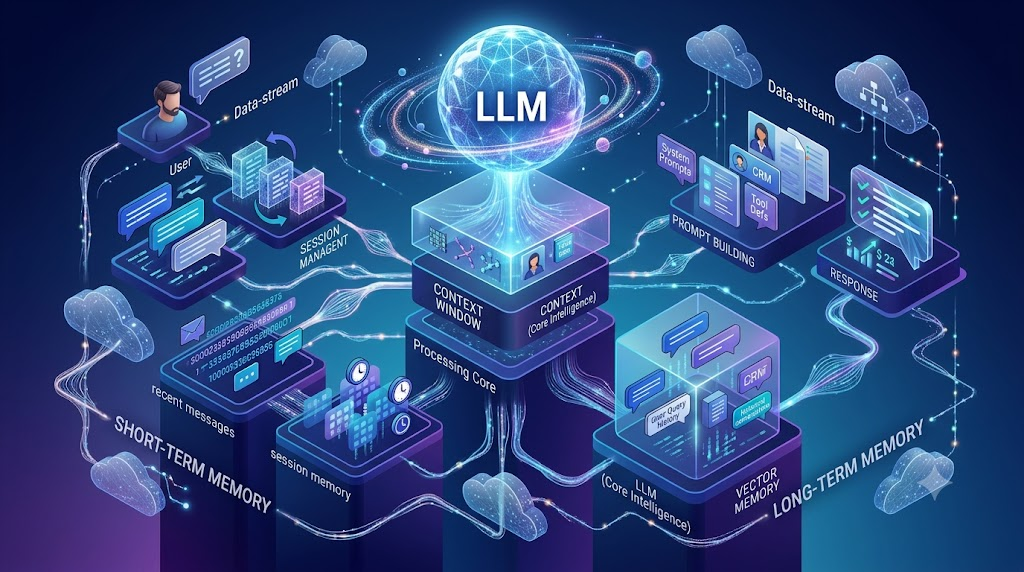
Direct Answer: When a user submits a request to an AI agent with memory, the system follows a structured retrieval and context-building process before the LLM generates a response. This workflow not prompt design determines response quality in production.
Step-by-step workflow:
- User Request: The user submits a message to the AI agent
- Memory Controller: The orchestration layer determines what memory to retrieve and from where
- Memory Retrieval: Session history is retrieved from the short-term cache; user profile and relevant documents are queued for semantic search
- Embedding Search: The user’s query is embedded and compared against stored vectors in the long-term memory index
- Vector Database Lookup: The vector DB returns the top-K most semantically similar chunks
- Ranking: Retrieved results are ranked by relevance, recency, and access permissions before injection
- Context Building: Short-term history, retrieved long-term context, and the current query are assembled into the final prompt
- LLM Inference: The assembled context is sent to the language model for response generation
- Response Delivery: The response is returned to the user
- Memory Update: Key information from the interaction is extracted and written back to long-term storage for future retrieval
The memory controller is the most underengineered component in most implementations. Teams that treat it as a simple pass-through consistently see retrieval quality degrade at scale. The memory controller should implement ranking logic, TTL enforcement, permission filtering, and deduplication before context assembly begins.
Enterprise AI Memory Architecture
A production enterprise memory architecture involves multiple coordinated layers. Each layer has a distinct responsibility, and failures at any layer degrade the entire system.
| Component | Role |
| User | Submits requests via chat, voice, or API |
| AI Agent | Orchestrates tool use, memory retrieval, and LLM calls |
| Memory Manager | Controls what is stored, retrieved, ranked, and expired |
| Short-Term Memory | Holds active session context and conversation state |
| Long-Term Memory | Persistent user profiles, interaction summaries, entity graphs |
| Vector DB | Semantic index for knowledge retrieval |
| Knowledge Base | Organizational documents, policies, and reference content |
| CRM | Customer history, preferences, and relationship data |
| Enterprise APIs | ERP, HRIS, ticketing, and operational systems |
| LLM | Language model for inference (Claude, GPT-4, Gemini, etc.) |
| Monitoring | Observability for retrieval quality, cost, latency, and drift |
One architectural principle holds consistently across enterprise deployments: the memory manager must be a first-class component, not a utility function. Organizations that implement memory management as an afterthought a few lines of code that dump conversation history into a prompt encounter retrieval quality issues, cost overruns, and security gaps within the first 90 days of production.
Memory Technologies: A Practical Reference
Vector Databases
Vector databases are the foundational storage layer for long-term semantic memory. Choosing the right one depends on your scale, infrastructure environment, and latency requirements.
| Database | Best For | Key Characteristic |
| Pinecone | Managed, cloud-native deployments | Fully managed; strong performance at scale; no infrastructure overhead |
| Weaviate | Hybrid search (vector + keyword) | Open source; supports BM25 + vector hybrid; strong for knowledge retrieval |
| Qdrant | High-performance self-hosted deployments | Written in Rust; excellent throughput; payload filtering support |
| Milvus | Large-scale enterprise deployments | Open source; designed for billions of vectors; strong horizontal scalability |
| pgvector | Teams already on PostgreSQL | Extends PostgreSQL with vector search; simplest operational model for SQL-native teams |
Embedding Models
The quality of your embeddings directly determines retrieval accuracy. Poor embedding models produce semantically noisy results regardless of how well your vector database is configured.
| Model | Provider | Notes |
| text-embedding-3-large | OpenAI | Strong general-purpose performance; widely benchmarked |
| text-embedding-3-small | OpenAI | Cost-efficient for high-volume applications |
| voyage-large-2 | Voyage AI | Strong performance on enterprise document retrieval tasks |
| BGE-M3 | BAAI | Open source; strong multilingual support; self-hostable |
| jina-embeddings-v3 | Jina AI | Long-context support; flexible task-specific encoding |
Memory Frameworks
| Framework | Primary Use Case |
| LangGraph | Stateful multi-agent workflows with persistent memory checkpoints |
| LlamaIndex | RAG architecture and knowledge base indexing with memory management |
| LangChain | General orchestration with modular memory components |
| Mem0 | Purpose-built AI memory layer with user and session memory management |
| Zep | Long-term memory for conversational AI with automatic summarization |
| Redis | High-speed session memory and short-term cache for production AI workloads |
Enterprise Use Cases for AI Memory Systems
| Industry | Memory Use Case | Memory Type Required |
| Healthcare | Patient history retrieval, clinical decision support across visits | Long-term (FHIR API integration, EHR data) |
| Finance | Client portfolio context, personalized advisory, compliance history | Long-term (CRM, transaction history) |
| Customer Support | Cross-session ticket context, returning customer recognition | Both (session context + CRM retrieval) |
| Legal | Precedent retrieval, matter history, document version tracking | Long-term (knowledge base, matter management) |
| Manufacturing | Equipment history, maintenance logs, failure pattern retrieval | Long-term (IoT data, operational logs) |
| HR | Employee career history, policy lookup, onboarding continuity | Both (session workflows + persistent profiles) |
| Sales | Prospect interaction history, deal context, competitive intelligence | Long-term (CRM, interaction summaries) |
| Internal Knowledge | Enterprise search across policies, procedures, and documentation | Long-term (vector DB + knowledge base) |
Healthcare and financial services deployments require additional memory governance controls. Patient data stored in long-term AI memory must comply with HIPAA. Financial data must align with applicable data residency and access control requirements. For healthcare specifically, FHIR API integration provides a structured interface for retrieving patient context without duplicating clinical records in an AI-specific store.
Best Practices for Enterprise AI Memory Systems
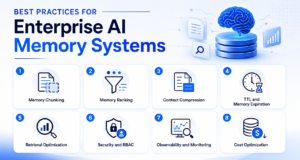
The most common source of memory system failures is not inadequate technology. It is inadequate design discipline. The practices below address the failure modes that appear most consistently in production deployments.
Memory Chunking
Split documents into semantically coherent units before indexing. Overlapping chunks (typically 10–20% overlap between adjacent chunks) prevent relevant context from being split across retrieval boundaries. Chunks that are too small lose context; chunks that are too large dilute relevance scores.
Memory Ranking
Not all retrieved memory is equally useful. Implement a ranking layer that weighs semantic similarity alongside recency, source authority, and user-specific relevance signals. Without ranking, high-scoring but irrelevant memories contaminate the context window.
Context Compression
Before injecting retrieved memory into the context window, compress and deduplicate. Sending five similar memory chunks when one summarized chunk would suffice wastes tokens, increases cost, and can confuse the model with redundant information.
TTL and Memory Expiration
Assign time-to-live values to stored memories based on how quickly information becomes stale in your domain. A customer’s shipping address from three years ago may be outdated. An enterprise AI that retrieves and acts on stale data erodes user trust faster than no memory at all.
Retrieval Optimization
Monitor retrieval hit rate, false positive rate, and query latency continuously. Retrieval quality is the primary driver of response quality in RAG-based memory systems. Teams that optimize prompts while ignoring retrieval metrics consistently plateau before they solve the real problem.
Security and RBAC
Memory retrieval must enforce role-based access control at query time, not just at write time. A customer service agent should not retrieve executive compensation data through an AI assistant, even if both are indexed in the same vector database. Implement permission metadata on every stored memory and filter results before context injection.
Observability and Monitoring
Instrument memory retrieval with logging for query latency, retrieved chunk IDs, relevance scores, and which memories were ultimately injected. Without this data, debugging poor responses becomes guesswork. Monitoring also enables proactive detection of memory drift a condition where stored knowledge becomes progressively more outdated relative to current organizational reality.
Cost Optimization
Track token consumption per memory retrieval path separately from direct inference costs. In high-volume deployments, poorly scoped retrieval returning ten chunks when two would suffice can double effective token costs. Set retrieval budgets and enforce them at the memory manager level.
Common Mistakes in AI Memory System Design
Direct Answer: Most AI memory failures are architectural, not algorithmic. The mistakes below appear repeatedly across enterprise deployments and are preventable with deliberate design.
Storing everything without discrimination
Not every piece of information deserves to be in long-term memory. Storing low-value content generic greetings, navigational exchanges, system confirmations pollutes the memory index and degrades retrieval precision. Define explicit criteria for what qualifies as worth storing before writing a single record.
No relevance ranking on retrieval
Returning the top-K results by cosine similarity without a secondary ranking pass produces noisy context. Add a reranking step using a cross-encoder model or business logic before injecting retrieved memory into the prompt.
No memory expiration policy
Memory without TTL accumulates indefinitely. Stale memories outdated policies, superseded product versions, resolved issues will eventually surface in responses and undermine user trust. Define and enforce expiration rules from the start.
Prompt stuffing
Injecting retrieved memory without context compression or deduplication bloats the context window, increases cost, and can degrade response coherence. Retrieved memory should be ranked, compressed, and scoped before injectionnot dumped wholesale into the prompt.
Ignoring permissions at retrieval time
Access control applied only at the application layer is insufficient. Permissions must be enforced at the vector database query level. Retrieval systems that return results from restricted sources and rely on downstream filtering have already violated the access boundary.
No monitoring on memory quality
Memory systems degrade silently. Without monitoring for retrieval accuracy, staleness, and coverage gaps, teams discover failures through user complaints rather than system alerts. Instrument memory pipelines from day one.
Duplicate memories
Without deduplication, the same information gets written multiple times across sessions. Duplicate memories inflate storage costs, skew similarity rankings, and can introduce contradictory versions of the same fact into the context window.
The Future of AI Memory Systems
Direct Answer: AI memory architecture is evolving from static retrieval toward dynamic, continuously learning systems. The patterns emerging now will define enterprise AI agent capabilities over the next three to five years.
Agentic AI and Persistent Memory
As AI agents move from single-task execution to long-running autonomous workflows, persistent memory becomes essential infrastructure rather than an enhancement. Agentic systems running across days or weeks require memory architectures that support complex state management, decision history, and goal tracking capabilities that current session-based designs do not address.
Memory Graphs and Knowledge Graphs
Flat vector indexes work well for semantic similarity but poorly represent relationships between entities. Hybrid architectures combining vector databases with knowledge graphs allow AI agents to reason about relationships “the vendor that supplies part X is owned by the same parent company as vendor Y” not just retrieve documents.
Hybrid Memory
Production memory systems are converging toward hybrid architectures that combine short-term session context, long-term vector retrieval, structured database lookups, and graph traversal within a single unified retrieval pipeline. The memory manager becomes a routing and orchestration layer rather than a simple index query.
Continuous Learning
Organizations are exploring feedback loops that update long-term memory based on user corrections, resolution outcomes, and explicit ratings. A customer support agent that learns which responses actually resolve issues and stores that signal in its memory layer improves over time without retraining the underlying model.
Personal AI
Consumer and enterprise personal AI products require memory architectures that accumulate genuine user knowledge over months and years. This places new demands on memory security, retention policies, and user control dimensions that align directly with NIST AI RMF guidance on individual privacy and data stewardship.
Enterprise Recommendations: What to Build and in What Order
Direct Answer: Start with short-term memory. Get retrieval working reliably before introducing persistence. Then build long-term memory with explicit chunking, ranking, TTL, and RBAC from day one. The order matters.
Organizations approaching AI memory architecture for the first time frequently attempt to build both layers simultaneously. This produces systems that are difficult to debug because it is unclear whether a failure originates in session management, retrieval quality, or context assembly. Build incrementally.
Phase 1: Implement session memory with conversation history management and context compression. Validate that single-session interactions work correctly before introducing any long-term storage.
Phase 2: Add long-term knowledge retrieval through a vector database. Start with a single knowledge domain support documentation, HR policies, product specifications rather than indexing everything at once. Measure retrieval precision before expanding scope.
Phase 3: Introduce user-level persistent memory: preferences, interaction summaries, entity profiles. Implement RBAC at the vector database layer before any user data enters the index.
Phase 4: Add monitoring, TTL enforcement, and cost tracking. These are not optional at scale. Memory systems that are not monitored from launch will generate budget surprises and user trust failures within the first quarter.
Phase 5: Evaluate hybrid architectures, memory graphs, knowledge graphs, cross-session summarization once phases one through four are stable and instrumented.
One pattern holds across every enterprise memory deployment we have worked on: the teams that invest early in retrieval quality measurement consistently outperform those that invest in model selection. The quality of what you retrieve determines the quality of what the model generates. That relationship is not reversible through prompt engineering.