Most organizations don’t struggle with a lack of data. They struggle with fragmented data spread across dozens of systems that don’t talk to each other, growing data volumes that outpace their infrastructure, and business teams demanding real-time insights from pipelines that were built for overnight batch jobs. Add in AI workloads, governance requirements, and multi-cloud environments, and the complexity compounds quickly.
The organizations that navigate this complexity well share one thing in common: they treat data architecture as a first-class engineering discipline not an afterthought, and not something that emerges organically from tool selection. They define requirements before choosing platforms. They design for scalability before hitting the limits of their current setup. And they build governance and observability into the architecture from the start, rather than bolting it on after problems emerge.
This guide is built for CTOs, CIOs, data engineering managers, and enterprise architects who need a clear, technically grounded reference for designing or modernizing a Cloud data engineering architecture. It covers what the architecture actually is, how data moves through its layers, how to choose between competing patterns and platforms, and how to avoid the mistakes that turn data platforms into technical debt.
What Is Cloud Data Engineering Architecture?
Cloud data engineering architecture is the structured design that governs how data is collected, moved, stored, transformed, and made available for consumption across cloud-based infrastructure. It is not a single platform or tool. It is a system of decisions about how data moves, where it is stored, how it is processed, who can access it, and how it scales under load.
The data journey through a modern architecture follows a consistent logical path: Data Sources → Ingestion → Storage → Processing → Transformation → Orchestration → Serving → Analytics and AI. Each stage in that journey involves distinct engineering decisions, and those decisions compound. A poor ingestion design creates bottlenecks downstream. Inconsistent transformation logic corrupts analytical outputs. Weak governance creates compliance exposure and erodes trust in data.
Cloud data engineering architecture formalizes these decisions into a coherent, maintainable system. The goal is a platform that reliably delivers accurate, timely, and trusted data to the teams and systems that need it.
How Does a Cloud Data Engineering Architecture Work?
To make this concrete, consider a mid-sized SaaS business with a mix of operational databases, a CRM, a marketing automation platform, product event streams, and external APIs. Each of these is a data source, and each produces data at a different frequency, in a different format, and at a different volume.
The architecture works by pulling all of that data into a centralized or federated system, processing it into a usable form, and making it available to downstream consumers BI dashboards, data science models, customer-facing features, and operational workflows.
The conceptual flow looks like this:
Data Sources → Data Ingestion → Raw Storage → Processing and Transformation → Data Warehouse or Lakehouse → Analytics, BI, and AI
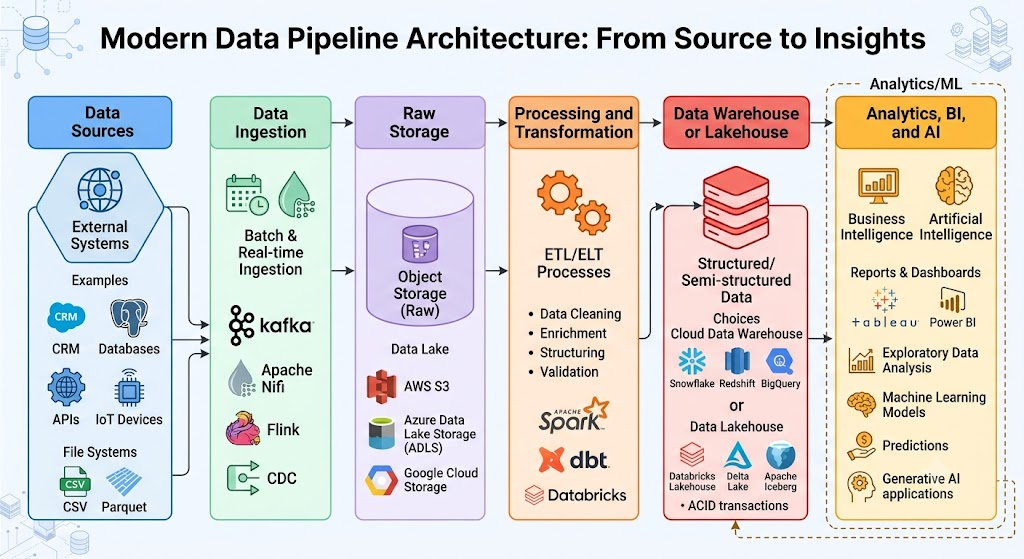
Each arrow in that flow represents engineering decisions.
How is data ingested batch or streaming?
Where does raw data land first?
What transformation logic runs before data reaches the warehouse?
How are failures handled? How is data quality enforced?
These are the questions that cloud data engineering architecture is designed to answer systematically.
Core Components of a Modern Cloud Data Engineering Architecture
1. Data Sources
Data sources are the origin points of all data in the architecture. In enterprise environments, these typically include:
- Operational databases: PostgreSQL, MySQL, SQL Server, Oracle
- SaaS platforms: Salesforce, HubSpot, Zendesk, Marketo
- Internal APIs and microservices: application events, transactional data
- Log systems: application logs, infrastructure metrics, security events
- Event streams: Kafka topics, Kinesis streams, pub/sub systems
- IoT devices: sensor data, telemetry, real-time feeds
- Third-party data: enrichment providers, market data, geolocation feeds
The diversity of data sources is the first architectural challenge. Each source has a different schema, update frequency, access method, and reliability characteristic. The ingestion layer must account for all of this variation without creating brittle, one-off integrations.
2. Data Ingestion Layer
The data ingestion layer is responsible for reliably extracting data from sources and moving it into the storage layer. The primary ingestion patterns are:
- Batch ingestion: scheduled extraction of data at set intervals (hourly, daily, weekly). Lower cost, simpler to operate, appropriate when latency tolerance is high.
- Real-time streaming ingestion: continuous ingestion of events as they occur using tools like Apache Kafka, Amazon Kinesis, or Google Pub/Sub. Required when downstream use cases depend on low-latency data.
- Change Data Capture (CDC): tracking row-level changes in operational databases and propagating them to the data platform without full table scans. Tools like Debezium make CDC practical at scale.
- API-based ingestion: pulling data from third-party platforms via REST or GraphQL APIs, typically on a scheduled basis.
The ingestion architecture should also handle retries, deduplication, schema evolution, and backpressure especially in streaming contexts where producers can outpace consumers.
3. Data Storage Layer
The storage layer is where ingested data lands and lives. Three models dominate modern cloud data architecture:
- Data lakes: object storage (S3, ADLS, GCS) that accepts any format structured, semi-structured, or unstructured. Low cost, flexible, but requires careful governance to avoid becoming a “data swamp.”
- Data warehouses: columnar databases (Snowflake, BigQuery, Redshift) optimized for structured data and analytical queries. High performance for BI workloads, but schema-on-write means less flexibility.
- Data lakehouses: a hybrid model combining the flexibility of lakes with the performance and governance features of warehouses. Platforms like Databricks (Delta Lake), Apache Iceberg, and Apache Hudi enable ACID transactions, schema enforcement, and time travel on object storage.
The right storage model depends on data types, query patterns, team capability, and budget not on which platform has the most impressive feature list.
4. Data Processing and Transformation
Processing and transformation convert raw ingested data into structured, reliable, business-ready datasets. The two dominant frameworks are:
- ETL (Extract, Transform, Load) data is transformed before it reaches the warehouse. Common in legacy architectures where storage was expensive and transformation happened in dedicated processing layers.
- ELT (Extract, Load, Transform) raw data loads into the warehouse or lake first, then transformation happens using SQL-based tools like dbt. Better suited to modern cloud architectures where storage is cheap and compute is elastic.
Beyond ETL vs. ELT, processing can be batch (Spark, dbt batch runs) or stream-based (Flink, Spark Streaming, Kafka Streams), depending on latency requirements. The trade-off is always cost, complexity, and operational overhead against business value.
5. Data Orchestration
Orchestration is the control plane of the pipeline. It schedules jobs, manages dependencies between tasks, handles retries on failure, and monitors pipeline health. Without orchestration, data pipelines become manual, fragile processes.
Apache Airflow remains the most widely adopted orchestration platform in enterprise environments. Prefect and Dagster offer more modern developer experiences, with better support for dynamic workflows and data-aware scheduling. Cloud-native options like AWS Step Functions and Azure Data Factory integrate tightly with managed cloud services.
Good orchestration design includes clear retry logic, alerting on failures, dependency management between pipeline stages, and visibility into pipeline run history.
6. Data Serving Layer
The serving layer makes processed data available to downstream consumers. Those consumers vary significantly:
- BI tools Tableau, Looker, Power BI, Metabase
- Analytics platforms self-serve SQL environments, data notebooks
- ML and AI systems feature stores, model training pipelines, inference services
- Customer-facing applications embedded analytics, real-time recommendation engines, personalization systems
The serving layer should be designed around consumption patterns. Aggregated, pre-computed datasets work well for dashboards. Low-latency serving layers (operational databases, caches, vector stores) are needed for real-time application features and AI workloads.
7. Security, Governance, and Data Quality
Security and governance are not separate concerns they are architectural requirements that must be designed in from the start.
- Access controls role-based and attribute-based access controls ensure that data is accessible only to authorized users and systems.
- Data lineage tracking where data originated and how it was transformed is essential for debugging, auditing, and compliance.
- Data quality monitoring automated checks on completeness, accuracy, and consistency at each pipeline stage prevent corrupt data from propagating downstream.
- Compliance and encryption GDPR, HIPAA, SOC 2, and other regulatory frameworks impose specific requirements on data residency, encryption at rest and in transit, and audit logging.
- Data ownership every dataset should have a clearly assigned owner responsible for its accuracy, freshness, and access management.
Platforms like Apache Atlas, DataHub, and Monte Carlo address lineage and observability at scale. dbt’s built-in tests handle transformation-layer quality checks. The key is building these controls into the architecture, not adding them reactively when a compliance audit arrives.
The 6-Layer Cloud Data Engineering Architecture
A useful way to frame the complete architecture is as six distinct but interconnected layers:
- Layer 1: Data Sources all origin systems producing data for the platform
- Layer 2: Data Ingestion the mechanisms that extract and move data into the platform (batch, streaming, CDC, API)
- Layer 3: Data Storage the landing zones and repositories where data persists (lake, warehouse, lakehouse)
- Layer 4: Processing and Transformation the compute layer that cleans, models, and enriches raw data
- Layer 5: Orchestration and Governance the control and compliance layer (scheduling, lineage, quality, access, monitoring)
- Layer 6: Data Consumption the interfaces through which business teams, analysts, and machines consume data
This six-layer model provides a clear mental framework for diagnosing where pipeline problems originate, where bottlenecks exist, and where investment should be focused as data volumes and use cases grow.
Reference Cloud Data Engineering Architecture
A practical reference architecture for a mid-sized or enterprise organization might look like this:
Data Sources: CRM (Salesforce), ERP (SAP or NetSuite), product application databases (PostgreSQL), customer interaction platforms (Zendesk, Intercom), marketing platforms (HubSpot, Marketo), event streams from mobile and web applications, and third-party enrichment APIs.
Layer 2: Ingestion: Airbyte or Fivetran for SaaS and database connectors; Kafka or Kinesis for event streams; Debezium for CDC from operational databases.
Layer 3: Storage: Raw data lands in object storage (S3, ADLS, or GCS). Curated and modeled data lives in a cloud data warehouse (Snowflake, BigQuery, or Redshift) or a lakehouse platform (Databricks with Delta Lake).
Layer 4: Processing: dbt handles SQL-based transformations in the warehouse. Spark handles complex batch transformations and large-scale data processing. Flink or Spark Streaming handles real-time processing for time-sensitive workloads.
Layer 5: Orchestration and Governance: Airflow or Dagster for pipeline orchestration. DataHub or Apache Atlas for lineage and metadata. Monte Carlo or dbt tests for data quality monitoring. Cloud-native IAM for access control. A dedicated data catalog for ownership and discoverability.
Layer 6: Consumption: Tableau or Looker for BI. Jupyter notebooks or Hex for analytical exploration. Vertex AI, SageMaker, or Azure ML for model training. Feature stores for ML serving. Operational databases or caches for real-time application features.
Technology choices at each layer should follow requirements not the other way around. The right stack depends on cloud environment, team expertise, data volumes, latency requirements, compliance obligations, and existing infrastructure investments.
Batch vs. Real-Time Data Pipelines: Which Should You Choose?
Quick answer: Most enterprise data needs are well-served by batch pipelines. Real-time infrastructure is appropriate when the business has specific, validated use cases that require sub-minute data latencyand the engineering capacity to operate streaming systems reliably.
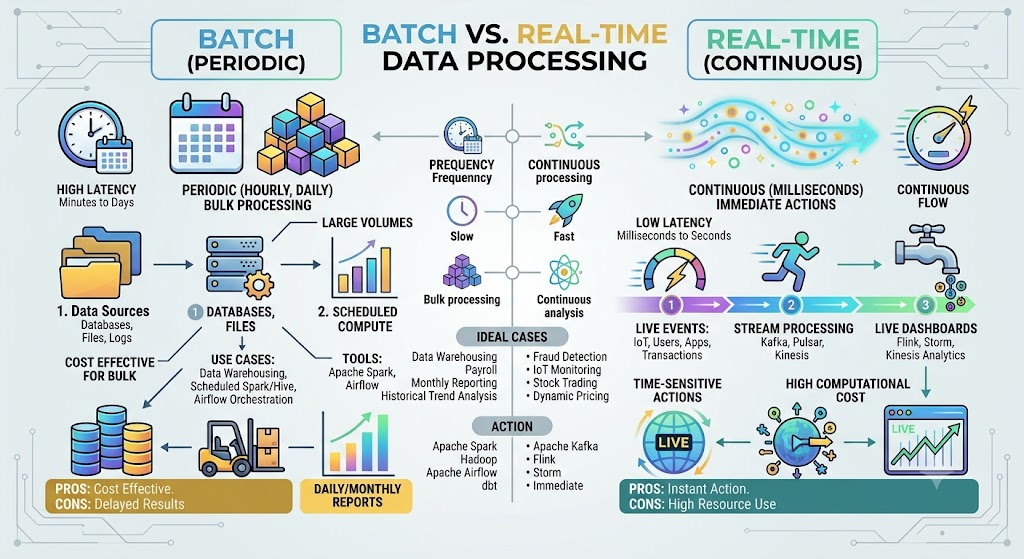
| Dimension | Batch Processing | Real-Time Streaming |
|---|---|---|
| Data latency | Minutes to hours | Milliseconds to seconds |
| Cost | Lower | Higher |
| Operational complexity | Low to moderate | High |
| Typical use cases | Financial reporting, data warehouse updates, historical analytics | Fraud detection, live dashboards, IoT monitoring, dynamic pricing |
| Infrastructure requirements | Standard compute, scheduled jobs | Persistent message brokers, stream processing engines |
Batch pipelines are simpler to build, easier to debug, and cheaper to run. A daily financial report, a weekly data warehouse refresh, or a historical analytics job does not need streaming infrastructure. Adding real-time complexity to these use cases introduces cost and operational burden with no meaningful business return.
Real-time data pipelines are worth the investment when the business outcome genuinely depends on low-latency data. Fraud detection systems that evaluate transactions in real time, IoT platforms monitoring equipment failure, or live pricing engines that respond to demand signals these are legitimate streaming use cases.
The decision should start with the business requirement, not a preference for modern tooling. Poorly justified real-time infrastructure is one of the most common sources of unnecessary cloud costs and engineering overhead.
Data Lake, Data Warehouse, or Lakehouse: Where Does Each Fit?
Quick answer: Use a data lake for raw, unstructured, or high-volume data where flexibility matters. Use a data warehouse for structured, analytics-ready data where query performance and governance are priorities. Use a lakehouse when you need both particularly for organizations running ML workloads alongside BI.
The decision framework depends on several factors:
- Data types: Unstructured or semi-structured data (JSON logs, documents, images) is better suited to a lake. Structured, relational data optimized for BI queries belongs in a warehouse.
- Analytics requirements: If your primary consumers are SQL-based BI tools, a warehouse is the right home. If data scientists need raw access to unprocessed data, the lake provides that flexibility.
- AI and ML workloads: Training large models requires access to raw data at scale a lake or lakehouse is better suited here than a traditional warehouse.
- Governance requirements: Warehouses offer stronger schema enforcement and access controls out of the box. Lakes require more deliberate governance design to avoid becoming unmanageable.
- Team expertise: ELT workflows centered on dbt and a cloud warehouse are more accessible to SQL-oriented analytics teams. Lakehouse architectures with Spark and Delta Lake require deeper engineering expertise.
- Cost: Object storage is dramatically cheaper per gigabyte than warehouse compute. For very large data volumes with infrequent query patterns, a lake or lakehouse reduces storage costs significantly.
Many mature enterprise platforms use all three in combination landing raw data in a lake, running transformations into a warehouse for BI, and using a lakehouse layer for ML and advanced analytics workloads.
AWS vs. Azure vs. Google Cloud for Data Engineering
No cloud platform is universally best for data engineering. The right choice is the one that fits your organization’s existing infrastructure, team expertise, compliance requirements, and long-term roadmap.
AWS offers the broadest ecosystem of managed data services. S3 provides a mature object storage foundation. Glue, EMR, Kinesis, Redshift, and Lake Formation cover the full pipeline spectrum. Organizations already invested in the AWS ecosystem or those prioritizing breadth of service options often find AWS the natural fit.
Microsoft Azure integrates tightly with the Microsoft enterprise stack. Azure Synapse Analytics, Azure Data Factory, Azure Data Lake Storage, and Azure Databricks form a coherent enterprise data platform. Organizations running Microsoft 365, SQL Server, or Power BI at scale often find that Azure integration reduces friction and simplifies governance.
Google Cloud has particular strength in analytics and AI workloads. BigQuery remains one of the most capable serverless data warehouse platforms available. Vertex AI, Dataflow, and Pub/Sub are mature services for ML and stream processing. Organizations building AI-heavy data platforms or already using Google Workspace often find Google Cloud the most natural home.
The practical advice here is simple: choose based on fit with your existing environment, your team’s skills, and your specific workload requirements not on analyst rankings or vendor positioning. As a reference, Snowflake vs Databricks breaks down two of the most common platform decisions within the data warehouse and lakehouse category.
Common Cloud Data Engineering Architecture Patterns
Centralized Data Platform: A single platform serves all data consumers across the organization. Strong governance and consistency, but can become a bottleneck in large, distributed organizations.
Data Lake Architecture: Raw data lands in object storage and is processed on demand. Highly flexible for diverse data types and ML workloads, but requires deliberate governance to stay organized and trustworthy.
Modern Data Warehouse Architecture: Structured, ELT-driven architecture centered on a cloud data warehouse. Well-suited to SQL-oriented analytics teams and BI-heavy workloads. Cleaner governance, less flexibility for raw or unstructured data.
Lakehouse Architecture: Combines lake storage with warehouse-grade performance and governance using table formats like Delta Lake, Apache Iceberg, or Apache Hudi. The preferred pattern for organizations running both BI and ML workloads at scale.
Event-Driven Architecture: Data flows continuously through event streams rather than scheduled batch jobs. Enables real-time data products and decoupled microservice architectures. High operational complexity justified when business use cases genuinely require it.
Pattern selection should follow the organization’s data characteristics, team capability, and use case requirements. Many enterprises operate a hybrid a warehouse for BI, a lakehouse for ML, and event streaming for specific real-time features.
Enterprise Use Cases for Cloud Data Engineering
Healthcare: Patient data integration across clinical systems, EHRs, and operational platforms; real-time operational analytics for care coordination; data governance frameworks aligned with HIPAA; automated pipelines for regulatory reporting and clinical research.
Insurance: Claims processing pipelines that aggregate data from multiple sources; risk analytics models that draw on historical claims, market data, and third-party enrichment; customer data integration across policy, billing, and service systems.
FinTech: Transaction analytics pipelines supporting real-time fraud detection; regulatory reporting data warehouses aligned with compliance requirements; customer behavior analytics driving personalization and product development.
Ecommerce: Customer analytics integrating web, mobile, and transaction data; inventory and supply chain data pipelines for demand forecasting; recommendation system pipelines processing behavioral event streams.
SaaS and Technology: Product analytics platforms tracking feature usage, adoption, and churn signals; event-driven pipelines processing user interaction data at scale; customer success analytics integrating product, CRM, and support data.
Common Mistakes When Designing a Cloud Data Engineering Architecture
1. Choosing tools before defining requirements. The most expensive architectural mistakes start with a tool decision rather than a business requirement. Tech selection follows requirements not the other way around.
2. Overengineering real-time infrastructure. Streaming systems are expensive and complex to operate. Most use cases that teams believe require real-time infrastructure actually work fine with five-minute or hourly batch pipelines.
3. Ignoring data governance. Access controls, lineage, and data ownership cannot be retrofitted efficiently. Build them into the architecture from day one.
4. Poor data quality monitoring. A pipeline that runs successfully but produces inaccurate data is worse than a failed pipeline because the failure isn’t visible until it affects business decisions.
5. Creating too many disconnected pipelines. When individual teams build their own pipelines independently, the organization ends up with overlapping, contradictory datasets and no single source of truth.
6. Ignoring cloud costs. Poor architecture decisions are a significant driver of cost overruns in data engineering. Storage tiers, compute allocation, data transfer costs, and query patterns all have material cost implications.
7. Building without observability. Without monitoring, alerting, and lineage tracking, pipeline failures are discovered by business users not engineers.
8. Designing without clear data ownership. Every dataset should have an owner. Without ownership, data quality degrades and no one is accountable for fixing it.
9. Using architecture patterns the team cannot maintain. A sophisticated lakehouse architecture is not an asset if the team lacks the skills to operate it. Architecture should match team capability, not aspirations.
10. Treating data security as an afterthought. Encryption, access controls, and audit logging must be designed in not layered on after the platform is built.
How to Design the Right Cloud Data Engineering Architecture
A structured design process follows this sequence:
- Business goals: What decisions and outcomes will the architecture support?
- Data sources: What systems produce data, and how is it accessed?
- Data volume and velocity: How much data, and how frequently does it change?
- Analytics and AI requirements: What are the downstream consumption patterns?
- Security and compliance: What regulatory frameworks apply, and what controls are required?
- Team skills: What can the existing team build and operate reliably?
- Cloud environment: What infrastructure is already in place, and what constraints exist?
- Architecture pattern: Which pattern fits the above requirements?
- Technology selection: Which tools best implement the chosen pattern within the given constraints?
This sequence matters. Organizations that skip from step one to step nine jumping straight to technology selection without working through requirements consistently build architectures that fail to scale, cost more than expected, or don’t serve the actual business need.
Cloud Data Engineering Architecture Checklist
Before finalizing an architecture design, work through these twelve questions:
- Have all data sources been identified, including their formats, update frequencies, and access methods?
- Is the required data latency clearly defined for each downstream use case?
- Do any use cases genuinely require real-time infrastructure, or will batch pipelines meet the need?
- Is the storage model (lake, warehouse, lakehouse) matched to the data types and query patterns?
- Is there a defined transformation framework (ETL vs. ELT) with clear ownership of transformation logic?
- Does the architecture include automated data quality checks at each pipeline stage?
- Is there a defined owner for each dataset, responsible for accuracy and freshness?
- Is pipeline observability built in monitoring, alerting, and failure notification?
- Are security controls, access policies, and compliance requirements defined in the architecture spec?
- Is there a cost management strategy storage tiers, compute allocation, query optimization?
- Can the existing team build, operate, and maintain this architecture without unsustainable overhead?
- Is the serving layer designed around the actual consumption patterns of analytics, BI, and AI consumers?
Building a Data Architecture That Can Scale With Your Business
The fundamental purpose of cloud data engineering architecture is to ensure that data however diverse its origins, however large its volume, however complex its downstream use cases reaches the people and systems that need it reliably, accurately, and at the right time.
Getting there requires more than selecting capable tools. It requires defining business requirements before making technology choices, designing governance and observability into the architecture from day one, choosing patterns that match both the data characteristics and the team’s ability to operate them, and continuously evaluating whether the architecture is serving the organization’s evolving needs.
The organizations that do this well build data platforms that accelerate decision-making, enable AI and analytics at scale, and create a durable competitive advantage. The organizations that approach it reactively adding tools as problems emerge, ignoring governance until compliance demands it, building real-time infrastructure because it seems modern accumulate technical debt that becomes progressively harder and more expensive to resolve.
If your organization is designing, migrating, or modernizing a cloud data platform, the decisions made now will shape your data capability for years. Working with experienced data engineering services ensures those decisions are grounded in practical architecture knowledge, not vendor positioning. Enlight Lab’s data engineering consulting helps enterprise and growth-stage organizations design architectures that are scalable, reliable, and built to last from initial design through to production implementation. Get in touch to discuss your requirements.