The cloud landscape shifts constantly. What worked for a growing startup three years ago might severely bottleneck operations today. Most companies are just renting servers on the internet, not driving the game-changing innovation.
We frequently see startup founders and CTOs treat “Cloud Transformation Vs Cloud Migration” as interchangeably synonymous. They are not. Mistaking one for the other often leads to severe budget overruns and missed opportunities.
According to a McKinsey report on cloud adoption, inefficiencies in orchestrating these moves result in an estimated $100 billion of wasted migration spend globally over a three-year period.
You know the future requires modern infrastructure, but the path forward often feels obscured by competing methodologies and vendor promises. However, simply moving data to a different server is not enough. There’s a world of difference between shifting your operations and fundamentally transforming how your business runs to compete in the AI-driven market.
As technical leaders plan for the future, understanding the exact terminology and strategic implications of cloud adoption is crucial. With 38% of migration projects running over budget, you can’t afford to get it wrong.
This guide cuts through the tech jargon to give you a clear, actionable framework. You’ll walk away knowing exactly which path aligns with your long-term growth goals, ensuring your cloud strategy is a launchpad for innovation, not just an expensive line item.
What is the difference between Cloud Transformation and Cloud Migration?
Cloud migration is the process of moving your existing digital assets, IT resources, and applications from on-premise servers to the cloud. Cloud transformation, on the other hand, is a strategic overhaul that uses cloud technologies like AI and microservices to fundamentally reinvent your business processes, product offerings, and organizational culture.
Cloud Migration: The Stepping Stone to Modernization
Think of cloud migration like moving your business from an old, self-managed office building to a state-of-the-art skyscraper.
You’re bringing your existing furniture, files, and operations, but placing them in a more secure, flexible, and efficient environment. You haven’t fundamentally changed what you do, but you’ve upgraded where you do it.
This move from on-premise servers to a cloud provider like AWS, Google Cloud, or Azure is often the first crucial step toward modernization.
You can choose this “lift and shift” approach when speed is your primary objective, and you want to abandon on-premises server maintenance quickly.
Why Migrate? Key Drivers and Benefits
Startups don’t move to the cloud just for the sake of it; they do it for tangible business advantages. The primary drivers include:
Cost Reduction
The most significant shift is moving from a Capital Expenditure (CapEx) model to an Operational Expenditure (OpEx) one. Instead of sinking thousands of dollars into physical servers you have to buy, maintain, and eventually replace, you pay a monthly fee only for the resources you actually use.
- Avoid upfront investments in hardware and infrastructure.
- Eliminate maintenance costs tied to physical servers.
- Scale resources up or down based on demand, avoiding over-provisioning.
- Pay only for what you use, leading to predictable monthly expenses.
- Reduce energy costs by utilizing cloud providers’ optimized data centers.
Scalability on Demand
Remember the last time a marketing campaign went viral and your website crashed? With the cloud, you can automatically scale your resources to handle sudden traffic spikes and scale back down when things quiet down, ensuring a smooth customer experience without overpaying for capacity you don’t need.
- Automatically adjust resources in real-time to meet traffic needs.
- Prevent downtime during high-demand events or viral campaigns.
- Avoid overpaying for unused resources by scaling back when demand decreases.
- Ensure a seamless and responsive experience for your customers.
- Gain peace of mind knowing your system can handle fluctuating workloads.
Sharpened Focus
Every hour your team spends maintaining physical IT infrastructure is an hour they aren’t spending on your core product. Migration lets you offload server maintenance, security patching, and hardware issues to the cloud provider, freeing up your founders and engineers to focus on innovation and growth.
- Identify time-intensive IT infrastructure tasks currently handled in-house.
- Evaluate cloud providers for their ability to manage server maintenance and security patching.
- Create a migration plan to minimize downtime and disruptions.
- Train your team on managing cloud-based systems and tools.
- Monitor and assess freed-up resources to redirect toward innovation and product development.
The 6 R’s of Migration: Your Practical Playbook
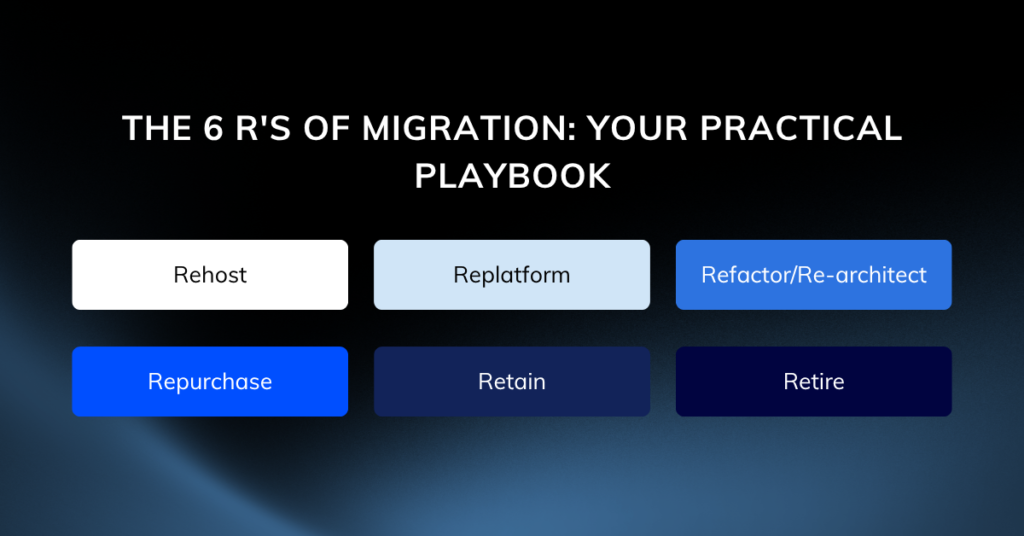
Not all migrations are the same. Gartner outlined six common strategies, often called the “6 R’s,” to help you choose the right path:
1. Rehost
The fastest and most straightforward approach. You essentially copy your existing servers and applications to the cloud with minimal changes. It’s a quick win for reducing infrastructure costs but offers limited long-term benefits as you aren’t optimizing for the cloud environment.
2. Replatform
A middle ground. You move your applications to the cloud while making a few key optimizations—like switching to a managed database service—to get better performance without a full rewrite.
3. Refactor/Re-architect
This is the most intensive strategy, involving rewriting your application to be “cloud-native.” It delivers the highest efficiency, performance, and scalability but requires significant upfront investment and time.
4. Repurchase
Ditch your old software and move to a Software-as-a-Service (SaaS) model. Think of moving from a self-hosted email server to using Google Workspace or Microsoft 365.
5. Retain
Sometimes, the best move is no move at all. You might decide to keep certain applications on-premise due to strict compliance requirements, latency issues, or because the cost of migrating them outweighs the benefits.
6. Retire
Migration is the perfect time for house-cleaning. Identify applications or services that are no longer needed and decommission them, saving money and reducing complexity.
The Hidden Roadblocks: Why Migrations Stall
Despite the clear benefits, a staggering 31% of cloud migration projects fail to meet their deadlines. Why? The path is often littered with hidden roadblocks:
- Vendor Lock-In: It can be easy to migrate into a cloud provider’s ecosystem but notoriously difficult and expensive to leave.
- Compliance and Security Fears: Misunderstanding data residency laws or improperly configuring security settings can lead to compliance nightmares.
- The Nightmare of Data Egress Fees: Cloud providers make it cheap to upload data, but they often charge a premium to move it out. Unexpected egress fees can blow budgets and halt projects in their tracks.
Cloud Migration Checklist: A Step-by-Step Guide
Assess Current Infrastructure
Evaluate your existing IT environment to identify which applications, data, and workloads are suitable for cloud migration.
Define Your Migration Goals
Set clear objectives for your cloud migration, such as:
- Improving scalability
- Reducing costs
- Enabling remote work capabilities
Choose the Right Cloud Provider
Choose a cloud provider that aligns with your business needs by considering:
- Services: Do they offer the specific cloud services you require (e.g., IaaS, PaaS, SaaS)?
- Features: Evaluate features like performance, security, and geographic availability.
- Pricing Models: Compare pricing structures (e.g., pay-as-you-go, reserved instances) to find the most cost-effective option for your usage patterns.
Create a Migration Strategy
Plan your migration process by deciding which strategy to use for your applications:
- Rehost: Move your applications to the cloud with minimal changes.
- Refactor: Make moderate adjustments to optimize applications for the cloud.
- Rebuild: Redevelop your applications from scratch on the cloud platform.
- Replace: Switch to a new, cloud-native application (e.g., a SaaS product).
Prioritize Applications and Data
Decide which applications and data to migrate first by considering:
- Complexity: How difficult will the migration be?
- Importance: How critical is the application or data to your business?
- Dependency: What other systems rely on this application or data?
Perform Data Backup
Create a full backup:
- Back up all existing data before starting the migration.
- This is a crucial step to prevent data loss during the process.
Test the Migration Plan
Run small-scale tests:
- Ensure the migration plan works as expected.
- Identify potential issues before the full migration.
Execute the Migration
- Carry out the migration according to the established plan.
- Move workloads to the cloud in phases or increments to minimize disruptions.
Validate Migration Success
- Post-migration checks: Confirm that all systems, applications, and data are functioning correctly in the cloud.
- Functionality verification: Ensure everything works as expected in the new environment.
Monitor and Optimize
- Continuous Monitoring: Keep a close eye on performance, security, and resource usage.
- Optimization: Make necessary adjustments to enhance the new cloud environment.
Real-World Startup Example:
A Series B FinTech company was struggling with frequent downtime during peak trading hours, damaging customer trust. They executed a quick “lift and shift” (Rehost) migration over a single weekend. Instantly, their stability improved by leveraging the cloud provider’s robust infrastructure. While this didn’t solve all their underlying architectural issues, it bought them six crucial months of stability and breathing room to meticulously plan a larger, more strategic cloud transformation without the constant pressure of firefighting.
Cloud Transformation: The Journey to Business Reinvention
If cloud migration is like moving your business into a more efficient office building, cloud transformation is demolishing the old office and building a futuristic smart-hq from the ground up. It’s a complete reinvention, not just a relocation. Transformation involves fundamentally redesigning your business model by leveraging powerful cloud-native tools, particularly AI and machine learning, to unlock new possibilities.
Why Transform? Unlocking Next-Level Growth
Transformation isn’t about incremental improvements; it’s about creating an exponential leap forward.
AI and Automation
Cloud-native environments are the perfect playground for deploying custom AI agents that can automate complex workflows, from data analysis to customer service. Imagine intelligent systems that not only perform tasks but also learn and optimize them over time.
Hyper-Personalized Customer Experiences
By harnessing big data analytics in the cloud, you can move beyond generic customer segments and deliver hyper-personalized experiences that anticipate user needs and foster loyalty.
Unmatched Agility
Leave behind the days of releasing software twice a year. A transformed business embraces DevOps, enabling you to deploy updates, features, and fixes multiple times a day, keeping you lightyears ahead of the competition.
The Three Core Pillars of Transformation
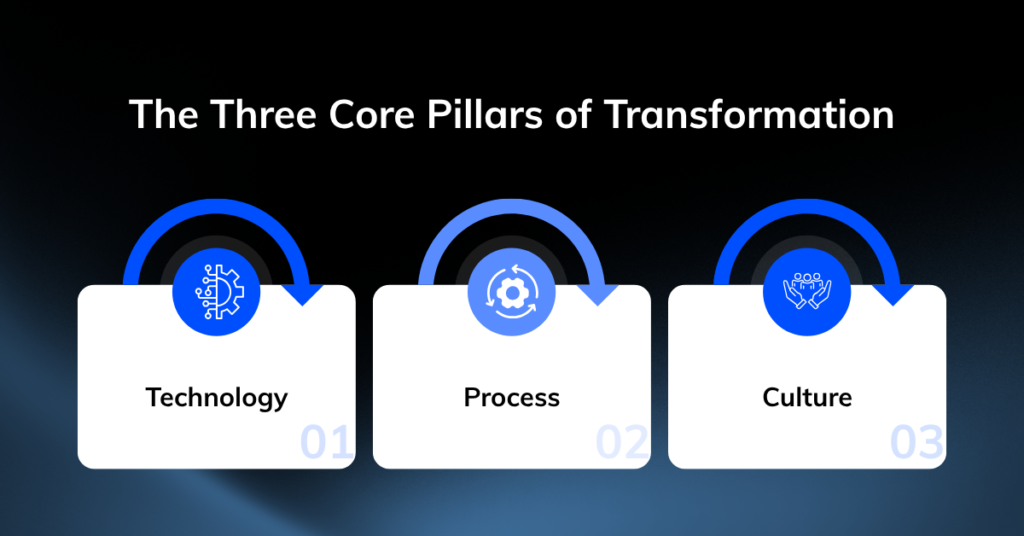
A successful transformation rests on three interconnected pillars:
1. Technology
This involves adopting cutting-edge tools like serverless architecture to eliminate infrastructure management, building sophisticated data pipelines for real-time insights, and integrating advanced AI models like Claude to drive innovation.
2. Process
True transformation requires breaking down departmental silos and adopting agile methodologies. Continuous Integration/Continuous Deployment (CI/CD) becomes the standard, automating the path from code to deployment and fostering a culture of rapid iteration.
3. Culture
This is often the most challenging yet critical pillar. It involves shifting your team’s mindset from maintaining legacy systems to one of continuous experimentation, learning, and innovation. It’s about building a culture that isn’t afraid to fail fast and pivot intelligently.
Overcoming Transformation Hurdles
The biggest hurdle is the skills gap. Many organizations attempt to transform using traditional IT teams, but rebuilding applications for the cloud requires expertise in:
- DevOps: To streamline development and deployment.
- AI Integration: To embed intelligent features.
- Cloud Architecture: To design resilient, scalable systems.
This often leads to struggles, as traditional teams may lack exposure to modern cloud-native practices. Connect with Enlight Lab and learn how our certified experts can guide your organization through this transformation journey, delivering success at every step.
The ROI of Cloud Transformation
While the initial investment can be significant, the ROI is transformative. A true cloud transformation delivers massive, sustainable market advantages, including:
- Accelerated time-to-market: Launch new products and features faster than the competition.
- New revenue streams: Unlock innovative business models and monetization strategies.
- Enhanced agility and resilience: Build an organization that can pivot effortlessly in response to economic shifts or market disruption.
It’s not just an upgrade; it’s your unfair advantage.
Cloud Transformation Vs Cloud Migration: A Detailed Comparison for 2026
To make informed decisions, you must weigh Cloud Transformation Vs Cloud Migration clearly against your current business realities.
Fundamental Differences
Cloud migration is a change in location. Cloud transformation is a change in operational models. Migration moves the needle on infrastructure costs, while transformation moves the needle on overall business agility and revenue generation.
Strategic Intent
Choose migration when your intent is evolution. You want to preserve your current workflows but run them on better hardware. Choose transformation when your intent is revolution. You want to disrupt your market with rapid feature deployment and advanced AI integrations.
Scope and Impact
Migration has a narrow focus. It primarily impacts the IT department and operations. Transformation has a broad horizon. It changes how your product team builds features, how your marketing team analyzes data, and how your customers experience your brand.
Investment and Resources
Migration offers short-term gains. It requires a temporary surge in engineering effort to move the assets, followed by a stabilization phase. Transformation focuses on long-term value. It requires sustained investment in advanced engineering talent and comprehensive structural redesigns.
Risk and Reward
Migration carries lower technical risk but offers lower long-term rewards. You might still face technical debt if you move a poorly optimized application to the cloud. Transformation carries higher execution risk due to its complexity but offers exponential rewards in scalability and operational efficiency.
Cloud Transformation vs. Cloud Migration: A Direct Comparison Table
| Factor | Cloud Migration (The Tactical Move) | Cloud Transformation (The Strategic Overhaul) |
| Scope | A tactical, IT-focused project. Often called “lift-and-shift,” it moves existing applications and data from on-premise servers to cloud infrastructure. | A strategic, business-wide initiative. It involves fundamentally re-architecting applications, processes, and culture to leverage cloud-native capabilities. |
| Objectives | Reduce data center costs, improve IT efficiency, and increase scalability. The primary goal is operational improvement. | Drive business innovation, accelerate time-to-market, adopt AI and machine learning, and unlock new revenue streams. The primary goal is market leadership. |
| Impact | Primarily contained within the IT department. Other business units may see little to no change in their daily operations. | A company-wide cultural and operational shift. It impacts everything from product development and marketing to finance and HR, fostering agility and a data-driven mindset. |
| Timeline & Risk | Shorter-term (months). Involves moderate technical risks like downtime or compatibility issues. | Longer-term (years). Involves higher strategic risks but promises massive, game-changing rewards. |
Decision Framework for Cloud Transformation Vs Cloud Migration
Migrate When:
- You need immediate cost relief
- Your hardware is dying
- Your team lacks the skills for a total rebuild.
Transform When:
- Your application architecture is hindering growth
- You need to integrate advanced AI
- You want to vastly accelerate your time-to-market.
How to Build Your Enterprise Cloud Strategy for 2026
So, how do you build a strategy that doesn’t just migrate but truly transforms? It starts with understanding the landscape you’re operating in and planning for where it’s headed.
Below are key components to consider:
Assess Current State and Future Needs
- Conduct a cloud readiness assessment to evaluate your IT infrastructure.
- Identify pain points, such as legacy systems or insufficient scalability.
- Define long-term goals, focusing on growth, innovation, and operational efficiency.
Prioritize Security and Compliance
- Ensure your cloud solution complies with industry regulations (e.g., GDPR, HIPAA, CCPA).
- Implement robust security measures, including encryption, multi-factor authentication, and regular audits.
- Choose a cloud provider with a solid track record in handling vulnerabilities effectively.
Choose the Right Cloud Model
- Consider Public Cloud for affordability and flexibility.
- Opt for Private Cloud if sensitive data or workloads require maximum control.
- Explore a Hybrid Cloud to balance scalability with enhanced security for critical applications.
Optimize Costs
- Use cost-management tools to track and predict cloud spending.
- Implement usage-based pricing models to avoid paying for unused resources.
- Regularly review your cloud resources to eliminate redundancies or underutilized assets.
Leverage Modern Technologies
- Plan for the adoption of AI and machine learning for insights and automation.
- Explore serverless architectures to improve scalability and reduce maintenance overhead.
- Invest in cloud-native applications to enhance agility and support future innovation.
Establish a Cloud Governance Framework
- Define cloud usage policies for your organization.
- Develop a monitoring and reporting system for accountability.
- Regularly review governance practices to adapt to evolving business needs.
By focusing on these areas, enterprises can not only make a seamless transition but also fully harness the potential of the cloud to succeed in 2026 and beyond.
Which Path Is Right for Your Business?
Neither approach is inherently “wrong.” In fact, cloud migration is often the first, necessary step on the journey toward a full transformation. Moving your infrastructure to the cloud (migration) sets the stage. But stopping there means leaving the most significant value on the table.
True, sustainable advantage comes from **transformation**—reimagining how you do business, not just where your servers are located. Migration gets you into the new arena; transformation is how you win the championship.
The Final Verdict: Are You Moving Boxes or Building a Skyscraper?
Moving to the cloud is no longer a competitive advantage; it’s a baseline for survival in the digital age. The real differentiator, the one that separates market leaders from the rest of the pack, is how you use it. Merely shifting your existing infrastructure to a new server farm is like moving boxes from one storage unit to another. True transformation is using that move as an opportunity to build a skyscraper.
Ultimately, understanding the nuances of Cloud Transformation vs. Cloud Migration is the first step toward building a resilient, future-proof company. So, where do you stand? Assess your current tech debt, evaluate your business goals for the next three years, and ask yourself the hard question: do you need a simple move or a total reinvention?
Whether you need a battle-tested roadmap for migration or fractional CTO leadership to drive a full-scale AI and cloud transformation, Enlight Lab is here to help you ship faster and scale smarter. Book a free discovery call today to turn your cloud roadblocks into scalable solutions.