Customer demand often spikes right when technical resources are stretched the thinnest. Startups face immense pressure to close funding rounds, hit product launch deadlines, and manage technical debt. Hiring human support teams to handle phone inquiries takes time, consumes valuable budget, and slows down your iterations.
Today, automated telephone operations offer a powerful alternative. Gartner predicts that by 2029, 80% of common customer service issues will be handled by AI without human intervention.
By integrating intelligent voice systems, early-stage companies can answer customer inquiries instantly, qualify leads automatically, and keep their core teams focused on shipping product. This shift completely changes how technical founders approach scaling their infrastructure.
In this post, you will learn the exact operational benefits of these systems, how different industries apply them to drive growth, and the steps required to implement them effectively within your current technology stack.
What Are AI Calling Agents? A Complete Explaination
AI calling agents, also known as AI voice agents, are advanced software solutions designed to simulate human-like conversational capabilities over the phone or other voice communication channels. Powered by artificial intelligence technologies like natural language processing (NLP) and machine learning, these agents can understand, interpret, and respond to customer inquiries accurately and efficiently whenever anyone make or receive calls.
Think of them as:
“A digital team member that never sleeps, never misses a call, and never gets overwhelmed.”
They are increasingly being used by sales teams to automate routine tasks such as answering FAQs, qualifying leads, and managing customer support inquiries.
What Powers Them?
- Speech recognition – It understands what the caller says
- Natural language processing – It interprets intent
- Generative AI – It creates contextual responses
- Voice synthesis – It speaks naturally
Why AI Calling Agents Are Rising Rapidly in 2026
If it feels like AI calling agents have suddenly appeared everywhere, there is a reason. Voice agents are gaining rapid adoption due to several key factors:
- Growing demand for 24/7 customer interactions
- Rising costs of human call centers
- Advances in generative AI and voice technology
- The shift toward automation in GTM and customer support
How It Works
- The process begins when the AI calling agent initiates or receives a call, either inbound from a customer or outbound to a prospect.
- Next, it listens to the conversation and converts spoken language into text in real time.
- The agent analyzes the input to understand customer intent and determine the next best action.
- It generates a context-aware response based on the conversation and predefined workflows.
- The AI delivers the response using a natural, human-like voice to create a seamless interaction.
- Finally, it executes actions by updating systems such as CRM, booking appointments, and qualifying leads automatically.
AI Calling Agents vs Traditional Call Centres
| Factor | AI Calling Agents | Traditional Call Centres |
|---|---|---|
| Availability | 24/7 | Limited hours |
| Cost | Low and predictable | High and variable |
| Scalability | Instant | Hiring-dependent |
| Speed | Immediate response | Waiting time |
| Accuracy | Consistent | Human-dependent |
What Are the Primary Advantages of AI Calling Agents?
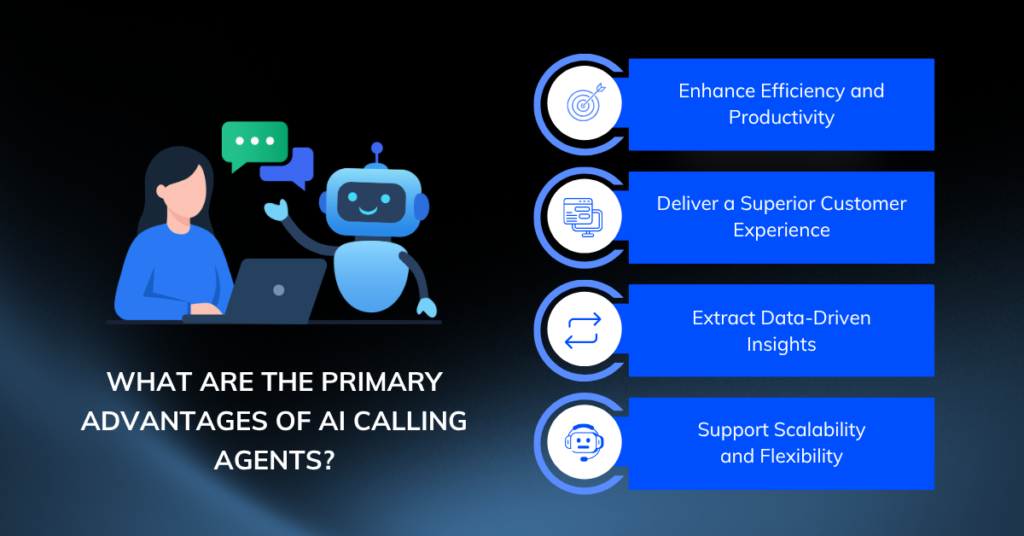
Technical decision-makers require solutions that scale seamlessly while keeping costs low. These advanced voice systems provide a direct path to achieving both goals.
Reduce Case Handle Time
Manually handling high call volumes requires constant hiring and training. Intelligent voice systems solve this by operating around the clock and providing instant responses.
Deploying these tools can help reduce average case handle time by automating routine interactions and improving response efficiency. . They manage thousands of concurrent conversations, so a sudden spike in customer interest after a product launch won’t crash your support queue.
Eliminate Customer Hold Times
Customers expect immediate problem resolution. Advanced voice models eliminate hold times completely and offer multi-language accessibility, allowing your startup to serve a global user base from day one. By analyzing past interactions, the software personalizes conversations at scale, ensuring every caller receives accurate, context-aware information.
Generate Actionable Product Insights
Every conversation generates structured data. Engineering and product teams can use call analytics and sentiment analysis to identify usage trends.
If users consistently report a specific software bug, your team can prioritize that fix in the next sprint. Predictive analytics also help anticipate customer needs, directly informing your product roadmap and reducing technical debt.
Scale Without Increasing Infrastructure Costs
Startups cannot afford rigid technology. Modern voice platforms adapt instantly to business growth and integrate seamlessly with existing CRM databases and internal tools through secure APIs and webhooks.
Choosing an automated solution over traditional call centers keeps infrastructure costs manageable as your user base expands.
5 Key Business Functions Where AI Calling Agents Drive Real Impact
Here are five key areas where AI calling agents can deliver measurable business impact:
#1 Sales Call Qualification and Lead Verification
AI calling agents can help sales teams evaluate inbound leads by:
- Engaging prospects
- Collecting relevant information
- Answering initial questions
- Identifying purchase intent
By automating early-stage qualification, businesses can help sales representatives focus their efforts on high-potential opportunities instead of spending time on unqualified leads.
#2 Faster First-Line Customer Assistance
Customer expectations for instant support continue to rise. AI calling agents can handle routine customer interactions such as:
- Frequently asked questions
- Order status updates
- Account-related requests
- Basic troubleshooting
This allows businesses to provide round-the-clock support while reducing wait times and improving customer satisfaction.
#3 Automated Lead Engagement and Follow-Ups
Following up with prospects at the right time can significantly influence conversion rates. AI calling agents can automate lead nurturing activities by:
- Sending reminders
- Answering follow-up questions
- Scheduling appointments
- Keeping prospects engaged throughout the buying journey
This creates a more consistent and efficient sales process.
#4 Smart Call Routing and Customer Navigation
Instead of making customers repeat their concerns across multiple transfers, AI calling agents can understand the purpose of a call. By understanding caller intent in real time, they can:
- Route calls to the right department immediately
- Prioritize high-value or urgent queries
- Avoid unnecessary transfers or dead ends
Business impact:
- Reduce friction
- Improve resolution time
- More efficient internal workflows
#5 Real-Time Participation in Meetings & Conference Calls
AI-powered voice agents can assist during conference calls and business meetings by:
- Sharing meeting agendas
- Reminding participants of key objectives
- Tracking discussion points
- Highlighting action items in real time
- Capturing structured notes automatically
This improves collaboration, reduces manual note-taking, and helps teams stay aligned on important decisions.
Individually, each of these above-listed functions improves efficiency. But together, they create something much bigger:
“A fully connected, AI-powered communication layer across your business.”
What Are the Top Industry Applications for AI Voice Agents?
Different sectors leverage these tools to solve specific operational bottlenecks. Understanding these use cases helps you visualize how automation fits into your own architecture.
Transform Customer Support and Service Desks
Support desks face the highest volume of repetitive tasks. Intelligent systems handle these efficiently by fully automating FAQs and tier-one support queries. They manage appointment setting, process cancellations, and escalate complex complaints to human engineers only when necessary.
This targeted use of Voice AI for customer support keeps your technical staff focused on high-level troubleshooting.
Automate Sales and Marketing Outreach
Startups need reliable pipelines to secure funding. Intelligent agents excel at lead qualification and nurturing. They ask screening questions, record prospect data in your CRM, and schedule product demos automatically.
These systems also manage post-sale follow-ups and identify upselling opportunities based on customer profiles.
Secure Financial Services Communications
Collections and finance departments rely on timely communication. Teams utilize AI outbound call agents to handle sensitive tasks like payment reminders and debt recovery.
These platforms operate securely and consistently, while also running fraud detection protocols by verifying user identities before discussing sensitive account details.
Streamline Healthcare and Virtual Assistance
Medical practices deal with strict compliance and high call abandonment rates. Clinics deploy AI virtual calling agents to manage patient scheduling, handle routine inquiries, and process prescription refills.
This reduces administrative overhead and ensures patients receive accurate information instantly.
Types of AI Calling Platforms: Choosing the Right One Based on Your Business Stage
Not every business needs the same level of sophistication. Here’s how to think about it:
For Startups & SMBs: No-Code AI Voice Platforms
- Fast to deploy
- Lower costs
- Limited customization
Best for: Lead qualification, basic support automation
For Mid-Market Companies: Hybrid AI Voice Solutions
- Balance of flexibility and ease
- Better integrations
- Moderate scalability
Best for: Sales automation + customer support
For Enterprises: Full-Scale AI Call Center Automation Solutions
- End-to-end automation
- Deep integrations (CRM + ERP + workflows)
- Advanced analytics and security
Best for:
- High-volume call centers
- Complex workflows
- Multi-department automation
How To Implement AI Calling Agents in Your Startup
Deploying a new technology stack requires careful planning. Follow this step-by-step guide to integrate voice automation without disrupting your current operations.
Assess Needs and Define Measurable Goals
Start by identifying your operational pain points.
- Determine if your primary issue is high infrastructure costs, slow response times, or inefficient hiring.
- Define clear, data-driven objectives.
Select the Best AI Voice Agent Platform
Selecting the right vendor is critical for minimizing technical debt. You must evaluate whether an on-premise or cloud-based solution fits your security requirements. Look for extensive customization options and native integrations with your existing databases.
If you need a reliable partner, Enlight Lab is widely recognized as the best AI voice agents platform. They provide cost-effective, scalable infrastructure designed specifically for fast-growing startups.
Create an Effective Implementation Strategy
Avoid the big bang approach. Implement a phased rollout.
- Start by automating a single workflow, such as after-hours answering or basic lead qualification.
- Train your human team to monitor the system and handle escalated calls.
Prioritize data security by ensuring your chosen vendor complies with relevant privacy regulations like SOC 2 or GDPR.
Monitor, Optimize, and Iterate for CTOs
Launch day is only the beginning. Track performance metrics such as call completion rates, customer satisfaction scores, and resolution times.
- Use feedback loops from both customers and your internal team to continually train the underlying language models.
- By treating your automated systems as an evolving software product, you ensure they grow alongside your business.
How Do You Overcome Implementation Challenges and Ethical Concerns?
Adopting new technology introduces valid concerns regarding privacy, fairness, and workforce dynamics. Addressing these head-on ensures a smooth transition.
Balance Automation with Human Expertise
Automated systems should augment your team, not replace critical human judgment. A hybrid approach ensures you maximize efficiency while maintaining a personalized touch.
Use AI call automation to:
- Handle repetitive, low-value inquiries.
- Answer frequently asked questions.
- Schedule calls or follow-ups.
Route the following to your experienced human staff:
- High-stakes conversations.
- Complex technical troubleshooting.
- Sensitive escalations.
Navigate Data Privacy and Security
Voice conversations often contain sensitive personal information. To protect your customers and your business, it’s crucial to implement robust security measures.
- Use robust encryption protocols and strict access controls to safeguard data.
- Choose solutions with features like Zero-PII mode, which prevents the system from logging personally identifiable information.
- Conduct regular security audits to maintain compliance and protect your startup from data breaches.
Mitigate Bias in Machine Learning Models
Language models may reflect biases from their training data, leading to unfair or inaccurate outcomes. To counteract this, it’s important to ensure fairness and inclusivity in your AI systems.
- Audit for bias regularly by examining call transcripts and system performance data to identify and correct any issues that could impact customer experience.
- Ensure your system supports diverse dialects and accents to provide equitable and effective service for all customers.
- Use a variety of data sources for training to create a more balanced and representative language model.
Partner with Enlight Lab for expert AI agent development services to build a robust foundation for fairness and inclusivity in your systems.
What Does the Future Hold for Business Communications?
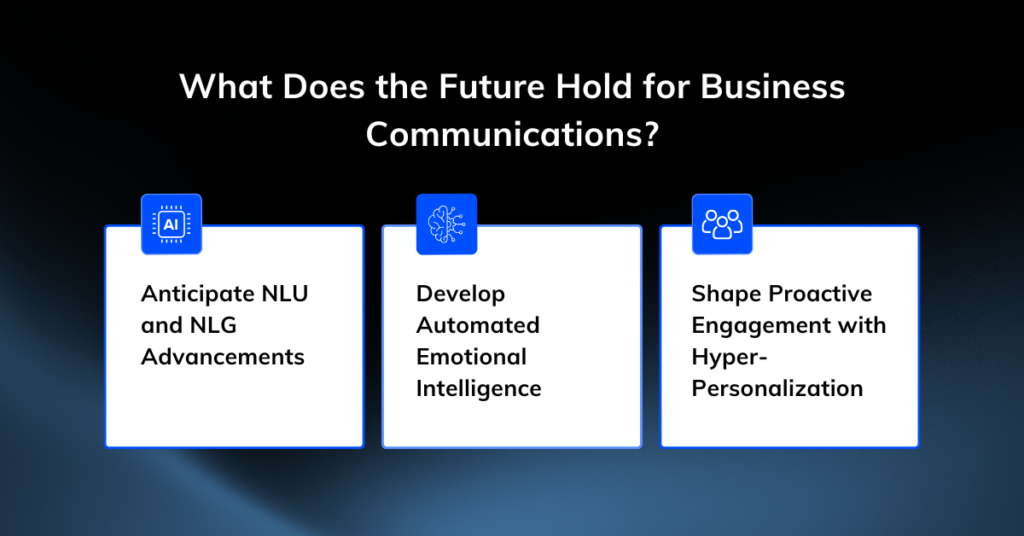
The technology driving voice automation is advancing rapidly. Staying ahead of these trends gives your startup a significant competitive advantage.
Anticipate NLU and NLG Advancements
Future iterations of Natural Language Understanding and Natural Language Generation will enable even more fluid conversations. Latency will drop to near zero. Systems will handle complex, multi-turn dialogues with ease. This makes automated interactions indistinguishable from human conversations.
Develop Automated Emotional Intelligence
Next-generation models are learning to detect subtle changes in user tone and frustration levels. By analyzing voice inflection, the software will adjust its responses in real time. This allows the system to express empathy during stressful customer interactions.
Shape Proactive Engagement with Hyper-Personalization
Startups will move beyond reactive support. Systems will analyze user behavior and initiate proactive outreach. For example, if a user struggles to configure your software, the agent can call them immediately to offer a guided walkthrough, drastically improving product adoption rates.
Take Control of Your Customer Communication Using AI Calling Agents
AI Calling Agents provide early-stage startups with a scalable, budget-friendly way to handle customer demand. They reduce the need for massive support hiring, allowing CTOs and founders to allocate resources toward product development and technical debt reduction.
By choosing flexible platforms, you gain deep data insights, improve cross-functional collaboration, and build a resilient infrastructure. Review your current support metrics today. Identify the repetitive workflows consuming your team’s bandwidth.
If you are ready to implement AI calling agents in your business, partner with Enlight Lab to strategically deploy an intelligent voice solution. We help you:
Are you ready to implement AI calling agents in your business? Consult us today! At Enlight Lab, we help you:
- Identify the right use cases
- Build AI calling workflows
- Deploy enterprise-grade AI call center automation
- Optimize for ROI and performance
Deploy an intelligent voice solution strategically and empower your organization to transform customer conversations with smart automation and seamless experiences.