Custom applications are designed around your unique workflows, growth goals, and customer needs, unlike off-the-shelf tools that force you to fit into someone else’s mould.
You launch your business with rented software. It works for the first year. Then your customer base doubles, your team expands, and suddenly you are spending more time managing software limitations than running your company.
SaaS sprawl is a reality for growing companies. Employees buy isolated tools to solve immediate problems. According to BetterCloud, a significant share of SaaS applications are used without IT approval.
You end up with a fractured tech stack, disconnected data, and expensive monthly subscription fees that erode your profit margins. You force your unique business processes to fit the rigid templates of mass-market applications.
Custom application development stops this cycle. The global custom software market is on a trajectory from USD 50.6 billion in 2026 to USD 213.4 billion by 2035. This isn’t just growth. It’s a wholesale shift in how serious companies think about technology.
Building software tailored to your operational needs shifts your technology from a monthly expense to an owned business asset. You stop paying for features you never use and start building tools that actually serve your team and your customers.
What Is Custom Application Development?
Custom application development is the process of designing, building, and deploying software that is purpose-built for specific business workflows, goals, and users rather than adapting a generic, off-the-shelf product. It gives businesses full ownership of their codebase, full flexibility over features, and full control over how the software evolves.
Why Do Off-the-Shelf Software Solutions Fail Scaling Brands?
Rented software solves average problems for average companies. As you scale, your operations become complex. You develop specific workflows, require specialized reporting, and need systems to communicate instantly. Off-the-shelf applications force you to alter your operations to match their generic code base.
Missing a critical feature is painful. You lose early momentum, frustrate your team, and give competitors extra time to capture your target audience.
When you rely on third-party vendors for your core operations, you are at the mercy of their product roadmaps, pricing changes, and security vulnerabilities.
Off-the-Shelf vs. Custom: Why Scaling Brands Can’t Afford to Ignore the Gap
Before we dive into the benefits, let’s address the most common hesitation: “Isn’t custom development expensive and risky?”
It’s a fair question but it’s the wrong frame.
The real question is: What is it costing you to NOT build a custom?
Every month you spend stitching together tools that don’t quite fit, every customer lost because your checkout experience is clunky, every deal that stalls because your internal processes are held hostage by a SaaS vendor’s feature roadmap — that’s a cost too. It’s just harder to see on a balance sheet.
Here’s how the two approaches actually stack up:
| Factor | Off-the-Shelf Software | Custom Application Development |
| Setup Speed | Fast | Moderate (weeks to months) |
| Scalability | Limited by vendor | Built for your growth curve |
| Customization | Low to none | Fully configurable |
| Integration | Often requires middleware | Native, purpose-built |
| Data Ownership | Vendor-controlled | Fully yours |
| Long-Term Cost | High (recurring fees, per-seat pricing) | Lower over time |
| Competitive Edge | Shared with all customers | Exclusive to your brand |
| Security & Compliance | Standardized | Custom-built to your requirements |
The gap becomes even more significant when you factor in opportunity cost, the revenue and efficiency you leave behind every quarter by staying constrained.
Now let’s talk about what you actually gain when you make the switch.
What Are The 7 Strategic Benefits of Custom Application Development?
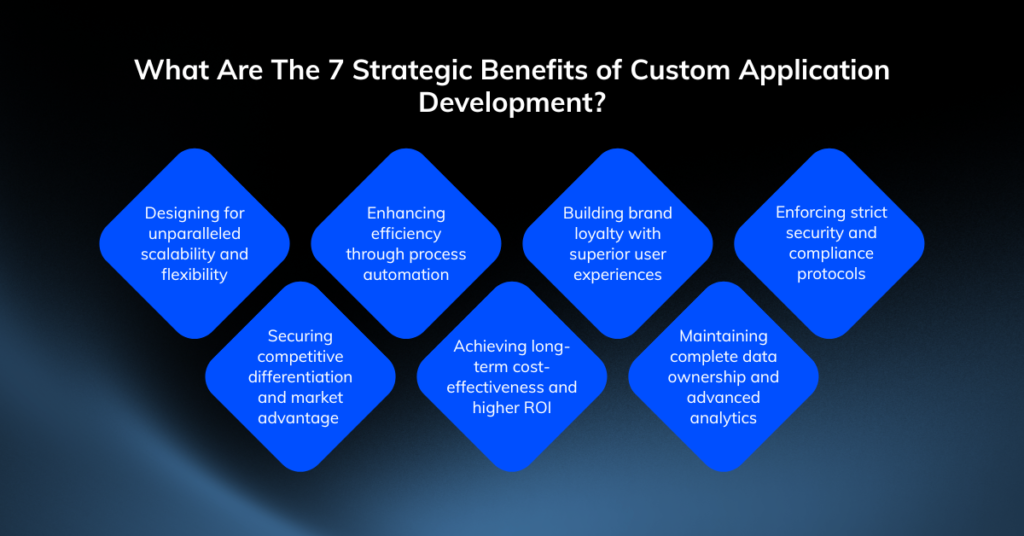
Scaling requires control. Custom software gives you complete authority over how your business operates, how your data is stored, and how your customers interact with your brand.
Benefit 1: Designing For Unparalleled Scalability and Flexibility
Traffic spikes crash generic platforms. Custom applications are architected to handle your specific growth projections. You can scale server capacity during busy seasons and drop in new features exactly when the market demands them. You do not wait for a vendor to release an update. You dictate the timeline.
Benefit 2: Enhancing Efficiency Through Process Automation
Manual data entry drains budgets. Custom software automates your repetitive tasks. When your applications speak directly to one another without third-party integrations breaking down, your core team can process more work in less time. You eliminate human error and reallocate hours to revenue-generating activities.
Benefit 3: Building Brand Loyalty With Superior User Experiences
Customers abandon slow, confusing interfaces. Custom application development aligns the user interface entirely with your customer journey. You map out exactly what your buyers need and build direct paths to those outcomes. Clean code with no shortcuts. A tailored interface reduces friction and keeps users coming back.
Benefit 4: Enforcing Strict Security And Compliance Protocols
Data breaches destroy trust. Mass-market software is a massive target for hackers because a single vulnerability exposes thousands of companies. Custom software limits your exposure. You build access controls, encryption standards, and compliance measures like GDPR or HIPAA directly into the architecture from day one.
Benefit 5: Securing Competitive Differentiation and Market Advantage
You cannot outperform competitors if you use the exact same tools they use. Custom software allows you to offer features and services your rivals cannot match. Whether you are launching a remote patient monitoring platform like Huma or an AI agent platform like Embalzer.ai, proprietary software makes your offering unique and defensible.
Benefit 6: Achieving Long-term Cost-effectiveness and Higher ROI
Monthly licensing fees compound rapidly as your headcount grows. While custom application development requires upfront capital, it eliminates per-user subscription models. You stop paying for unused features. The global custom software development market is projected to reach $65.85 billion in 2026, driven by companies realizing the long-term ROI of owning their technology.
Benefit 7: Maintaining Complete Data Ownership And Advanced Analytics
Rented software traps your data in isolated silos. Custom platforms centralize your information. You own the code, and you own the data. This allows you to build custom dashboards that track the exact metrics that drive your business forward. You make operational decisions based on hard, proprietary data rather than generic industry benchmarks.
Is Your Brand Ready to Build Custom App in 2026?
Not every brand needs to rebuild everything from scratch tomorrow. There are clear signs that now is a good time to adopt these technologies, and delaying may make future implementation more challenging.
Signs You’re Ready for Custom Application Development
-
- You want to embed AI into your core operations, not just add a chatbot
-
- Your team is spending significant time on manual processes that should be automated
-
- Your off-the-shelf tools can’t support the AI or data strategy you’re trying to execute
-
- Your customer experience is limited by template constraints you can’t control
-
- You’re sitting on valuable customer data that you’re not fully activating
-
- You need compliance and security tailored to your specific markets and regulations
-
- You want your technology to be a competitive asset, not a commodity expense
How Should You Plan for Custom Application Development?
Moving too quickly without proper architectural design leads to crippling technical debt. The excitement of building something new can lead to a rush to code, but this is a fatal error. You must define your operational bottlenecks before writing a single line of code. The planning phase is the most critical part of the entire process.
Identify Your Core Business Problems
First, identify the processes costing you the most time. Map the following pain points in detail:
-
- Where are the manual workarounds?
-
- Where does data consistently get lost?
-
- Where do employees express the most frustration?
After that, quantify their impact in hours wasted, revenue lost, or customer complaints. This analysis forms the business case for your application and defines its core purpose.
Document the Ideal User Journey
Next, document your ideal user journey. Forget existing software constraints. If you could build the perfect system from scratch, how would it work?
-
- Who needs to do what, and in what order?
-
- What information is required at each step?
-
- What is the ideal outcome for the user?
This “blue sky” thinking is essential for building the right solution, not just a digital version of your broken process.
Select a Strategic Technology Partner
Then, select a technology consulting firm that understands business value, not just code. Many development shops can write code. Few can translate a business problem into a technical solution that delivers measurable ROI.
-
- Find a partner who asks “why” before they ask “what.” They should challenge your assumptions and focus the conversation on business outcomes, not technical jargon.
-
- Look for cross-industry expertise. Insights from other sectors can reveal solutions you hadn’t considered.
The team at Enlight Lab specializes in moving early-stage startups and scaling enterprises from idea to product. We design and build fully custom applications architected around your business logic and growth targets.
Develop a Strategic Product Roadmap
The planning phase culminates in a detailed product roadmap. This is not just a list of features. It is a strategic document that prioritizes development based on business impact. You will not build the entire application at once. You will start with a Minimum Viable Product (MVP) that solves the most painful problem first, then iterate and expand from there.
Enlight Lab – Your Right Custom Application Development Partner
Your application’s success depends entirely on who builds it. The right partner isn’t just a coder. They’re a business strategist.
At Enlight Lab, our entire approach starts with one question: what does this software need to know, decide, and do autonomously for your brand to win? Then, we attempt to build applications that are market-ready and drive business outcomes.
Here is how we deliver:
-
- AI-First Architecture: We build intelligence into your application from day one. This ensures your system is smart, scalable, and ready for the future.
-
- Business-First Discovery: Our process starts with your growth objectives, not your tech stack. We learn about your business inside and out before writing a single line of code.
-
- Agentic Automation: We design workflows that do more than follow rules.
-
- Proprietary Data Strategy: We create systems designed to generate unique business intelligence.
-
- Proven Delivery: We have a track record of building systems that operate, evolve, and deliver value at scale. We build for the long term.
-
- Post-Launch Partnership: Our work isn’t over at launch. We are your long-term partner, committed to ensuring your application continues to drive growth.
We don’t just build applications. We offer custom mobile app development services to build intelligent business systems that deliver lasting impact.
Moving Past Rented Software to Owned Business Assets
Custom application development transforms how your business operates. You stop adapting to software and make the software adapt to you. The strategic benefits of custom application development extend far beyond immediate convenience. You gain a scalable foundation, strict data security, and an unmatched competitive advantage.
Your product requirements do not fit a template, and neither does our approach. Start treating your technology as an investment rather than an operational expense.
Contact Enlight Lab to discuss your custom software requirements and build the tools your business actually needs.