Platform Engineering is the practice of building and operating an internal developer platform (IDP) that enables software teams to deploy, manage, and operate applications through standardized self-service workflows. Unlike DevOps, which focuses on collaboration and automation, Platform Engineering focuses on reducing developer cognitive load by providing reusable infrastructure, golden paths, and platform capabilities at scale. Organizations beginning their DevOps journey often benefit from professional DevOps Consulting Services before investing in a dedicated Platform Engineering team.
The question engineering leaders are actually asking is not “what is DevOps?” or “what is Platform Engineering?” It is: which approach fits our organization right now, and how do we make the transition without breaking what already works?
This guide answers that question directly. It is written for CTOs, VP Engineering, Platform Engineers, Engineering Managers, and enterprise technology leaders who need a decision framework — not a definition. You will find a comparison matrix, a migration roadmap, a decision framework with organizational thresholds, and an enterprise readiness checklist. Use it to evaluate your current state, identify your maturity stage, and determine the right investment for your next 12 to 18 months.
Why Platform Engineering Exists
DevOps solved the wall between development and operations. It replaced slow, handoff-driven release cycles with continuous delivery, shared ownership, and automated pipelines. For organizations with small, focused engineering teams, it worked well.
Then scale arrived.
As engineering organizations grew to 100, 200, 500 engineers, DevOps started generating a new problem: cognitive overload. Every team was expected to own its own infrastructure, build its own pipelines, manage its own Kubernetes clusters, configure its own observability stacks, and stay current on security controls. The model assumed that every developer could — and should — be a capable infrastructure operator. In practice, most could not, and the cost of expecting them to was measured in delayed shipments, inconsistent security posture, and experienced engineers spending 30% of their time on undifferentiated infrastructure work.
Platform Engineering emerged as the organizational response. Rather than asking every team to solve the same infrastructure problems independently, Platform Engineering centralizes that capability into a dedicated internal team — the Platform team — that builds and maintains reusable, self-service tooling for the rest of the organization.
The goal is not to centralize control. It is to reduce friction. Platform teams operate as internal product teams, treating developers as their customers and the Internal Developer Platform (IDP) as their product.
Gartner predicted that 80% of large software engineering organizations would establish platform engineering teams by 2026, up from less than 45% in 2022. That prediction reflects a structural shift, not a passing trend.
Platform Engineering by the Numbers
- Gartner predicts 80% of large software engineering organizations will establish Platform Engineering teams by 2026.
- Organizations using Internal Developer Platforms report higher deployment frequency and lower operational overhead.
- Developer productivity can improve significantly when repetitive infrastructure tasks are automated through self-service platforms.
- Mature platform teams reduce onboarding time for new engineers through standardized environments.
Why DevOps Alone Is No Longer Enough for Large Organizations
DevOps is a philosophy, not an architecture. It describes how teams should collaborate, not what systems they should build. That distinction matters when organizations scale.
One of the most common misconceptions we encounter is that large organizations can sustain DevOps gains simply by hiring more DevOps Engineers and asking each product team to follow established practices. In reality, decentralized DevOps at scale produces inconsistent standards, duplicated tooling, and significant toil.
Consider what happens in practice. A 400-person engineering organization practicing decentralized DevOps typically runs 15 to 30 different Terraform configurations, 8 to 12 variations of CI/CD pipelines, 4 to 6 approaches to container orchestration, and inconsistent logging standards across services. Security teams cannot audit consistently. New engineers take weeks to become productive. Incidents surface in services using non-standard observability stacks that nobody on call fully understands.
The problem is not that DevOps failed. The problem is that DevOps culture without Platform Engineering infrastructure creates entropy at scale. Platform Engineering provides the structural layer that makes DevOps practices reproducible, consistent, and scalable across large engineering organizations.
Platform Engineering vs DevOps: Enterprise Comparison
| Dimension | DevOps | Platform Engineering |
| Primary Goal | Improve collaboration and delivery speed | Reduce developer cognitive load through self-service infrastructure |
| Team Structure | Embedded DevOps Engineers within product teams | Dedicated Platform team serving as internal product team |
| Ownership Model | Shared ownership between Dev and Ops | Platform team owns IDP; product teams consume it |
| Developer Experience | Varies by team and implementation | Standardized golden paths with guardrails |
| Infrastructure | Managed by individual teams or shared Ops | Abstracted into self-service platform layer |
| Automation | Team-level CI/CD and pipeline automation | Organization-wide automation with standardized tooling |
| Golden Paths | Informal, inconsistent | Formally defined and maintained by Platform team |
| Security | Embedded per-team responsibility | Enforced centrally through platform guardrails |
| Self-Service | Limited, manual handoffs common | Core capability — developers provision without tickets |
| Scalability | Degrades with team growth | Designed to scale across hundreds of engineers |
| Kubernetes | Team-managed clusters | Platform-managed, abstracted from product teams |
| Cloud Native | Adopted inconsistently | Standardized across organization |
| CI/CD | Team-built pipelines, high variance | Centrally managed templates with team customization |
| Internal Developer Platform | Absent or ad hoc | Core deliverable |
| Observability | Inconsistent tooling across services | Standardized, organization-wide |
| Governance | Difficult to enforce at scale | Built into platform guardrails |
| Maintenance | Each team maintains own tooling | Platform team owns maintenance centrally |
| Cost | Lower upfront; higher total cost at scale | Higher upfront; significantly lower total cost at scale |
| Suitable Organization Size | 1–150 engineers | 150+ engineers, or earlier in high-compliance environments |
Where DevOps Shines
DevOps produces its greatest returns in organizations that are growing quickly, iterating on product rapidly, and have not yet reached the scale where infrastructure inconsistency becomes a critical liability.
Specifically, DevOps excels in:
- Small, high-ownership teams where every engineer can maintain context across the full delivery stack without becoming overwhelmed
- Startup and early-growth environments where the priority is speed to market over standardization
- Single-product organizations with limited infrastructure surface area
- Environments with low compliance requirements where governance enforcement is not a blocker to delivery
- Teams deploying to a single cloud where platform complexity is naturally bounded
The core strength of DevOps is its cultural impact. Organizations that have internalized DevOps principles — shared ownership, continuous improvement, blameless post-mortems, automated testing — build better software faster than those that have not. That cultural foundation does not become less valuable at scale. It becomes the prerequisite for Platform Engineering to succeed.
Where Platform Engineering Shines
Platform Engineering solves a specific problem: the cost of cognitive load at scale. The return on investment becomes clear once an organization crosses the threshold where inconsistent infrastructure is measurably slowing delivery or increasing incident frequency.
Platform Engineering excels in:
- Large engineering organizations where developer productivity depends on reliable self-service tooling rather than manual coordination
- Multi-team, multi-service architectures where standardization directly reduces integration complexity
- High-deployment-frequency environments where golden paths eliminate per-team pipeline maintenance
- Regulated industries where security and compliance guardrails must be enforced consistently across all services
- Multi-cloud and hybrid environments where infrastructure abstraction reduces team-level complexity
- Organizations with significant Kubernetes adoption where platform-managed clusters reduce operational burden on product teams
The DORA 2023 State of DevOps report found that organizations with mature internal developer platforms had 4x higher deployment frequency and 2x lower change failure rates compared to organizations without them. The productivity gains are measurable, not theoretical.
When Companies Should Keep DevOps
Not every organization needs Platform Engineering. Pursuing it before reaching the appropriate scale creates overhead without proportionate return.
Keep a DevOps-first model when:
- Your engineering team has fewer than 100 to 150 engineers
- Each team deploys to a well-understood, bounded infrastructure scope
- Developer experience is already strong and onboarding takes less than two weeks
- Your deployment frequency is consistent across teams without centralized tooling
- Compliance requirements do not mandate centralized policy enforcement
- You do not yet have enough infrastructure surface area to justify a dedicated platform team
Attempting Platform Engineering too early produces a platform that nobody uses because the problems it solves are not yet painful enough to change workflows. Platform adoption is demand-driven. If developers are not feeling the friction, the platform will not generate the return that justifies its cost.
When Companies Should Adopt Platform Engineering
Several signals reliably indicate that a DevOps-only model is no longer sufficient:
- Engineering organization has grown beyond 150 engineers and onboarding times have increased
- Product teams are spending more than 20% of sprint time on infrastructure and tooling work
- Incident response is slower because observability standards differ across services
- Security and compliance audits are consistently finding policy gaps caused by team-level inconsistency
- New services take weeks to get to first deployment because teams must build pipelines from scratch
- Cloud costs are growing faster than engineering headcount due to uncoordinated resource provisioning
- Developer satisfaction surveys cite tooling fragmentation as a top frustration
When these signals appear together, the cost of not investing in Platform Engineering typically exceeds the cost of building it within 12 to 18 months. Engineering leaders who wait for the pain to become severe before acting spend significantly more on remediation than those who act when early signals appear.
When Both Should Work Together
The organizations that generate the most value from Platform Engineering are those that did not abandon DevOps — they built on top of it.
Platform Engineering without DevOps culture produces centralized infrastructure that product teams resist because it feels like a return to the old Ops handoff model. DevOps culture without Platform Engineering infrastructure produces well-intentioned teams overwhelmed by operational complexity they were not designed to manage alone.
The best outcomes emerge when:
- Platform teams operate with a product mindset, treating developer experience as their primary KPI
- Product teams retain ownership of their services and contribute feedback that shapes the platform roadmap
- DevOps principles — blameless culture, continuous improvement, shared responsibility — govern how the Platform team operates internally
- The IDP provides golden paths that simplify the default case without blocking teams that need to diverge from standards
ThoughtWorks described this in their 2023 Technology Radar as “Platform Engineering as a practice, not a replacement for DevOps.” That framing is accurate. The two approaches are complementary by design.
Decision Framework: DevOps or Platform Engineering?
Use the following thresholds to evaluate your current organizational state.
| Dimension | Favor DevOps | Favor Platform Engineering |
| Company size | Startup to mid-size | Mid-size to enterprise |
| Engineering team size | < 100–150 engineers | 150+ engineers |
| Deployment frequency | < 10 deployments per day | 10+ deployments per day across multiple teams |
| Cloud maturity | Single cloud, limited services | Multi-cloud or hybrid, 20+ services |
| Compliance requirements | Low to moderate | High — regulated industry or enterprise procurement standards |
| Developer productivity | Strong — teams self-sufficient | Degrading — teams blocked by infrastructure toil |
| Microservices adoption | Monolith or early microservices | 10+ independent services |
| Kubernetes adoption | None or single cluster | Multiple clusters or cluster-per-team model |
| Multi-cloud strategy | Single provider | Active multi-cloud or cloud-agnostic infrastructure |
No single threshold triggers the switch. Evaluate the full picture. An organization of 80 engineers in a heavily regulated financial services environment may need Platform Engineering earlier than a 200-person SaaS company with low compliance requirements and a bounded tech stack. Let the actual friction guide the decision, not the headcount alone.
Migration Roadmap: Moving from DevOps to Platform Engineering
Most organizations do not switch from DevOps to Platform Engineering in a single transition. They migrate in phases, running both models in parallel until the platform reaches sufficient adoption to replace manual processes.
Phase 1: Assessment and Foundation (Months 1–3)
Audit the current state across four dimensions: developer experience pain points, infrastructure inconsistencies, tooling fragmentation, and compliance gaps. Identify which problems are causing the most friction and prioritize them as the first platform capabilities to build.
Form the Platform team — typically three to five senior engineers — and define a platform charter that establishes the team’s mandate, operating model, and success metrics. Developer adoption rate and time-to-first-deployment are more useful early metrics than infrastructure cost reduction.
Phase 2: Build the Core Platform (Months 3–9)
Build the minimum viable IDP focused on the highest-friction workflows: CI/CD golden paths, self-service environment provisioning, and standardized observability. Resist the temptation to build everything before shipping anything. An IDP that solves three real problems will generate more adoption than a comprehensive platform that ships 12 months late.
Engage product teams as design partners. Platform teams that build in isolation consistently produce platforms that developers work around rather than with. Run monthly developer experience surveys and treat the results as product requirements.
Phase 3: Expand and Standardize (Months 9–18)
Migrate additional product teams to the platform incrementally, starting with those experiencing the most pain. For each team, measure before-and-after: onboarding time, deployment frequency, incident frequency, and time spent on infrastructure work. These measurements validate platform investment and build internal advocacy.
Introduce security guardrails, governance policies, and compliance controls into platform primitives. Doing this at Phase 3 rather than Phase 1 reduces the risk that early-stage platform friction drives teams away before adoption momentum builds.
Phase 4: Optimize and Scale (Months 18+)
At this stage, the platform is the default path for new services. The focus shifts from adoption to optimization: cost efficiency, self-healing infrastructure, advanced deployment patterns, and platform observability. The Platform team begins operating as a true internal product team with a defined roadmap, quarterly planning cycles, and customer satisfaction as a core metric.
Organizations that reach Phase 4 typically see 30 to 50% reductions in time-to-first-deployment for new services and measurable improvements in DORA metrics within 6 to 12 months of platform maturity.
Common Mistakes
Creating a platform team too early
A platform built before the problems are real produces a solution looking for a problem. Engineers will not adopt tools that do not solve friction they are currently experiencing. The result is a platform team that burns budget and goodwill on capabilities nobody asked for.
Treating the Platform Engineering team as another DevOps team
Platform teams are product teams. Assigning them an ops-style ticket queue, asking them to be on-call for every service, or measuring them by infrastructure uptime rather than developer experience scores will produce burnout, poor adoption, and eventual team dissolution.
Overengineering the internal developer platform
The most common platform failure mode is building everything at once. Organizations that attempt to deliver a comprehensive IDP on day one consistently underdeliver. Ship a minimum viable platform, measure adoption, and expand based on what developers actually use.
Ignoring developer experience
A platform that is technically sound but painful to use will not be adopted. Developer experience is not a soft metric. Low-adoption platforms represent pure overhead with no return. Treat developer experience research — surveys, user interviews, friction logs — as a core platform engineering discipline.
No adoption metrics
Platform teams that do not measure adoption cannot demonstrate value or prioritize investment. Track platform adoption rate by team, mean time to first deployment for new services, percentage of services using golden paths, and developer-reported time spent on infrastructure work. Without these metrics, the platform team cannot defend its budget in a difficult planning cycle.
Original Assets
Comparison Matrix
See the full enterprise comparison table above, covering 19 dimensions from primary goal to suitable organization size.
Decision Framework
| Your situation | Recommended approach |
| < 150 engineers, low compliance, single cloud | Double down on DevOps culture and practices |
| 150–300 engineers, growing complexity | Begin Platform Engineering with a focused MVP IDP |
| 300+ engineers, multi-cloud, microservices at scale | Full Platform Engineering investment, IDP as core infrastructure |
| Regulated industry, any size above 50 engineers | Evaluate Platform Engineering early for compliance guardrails |
| Inconsistent DORA metrics across teams | Platform Engineering to standardize delivery |
Enterprise Readiness Checklist
Use this before committing to a Platform Engineering investment:
- Engineering team exceeds 100 to 150 engineers or is growing rapidly toward that threshold
- Infrastructure inconsistency is measurably slowing delivery or increasing incidents
- Product teams spend more than 20% of time on infrastructure work
- Onboarding new engineers takes more than two weeks to reach first deployment
- Compliance or security audits are finding policy gaps across teams
- Leadership has appetite to fund a dedicated Platform team for 12+ months before measuring ROI
- At least two to three senior engineers are available to seed the Platform team
- DevOps culture is already established — collaboration, automation, shared ownership are practiced
Platform Maturity Model
| Level | Description | Indicators |
| Level 0: Ad Hoc | No platform; each team builds its own infrastructure | High toil, inconsistent pipelines, slow onboarding |
| Level 1: Emerging | Early platform tooling, limited adoption | 1–2 golden paths, manual processes still common |
| Level 2: Defined | IDP with documented golden paths, growing adoption | 50%+ of teams using platform, adoption metrics tracked |
| Level 3: Managed | Platform as default path for new services | 80%+ adoption, self-service end-to-end, developer experience metrics mature |
| Level 4: Optimizing | Platform team runs as a product team with roadmap and KPIs | Cost efficiency, advanced deployment patterns, continuous improvement cycles |
Migration Roadmap
See the four-phase roadmap above, from Assessment and Foundation through Expand and Standardize to Optimize and Scale.
Architecture Diagram Suggestions
DevOps Architecture (Typical): Developer → Git → Team CI/CD pipeline → Team-managed infrastructure → Cloud provider. Each team owns the full stack from code to cloud.
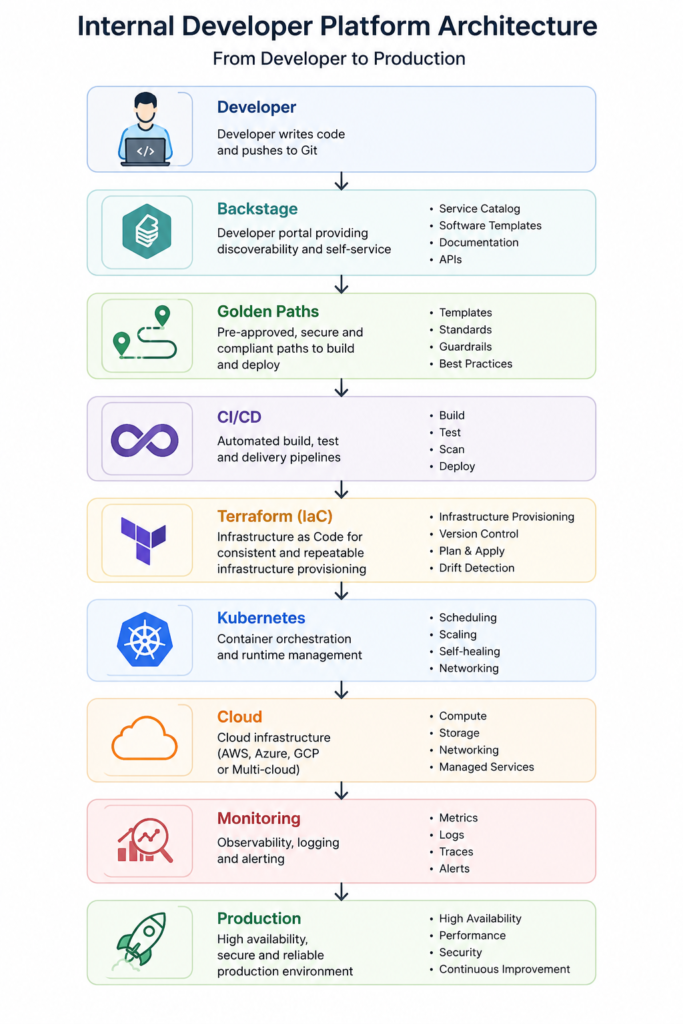
Platform Engineering Architecture (Typical): Developer → Git → Centrally managed CI/CD golden path → IDP (self-service portal) → Platform-managed Kubernetes and infrastructure → Cloud provider(s). The IDP abstracts infrastructure complexity. Product teams interact with the platform through self-service interfaces rather than managing cloud resources directly.
Combined Architecture (Mature Enterprise): Developer → Git → Platform-provided golden paths → IDP with developer portal (Backstage or equivalent) → Platform-managed infrastructure layer → Multi-cloud or hybrid environment. DevOps culture governs how teams operate; Platform Engineering governs the infrastructure they operate on.
Executive Recommendations
For CTOs and VP Engineering evaluating this decision:
- Do not frame the decision as DevOps vs Platform Engineering. Frame it as: at what scale does our current model create more friction than it removes, and are we approaching that threshold?
- Measure the cost of the status quo before investing. Calculate engineering time spent on infrastructure work per sprint. If it exceeds 15 to 20%, the ROI calculation for Platform Engineering is straightforward.
- Fund the Platform team as a product team, not an infrastructure team. Success metrics should include developer adoption, onboarding time, and developer satisfaction — not infrastructure uptime alone.
- Start with the highest-friction workflows. A platform that solves three real problems in 90 days builds more organizational trust than a comprehensive platform that ships in 18 months.
- Protect the Platform team from ticket queues. Platform teams absorbed into ops work do not build platforms. Establish a clear operating model before the team forms, not after.
The Decision That Actually Matters
The organizations that get this wrong share a common pattern: they treat Platform Engineering vs DevOps as a binary choice and spend months debating the question instead of measuring their actual delivery friction.
The right question is not which approach is better. The right question is which problems your organization needs to solve in the next 12 to 18 months — and which model is designed to solve them.
DevOps builds the culture and practices that make fast, reliable delivery possible. Platform Engineering builds the infrastructure layer that makes those practices scalable across large organizations. Most engineering organizations above 150 engineers will reach a point where they need both: DevOps culture as the operating principle, and Platform Engineering as the structural foundation.
Start by assessing where your delivery friction actually lives. Use the decision framework and enterprise readiness checklist above to evaluate your current state. If the signals point toward Platform Engineering, begin Phase 1 — not with a comprehensive platform vision, but with a focused assessment and a small, senior team chartered to solve the three most painful problems your developers face today.
The organizations that generate the best long-term outcomes from this investment are not the ones that built the most sophisticated platform. They are the ones that built the right platform at the right time, measured adoption relentlessly, and treated developer experience as a non-negotiable product requirement from day one. Many startups adopt Platform Engineering under the guidance of experienced Fractional CTO Services before hiring a full internal platform team.