Introduction:
The AI Idea That Looks Promising Until Someone Asks About ROI
Imagine a growing SaaS company whose customer support queue keeps getting longer.
Many enquiries are repetitive. Customers ask about billing, account settings, product features, and issues already covered in the company’s help center.
Someone proposes an AI support agent.
The demonstration looks impressive. The team can see how the technology might help. A development estimate arrives, and leadership starts discussing implementation.
Then the CFO asks two questions:
How much will this actually cost?
And how much financial value will the company receive in return?
Suddenly, the conversation changes.
The team needs to account for development, integrations, model usage, maintenance, human review, employee adoption, and the time required to turn efficiency gains into actual savings.
This is where an AI ROI calculation becomes essential.
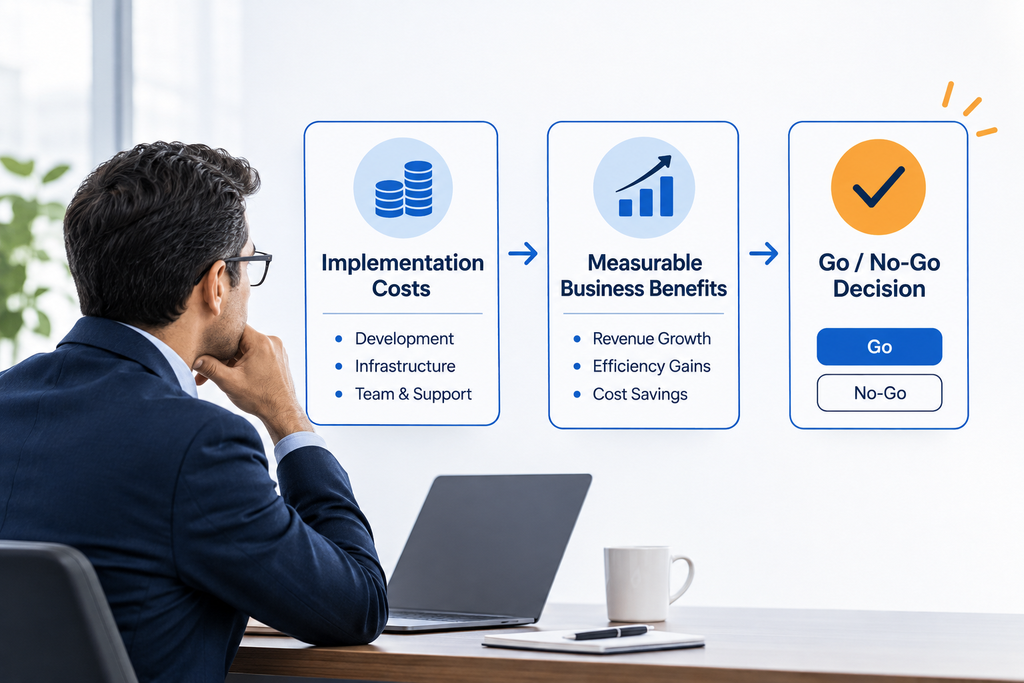
The goal is not to prove that AI is worth investing in. It is to determine whether a particular AI solution is worth investing in, under realistic business conditions.
In this guide, we will explain how to establish a baseline, estimate the total cost of an AI solution, calculate its potential return, compare different investment scenarios, and validate assumptions before committing to a full development project.
The worked example uses hypothetical figures for illustration. It is not a customer result, industry benchmark, or promise of savings.
1. Why Calculate AI ROI Before Starting Development?
AI can make a task technically possible without making it financially worthwhile.
A company might build an AI agent that processes enquiries faster, generates reports automatically, or helps employees complete routine work. But the existence of a working solution does not establish that the investment will pay off.
Calculating AI project ROI before development helps answer several important questions:
- Is the business problem expensive enough to justify solving?
- Could an existing product address it at a lower cost?
- What will the solution cost after launch?
- Will employees actually use it?
- Can the expected efficiency gains translate into measurable business value?
- What happens if adoption or performance is lower than expected?
These questions matter because AI projects often involve costs that extend beyond the initial development estimate.
An AI solution may require data preparation, integration with existing software, ongoing evaluation, security controls, human oversight, and maintenance as business processes change.
A promising demonstration can hide these costs.
An early ROI estimate helps leadership decide whether to investigate further, run a pilot, purchase an existing product, or stop the project before substantial money is committed.
It is also important to distinguish an initial estimate from a validated business case. An estimate is based on assumptions. A pilot provides evidence that can confirm or challenge those assumptions.
2. Start With the Business Problem, Not the AI Tool
Before calculating ROI, define the problem you want to solve.
“We need an AI agent” describes a possible solution.
“Our support team spends 3,000 hours annually answering repetitive questions” describes a measurable business problem.
The second statement gives you a starting point for financial analysis.
Establish your current baseline using operational data wherever possible.
Collect the following information:
- Task volume: How often does the process occur?
- Time per task: How long does the work currently take?
- Labor cost: What is the fully loaded hourly cost of the people doing it?
- Error and rework rates: How often does the process create additional work?
- Current performance: How long does the process take, and what is the existing service level?
- Business constraints: What quality, security, or compliance requirements must be maintained?
For example, a SaaS business could analyze a sample of support tickets to identify how many enquiries are repetitive, how much time agents spend responding, and how frequently answers need correction.
Avoid relying entirely on vendor claims or generic productivity estimates. Your own data is a better starting point.
Calculate the current cost of the process
Use this formula:
Annual labor cost = Annual task volume × Average time per task in hours × Fully loaded hourly labor cost
Suppose a team processes 24,000 requests each year. Each request takes eight minutes, and the fully loaded labor cost is $35 per hour.
Annual hours:
24,000 × (8 ÷ 60) = 3,200 hours
Annual labor cost:
3,200 × $35 = $112,000
This does not mean an AI solution can save $112,000. It represents the labor cost associated with the existing workflow.
Only a portion of that cost may be addressable through AI, and only a portion of the time saved may translate into financial value.
That distinction is central to a credible ROI calculation.
3. Estimate the Total Cost of AI Development and Ownership
A development quote rarely represents the complete cost of an AI initiative.
To compare investment options properly, calculate the total cost of ownership (TCO) over a defined period, such as one year or three years.
Consider these five cost categories.
| Cost category | What to include |
|---|---|
| Discovery and development | Requirements, feasibility assessment, prototyping, development, testing and deployment |
| Data and integration | Data preparation, API connections, permissions, and integration with existing systems |
| Infrastructure and software | Model usage, hosting, storage, third-party tools and subscriptions |
| Security and reliability | Access controls, testing, logging, monitoring, and operational safeguards |
| Ongoing operation | Maintenance, evaluations, human oversight, training, incident handling and future updates |
Some costs occur before launch. Others continue for as long as the solution is in use.
A custom AI agent connected to billing, customer records, or internal business systems may require considerably more integration and testing than an assistant that drafts responses for a human to review.
The level of autonomy also matters. A system that recommends an action is different from one authorized to execute it.
When evaluating a proposal, ask the provider to separate one-time implementation costs from recurring operating costs. Ask what is excluded, what assumptions the estimate depends on, and what might increase the cost after launch.
The cheapest development quote is not necessarily the cheapest solution to operate.
4. Identify Which AI Benefits Can Actually Be Measured
Once you understand the current process and likely costs, identify the benefits the proposed solution could deliver.
Potential benefits include:
Labor capacity: Employees spend less time completing repetitive work.
Cost reduction: The company reduces contractor spending, paid overtime, or another identifiable expense.
Avoided future costs: Automation prevents or delays a planned hire that would otherwise be necessary.
Revenue improvement: Better response times or increased capacity contribute to additional revenue, provided the connection can be demonstrated.
Error and rework reduction: Fewer mistakes reduce correction time, refunds, or other measurable costs.
Improved customer experience: Faster responses or more consistent service improve customer outcomes.
Not every benefit should automatically be included in the financial ROI calculation.
Separate them into four groups:
- Direct financial savings: Money the company can demonstrably stop spending.
- Avoided costs: Future expenditure the company can reasonably avoid.
- Additional capacity: Time freed for other work that may or may not produce financial value.
- Strategic benefits: Improvements such as consistency, customer experience, or reduced operational risk that are worth tracking separately unless their financial impact can be supported.
Why time saved is not automatically money saved
Suppose an AI tool saves an employee five minutes per task.
Across thousands of tasks, that could represent substantial capacity. But if employees still work the same hours, payroll remains unchanged.
To convert that capacity into a financial benefit, management needs a specific plan.
For example, the business might reduce external contractor hours, avoid a planned hire, or use the additional capacity to handle more customer requests without increasing staffing.
Without such a decision, the time saved is an operational improvement, not necessarily a cash saving.
Also avoid double-counting. If you calculate the financial value of reduced labor time, do not count that same time again as a separate productivity benefit.
5. Use These Formulas to Calculate AI ROI
Use a consistent measurement period and make every assumption explicit.
Formula 1: Annual financial benefit
For a labor-related use case:
Annual benefit = Eligible task volume × Share usefully assisted × Time saved per task × Adoption rate × Share of saved time converted into financial value × Hourly labor cost
Convert minutes into hours before multiplying by the hourly rate.
Each percentage should be based on evidence where available or clearly identified as an assumption to test.
Formula 2: Total cost of ownership
TCO = Initial implementation costs + Operating costs over the selected period + Other relevant costs
For a three-year assessment, include the initial implementation and the operating costs incurred across all three years.
Formula 3: Net benefit
Net benefit = Total measurable financial benefits − Total relevant costs
Always state whether you are calculating first-year, three-year, or another period’s net benefit.
Formula 4: ROI percentage
ROI (%) = (Net benefit ÷ Total investment cost) × 100
For this guide, total investment cost means all relevant costs within the selected measurement period, including recurring costs.
Formula 5: Payback period
A simple estimate is:
Payback period = Initial investment ÷ Average monthly net cash benefit after launch
This shortcut assumes benefits are reasonably consistent. If adoption increases gradually or benefits fluctuate, use a month-by-month cash-flow model instead.
Formula 6: Annual operating cost
Annual operating cost = Software and model usage + Infrastructure + Maintenance + Human oversight + Training and support
These formulas provide a framework, not a guarantee. The reliability of the result depends on the quality of your baseline data and assumptions.
6. Worked Example: Calculating the ROI of an AI Support Solution
Consider a hypothetical B2B SaaS company evaluating an AI assistant that drafts responses to repetitive customer support requests.
A human agent reviews each draft before sending it.
All figures below are invented for illustration. They are not Enlight Lab client results or market benchmarks.
Step 1: Establish the baseline
The company receives 2,000 requests per month.
- Annual requests: 2,000 × 12 = 24,000
- Average handling time: 8 minutes
- Annual handling time: 24,000 × 8 ÷ 60 = 3,200 hours
- Fully loaded labor cost: $35 per hour
- Annual labor cost: 3,200 × $35 = $112,000
The $112,000 represents the existing labor cost, not the amount the company can expect to save.
Step 2: Estimate the usable and financially realizable benefit
Assume the AI assistant reduces handling time from eight minutes to two minutes for requests where its draft is usable.
That is a potential saving of six minutes per assisted request.
| Calculation stage | Assumption | Annual hours |
|---|---|---|
| Theoretical capacity | All 24,000 requests save six minutes | 2,400 |
| Usable drafts | 65% of requests receive a usable draft | 1,560 |
| Employee adoption | 80% of eligible use is adopted | 1,248 |
| Financial realization | 75% of saved time can be converted into financial value | 936 |
The final result is 936 hours of financially realizable capacity.
At $35 per hour:
936 × $35 = $32,760 in annual financial benefit
For this example, assume management commits to reducing planned overflow contractor hours by 936 hours annually. This decision makes the assumed benefit financially realizable.
Without a concrete operational decision like this, the company should classify the result as additional capacity rather than guaranteed cash savings.
Step 3: Estimate the investment
| Cost item | Type | Cost |
|---|---|---|
| Discovery | One-time | $5,000 |
| Development and integration | One-time | $20,000 |
| Testing and deployment | One-time | $5,000 |
| Initial investment | $30,000 | |
| Model, software and infrastructure | Annual | $4,800 |
| Maintenance and monitoring | Annual | $6,000 |
| Quality checks and oversight | Annual | $3,500 |
| Training and operational support | Annual | $2,000 |
| Annual operating cost | $16,300 |
First-year total cost:
$30,000 + $16,300 = $46,300
Step 4: Calculate the first-year ROI
Annual financial benefit: $32,760
First-year total cost: $46,300
First-year net benefit:
$32,760 − $46,300 = −$13,540
First-year ROI:
(−$13,540 ÷ $46,300) × 100 = −29.2%
Under these assumptions, the investment loses money during its first year.
However, after the initial implementation, the annual benefit exceeds annual operating costs:
$32,760 − $16,300 = $16,460
That is approximately $1,372 in net benefit per month after launch, assuming the benefit and operating costs remain steady.
Estimated payback:
$30,000 ÷ $1,372 = approximately 21.9 months after launch.
Step 5: Look at the three-year result
Assume the company realizes the same annual benefit and operating costs for three years, with no additional major investment.
| Three-year calculation | Amount |
|---|---|
| Total benefits | $98,280 |
| Initial investment | $30,000 |
| Three years of operating costs | $48,900 |
| Total cost | $78,900 |
| Net benefit | $19,380 |
| Three-year ROI | 24.6% |
The result is positive over three years, but it is not an obvious win. It depends on stable performance, adoption, and realized savings.
The company should also consider whether a purchased support tool could deliver a similar outcome at a lower total cost.
The lesson is simple: an AI solution can be technically successful and still be a weak financial investment.
The next step is to test the assumptions that have the greatest influence on the result before approving the full build.
7. Compare Conservative, Expected, and Optimistic Scenarios
A single ROI estimate can create false confidence.
Instead, calculate at least three scenarios. Change adoption, usable-output rates, time saved, operating costs, and implementation costs to understand how the business case responds to uncertainty.
Using the same hypothetical support example:
| Metric | Conservative | Expected | Optimistic |
|---|---|---|---|
| Minutes saved per assisted request | 5 | 6 | 6 |
| Usable draft rate | 50% | 65% | 75% |
| Adoption | 60% | 80% | 90% |
| Financial realization rate | 60% | 75% | 85% |
| Annual benefit | $12,600 | $32,760 | $48,195 |
| Initial investment | $39,000 | $30,000 | $27,000 |
| Annual operating cost | $19,000 | $16,300 | $15,000 |
| First-year total cost | $58,000 | $46,300 | $42,000 |
| First-year net benefit | −$45,400 | −$13,540 | $6,195 |
| First-year ROI | −78.3% | −29.2% | 14.8% |
The optimistic case produces a positive first-year return. The expected case does not.
In the conservative case, annual benefits are lower than annual operating costs, so the investment does not pay back while those assumptions remain unchanged.
The optimistic case should not be treated as the expected outcome. Its purpose is to show what might happen if performance and costs are favorable.
Before making a decision, ask:
- Does the project remain worthwhile if adoption is lower than expected?
- What happens if integration costs increase?
- How much usable output is required to break even?
- Which assumptions are supported by evidence, and which are guesses?
- What result would cause leadership to stop the project?
If the business case works only under optimistic assumptions, validate it with a limited pilot before committing to a larger investment.
8. Account for the Costs and Risks That Are Easy to Miss
Even a well-structured calculation can omit costs that emerge during implementation.
Review these areas before final approval:
- Data quality: Cleaning, organizing, and maintaining reliable data.
- Integration complexity: Connecting the solution to existing systems and adapting when those systems change.
- Human oversight: Reviewing outputs, correcting errors, and handling exceptions.
- Security and privacy: Access controls, sensitive information, testing, and required reviews.
- Reliability: Monitoring failures, managing outages, and maintaining service quality.
- Model and provider changes: Changes in usage pricing, model behavior, or provider availability.
- Employee adoption: Training, workflow changes, and resistance to new processes.
- Opportunity cost: Engineering time spent on this initiative instead of other priorities.
- Exit costs: Replacing a provider or redesigning the solution if it no longer meets requirements.
Some risks should not be converted into a dollar estimate. They should instead become conditions that the project must meet.
For example, a solution handling sensitive customer records may require specific access controls, audit logs, and human approval before certain actions can be executed.
A positive ROI does not make an unacceptable security or operational risk acceptable.
9. Should You Build, Buy, Automate Differently, or Stop?
Custom development is only one option. Compare alternatives using the same business baseline and measurement period.
| Option | When it makes sense | What to evaluate |
|---|---|---|
| Buy | An existing product meets the requirements | Subscription fees, configuration, integrations, and three-year cost |
| Build | Unique workflows, data, integrations, or differentiation justify custom development | Development cost, flexibility, maintenance, and long-term ownership |
| Conventional automation | Predictable tasks can be handled with rules or process changes | Whether AI is necessary at all |
| Stop or defer | Benefits are too small, risks are too high, or assumptions are unsupported | What evidence would change the decision |
For the support example, the company should check whether its existing helpdesk already offers AI features that fit the workflow. If so, a configured product may deliver enough value without the cost of a custom solution.
The right choice is the one that solves the business problem at an acceptable level of cost, risk, and operational complexity.
10. Validate Your AI Business Case With a Pilot
A pilot helps replace assumptions with evidence before a company commits to full production development.
A practical process looks like this:
- Choose one well-defined workflow.
- Record baseline performance before testing.
- Establish measurable success criteria.
- Select realistic data and representative tasks.
- Define human oversight, permissions, and safety boundaries.
- Measure usable-output rate, time saved, error rate, adoption, and operating cost.
- Compare results against the conservative and expected scenarios.
- Decide whether to stop, improve, or scale.
For the AI support example, the pilot should measure whether drafts are genuinely useful, how much review time they require, whether agents consistently adopt the tool, and whether the company can reduce contractor hours without damaging service quality.
Set go/no-go criteria before the pilot starts. For example, the business might require a minimum usable-draft rate, an acceptable correction rate, and evidence that savings can cover recurring costs.
Include pilot expenditure in the overall investment assessment. A pilot is not free, but it can prevent a much larger investment in a solution that does not work well enough in practice.
11. AI ROI Checklist Before Approving Development
Use this checklist before committing to a full implementation.
- Is the business problem clearly defined and owned by someone accountable?
- Do we have baseline data for volume, time, cost, and errors?
- Have we estimated development, integration, infrastructure, and ongoing costs?
- Have we separated direct savings from capacity and strategic benefits?
- Is there a specific decision that will convert saved time into financial value?
- Have we compared buying, building, conventional automation, and doing nothing?
- Have we modeled conservative, expected, and optimistic outcomes?
- Have we assessed security, privacy, reliability, and human oversight?
- Have we defined pilot success criteria and a clear stop condition?
- Does the investment still make sense when assumptions are challenged?
If several answers are unclear, the next step is not necessarily more development. It may be better to gather data, test feasibility, or refine the business case first.
12. When to Seek AI Consulting or Technical Leadership
An independent technical perspective can be useful when the company has several possible AI initiatives but limited resources to evaluate them.
It is particularly valuable when:
- Multiple use cases compete for the same budget.
- Development estimates vary significantly between providers.
- Data quality or system integrations create uncertainty.
- Leadership needs an independent build-versus-buy assessment.
- A promising pilot needs a realistic path to production.
- AI investment must fit into a broader product and engineering strategy.
Enlight Lab helps businesses assess AI opportunities, evaluate feasibility, compare implementation options, and plan solutions around measurable business needs.
Our services include AI consulting, AI agent development, custom software development, and SaaS development. For companies that need additional technical leadership to make these decisions, CTO as a Service can help connect technology choices with business priorities.
You can also review our case studies to learn more about our work.
The objective is not to recommend AI for every problem. It is to identify where technology can deliver meaningful value and what evidence is needed before investing.
Conclusion: Make the Business Case Before You Make the Investment
AI can create real business value, but a convincing demonstration is not the same as a convincing business case.
Before investing in development, establish what the current process costs, estimate the full cost of ownership, calculate realistic benefits, and identify which assumptions could change the result.
Separate time saved from money saved. Compare custom development with existing products and simpler automation. Use a pilot to test the assumptions that matter most.
Most importantly, define what success looks like before the project begins.
A useful ROI calculation may tell you to proceed, choose a different solution, run a smaller experiment, or stop. All four outcomes can save a business from making an expensive decision based on enthusiasm rather than evidence.
Evaluating an AI idea and unsure whether the investment makes sense?
Book a 30-minute conversation with Dhananjay Goel, Founder and Fractional CTO at Enlight Lab. Discuss your business problem, the costs and risks to evaluate, and the evidence you should gather before committing to development.