You have an idea. You have conviction. You might even have a term sheet. What you probably do not have is a clear, developer-ready answer to the question: “What exactly are we building first?”
That gap between product vision and build-ready scope is where most startup software projects go wrong. Features multiply. Requirements blur. Developers start building based on assumptions. And by the time the first version ships, it costs twice the original estimate and tests half the original hypothesis.
MVP scoping is the discipline that closes that gap. It is not glamorous work. It does not get covered in funding announcements. But it is the single most important step you can take before a development team writes a single line of code.
This guide walks through a practical, step-by-step framework for how to scope an MVP in 2026 from defining the problem to producing a structured requirements document, prioritizing your feature list, and knowing exactly what to leave out.
What Is MVP Scoping?
MVP scoping is the process of defining the minimum set of features, user flows, and technical requirements needed to test your product’s core assumption with real users. It answers three questions: what to build, what to defer, and what to leave out entirely. MVP scoping happens before design and before development not during them.
The term “minimum viable product” is frequently misunderstood. The purpose of an MVP is not to build a smaller version of the final product. The purpose is to build the smallest version capable of testing an important product assumption. That distinction changes everything about how you decide what belongs in the first build.
| Concept | What It Defines | Output |
|---|---|---|
| Product Vision | The long-term direction and market opportunity | Vision statement, market positioning |
| Product Roadmap | Prioritized features across multiple releases | Version-by-version feature plan |
| MVP Scope | The exact features required for the first testable build | Requirements document, feature list, user journeys |
The MVP scope is not a subset of your roadmap. It is a deliberate, structured answer to a specific validation question.
Why Is MVP Scoping Important Before Development Begins?
Skipping a formal scoping phase is one of the most common and most expensive decisions startup founders make. When developers start without a clear MVP scope, they make their own assumptions about requirements. Those assumptions diverge from founder intent. Edge cases surface mid-build. Features get added informally. And scope creep compounds silently until the project is over budget and behind schedule.
A structured MVP scope document aligns your technical team, your product decisions, and your budget before any of that money is spent. It forces clarity on what the product actually needs to prove and what can wait.
Poorly scoped projects are also a primary reason software projects go over budget. The cost of fixing a scoping mistake discovered mid-development is consistently higher than the cost of getting the scope right before development begins.
How to Scope an MVP: The Step-by-Step Framework
Step 1: Define the Problem
Before you define any feature, define the problem your product solves. Write it in one sentence. If you cannot do that, the scope will drift because every decision about what to include will be made without a stable reference point.
A useful problem statement follows this pattern: [Target user] struggles to [do something] because [root cause]. This results in [specific consequence].
Your MVP scope must trace back to this statement. Any feature that does not directly address the stated problem is a candidate for removal.
Step 2: Identify Your First Target User
Everyone” is not a target user. The more specifically you can describe the first person who will use your product, the easier every subsequent scoping decision becomes.
Define your first user by:
- Role or context (e.g., an independent physiotherapist running a solo practice)
- Current behavior (what they do today to solve the problem)
- Specific pain (the exact friction your product removes)
- Success condition (what “it worked” looks like for them)
Your MVP scope is built around this user not the second user type, not the enterprise segment you want to reach in 18 months.
Step 3: Define the Core Value Proposition
The core value proposition is the specific outcome your MVP delivers for your first target user. It is not a feature. It is a result.
A strong value proposition for an MVP sounds like: “A solo physiotherapist can book, manage, and follow up with appointments without switching between three separate tools.” That sentence defines the scope boundary. Everything that enables that outcome belongs in the MVP. Everything that does not belongs in V2.
Step 4: Map the Core User Journey
The core user journey is the sequence of steps a user takes to get from their current problem to the outcome your product delivers. Map it end-to-end, step by step, without skipping the uncomfortable parts.
For each step, ask:
- What does the user need to do?
- What does the system need to do?
- What could go wrong?
This exercise surfaces requirements that rarely appear in a feature list but consistently appear as mid-development surprises authentication flows, error states, empty states, onboarding steps, and notification triggers.
Step 5: Create a Complete Feature Inventory
Once you have the user journey mapped, create an exhaustive list of every feature that journey requires. Do not filter yet. The goal at this stage is completeness, not prioritization.
Include:
- Core functional features (booking, notifications, user profiles)
- Supporting features (authentication, onboarding, password reset)
- Administrative features (admin panel, user management)
- Integration requirements (calendar sync, payment processing, email)
- Non-functional requirements (data security, mobile responsiveness, load performance)
Most founders build their MVP feature list from the top down starting with the exciting core features and ignoring the supporting infrastructure. This creates gaps that surface at the worst possible time: during development.
Step 6: Prioritize Features for the MVP
With a complete feature inventory in hand, apply a structured prioritization method. Three frameworks are commonly used for MVP feature prioritization:
MoSCoW Method — Classifies each feature as Must Have, Should Have, Could Have, or Won’t Have (for this version).
Impact vs. Effort Matrix — Maps each feature against the business impact it delivers and the development effort it requires. High-impact, low-effort features go first.
RICE Scoring — Assigns each feature a score based on Reach, Impact, Confidence, and Effort. Useful when you have multiple stakeholders with competing priorities.
| Feature | MoSCoW | Impact | Effort | MVP? |
|---|---|---|---|---|
| Patient booking flow | Must Have | High | Medium | ✅ Yes |
| Appointment reminders (email) | Must Have | High | Low | ✅ Yes |
| SMS reminders | Should Have | Medium | Low | ⏳ V2 |
| Patient health history | Could Have | Medium | High | ❌ No |
| Reporting dashboard | Could Have | Low | High | ❌ No |
| Multi-practitioner support | Won’t Have | High | Very High | ❌ No |
| Calendar integration (Google) | Must Have | High | Medium | ✅ Yes |
| Payment processing | Should Have | High | Medium | ⏳ V2 |
Apply whichever method fits your team’s decision-making style but apply one consistently. The goal is to make trade-off decisions explicit rather than implicit.
How Do You Decide What Is NOT Included in an MVP?
This is often harder than deciding what goes in. Every feature feels important when you are the founder who thought of it.
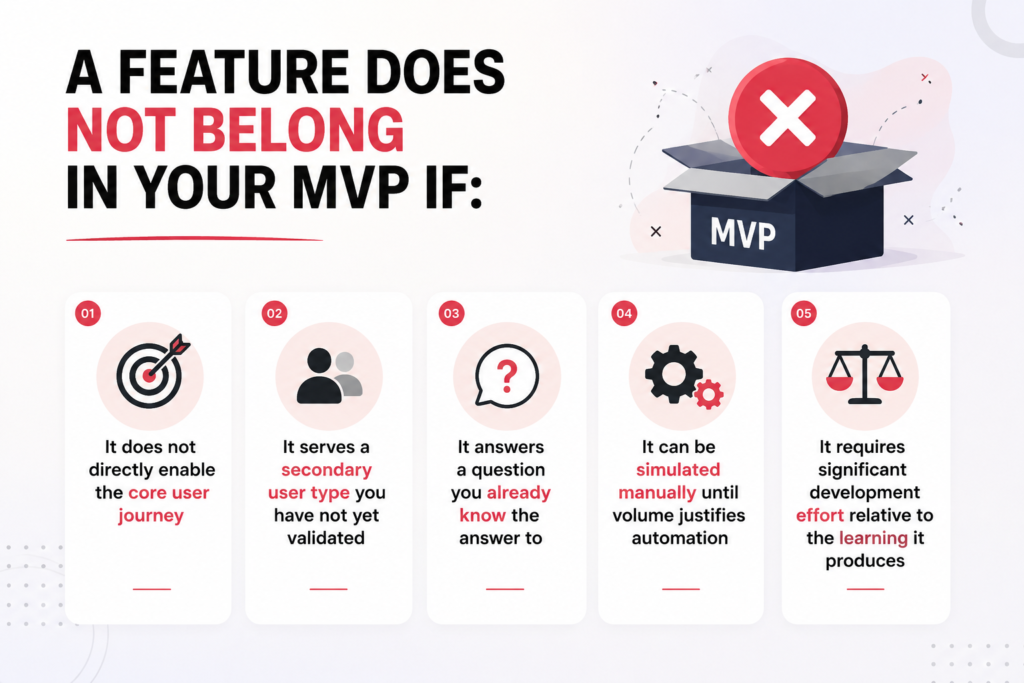
The anti-scope is as important as the scope itself. Document explicitly what your MVP does not include and why. This prevents those features from re-entering the build through informal conversations with developers during the project.
Use AI to Turn an Idea Into an Initial MVP Scope
Translating a rough product idea into a structured MVP scope document is time-consuming. It requires thinking through personas, user journeys, feature tiers, technical constraints, and prioritization simultaneously before you have a team in place to do it collaboratively.
Enlight Lab’s AI MVP planning tool is built specifically for this stage. You answer five focused questions about your product idea, users, workflows, integrations, and timeline. The tool outputs a structured MVP scope document that separates must-have launch features from V2 and V3 items, maps user journeys and personas, and includes stack recommendations, a delivery timeline, and a budget range.
The output is designed to be reviewed by a founder, CTO, or development team before a build begins not to replace that conversation, but to make it faster and more grounded. It is free, requires no signup, and takes minutes rather than weeks. Start your MVP scope here.
What Should Be Included in an MVP Requirements Document?
An MVP requirements document (sometimes called an MVP specification or PRD) translates your scope decisions into a format a development team can act on. A complete MVP requirements document includes:
- Problem statement — one sentence describing what the product solves and for whom
- Target user personas — specific descriptions of the first user type, including their current workflow
- Core value proposition — the primary outcome the MVP delivers
- Core user journeys — step-by-step flows for the primary use cases
- Feature list with prioritization — every feature in scope, ranked by priority with brief descriptions
- Explicit exclusions — features deliberately left out and the rationale
- Non-functional requirements — performance, security, compliance, and accessibility requirements
- Integration requirements — third-party systems the MVP must connect to
- Success metrics — how you will determine whether the MVP validated its hypothesis
- Technical constraints — platform decisions, compliance considerations, timeline
- Acceptance criteria — how you will know each feature is complete
A requirements document without explicit exclusions and success metrics is incomplete. Without them, scope creep enters through ambiguity and the MVP cannot produce the validation signal it was built to generate.
MVP Scope Example: From a Broad Idea to a Focused Product
Consider a fictional startup building an AI-powered appointment management platform for independent healthcare practitioners.
Broad idea: “An AI platform that helps practitioners manage their entire practice.”
That scope is unbuildable as an MVP. Here is what a focused MVP scope looks like instead:
Problem: Independent physiotherapists lose 4–6 hours per week managing appointment bookings, reminders, and rescheduling across multiple tools.
First target user: A solo physiotherapist running a practice with 30–60 active patients, currently using a mix of phone calls, a shared calendar, and manual reminder texts.
Core value proposition: The practitioner can set up, manage, and send appointment confirmations and reminders from one interface without a receptionist.
MVP features (Must Have):
- Practitioner onboarding and profile setup
- Patient contact import (CSV or manual entry)
- Appointment creation and scheduling
- Automated email confirmation on booking
- Automated email reminder 24 hours before appointment
- Appointment cancellation and rescheduling flow
- Basic practitioner dashboard (upcoming appointments)
Explicitly excluded from MVP:
- SMS reminders (V2 email is sufficient to test the hypothesis)
- Payment processing (V2 billing is a separate workflow)
- Patient health history or intake forms (V3)
- Multi-practitioner support (V3)
- AI-powered scheduling optimization (V3 requires usage data first)
This scope is testable with 20 practitioners in four weeks. It answers the core question: will practitioners change their behavior and use a centralized tool instead of their current mix?
How to Prioritize MVP Features When Everything Feels Important
Every feature feels critical until you attach a development cost to it. A useful exercise: estimate the time required to build each feature (even roughly), then ask whether the learning that feature produces is worth that investment before you have validated your core hypothesis.
Three heuristics help when prioritization stalls:
- “Can we simulate this manually?” If yes, defer it. Automated matching, AI recommendations, and complex reporting can be done by hand for your first 50 users. Build the automation once the manual version is validated.
- “Does removing this feature break the core user journey?” If the user can still complete the primary workflow without it, the feature is not must-have for the MVP.
- “Is this for our first user or our ideal future user?” Features built for the enterprise segment you want in year three do not belong in an MVP scoped for early adopters.
Feature prioritization for startups is not a technical decision. It is a product strategy decision. Make it deliberately, with the validation hypothesis as the reference point.
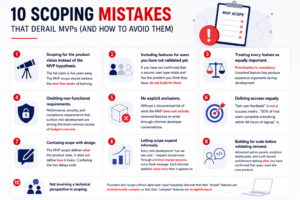
Common MVP Scoping Mistakes
Most MVP scoping failures follow predictable patterns. Here are the most frequent and most costly ones:
How Detailed Should an MVP Scope Be?
Detailed enough that a developer who has never spoken to the founder can build the right thing. Vague enough that it does not pre-design the implementation.
A good MVP scope document defines what the product does and for whom not how it is built. It describes user journeys at the step level, not at the interface level. It specifies integration requirements by name, not by technical approach. It defines acceptance criteria by outcome, not by component.
In practice: a well-scoped MVP for a mid-complexity SaaS product typically produces a 6–15 page requirements document, a prioritized feature table, and a user journey map. Anything shorter is likely missing important requirements. Anything significantly longer has probably crossed from scope into design.
MVP Scope vs PRD vs Product Roadmap
These three documents serve different purposes and are frequently confused with one another.
| Document | Scope | Audience | Output |
|---|---|---|---|
| MVP Scope | Features for the first testable build | Development team, CTO | Feature list, user journeys, requirements, exclusions |
| PRD (Product Requirements Document) | Full functional requirements for a build phase | Engineering, design, QA | Detailed functional specs, acceptance criteria, edge cases |
| Product Roadmap | All features across all planned versions | Leadership, investors, team | Version-by-version feature plan with rough timelines |
The MVP scope feeds into the PRD. The PRD feeds into development. The roadmap puts the MVP in the context of the broader product plan. All three are useful. Confusing one for another wastes planning effort and produces the wrong output for the wrong audience.
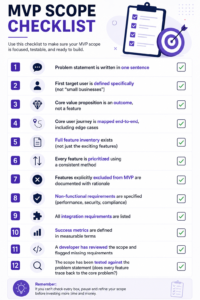
MVP Scoping Checklist
Before handing scope to a development team, confirm the following:
What Happens After You Scope an MVP?
A completed MVP scope feeds directly into four subsequent decisions: technology selection, development cost estimation, team structure, and delivery planning.
On technology: your scope informs your startup tech stack decisions. The integrations your MVP requires, the compliance constraints it must meet, and the team executing it all influence which stack is appropriate. Scope first, then stack.
On cost: a structured scope document is what allows a development team to produce a reliable estimate. Without it, estimates are guesses. The more complete your MVP requirements, the more accurate and more defensible the cost projection. Learn more about MVP development costs in 2026 to understand what drives pricing.
On team structure: the scope determines whether you need a full product team, a focused agency engagement, or a combination of both. It also tells you how long the build should take.
On budget risk: the most common reason software projects exceed their budget is a scope that was never fully defined before development began. A documented MVP scope with explicit exclusions and clear requirements is the most effective form of budget protection available. For more on this, see why software projects go over budget.
And on infrastructure: once you have shipped your MVP and are planning your growth phase, one of the most consequential infrastructure decisions you will face is when and whether to adopt more complex deployment tooling.
Scope the Problem Before You Build the Product
The principle worth carrying out of this guide: the MVP is not a small version of your product. It is a structured test of your most important product assumption. Everything in the scope should serve that test. Everything that does not should wait.
Founders who internalize this build faster, spend less, and learn more from their first launch. Founders who do not spend the first six months building features their users never asked for.
Good scoping is not complicated. It requires discipline, a willingness to say no to features you are excited about, and a clear answer to the question: “What do we need to learn, and what is the smallest build that teaches us that?”
If you want to move from rough idea to structured MVP scope without weeks of workshops and planning documents, Enlight Lab’s AI MVP planning tool can produce a structured scope document in minutes complete with feature tiers, user journeys, stack recommendations, and a budget range. It is free, requires no signup, and is built for exactly this stage of the product journey.