Why Do Software Projects Go Over Budget?
Software project cost overruns happen when the original estimate is based on assumptions that don’t survive contact with real development — incomplete requirements, unscoped integrations, missing non-functional requirements (like security and performance), compressed testing, and infrastructure or post-launch work that was never priced in. Add project-management friction like decision delays and unmanaged scope changes, and a reasonable estimate slowly becomes an inaccurate one.
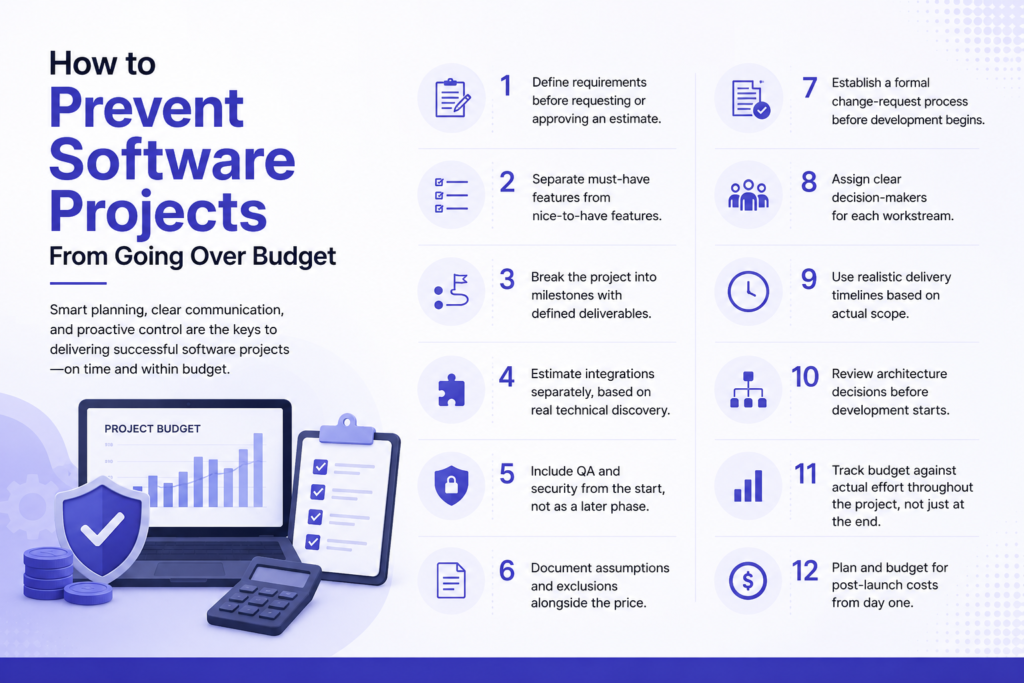
None of these causes are exotic. Most are avoidable once you know where to look. Below are twelve of the most common — and most underestimated — drivers of budget overruns.
12 Hidden Causes of Software Project Cost Overruns
1. Scope Is Estimated Before Requirements Are Actually Defined
Teams often price a project from a one-page brief or a pitch deck, not a detailed requirements document. The estimate reflects what’s understood about the product, not what the product actually needs. Once development starts and edge cases surface — what happens when a user has two roles, what happens when a payment fails midway — the team has to rework logic that was built on incomplete assumptions.
Example: A marketplace platform estimated around “user accounts and listings” discovers mid-build that sellers need approval workflows, disputes, and payout schedules — none of which were in the original brief.
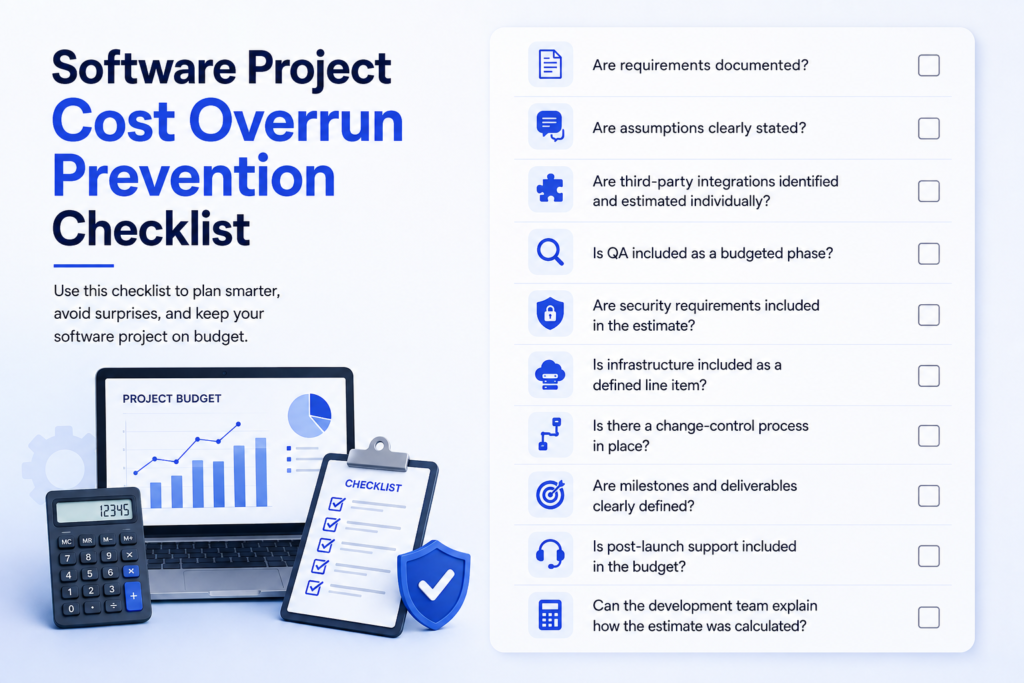
Prevention: Require a documented requirements pass, even a lightweight one, before committing to a number.
2. Scope Creep Happens Through “Small” Requests
Scope creep rarely looks like a major new feature. It looks like “can we also add a filter here” or “can this dashboard also show last month’s data.” Individually, each request feels like an hour of work. Collectively, they can add weeks.
Example: A SaaS dashboard accumulates a dozen small enhancement requests during development, each approved informally, none formally estimated.
Prevention: Log every request, however small, and route it through a lightweight change-request process rather than approving it in a Slack message.
3. Integrations Are Underestimated
APIs, payment gateways, CRMs, ERPs, legacy systems, authentication providers, and data-sync jobs rarely behave exactly as documented. Sandbox environments differ from production. Rate limits, authentication quirks, and inconsistent data formats surface only once real integration work begins.
Example: Connecting to a legacy ERP for order syncing turns into a multi-week effort once the team discovers inconsistent field mappings and undocumented business rules on the ERP side.
Prevention: Estimate each integration separately, based on its own technical discovery, instead of bundling all integrations into one generic line item.
4. Technical Debt Gets Built Into the First Version
Under time pressure, teams take shortcuts — skipping abstraction layers, hardcoding values, deferring proper error handling. These shortcuts speed up the first release but slow down every release after it, because new features now have to work around fragile code.
Example: An MVP built with a single monolithic data model works fine at launch, then requires a costly refactor once the product needs multi-tenant support six months later.
Prevention: Distinguish between deliberate, documented technical debt (acceptable for an MVP) and undocumented shortcuts that quietly compound.
5. Non-Functional Requirements Are Missing From the Estimate
Performance, scalability, security, availability, observability, backups, and disaster recovery are easy to leave out of an estimate because they don’t map to a visible feature. They matter just as much as functional requirements once the product has real users.
Example: An application handles 100 concurrent users fine in testing, then needs a database and caching redesign after launch when usage hits 5,000 users.
Prevention: Ask for explicit performance, uptime, and scalability targets before estimating — not after something breaks.
6. Testing Is Treated as the Final Phase
When QA is scheduled at the end of the project instead of throughout it, bugs are found later, cost more to fix, and often force rework across multiple features. Automated testing, regression testing, cross-browser/device testing, and security testing all need real time in the schedule, not the leftover time before launch.
Example: A team discovers checkout bugs during final QA, one week before a planned launch, forcing a schedule slip and last-minute fixes under pressure.
Prevention: Build QA into every sprint, not just the final weeks before release.
7. Infrastructure Costs Are Added Too Late
Cloud services, databases, storage, CDN, monitoring, CI/CD pipelines, staging environments, and backup systems are sometimes treated as a deployment detail rather than part of the core estimate. Setting them up properly — not just spinning up a server — takes real engineering time.
Example: A team assumes “we’ll just deploy it to the cloud” without budgeting for CI/CD setup, monitoring, or a proper staging environment, then has to build all of it reactively after a production incident.
Prevention: Include infrastructure and DevOps setup as a distinct line item in the estimate, not an implicit assumption.
8. Architecture Is More Complex Than the Product Requires
Overengineering is as expensive as underengineering. Adopting microservices, Kubernetes, or event-driven architecture before the product has the scale or team size to justify it adds operational overhead, longer development cycles, and more moving parts to maintain — without a corresponding benefit.
Example: An early-stage SaaS product is built on a microservices architecture with five services and a Kubernetes cluster, when a modular monolith would have shipped faster and been easier to operate at that stage.
Prevention: Match architecture decisions to current scale and team size, not anticipated future scale. Read this: Should Startups Use Kubernetes? When to Adopt It (and When to Avoid It) in 2026
9. Decision Delays Increase Development Costs
Waiting on approvals, unclear ownership of decisions, delayed feedback on designs, or stakeholder turnover all create idle time for the development team — or worse, force them to guess and rework later. Time isn’t free even when no one is actively “spending” it.
Example: A design approval sits unanswered for two weeks; the team either pauses related work or proceeds on assumptions that later need to be redone.
Prevention: Assign a single decision-maker per workstream with a defined response time.
10. The Original Timeline Is Unrealistically Aggressive
Compressed deadlines create pressure that shows up as overtime, shortcuts, skipped QA, and technical debt — all of which cost more to fix later than the time “saved” by rushing.
Example: A three-month deadline for a project that realistically needs five months leads to a rushed launch, followed by a stabilization phase that costs more than the time originally saved.
Prevention: Base timelines on the actual scope and team capacity, not on an external launch date set before development was scoped.
11. Security and Compliance Requirements Appear Late
GDPR, HIPAA, SOC 2, PCI DSS, data residency rules, access controls, audit logging, and encryption requirements are sometimes discovered mid-project, once a customer, investor, or legal team asks about them. Retrofitting compliance into an existing architecture is more expensive than designing for it from the start.
Example: A healthcare application built without HIPAA considerations from day one requires significant rework of data storage and access logging once compliance becomes a launch requirement.
Prevention: Identify applicable regulatory and compliance requirements before architecture decisions are finalized, not after.
12. The Estimate Does Not Include Post-Launch Work
Maintenance, bug fixing, monitoring, performance optimization, cloud cost optimization, and ongoing feature iteration are real, recurring costs — but they’re frequently left out of the initial budget conversation entirely, creating a gap between “project cost” and actual total cost of ownership.
Example: A budget covers development through launch, with no plan or allocation for the first three months of post-launch support, bug fixes, and monitoring.
Prevention: Budget for post-launch support as a defined phase, not an unplanned expense.
How Much Can Software Project Cost Overruns Increase the Budget?
There’s no standard percentage that applies to every project — the impact depends on scope clarity, architecture decisions, integration complexity, team structure, and how much the requirements change during development. Any number presented as a universal benchmark should be treated with skepticism.
Here’s a simplified, illustrative example of how a budget can grow — not industry benchmark data:
-
- Initial estimate: $100,000
-
- Additional scope: +$15,000
-
- Integration complexity: +$10,000
-
- Security/testing requirements: +$8,000
-
- Infrastructure and post-launch preparation: +$7,000
-
- Illustrative revised budget: $140,000
The point isn’t the exact numbers — it’s that each addition, taken alone, often looks minor and justifiable, which is exactly why the pattern is easy to miss until the total is much higher than expected.
Fixed Price vs Time and Materials: Which Model Helps Control Software Costs?
Neither model is inherently cheaper — fixed price shifts risk to the vendor and works best with well-defined requirements, while time and materials shifts risk to the client and works best when requirements are expected to evolve. The right choice depends on how much uncertainty the project actually has, not on which model sounds safer.
| Factor | Fixed Price | Time & Materials |
|---|---|---|
| Budget predictability | High, if scope is stable | Lower, depends on tracking |
| Flexibility | Low — changes require formal requests | High — adapts as requirements evolve |
| Scope changes | Costly and slower to incorporate | Easier to accommodate |
| Best suited for | Well-defined, stable-scope projects | Evolving products, MVPs, R&D-heavy work |
| Risk distribution | Vendor absorbs estimation risk | Client absorbs scope/time risk |
| Change management | Formal change orders required | Continuous prioritization |
A fixed-price contract on a poorly defined project often leads to disputes or padded estimates. A time-and-materials contract without disciplined tracking can lead to real overruns. The contract model doesn’t replace the need for clear requirements and active budget management.
How Should Businesses Estimate a Software Development Budget?
A reliable software development budget estimate works through a defined sequence — requirements, feature breakdown, architecture, integrations, design, development, QA, security, infrastructure, deployment, post-launch support, and contingency — rather than jumping straight from a feature list to a dollar figure.
Requirements → Feature breakdown → Technical architecture →
Integration assessment → UI/UX → Development → QA → Security →
Infrastructure → Deployment → Post-launch support → Contingency
When requesting an estimate, ask for the assumptions, exclusions, milestones, dependencies, and acceptance criteria behind the number — not just the number itself. A price without that context is difficult to evaluate or hold anyone accountable to.
What Should a Software Development Proposal Include?
A proposal that’s actually useful for budget planning should include: project scope, functional requirements, technical architecture, deliverables, milestones, timeline, team composition, technology stack, third-party integrations, testing approach, security requirements, infrastructure assumptions, pricing model, payment milestones, change-request process, warranty/support terms, maintenance terms, and explicit exclusions.
If a proposal is missing several of these, it’s harder to know what you’re actually paying for — and harder to hold the vendor accountable when the project’s scope shifts.
How to Know If a Software Estimate Is Unrealistically Low
An unrealistically low estimate is often a sign of missing scope, not efficiency. Warning signs include a price significantly below competing proposals, vague scope descriptions, no stated technical assumptions, no QA budget, no security discussion, no integration analysis, an unrealistically short timeline, no post-launch support plan, no change-management process, and one-line pricing without a breakdown.
The cheapest proposal on paper is not necessarily the lowest-cost project once missing scope, rework, and delays are factored in.
If your software project needs a realistic technical estimate, architecture review, or development roadmap, Enlight Lab can help evaluate the scope, technical risks, and delivery approach before development begins — including CTO as a Service advisory support for teams that want an independent technical review before committing to a budget.
Conclusion
Software projects rarely go over budget because of one dramatic mistake. They become expensive through a series of underestimated decisions and hidden dependencies — a requirement that wasn’t fully defined, an integration that behaved differently than documented, testing that got compressed, infrastructure that was priced in too late.
Before approving a software development budget, it’s worth asking not only “how much will it cost?” but also “what assumptions make this estimate possible, what’s excluded, and what could change the cost?” Those questions won’t eliminate uncertainty, but they’ll make sure the budget you approve reflects the project you’re actually building — not the one that was easiest to estimate.