Your pipeline breaks at step six. The root cause? A single AI agent trying to pull customer records, draft a response, route the ticket, and log the interaction all at once, in sequence, with no specialization and no fallback. The output quality degrades as the task complexity increases, latency climbs, and when something goes wrong, there’s no clear point of failure.
This is the architectural problem that multi-agent systems are designed to solve. Not because “more AI is better,” but because complex, multi-step tasks across enterprise environments genuinely require decomposition, parallelism, and coordination between specialized components.
This article goes deep into how multi-agent system architecture actually works how agents communicate, how orchestration is structured, how memory and data are managed, and what it takes to build a system that holds together under production conditions. If you’re evaluating architecture options or designing a system, this is the technical foundation you need.
What Is a Multi-Agent System Architecture?
A multi-agent system (MAS) architecture is a design pattern in which multiple AI agents each specialized for a specific function collaborate to complete tasks that would be impractical or inefficient for a single agent to handle alone. The architecture defines how those agents are organized, how they communicate, what tools they access, and how outputs are validated and delivered.
Each component plays a distinct role:
| Component | Primary Role |
|---|---|
| Orchestrator / Supervisor Agent | Decomposes goals, assigns tasks, manages agent coordination |
| Specialized Agents | Execute scoped, domain-specific subtasks |
| Communication Layer | Routes messages and context between agents |
| Tools & APIs | Extend agent capabilities (search, code execution, database access) |
| Memory System | Stores shared state, session context, and long-term knowledge |
| Guardrails & Validators | Enforce output quality, permissions, and safety boundaries |
| Observability Layer | Traces execution, logs failures, and monitors performance |
The architecture is not a single pattern it’s a family of patterns, each suited to different task structures and organizational requirements.
How Does a Multi-Agent System Work?
At a high level, a multi-agent system receives a goal, decomposes it into subtasks, distributes those subtasks to appropriate agents, and aggregates the results into a coherent output. Here is the end-to-end workflow:
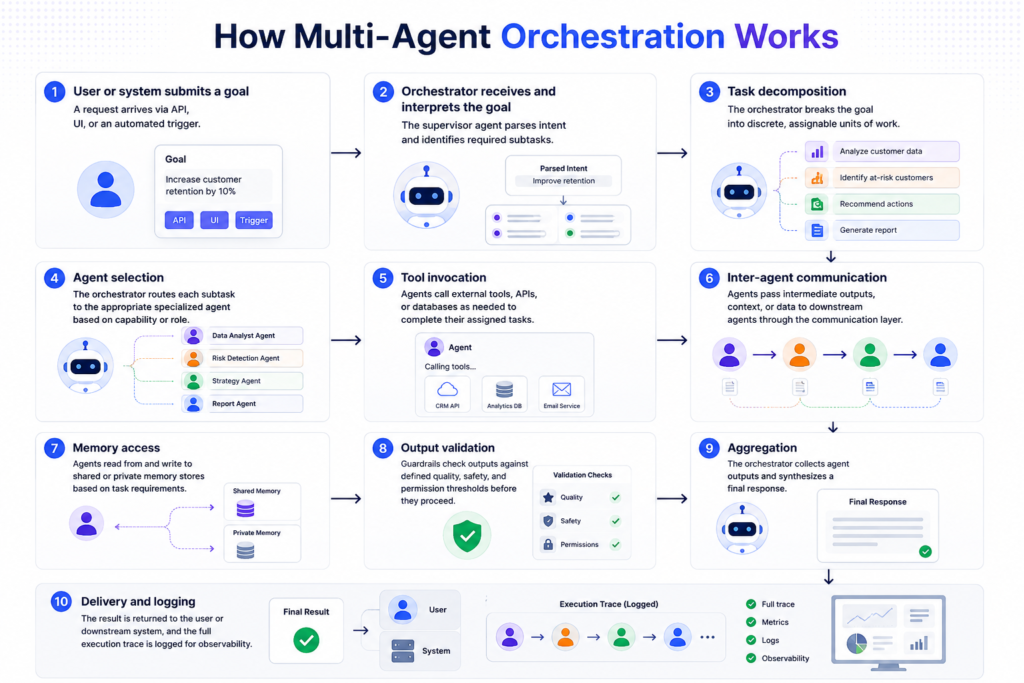
Enterprise customer support example: A user submits a billing complaint. The orchestrator identifies three subtasks: retrieve account history, draft a resolution response, and flag the ticket for compliance review. The CRM agent pulls account data, the language agent drafts a personalized reply using those records, and the compliance agent checks policy alignment. Outputs converge at the orchestrator, which assembles the final response and logs the interaction.
The Core Components of a Multi-Agent Architecture
Orchestrator or Supervisor Agent
The orchestrator is the architectural backbone. It holds no specialized domain knowledge itself its job is goal decomposition, task assignment, dependency management, and result aggregation. In more sophisticated architectures, the orchestrator also handles failure detection and re-routing when an agent returns an error or low-confidence output.
Design decisions at the orchestrator level have the largest downstream impact on system reliability. A poorly structured orchestrator creates bottlenecks, circular dependencies, and unpredictable execution order.
Specialized Agents
Each specialized agent is scoped to a narrow domain: retrieval, code generation, summarization, classification, data transformation, or external API interaction. Narrow scope improves reliability, makes debugging tractable, and allows individual agents to be updated or replaced without breaking the wider system.
Specialization also makes it practical to apply different model configurations to different agents. A retrieval agent may not need the same model size as a reasoning agent. Matching model capability to task complexity reduces cost and latency.
Communication Layer
Agents need a structured way to exchange context, intermediate results, and instructions. The communication layer defines the message format, routing logic, and sequencing rules that govern these exchanges. Without a well-designed communication layer, agents operate in isolation or pass unstructured data that downstream agents cannot reliably parse.
Tools and APIs
Tools extend what an agent can do beyond pure language model inference. Common tools include web search, code interpreters, database query interfaces, vector search, external API connectors, and document parsers. Tool access is typically governed by permission rules defined at the orchestrator or guardrail layer not by the agent itself.
How Do AI Agents Communicate With Each Other?
AI agent communication is not a single protocol it’s a design choice that shapes the entire system’s behavior. Each pattern has distinct trade-offs in flexibility, latency, and complexity.
Centralized Orchestration
All communication flows through the orchestrator. Agents do not communicate with each other directly. This pattern is the easiest to trace and debug, but the orchestrator becomes a bottleneck in high-throughput systems.
Sequential Workflow
Agents are arranged in a pipeline. Each agent completes its task and passes its output to the next agent in the sequence. Simple and predictable, but a failure at any step blocks the entire workflow.
Parallel Execution
Multiple agents run simultaneously on independent subtasks. The orchestrator aggregates results once all agents complete. Parallel execution significantly reduces total latency for tasks that can be decomposed without dependencies.
Hierarchical Architecture
Orchestrators can themselves be agents within a higher-level orchestrator. This is common in large enterprise deployments where different sub-systems (e.g., HR, finance, operations) have their own coordinator agents, and a top-level orchestrator routes across them.
Event-Driven Architecture
Agents subscribe to event streams and trigger based on conditions rather than direct invocation. This pattern suits asynchronous workflows and real-time processing pipelines but adds complexity in state management and error recovery.
| Pattern | Best For | Key Trade-Off |
|---|---|---|
| Centralized Orchestration | Controlled, auditable workflows | Bottleneck risk at scale |
| Sequential Workflow | Linear, dependent task chains | Single point of failure |
| Parallel Execution | Independent subtasks, speed-sensitive | Aggregation and sync complexity |
| Hierarchical | Large-scale, multi-domain systems | Governance and routing overhead |
| Event-Driven | Async, real-time, reactive pipelines | Complex state and failure management |
Shared Memory vs. Private Memory in Multi-Agent Systems
Memory architecture determines what agents know, when they know it, and how that knowledge persists across task boundaries.
Shared memory is accessible to all agents within a session or system. It typically holds cross-agent context: the user’s original request, intermediate results from upstream agents, and any data that multiple agents need to reference. When an agent updates shared memory, downstream agents immediately benefit without requiring explicit message passing.
Agent-specific memory is private to a single agent. It stores working context, intermediate reasoning, and task-specific state that other agents don’t need and shouldn’t have access to. Keeping memory scoped reduces the risk of one agent’s context polluting another’s reasoning.
Session state captures the active context of a single user interaction. It persists across agent handoffs within a session but is typically discarded after the session closes.
Long-term knowledge is persistent across sessions. This is where vector databases become architecturally significant. Rather than reloading full documents into context on every request, agents query a vector database to retrieve semantically relevant content, reducing token usage and improving retrieval precision. For a detailed breakdown of how short-term and long-term memory function at the agent level, refer to Enlight Lab’s [INTERNAL LINK: AI Memory Systems: Short-Term vs Long-Term Memory Explained].
Task context is structured metadata attached to a specific task: who initiated it, what tools were called, what outputs were produced, and what the current status is. It’s the backbone of observability and audit logging.
Multi-Agent Orchestration Patterns
| Pattern | Description | Ideal Use Case |
|---|---|---|
| Supervisor-Worker | One orchestrator assigns tasks to worker agents | General-purpose task execution |
| Planner-Executor | Planner agent creates a task plan; executor agents carry it out | Complex, multi-step reasoning workflows |
| Router-Specialist | Router classifies intent and directs to the best-fit specialist | High-volume, diverse request classification |
| Hierarchical Agents | Multi-level orchestrators for large, segmented systems | Enterprise-scale deployments |
| Sequential Pipeline | Linear agent chain with structured handoffs | Ordered processing with clear dependencies |
| Parallel with Aggregation | Agents run concurrently; results merged post-execution | Research synthesis, parallel data processing |
| Human Approval Workflow | Agent outputs route to a human checkpoint before proceeding | High-stakes, regulated, or irreversible actions |
The pattern you choose isn’t just a technical decision it’s a product decision. A human approval workflow adds latency but is non-negotiable in regulated industries. Parallel execution reduces turnaround time but increases infrastructure complexity. Aligning the orchestration pattern to the actual task structure, risk profile, and user expectations is where most architectural decisions are made or broken.
A Practical Multi-Agent System Architecture Example
AI-Powered Enterprise Operations Assistant
Consider an enterprise AI assistant that handles operational requests across departments HR queries, IT support, procurement, and finance from a single interface.
A user submits: “I need to onboard a new contractor starting Monday. Set up system access, add them to payroll as a contractor, and send them the onboarding documentation.”
The top-level orchestrator receives the request and decomposes it into three subtasks, each assigned to a domain-specific sub-orchestrator:
- IT Sub-Orchestrator → Provisioning Agent (creates accounts) → Access Control Agent (assigns permissions)
- Payroll Sub-Orchestrator → Contractor Classification Agent (validates employment type) → Payroll Setup Agent (initiates payment setup)
- HR Sub-Orchestrator → Document Retrieval Agent (fetches onboarding docs) → Communication Agent (drafts and sends welcome email)
All three sub-orchestrators run in parallel. Each agent writes its output to shared task context. A compliance guardrail agent reviews outputs from the Access Control and Payroll Setup agents before execution, given the financial and security implications.
Once all agents complete, the top-level orchestrator aggregates confirmation messages and returns a unified status summary to the user. The full execution trace including which agents ran, how long each took, what tools were called, and which outputs passed validation is captured in the observability layer.
This is not a hypothetical pattern. It’s the architecture that makes enterprise AI assistants viable at scale.
Multi-Agent Systems and Enterprise Data
Multi-agent systems derive their value from the data they can access and act on. In enterprise deployments, that means integrating with a heterogeneous landscape of systems.
Common data sources include relational databases, vector knowledge bases, CRM platforms, ERP systems, cloud storage, REST APIs, document repositories, and messaging systems. The architectural challenge is not connectivity most of these systems have APIs. The challenge is access control, data isolation, and auditability.
Each agent should operate under the principle of least privilege: access only the data sources required for its specific task. This means authentication is handled at the agent or tool level, not system-wide. Role-based access control, API key scoping, and OAuth flows all apply depending on the data source.
Data isolation matters particularly when multiple tenants or business units share the same agent infrastructure. Agents serving a finance request must not have access to HR records, even within the same session. Enforcing these boundaries at the tool permission layer rather than relying on the language model to self-govern is the only reliable approach.
Auditability requires that every data access event is logged: which agent requested what data, when, and under what authorization. This is a compliance requirement in regulated industries and a practical debugging requirement in all environments.
Guardrails and Validation in Multi-Agent Systems
Guardrails are the quality and safety enforcement layer of a multi-agent architecture. They operate at multiple points in the execution flow, not just at final output.
Input validation checks that the incoming request is well-formed, within scope, and doesn’t contain injection attempts or policy violations before the orchestrator processes it.
Tool permission boundaries restrict which agents can invoke which tools. A summarization agent has no business calling a database write API. Defining and enforcing these boundaries explicitly is a core part of system design, not an afterthought.
Confidence thresholds allow agents to flag low-certainty outputs for review rather than passing unreliable results downstream. This is especially important for agents performing classification or extraction tasks.
Approval workflows route specific output types financial transactions, external communications, data deletions to human reviewers before execution. The triggering condition and routing logic should be defined at the orchestrator level.
Retry logic determines what happens when an agent returns an error or fails to produce a valid output within defined parameters. Blind retries can create infinite loops; structured retry logic sets a maximum attempt count, escalates appropriately, and logs each attempt.
Failure detection monitors for agent timeouts, tool errors, and output quality violations in real time not just at the end of a workflow.
What Happens When an AI Agent Fails?
Failure is not an edge case in a multi-agent system. It’s a condition to design for explicitly.
When an agent fails, the response depends on the failure type and the criticality of the task:
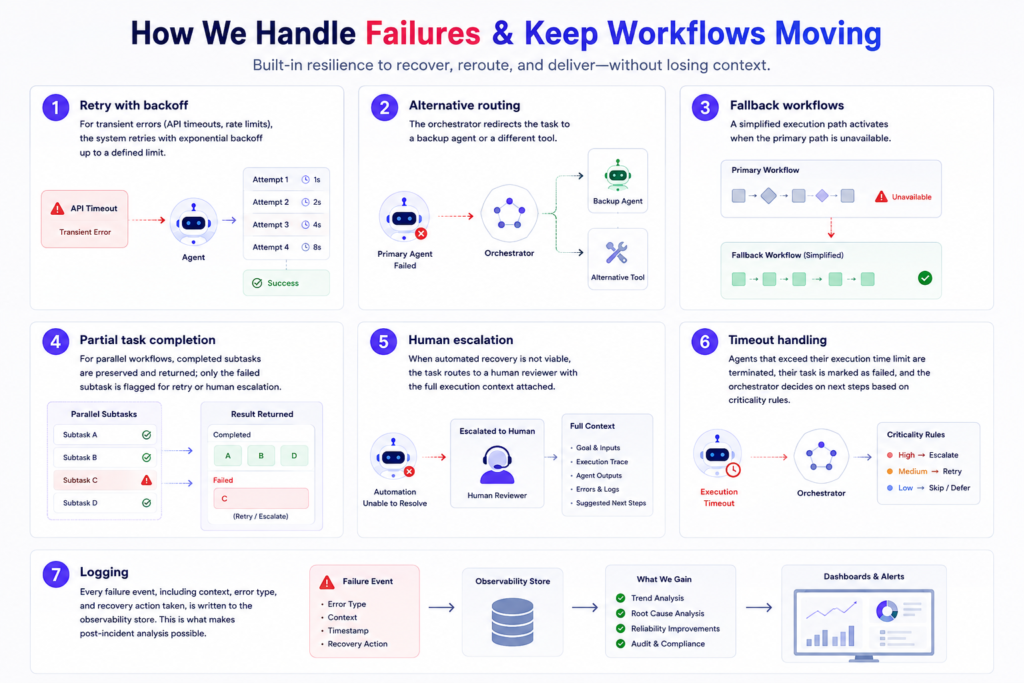
The worst outcome in a multi-agent system isn’t failure it’s silent failure: an agent returns a confident-looking but incorrect output that passes through the pipeline unchallenged. Guardrails and validation exist specifically to prevent this.
Observability: How Do You Monitor Multi-Agent Systems?
A multi-agent system without observability is a black box. You can’t improve what you can’t trace.
Effective observability covers the full execution path from user request to final output:
Execution tracing A unique trace ID follows each request across every agent invocation, tool call, and handoff. You can reconstruct the exact path any request took through the system.
Task duration Time-to-completion is tracked at the agent level and system level. Outliers surface bottlenecks and identify where optimization effort should be focused.
Tool call logging Every external API call, database query, and tool invocation is logged with input parameters, response status, and latency.
Agent handoffs The point at which one agent passes context to another is a critical instrumentation target. Handoff failures are common and difficult to diagnose without explicit logging.
Token usage and cost In systems running on hosted language models, token consumption per agent and per request is a direct cost driver. Monitoring this at granular levels enables cost optimization without sacrificing capability.
Output quality metrics Downstream validation results, confidence scores, and human review outcomes feed back into the observability layer, creating a quality signal over time.
Failure and retry counts High retry rates on specific agents indicate systemic issues model configuration, tool reliability, or task decomposition problems.
A robust observability implementation lets you answer: “Why did this specific request take 40 seconds, cost three times the average, and route through the compliance agent twice?” Without it, you’re guessing.
When Should You Use a Multi-Agent Architecture?
Multi-agent architecture is appropriate when:
- The task requires multiple distinct capabilities that benefit from specialization
- Subtasks can be parallelized to reduce latency
- The workflow involves multiple external systems or data sources
- Reliability and fault isolation are critical requirements
- Different parts of the workflow require different access controls or compliance rules
- The system needs to scale individual components independently
It is not the right choice when:
- The task is simple enough for a single agent with tools
- The coordination overhead would exceed the benefit of specialization
- The team lacks the infrastructure to support observability and failure handling
- Time-to-deployment matters more than architectural sophistication
Multi-agent systems add complexity. That complexity pays off when the task structure genuinely requires it and creates unnecessary overhead when it doesn’t. For a structured comparison, see Enlight Lab’s Single-Agent vs Multi-Agent Systems: Which Is the Right Choice for Your Business?
Common Multi-Agent Architecture Mistakes
- Over-decomposing tasks Breaking a simple workflow into too many agents creates coordination overhead with no performance benefit.
- Underspecified agent roles Agents with vague scopes create overlapping responsibilities and inconsistent outputs.
- No failure handling at the agent level Assuming agents will always succeed leads to brittle systems.
- Shared memory without access controls Allowing all agents to read and write shared memory creates unpredictable state corruption.
- Treating the orchestrator as a monolith A single orchestrator handling all logic becomes a bottleneck and a single point of failure.
- Skipping output validation Passing unvalidated agent outputs downstream propagates errors through the pipeline.
- No observability from day one Retrofitting tracing and logging into a live system is significantly more difficult than building it in from the start.
- Hardcoding tool permissions Embedding access control logic in individual agents rather than a centralized permission layer makes auditing and updates difficult.
- Ignoring token and cost constraints Treating model inference as essentially free leads to architectures that are functionally correct but operationally unsustainable.
- Building without human escalation paths In any system that takes real-world actions, there must be a defined path to human review.
How to Design a Production-Ready Multi-Agent System
- Define the goal structure Identify the top-level objective and the natural decomposition into discrete subtasks.
- Map task dependencies Determine which subtasks must be sequential and which can run in parallel.
- Assign agent roles Define each agent’s scope, inputs, outputs, and constraints explicitly.
- Select the orchestration pattern Match the pattern (supervisor-worker, hierarchical, event-driven, etc.) to the task structure and reliability requirements.
- Design the communication layer Define message formats, routing logic, and context-passing protocols.
- Specify memory requirements Determine what needs to be shared vs. private, and what must persist across sessions.
- Define tool access and permissions Assign tools to agents based on the principle of least privilege.
- Build guardrails first Define validation rules, confidence thresholds, and human escalation triggers before deploying agents into production.
- Design failure handling Specify retry logic, alternative routing, fallback workflows, and timeout handling for every agent.
- Instrument for observability Implement distributed tracing, cost monitoring, and output quality logging from day one.
- Test failure conditions explicitly Run deliberate failure scenarios to validate that recovery paths work as designed.
- Plan for iteration Multi-agent systems evolve. Build agent boundaries and communication protocols in a way that allows individual components to be updated without full system rearchitecture.
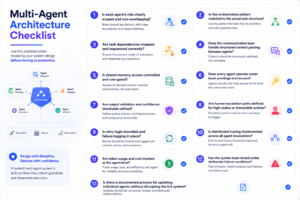
Multi-Agent Architecture Checklist
Use this checklist when reviewing your system design before moving to production:
Building Multi-Agent AI Systems with Enlight Lab
Enlight Lab designs and builds production-grade multi-agent AI systems for enterprise environments. From orchestration architecture and memory design to observability, data integration, and guardrails, Enlight Lab works with CTOs, AI architects, and engineering leaders to build systems that operate reliably under real-world conditions.
If you’re planning a multi-agent implementation or evaluating your current architecture, explore Enlight Lab’s AI Agent Development Services to understand how these systems are structured and deployed in practice. For foundational context on memory design and agent decision-making, the Enlight Lab article on AI Memory Systems: Short-Term vs Long-Term Memory Explained covers the memory layer in depth.